
SpaceX Q2 2026 Earnings and August 6 Lockup Expiry: What Investors Need to Know
SpaceX is entering a critical week as stronger operating results collide with a major increase in tradable share supply. The August 4 earnings report improved the fundamental outlook, while the August 6 lockup expiry could determine the stock’s near-term direction.
- Q2 revenue rose 92%: SpaceX delivered rapid revenue growth and a sharp improvement in profitability, showing that the underlying business is scaling more efficiently.
- August 6 marks the first lockup expiry: Previously restricted shares will become eligible for trading, potentially creating a large increase in market supply and additional selling pressure.
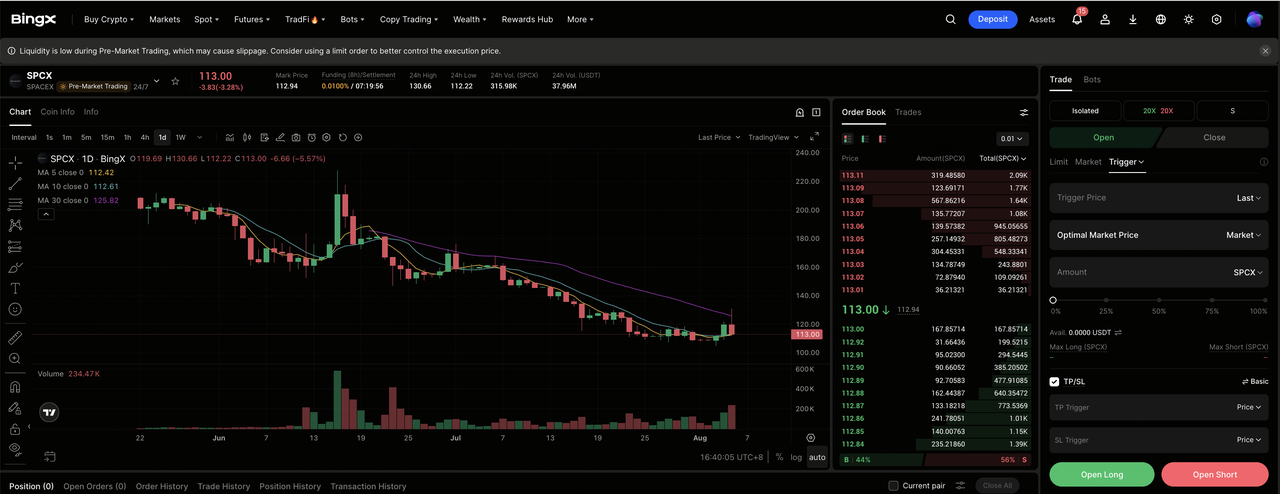
- SPCX has already fallen about 50% from its peak: The stock declined from a mid-June high of $225.64 to roughly $108 to $113 by late July, placing it below the $135 IPO price before the unlock arrives.
- The earnings rebound did not hold: Shares initially rose about 6% after the August 4 report, then moved back below the offering price. That reaction suggests investors remain more concerned about the upcoming unlock than the stronger quarterly results.
- Near-term price action may depend more on supply than fundamentals: SpaceX’s business is clearly improving, but the key question is whether demand can absorb the newly tradable shares. Investors may receive a clearer entry signal after the initial lockup-related selling pressure begins to settle.
Read More: SpaceX (SPCX) Price Prediction 2026: $227 Street-High AI Fusion or Trillion-Dollar Valuation Bubble?
SpaceX Q2 2026 Earnings and Share Unlock Overview
|
Item |
Detail |
What It Signals |
|
Q2 revenue |
$7.8B, up 92% year over year |
A clear fundamental inflection, beating expectations |
|
Q2 net loss |
$541M, narrowed from about $1.9B expected |
Losses narrowing sharply as scale effects appear |
|
Valuation |
47x to 74x price-to-sales |
Elevated, leaving little margin for a growth slowdown |
|
First lockup expiry |
August 6, about $123B in shares |
Roughly 1.4x current float, a supply shock of unusual scale |
|
Stock reaction |
Down about 50% from its June high |
The market is pricing the unlock ahead of time |
The scale of the unlock is the defining feature. At about $123 billion, the first tranche is roughly 1.4 times the current tradable float of about $86 billion and around 68 times the size of a typical large-cap lockup expiry. This is why the near-term setup is dominated by supply rather than by the strength of the earnings.
SpaceX Stock Outlook: Will the August 6 Share Unlock Outweigh Stronger Fundamentals?
The two forces operate on different timelines. Over the next one to two months, the increase in tradable shares is likely to carry more weight than SpaceX’s improving earnings. Over the following three to six months, revenue growth and narrower losses may gradually regain control of the stock’s direction. This suggests the stronger entry window may appear after the initial unlock pressure is absorbed.
The reason is simple: a large share unlock can expand supply faster than buyers can respond to improving fundamentals. The decline below the $135 IPO price suggests the market has already priced in part of that pressure, with SPCX near $108 carrying a meaningful unlock discount. That discount still leaves room for further downside, though it could also support a recovery once the added supply clears and attention returns to business performance.
What Are the Two Core Forces Behind SpaceX’s Stock Outlook?
SpaceX’s near-term setup is defined by two opposing forces: rapidly improving fundamentals and an unusually large increase in tradable share supply.
1. The Earnings Signal: Strong Growth at a High Valuation
SpaceX’s debut earnings report showed a clear improvement in growth and profitability.
|
Metric (Q2 2026) |
Actual |
Consensus Estimate |
Year-over-Year Change |
|
Total revenue |
$7.8B |
$6.8B |
0.92 |
|
Net loss |
$541M |
~$1.9B loss |
Narrowed sharply |
|
Adjusted EBITDA |
$3.5B |
~$2.0B |
1.91 |
|
Starlink revenue |
$4.3B |
~$3.8B |
0.66 |
|
AI revenue |
Not disclosed separately |
~$2.2B |
2.47 |
The strongest signal is the pace of operating improvement. Net loss fell from $4.3 billion in Q1 to $541 million in Q2, while adjusted EBITDA grew much faster than revenue. This suggests SpaceX is gaining operating leverage as the business scales.
The main concern is valuation. At an estimated market capitalization of $1.4 trillion to $1.65 trillion, SPCX trades at roughly 47 to 74 times sales. That leaves little room for slower growth, delayed profitability, or weaker execution.
2. The Supply Signal: A Large Unlock May Pressure the Stock
The second force is the staged release of previously restricted shares. The first tranche alone is unusually large relative to the existing float.
|
Tranche |
Shares |
Estimated Value |
Trigger |
|
Employees and early investors |
911.5M |
~$123B |
August 6, the second trading day after earnings |
|
Price-triggered tranche |
455.8M |
~$62B |
Five of 10 sessions above $175.50 before earnings |
|
Rolling tranches |
7% each |
Depends on price |
70, 90, 105, 120, and 135 days after listing |
|
Post-Q3 tranche |
Additional 28% |
Depends on price |
After Q3 earnings |
|
Founder and core investors |
46.1% stake |
Several hundred billion |
Locked until June 13, 2027 |
The first unlock is estimated at roughly 1.4 times the current tradable float, making it far larger than a typical large-cap lockup expiry. Even with stronger earnings, the sudden increase in available shares could pressure the stock until new demand absorbs the supply.
The staggered structure provides some protection because shares do not all enter the market at once. The founder’s 46.1% stake also remains locked until June 2027, limiting the maximum float during the first year.
SpaceX Stock Forecast: What Are Analysts’ Price Targets for SPCX?
The range of views on SpaceX is unusually wide, reflecting a stock where price discovery is still in early stages. Price targets span from $50 to $300, a sixfold gap that signals the market has not yet formed a consensus.
|
Institution or Voice |
Stance |
Core View |
|
Morgan Stanley |
Bull |
Overweight, price target $300; leadership in launch, connectivity, and AI, with the unlock largely priced in |
|
RBC Capital |
Bull |
Reaffirmed Outperform on August 3, price target $225 |
|
Policy backdrop |
Supportive |
Faster commercial launch approvals and a Starlink hardware exemption to 2028 form a temporary tailwind |
|
Gary Black |
Bear |
47x 2026 revenue with no profit before 2027 and a large unlock ahead; limited margin of safety |
|
Charlie Bilello, Peter Schiff |
Bear |
Warn on the combined impact of the earnings date and the unlock date |
|
Retail sentiment |
Cautious |
Some see a genuine bottom forming in the $50 to $100 range |
The takeaway from this spread is that price is currently driven by sentiment and share-supply structure rather than by fundamentals. In a phase of such wide disagreement, chasing strength is risky and panic-selling on declines is equally unwise. The more useful approach is to watch for signals that consensus is beginning to converge.
3 Key Risks SpaceX Investors Should Watch
SpaceX’s near-term risks center on the share unlock, its demanding valuation, and continued spending on AI infrastructure.
- Unlock selling could be heavier than expected: The first tranche is valued near $123 billion, far larger than a typical large-cap unlock. If early investors sell aggressively, the added supply could place significant pressure on SPCX.
- The valuation leaves little room for disappointment: At roughly 47 to 74 times sales with profitability still ahead, even a modest slowdown in growth could trigger sharp volatility. This makes leveraged or concentrated positions especially risky.
- AI investment continues to consume cash: Full-year capex may exceed $45 billion, keeping cash burn elevated while the AI segment’s path to profitability remains unclear. Investors may need several more quarters to determine whether AI becomes a major revenue driver or continues weighing on margins.
SpaceX Investment Outlook: When Is the Best Time to Buy SPCX?
SpaceX’s potential entry window depends on how quickly the market absorbs the scheduled share unlocks and whether the company continues improving its operating performance.
|
Phase |
Period |
Main Driver |
What Investors Should Watch |
Possible Approach |
|
Phase 1: Unlock pressure |
August to September 2026 |
August 6 unlock and additional share releases |
Trading volume, the 52-week low near $107, and whether SPCX can recover above the $135 IPO price |
Conservative investors may wait; aggressive traders may test small positions with strict risk controls |
|
Phase 2: Stabilization |
October to December 2026 |
Q3 earnings and fading selling pressure |
Starlink growth, narrower losses, lower selling volume, and the additional post-earnings unlock |
The strongest medium-term entry window may appear once the stock forms a durable base |
|
Phase 3: Long-term revaluation |
2027 and beyond |
AI monetization and the founder-share unlock |
Independent AI revenue, profitability progress, and the June 13, 2027 unlock of the founder’s 46.1% stake |
Long-term investors may reassess after clearer earnings evidence and the largest unlock event |
For most investors, the more attractive entry window may emerge in late 2026, after the initial unlock pressure fades and Q3 results confirm whether SpaceX’s growth and loss improvement remain on track.
Related Reading
- SpaceX (SPCX) Price Prediction 2026: $227 Street-High AI Fusion or Trillion-Dollar Valuation Bubble?
- Alphabet, TSMC, and ASML Q2 2026 Earnings: Can AI Growth Justify Record Capex?
- Microsoft, Meta, Amazon, and Apple Q2 2026 Earnings: Can AI Spending Still Be Covered by Cash Flow?
- June 2026 US CPI Cools to 3.5%: What the Inflation Drop Means for Stocks, Gold, and Crypto
- July 2026 Fed Rate Decision: What the Hawkish FOMC Means for Stocks, Gold, and Interest Rates
FAQs on SpaceX Q2 2026 Earnings and Lockup Expiry
1. Why Did SpaceX (SPCX) Stock Fall Below Its $135 IPO Price?
SPCX fell below its IPO price because investors began pricing in the August 6 share unlock. The expected increase in tradable shares outweighed the positive impact of 92% Q2 revenue growth and sharply narrower losses.
2. How Many SpaceX Shares Unlock on August 6, 2026?
Around 911.5 million SpaceX shares, valued near $123 billion, become eligible for trading on August 6. The unlock is larger than the existing tradable float and may create significant selling pressure.
3. Did SpaceX Beat Q2 2026 Earnings Expectations?
SpaceX reported Q2 revenue of $7.8 billion, above the roughly $6.8 billion consensus estimate. Net loss narrowed to $541 million, while adjusted EBITDA increased 191%, showing a substantial improvement in operating performance.
4. What Are Analysts’ SpaceX Stock Price Targets for 2026?
SpaceX analyst targets range from roughly $50 to $300. The wide range reflects uncertainty around the company’s valuation, profitability timeline, future AI revenue, and the impact of scheduled share unlocks.
5. When Could Be the Best Time to Buy SpaceX (SPCX) Stock?
A stronger entry window may emerge between October and December 2026, after the initial unlock pressure fades and Q3 earnings provide more evidence on Starlink growth, losses, and demand for the newly tradable shares.
Risk Reminder: This article is for educational and informational purposes only and does not constitute investment advice. Equity and equity-linked products are volatile and carry risk. Always conduct your own research before trading.
