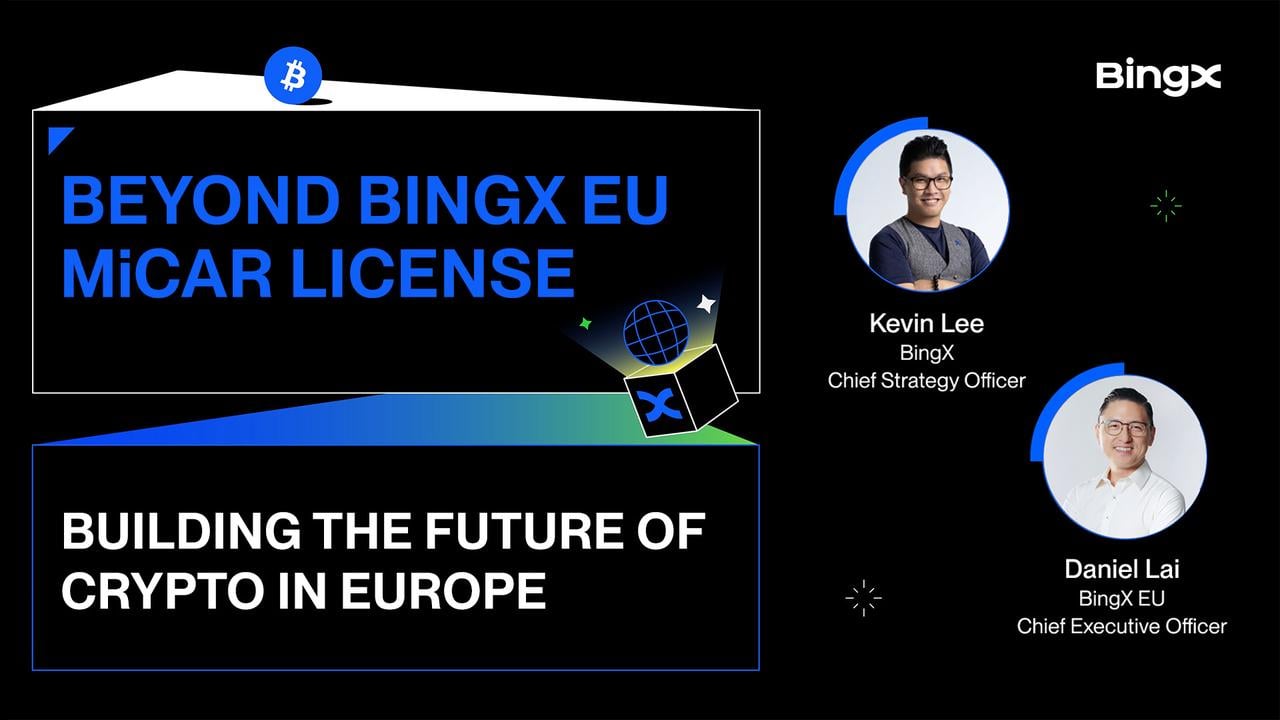
The introduction of MiCAR is changing the conversation around crypto in Europe. For industry participants, regulation is no longer simply a question of obtaining an authorization, but of building the structures, processes and standards needed to operate sustainably in a more mature market.
Companies going through the approval process understand the importance of the role of regulation in creating a more sustainable relationship between businesses and consumers. Daniel Lai, CEO of BingX EU, emphasizes that the regulator represents the interests of the consumers. “The authorization is about a balance being struck between how we go about doing business and making sure we take into account concerns and protections for the consumer. And so, if we do the balance right, that bodes well for us in terms of being able to build a sustainable crypto business in Europe", Lai said.
Kevin Lee, Chief Strategy Officer at BingX, similarly emphasized that regulatory compliance should be accompanied by a broader sense of responsibility from companies operating in the sector. "We have a responsibility to our users, we have a responsibility to the regulators, and we also have a responsibility to innovate as an industry as a whole", said Lee. In his view, the industry's development requires businesses to raise their own standards rather than simply waiting for regulation to dictate every step.
Regulation and innovation can evolve together
One of the recurring debates around crypto regulation is whether stricter rules could slow innovation. The discussion offered a different perspective: regulation and innovation can be part of the same evolutionary process.
Rather than seeing that interaction as a conflict, Lai argued for a more dynamic relationship. “I tend to think of it as balance. Balance as in harmony and sustainability. You don’t want one side to be too strong over the other. What you’re really looking for is dynamism, interplay, communication and understanding. This is a long-term dynamic process.”
Lee agreed, adding that the industry's responsibility does not end with compliance. “The EU has the right balance, in my point of view. It’s a huge market, and at the same time, objectively, it is one of the most mature and comprehensive places where we have a consistent framework around the globe,” he said.
That balance could become increasingly important as new technologies and use cases emerge, creating a continuous dialogue between innovation, market adoption and regulatory frameworks.
Europe: one market, many realities
Europe's appeal goes beyond the size of its addressable market. Lee pointed to the combination of market potential and regulatory maturity as a key reason for the region's strategic importance.
But the discussion also made clear that Europe should not be treated as a single, homogeneous market. Different countries have different languages, cultures, user expectations and levels of crypto adoption.
Lai highlighted the practical challenge of building a local operation within a global organization. “We are building a company from scratch,” he said, describing the experience of developing a European structure while learning how to operate within the region's particular regulatory and market environment.
Lee reinforced the point from a market perspective: “This is not a unified, one-dimensional market we’re talking about. It represents many languages, with each language community being its own sort of submarket. There’s a lot of communication and feedback that needs to be done in order for us to really up our game and serve our users at the highest levels.”
For companies entering the European market, the message is therefore clear: regulatory authorization may provide a common framework, but understanding local markets remains essential.
Regulation can support adoption, but it does not guarantee it
Another important point raised during the discussion was the relationship between regulation and user adoption. Regulation can provide greater clarity and protection, but it does not eliminate competition or automatically determine which platforms users will choose.
Lee stressed that regulation is only part of the equation. “Licensing is only the necessary factor, but not the sufficient factor,” Lee explained. “When European users can only trade on licensed platforms, they will start looking at something else: liquidity, the products that you can offer, the fees, UX and UI. There is a lot to compete on to make people actually want to trade on certain platforms.”
For Lai, that competitive environment needs to be viewed through the same lens of long-term sustainability. The objective, he argued, is ultimately to create the conditions for a sustainable crypto business rather than simply satisfy a regulatory requirement.
Beyond the license
The discussion ultimately pointed toward a market where regulation becomes less of a differentiator and more of a baseline expectation. Lee suggested that, over time, licensing could become so common that companies will no longer emphasize it as a distinguishing feature.
“I don’t think the licensing requirements, or whether or not you have a license in certain jurisdictions, will even be talked about,” he said. “This is going to be so common. Everyone should have it done already. Just like traditional finance, you won’t hear traditional finance companies waving about the fact that they have a license in Europe, because everyone assumes they do.”
For Lai, the significance of the current transition lies precisely in what comes after authorization: continuing to build, adapt and engage with the market.
The next phase of crypto in Europe may therefore be less about regulation versus innovation, and more about how the two can develop together. MiCAR provides a framework, but the long-term evolution of the market will depend on how companies respond to it, through stronger user protection, responsible innovation, local understanding and a focus on building businesses designed to last.
About BingX EU
MEGE zweite GmbH ("BingX EU") is a MiCAR-regulated crypto-asset platform, headquartered in Vienna, licensed as a Crypto-Asset Service Provider (CASP) under the Markets in Crypto-Assets Regulation (MiCAR). Dedicated to serving clients across 29 countries in the European Economic Area, BingX EU delivers fully regulated services in alignment with European standards for investor protection and market integrity. Under its MiCAR authorization, BingX EU provides a platform that offers regulated broker services, such as crypto custody, exchange, and other crypto services.
For media inquiries, please contact: media@bingx.eu
Disclaimers: The content qualifies as a marketing communication under the Markets in Crypto-Assets Regulation (MiCAR) and is issued by MEGE zweite GmbH (BingX EU). It does not constitute investment advice.
