
What Is Zama (ZAMA), the "HTTPZ" Layer for Confidential Smart Contracts?

  • 初級
  • 5分鐘
  • 發布於 2026-02-02
  • 更新於 2026-02-02

Discover how Zama (ZAMA) is revolutionizing digital privacy by bringing Fully Homomorphic Encryption (FHE) to public blockchains and AI. This guide explores how Zama’s fhEVM and "HTTPZ" protocol enable confidential smart contracts and private data processing without sacrificing decentralization.

 
Zama (ZAMA) is a pioneering cryptography protocol that brings Fully Homomorphic Encryption (FHE) to public blockchains like Ethereum. By allowing smart contracts to process data while it remains fully encrypted, Zama solves the "transparency bug" of blockchain, enabling private transactions, confidential DeFi, and secure AI.
 
Zama is the first $1 billion FHE unicorn, reaching this milestone in June 2025 after a successful Series B round led by Pantera Capital. As of February 2026, Zama has officially launched its mainnet and completed its highly anticipated token generation event (TGE). With its fhEVM technology, Zama enables developers to build "blind" smart contracts, applications that can compute results without ever "seeing" the underlying user data, bringing institutional-grade privacy to the Ethereum ecosystem.
 
In this article, you will learn what Zama is, how its revolutionary FHE-powered virtual machine works, the role of the ZAMA token, how it is paving the way for the "HTTPZ" era of the internet, and how to trade ZAMA perpetuals on BingX futures market.

What Is Zama (ZAMA) Confidentiality Protocol?

Zama is an open-source cryptography company that develops Fully Homomorphic Encryption (FHE) solutions to close the "Plaintext Exposure Window." In traditional computing and public blockchains, data must be decrypted to be processed. This moment of decryption is a vulnerability where hackers, service providers, or malicious nodes can access sensitive information.
 
Zama’s technology allows for end-to-end encryption of computation, meaning data stays encrypted even while it is being used by an AI model or a smart contract. Zama refers to this as HTTPZ, the zero-knowledge/confidential evolution of the internet, similar to how HTTPS made data transfer secure.
 
Zama operates through three core pillars:
  1. fhEVM (Fully Homomorphic EVM): A specialized smart contract engine that allows Ethereum-compatible chains to process encrypted data directly on-chain.
  2. TFHE-rs & Concrete: A suite of high-performance libraries and compilers that translate standard code (Rust, Python, Solidity) into encrypted circuits.
  3. Confidential Infrastructure: A network of independent operators like KMS and FHE nodes that verify and process encrypted computations without ever gaining access to the raw data.
In early 2026, Zama proved its scalability by hosting a confidential sealed-bid Dutch auction that attracted over 11,000 bidders and cleared at $0.05 per token. This was the first time a major token launch was conducted entirely on-chain without revealing individual bid sizes, preventing bot-sniping and front-running.
 
Learn more about how to claim Zama airdrop in our comprehensive guide.

How Does Zama Network Work?

Zama replaces the transparent state of public blockchains with a shielded state using a unique variant of FHE called TFHE (Torus Fully Homomorphic Encryption). This process involves several innovative steps to ensure both privacy and performance.

1. Programmable Bootstrapping

The main hurdle for FHE has always been "noise." Every calculation on encrypted data adds mathematical static that eventually makes the data unreadable. Zama’s breakthrough is Programmable Bootstrapping, a process that "refreshes" the data and clears the noise during computation without decrypting it. In 2026, Zama optimized this to take less than 1 millisecond per operation on high-end GPUs.

2. Encrypted Data Types in Solidity

Zama makes privacy accessible to regular developers. Using the fhEVM library, developers can use new data types like euint32 (encrypted 32-bit integer) or ebool (encrypted boolean). These types look like regular Solidity variables but are mathematically shielded.

3. Symbolic Execution Architecture

To keep gas fees low, Zama separates on-chain logic from heavy FHE computations. The smart contract executes "symbolically" on the host chain like Ethereum, while the actual encrypted heavy-lifting is offloaded to specialized FHE Coprocessors.

4. Threshold Decryption

To ensure no single node can peek at the data, Zama uses a Threshold Multi-Party Computation (MPC) network. Only when a 2/3 majority of the 13 decentralized KMS nodes agree on a result can a specific piece of data be decrypted for the user.

What Are the Key Use Cases for Zama?

Zama’s technology unlocks a new class of applications that were previously impossible or unsafe to build on public blockchains.
  1. Confidential DeFi
    1. Anti-Front-running: These DEXs utilize encryption to keep transaction details shielded from public view while they sit in the "mempool." By hiding trade amounts and prices until execution, the protocol prevents predatory bots from jumping ahead of orders to manipulate the market price.
    2. Private Credit Scoring: Using Zero-Knowledge Proofs or similar technologies, lending platforms can generate a reliability score based on your real-world financial activity. This allows you to secure under-collateralized loans without ever exposing your sensitive banking data or specific account balances to the protocol.
  2. Private Stablecoins and Payments Like cUSDT/cUSDC: These confidential variants function like standard stablecoins but mask the metadata of every transaction. While the network verifies that the funds exist and aren't being double-spent, your specific holdings and transfer history remain completely invisible to public block explorers.
  3. Privacy-Preserving AI
    1. Medical Diagnostics: Secure enclaves or Fully Homomorphic Encryption allow AI models to analyze health data while it remains in an encrypted state. This enables precise medical insights and diagnostic results without the AI provider or the cloud host ever accessing the patient's raw, unencrypted files.
    2. Identity Verification (DID): Decentralized ID systems allow you to share a "cryptographic yes" to specific eligibility questions rather than the documents themselves. You can prove you meet a certain criteria, like age or citizenship, without the verifying party ever seeing your passport or specific date of birth.
  4. Real-World Asset (RWA) Tokenization: Institutional platforms enable the on-chain movement of high-value assets like bonds or real estate while maintaining corporate secrecy. This allows firms to benefit from blockchain efficiency without exposing their massive positions or proprietary strategies to the prying eyes of competitors.

What Is the ZAMA Token Used for?

The ZAMA token is the economic engine of the confidential computation network. Following its public launch in early 2026, the token serves several critical functions:
  • Transaction Fees: Users pay in ZAMA to execute confidential operations. The protocol uses a burn-and-mint model where 100% of these fees are burned, creating deflationary pressure.
  • Staking and Security: Independent operators must stake ZAMA to run KMS nodes for Key Management and FHE nodes for Computation.
  • Governance: Holders vote on protocol parameters, such as the inflation rate for staking rewards, fee structures, and the addition of new supported blockchains, such as Solana integration targeted for Q2 2026.
  • Compute Rewards: 5% of the protocol's annual issuance is used to incentivize nodes to provide high-speed FHE processing.

How to Trade ZAMA/USDT Perpetual Contract on BingX Futures

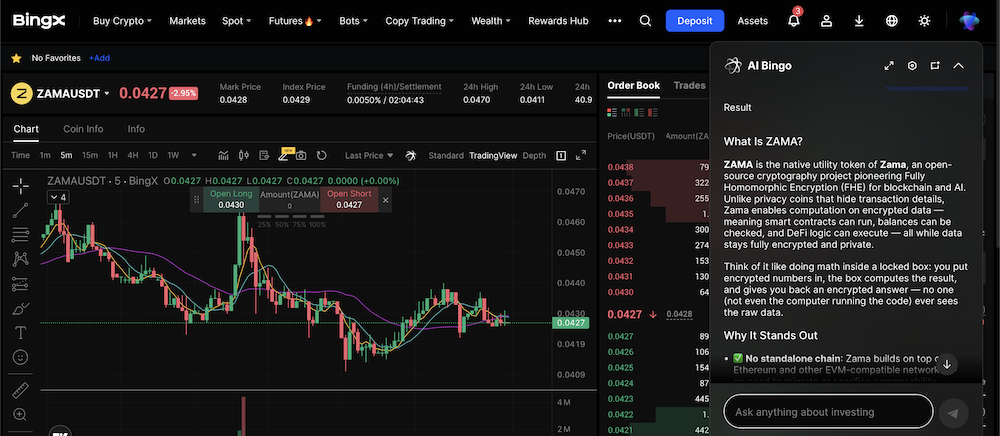
ZAMA/USDT perpetuals on the futures market powered by BingX AI insights
 
Leveraging the power of BingX AI, you can now analyze ZAMA’s market sentiment and technical patterns in real-time, helping you identify optimal entry and exit zones for your futures positions before you even place a trade.
  1. Fund Your Futures Account: Ensure you have USDT in your Futures account. You can easily transfer funds from your Spot account to your Futures account with zero fees.
  2. Select the ZAMAUSDT Pair: Navigate to the "Futures" tab on the BingX app or website and search for ZAMAUSDT perpetual contract.
  3. Analyze with BingX AI: Tap the BingX AI icon on the trading screen. Ask questions like "What is the current trend for ZAMA?" or "What are the support levels for ZAMAUSDT?" to receive a data-backed second opinion on your setup.
  4. Choose Your Margin Mode: Select between Cross Margin which uses your entire futures balance to avoid liquidation or Isolated Margin, which limits risk to the specific amount allocated to that trade.
  5. Set Your Leverage: Adjust your leverage, e.g., 2x to 5x for ZAMA. While leverage increases potential gains, it also significantly increases risk. Start low if you are new to the Zama ecosystem.
  6. Place Your Order: Choose a Market Order for instant execution or a Limit Order to enter at a specific price. Decide whether to go Long, betting the price will rise, or Short, betting it will fall.
  7. Set TP/SL (Take-Profit & Stop-Loss): Crucial for risk management, set your TP/SL levels immediately after opening your position to protect your capital from ZAMA's inherent volatility.
  8. Monitor Your Position: Use the "Positions" tab to track your unrealized P&L in real-time. You can adjust your TP/SL or close the position manually at any time.
Learn more about how to buy ZAMA with our detailed breakdown.

5 Key Considerations Before Investing in Zama (ZAMA)

Investing in a pioneering privacy infrastructure like Zama requires a balanced understanding of its technical "Holy Grail" potential and the practical hurdles of early-stage market adoption.
  1. Hardware and Scalability Milestones: While Zama's FHE technology is mathematically secure and "blind" to data, its long-term commercial success depends on hardware acceleration. The protocol currently handles 20 TPS; reaching its goal of 10,000+ TPS by 2027 depends on the successful development of dedicated FHE ASICs (specialized chips) currently in production with hardware partners.
  2. Regulatory Landscape and Compliance: Privacy protocols often face extreme scrutiny, but Zama addresses this through "Programmable Compliance." This allows developers to build "auditable privacy" rules directly into smart contracts, enabling selective disclosure for regulators (KYC/AML) without exposing raw user data to the public.
  3. Token Supply and Sell Pressure: The ZAMA token launch (TGE) on February 2, 2026, features a 100% initial unlock for public auction participants. While this ensures immediate liquidity, the sudden entry of 1.32 billion tokens into circulation can lead to significant early price volatility as auction participants take profits.
  4. Institutional and Retail Valuation Gap: Private Series B investors entered at a unicorn valuation of approx. $1 billion, while the public auction cleared at a significantly lower floor at $550 million FDV. This "mispricing" creates a unique entry point for retail, but also highlights a gap in incentive alignment between long-term institutional backers and immediate secondary market traders.
  5. Off-Chain Dependency and Network Security: Although state updates settle on-chain, the heavy encrypted lifting is performed by a decentralized network of KMS and FHE operators. The security of your data relies on the integrity of this 13-node MPC (Multi-Party Computation) committee and their use of secure hardware environments like AWS Nitro Enclaves.

Final Thoughts: Should You Buy Zama (ZAMA) in 2026?

Zama sits at the center of one of crypto’s most vital shifts: the move toward confidential computing. With over $1 billion in valuation and its breakthrough "HTTPZ" model, it positions itself as a key beneficiary if institutional demand for private DeFi and AI continues to grow.
 
However, ZAMA is a high-tech infrastructure asset, not a simple yield-bearing token. Its value depends on ecosystem growth, the successful rollout of FHE ASICs, and broader market sentiment toward privacy. If you’re evaluating ZAMA in 2026, treat it as a long-term play on the encrypted internet of tomorrow, and manage your risk accordingly.

Related Reading