
Visa Inc. (V) is a global digital-payments technology company that connects consumers, merchants, financial institutions and governments across more than 200 countries and territories. Unlike a traditional bank, Visa does not primarily lend money or issue cards. Its business is built around processing payments across its network and earning revenue from payment volume, transaction processing, cross-border activity and a growing range of value-added services. The company is also expanding in commercial payments, money movement and digital-commerce infrastructure.
In 2026, the investment case is increasingly about whether Visa can keep compounding earnings as global payment activity grows and the company expands beyond traditional card processing. Fiscal Q3 net revenue reached $11.6 billion, up 14%, while payments volume grew 10% and cross-border volume excluding intra-Europe rose 12%. At the same time, Visa continues to invest in new payment rails and value-added services while managing regulatory, litigation and competitive pressure. For investors, the key question is whether network scale, cross-border spending and newer services can keep growth strong enough to justify Visa’s premium valuation.
The V stock forecast for 2026 now centers on two competing views:
- The global payments and AI growth case: Bulls expect continued growth in payment volume, cross-border activity and value-added services, supported by Visa’s scale and increasing use of AI across fraud detection, personalization and payment infrastructure. If these trends continue, analysts see room for V to move toward targets as high as $460.
- The valuation-and-regulation case: Bears point to Visa’s premium multiple, rising operating costs, litigation risk, tighter payment regulation and competition from real-time payments, wallets and stablecoins. Even with healthy transaction growth, slower earnings or higher costs could pressure the valuation.
This guide breaks down the V stock forecast, 2026 price scenarios, key risks and analyst views, drawing on Visa’s fiscal Q3 2026 results, plus how to trade V stock futures on BingX TradFi with USDT collateral.
Top 5 Things for Visa Investors to Know in August 2026
- Revenue growth remained broad across Visa's payment network: Fiscal Q3 net revenue rose 14% to $11.633 billion, supported by higher payments volume, cross-border activity and processed transactions. The main question is whether that growth can hold as comparisons become tougher.
- Cross-border momentum remained a major growth driver: Volume excluding intra-Europe increased 12% in constant dollars, while international transaction revenue rose 6%. Continued strength in travel and international commerce would help offset slower growth in mature domestic markets.
- Transaction scale reinforced Visa's network advantage: Visa processed 71.7 billion transactions, up 10%, while data-processing revenue increased 17% to $6.0 billion. Higher payment activity continues to expand monetization across Visa's existing global infrastructure.
- Capital returns remained meaningful: Visa returned $6.2 billion through share repurchases and dividends during fiscal Q3, including the repurchase of about 14.5 million shares. Buybacks support per-share growth, though operating performance remains the more important driver.
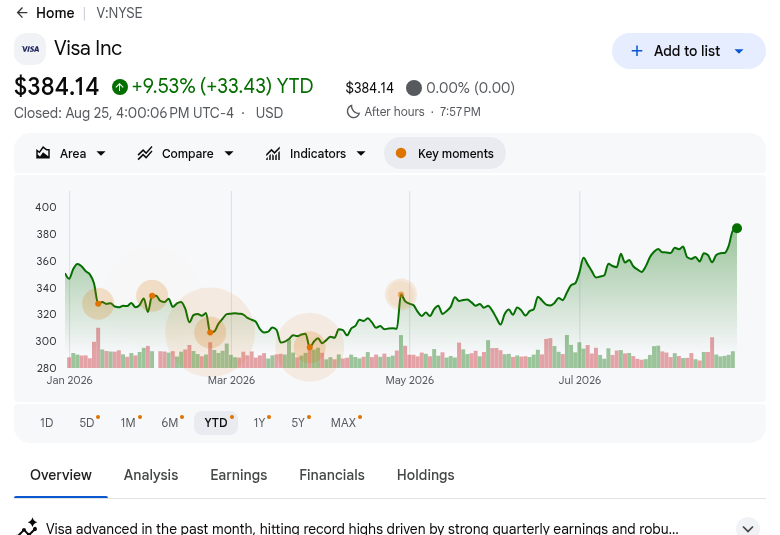
- Wall Street's $350 to $430 target range shows a wide valuation debate: Truist's $350 target and Morgan Stanley's $430 target sit around a $384.14 reference price. The spread reflects different assumptions around growth durability, legal risk and how much premium Visa already commands.
Read More: Visa (V) Q3 2026 Earnings News: $3.32 EPS Beat and 14% Revenue Growth Lift Shares 0.58%
What Is Visa Inc. (V)?

Visa Inc. is a global digital-payments technology company headquartered in San Francisco, California. It connects consumers, merchants, financial institutions and governments in more than 200 countries and territories through VisaNet, its authorization, clearing, settlement and data-processing network. Unlike a card issuer, Visa generally does not extend credit. It earns revenue by enabling and processing payments at global scale.
Visa's business has two main growth engines. Core consumer payments monetize payment volume, cross-border activity and processed transactions, while value-added services, commercial payments and money-movement products expand revenue beyond transaction processing. Fiscal Q3 net revenue rose 14%, payments volume increased 10%, cross-border volume excluding intra-Europe grew 12% and data-processing revenue advanced 17%. Other revenue rose 45%, while Visa returned $6.2 billion through repurchases and dividends. Investors should weigh that scale and cash-generation capacity against regulation, litigation, competition, cyber risk and alternative payment rails.
Read More: Top Financial Services and Fintech Stocks to Buy in 2026 Amid Agentic AI, Stablecoin Rails Shift
Visa (V) Fiscal Q3 2026 Earnings: Strong Volume Growth With Higher Costs and Legal Items
- Payments volume grew 10% despite Visa’s already large scale. Constant-dollar payments volume increased 10% in the three months ended June 30, while the prior service-revenue period grew 9%. The key question is whether spending growth remains broad across consumer and business activity.
- Cross-border volume remained a major growth driver. Cross-border volume excluding intra-Europe rose 12%, while total cross-border volume increased 13% in constant dollars. International transaction revenue grew 6%, making travel, ecommerce, currency movements, and revenue conversion important areas to watch.
- Data-processing revenue grew faster than total revenue. Data-processing revenue increased 17% to $6.0 billion, while processed transactions rose 10% to 71.7 billion. That growth reinforces the value of Visa’s network, though pricing, client incentives, and technology investment will determine how much of it flows through to earnings.
- Value-added and other revenue added another growth layer. Other revenue rose 45% to $1.5 billion, supported by commercial solutions, money movement, and value-added services. These businesses can diversify Visa beyond traditional payment processing and deepen relationships with clients.
- Operating expenses rose faster than revenue. GAAP operating expenses increased 19% to $4.76 billion, reflecting higher personnel costs as well as severance and litigation-related items. The next test is whether these costs normalize enough for stronger operating leverage and earnings growth.
Visa Fiscal Q3 2026 Financial and Consensus Profile: Revenue, EPS, Volumes and Capital Returns
Visa's latest reported quarter showed broad-based volume growth and double-digit revenue expansion, but operating expenses rose faster than revenue and special items affected GAAP earnings. The table separates reported results from operating indicators and capital-allocation data.
|
Financial Metric |
Guidance / Consensus |
Reported / Actual |
Surprise |
|
Net revenue |
N/A; reported result |
$11.633B |
+14% year over year |
|
GAAP net income / diluted EPS |
N/A; reported result |
$5.628B / $2.97 |
Net income +7%; EPS +10% |
|
Non-GAAP net income / diluted EPS |
N/A; reported result |
$6.296B / $3.32 |
Net income +8%; EPS +11% |
|
Payments volume |
N/A |
+10% constant-dollar growth |
Broad consumer and business spending support |
|
Cross-border volume ex intra-Europe |
N/A |
+12% constant-dollar growth |
International transaction revenue grew 6% |
|
Processed transactions |
N/A |
71.7B; +10% year over year |
Data-processing revenue grew 17% |
Q3 growth was strong, but expense discipline, legal items and capital returns remain the key swing factors for the next report.
Visa Inc. (V) 2026 Investment Outlook: $455 Bull Case vs. $340 Bear Case
Visa's outlook for the rest of 2026 depends on one central question: whether resilient payment volume, cross-border growth and value-added services can sustain earnings compounding, or whether regulation, litigation, alternative payment rails and premium valuation pressure interrupt the trajectory. The following scenarios use a normalized earnings and free-cash-flow framework, cross-checked against the frozen analyst range, over a common 12-month horizon from the $384.14 reference close.
The Bull Case: Global Digital-Commerce Growth Pushes V Toward $455
The upside case assumes Visa converts network activity into higher-value monetization and stronger operating leverage. Fiscal Q3 other revenue grew 45% and data processing grew 17%, giving value-added services and authorization scale room to improve the mix. Sustained payment and cross-border growth, profitable services expansion and disciplined capital returns could justify a higher normalized multiple.
A move toward $455 would require double-digit volume growth to remain broad, cross-border activity to stay strong, and data processing and other revenue to outpace total revenue without a new cost shock. The strongest confirmation would be continued revenue growth with improving expense leverage, stable legal exposure and cash returns that support per-share earnings.
The Base Case: Resilient Volumes Keep V Between $390 and $440
The base case treats fiscal Q3 as evidence of durable momentum rather than a one-quarter outlier. Visa delivered 14% revenue growth, 10% payments-volume growth and 12% cross-border growth excluding intra-Europe, while data processing revenue grew 17%. Normalizing personnel, litigation and other costs would support earnings conversion without requiring a major expansion of the existing multiple.
Under this scenario, V could trade mainly between $390 and $440 as volume growth stays resilient and capital returns continue. Key confirmation points are cross-border activity, processed transactions, client incentives, operating leverage and the absence of a major legal surprise, while a sharper consumer slowdown would push the outcome toward the downside case.
The Bear Case: Regulation and Slower Spending Pull V Toward $340
The downside case assumes Visa remains a high-quality network but payment growth normalizes faster than expected. Slower consumer spending, weaker travel and cross-border activity, and elevated legal or personnel costs would pressure earnings conversion. Even without a structural collapse in digital payments, a premium network multiple could reset as investors demand clearer evidence of durable operating leverage.
A move toward $340 would become more likely if processed volume slows, legal provisions rise, or alternative rails pressure network economics while expenses remain elevated. The scenario would be a valuation reset rather than a balance-sheet distress case, with payment volume, cross-border growth and operating expense trends determining whether the downside target is approached.
V Stock Price Forecasts for 2026 By Wall Street Analysts
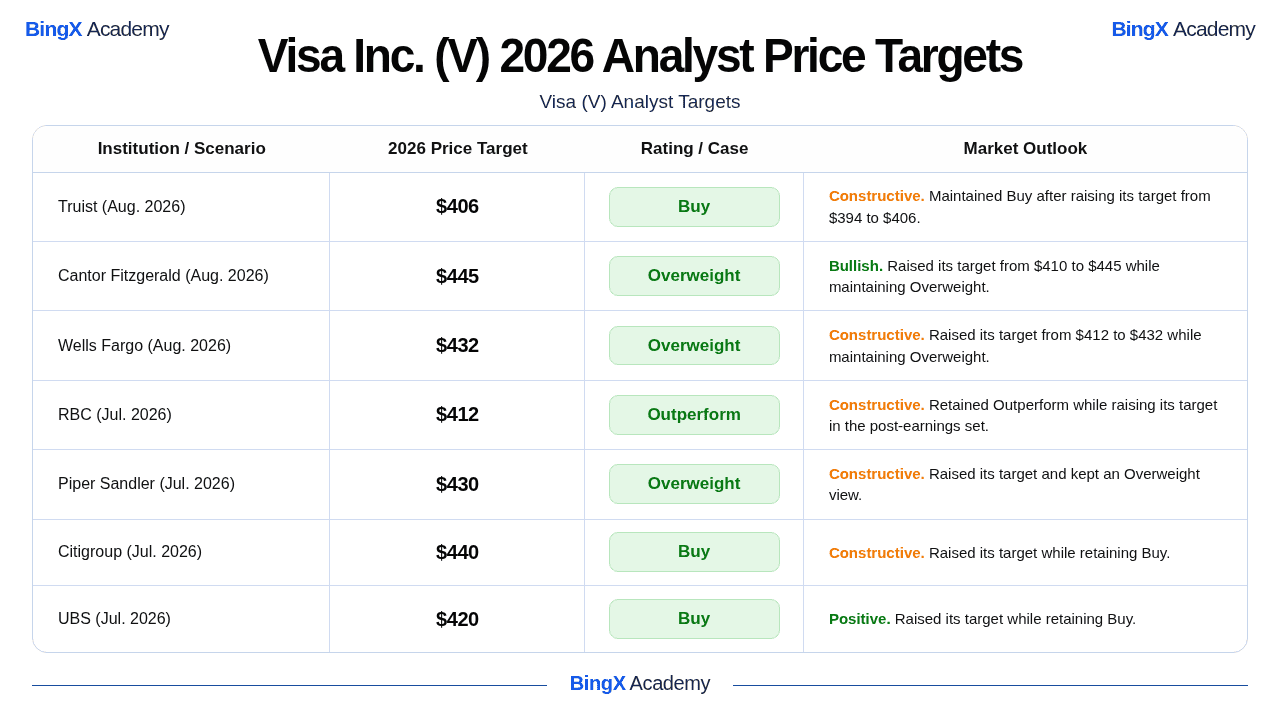
Published analyst targets and latest available Street reference points remain separate, not analyst rows. The frozen named-institution set shows a constructive but not uniform view of Visa, with targets from $350 to $445 and ratings spanning Buy, Overweight, Outperform and Hold. Bull, Base, Bear scenarios below are this article’s conditional research estimates, not analyst rows.
|
Institution / Scenario |
2026 Price Target |
Rating / Case |
Market Outlook |
|
Truist (Aug. 2026) |
$406 |
Buy |
Constructive. Maintained Buy after raising its target from $394 to $406. |
|
Cantor Fitzgerald (Aug. 2026) |
$445 |
Overweight |
Bullish. Raised its target from $410 to $445 while maintaining Overweight. |
|
Wells Fargo (Aug. 2026) |
$432 |
Overweight |
Constructive. Raised its target from $412 to $432 while maintaining Overweight. |
|
RBC (Jul. 2026) |
$412 |
Outperform |
Constructive. Retained Outperform while raising its target in the post-earnings set. |
|
Piper Sandler (Jul. 2026) |
$430 |
Overweight |
Constructive. Raised its target and kept an Overweight view. |
|
Citigroup (Jul. 2026) |
$440 |
Buy |
Constructive. Raised its target while retaining Buy. |
|
UBS (Jul. 2026) |
$420 |
Buy |
Positive. Raised its target while retaining Buy. |
How to Trade Visa Inc. (V) Stock on BingX
Navigate the volatility of Visa's earnings cycle using BingX TradFi and BingX AI tools. By leveraging AI-driven predictive analytics, you can better anticipate market sentiment shifts and price action around quarterly releases, payment-volume updates, cross-border trends, regulatory decisions, and litigation developments.
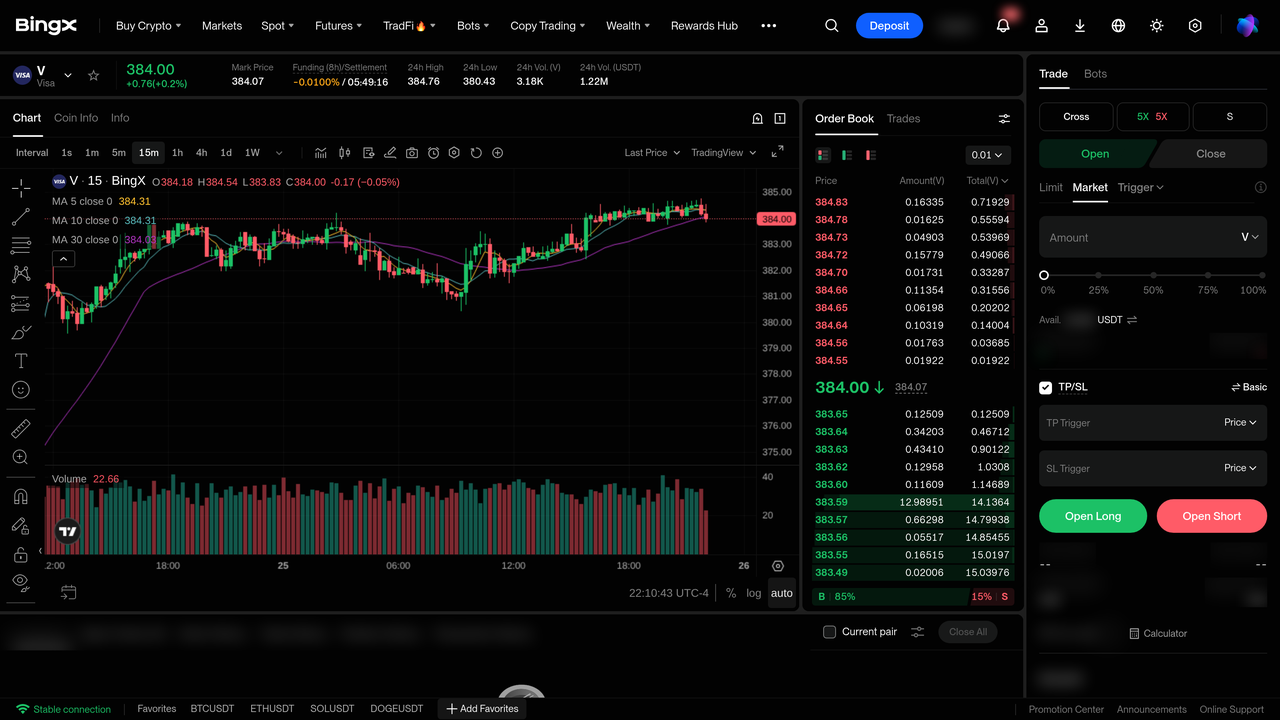
Step 1: Access BingX TradFi. Sign up and navigate to the specialized TradFi section on the main BingX exchange dashboard.
Step 2: Select Visa (V). Deposit USDT, then search for and select the V-USDT perpetual futures contract.
Step 3: Choose your direction. Select Open Long if you expect payment volume and cross-border growth to remain resilient, value-added services to improve monetization, and capital returns to support per-share earnings. Select Open Short if you expect consumer spending or travel to weaken, regulation or litigation to pressure Visa's economics, or alternative payment rails to erode network pricing.
Step 4: Select leverage and margin mode. Choose Isolated or Cross-Margin based on your risk tolerance. Because Visa can react quickly to quarterly earnings, cross-border-volume updates, regulatory decisions and litigation headlines, conservative leverage and clear position sizing are important.
Step 5: Execute strict risk protocols. Set Take-Profit and Stop-Loss (TP/SL) levels before or immediately after entering the trade. Visa can react quickly to quarterly earnings and guidance, payment-volume and cross-border updates, regulatory decisions, litigation developments, alternative-payment-rail announcements, and capital-return disclosures.
Top 5 Risks to Watch for Visa Investors in 2026
Visa combines a strong global payments network with regulatory, competitive, economic, operational, and valuation risks. The main issues to watch are:
- Regulation could pressure Visa’s economics. Changes to interchange rules, payment-system requirements, data regulations, or merchant costs could reduce pricing flexibility or increase compliance expenses. Litigation and new payment rules remain important catalysts.
- New payment systems could bypass parts of the card network. Account-to-account payments, digital wallets, stablecoins, and real-time payment rails may reduce reliance on traditional card infrastructure. Visa is expanding into these areas, but adoption and profitability remain uncertain.
- Consumer spending and travel cycles can slow growth. Visa depends on payment activity, processed transactions, and cross-border spending. Weaker consumer demand, slower travel, or recession could pressure revenue, especially given the stock’s premium valuation.
- Cybersecurity and operational failures remain major risks. Network outages, cyberattacks, data breaches, or third-party disruptions could create financial losses and damage trust in a business built around reliability.
- A premium valuation leaves less room for disappointment. Slower revenue growth, higher expenses, or larger legal charges could pressure the stock even if Visa’s long-term business remains strong. For traders using BingX perpetual contracts, leverage, funding, and liquidation risk add another layer of volatility.
Final Thoughts: Should You Invest in Visa Inc. in 2026?
Visa enters the next reporting cycle with double-digit revenue growth, resilient payment volumes and substantial capital returns, but regulation and valuation remain the unresolved counterweights. Fiscal Q3 revenue rose 14%, payments volume increased 10%, cross-border volume excluding intra-Europe grew 12%, and processed transactions reached 71.7 billion. The investment debate is therefore not whether Visa has a durable network, but whether value-added services and operating leverage can keep converting activity into earnings while legal and competitive pressure builds.
The bull case is that resilient digital commerce, cross-border travel and faster value-added-services growth support a higher earnings and cash-flow multiple. The bear case is that regulation, litigation, alternative payment rails or slower spending weaken monetization before expense growth normalizes. Investors who believe payment activity can stay broad may view the setup as an execution test rather than a target decision. More conservative investors might wait for volume, expense and legal updates, monitoring cross-border growth, data processing revenue, operating leverage and capital returns before treating either case as confirmed.
Risk Reminder: V scenarios are conditional research estimates, not investment advice or guaranteed returns. Visa shares and BingX TradFi perpetual contracts can lose value, while leveraged contracts can be liquidated. Review Visa filings, current market data, forecast assumptions and BingX contract terms independently before taking risk.
Related Reading
- Top Financial Services and Fintech Stocks to Buy in 2026 Amid Agentic AI, Stablecoin Rails Shift
- Mastercard (MA) Stock Price Forecast for 2026: Fintech Giant or Regulatory Target?
- Morgan Stanley (MS) Price Prediction 2026: Investment Bank Resurgence or $170 Correction?
- JPMorgan Chase (JPM) Price Prediction 2026: Fortress Defense or AI-Driven Alpha at $341?
- Goldman Sachs (GS) Price Prediction 2026: Record Quarter Momentum or Valuation Ceiling at $1,140?
- Robinhood (HOOD) Stock Forecast 2026: Can the Super-App Strategy Push HOOD Toward $160?
