Today you can buy crypto in dozens of ways. The number of reliable exchanges is growing, competition is intensifying, and user terms are becoming more flexible. However, behind seemingly similar interfaces and welcome bonuses lies the true cost of each trade. A difference of a fraction of a percent may seem insignificant, but with regular trading, futures activity, or frequent deposits and withdrawals, it can materially affect your bottom line.
That is why it is important to assess not only a platform's reputation and the set of available tools, but also the real cost structure and accessibility features such as minimum deposits and liquidity. In 2026, with the global crypto market capitalization surpassing $3 trillion, exchanges that combine ultra-low or zero minimum deposits, high trading liquidity, and competitive fees deliver the greatest value. Low minimum deposits allow beginners and small-capital traders to test strategies with as little as $1, while high liquidity ensures tight spreads, minimal slippage, and fast order execution even during volatile periods.
Read more: Top 5 Crypto Exchanges with the Best User Experience (UX) for Beginners in 2026
Why Do Crypto Exchange Fees Matter?
When evaluating fees, the difference between 0.1% and 0.2% may look minor, but it directly affects net returns, especially with an active trading strategy and large trades. The higher the capital turnover, the stronger the compounding effect of costs. If a trader regularly opens and closes positions, even fractions of a percent start to eat up a noticeable share of profits. As a result, a strategy may look profitable on paper, but after operating costs are deducted, performance deteriorates. This is especially evident in scalping trades.
At the same time, the full cost structure usually includes not only the fee for opening a position, but also fees for deposits and withdrawals, network fees when transferring cryptocurrency, the difference between the buy and sell price (spread), and additional fees for using certain tools. Ignoring these parameters distorts the real picture of returns. Even with relatively infrequent recurring crypto purchases, excessive fees add up over the long term and create noticeable additional costs.
Read more: Top 10 Safest Crypto Exchanges in 2026 and How to Choose The Best One For You
What Fees Do Crypto Exchanges Charge?
The size and type of fee depend on how the user interacts with the platform. Terms may differ when buying an asset on the spot market, trading futures, or withdrawing funds to an external wallet. The main types of fees include spot fees charged for buying or selling cryptocurrency on the spot market (usually split into maker and taker rates), futures trading fees that differ in structure from spot and may include a position funding mechanism, withdrawal fees that are typically a fixed amount depending on the specific asset and network used, and P2P fees for executing a trade on an exchange platform for direct exchange with Fiat.
When calculating fees, most exchanges use the maker-taker model: the maker places a limit order and adds liquidity, while the taker fills an existing order and removes it. Often, the maker fee can be lower or even zero. In the derivatives market, the structure is more complex. In addition to the trading fee, funding payments are taken into account, which depend on the balance between long and short positions and affect the cost of holding a position. Many platforms also offer discounts for high trading volume, paying fees using an affiliated token, or participating in loyalty programs.
Why Does High Liquidity Matter for Exchanges?
High liquidity is essential for efficient trading in the dynamic crypto markets of 2026. It enables users to execute large orders without significant price impact or slippage, maintains tight bid-ask spreads that reduce hidden costs, and supports rapid order filling even during high-volatility events. Exchanges with daily trading volumes in the billions, such as those exceeding $1.3 billion on leading platforms, provide deeper order books on major pairs like BTC/USDT and ETH/USDT. This is particularly valuable for futures traders, scalpers, and institutional participants. Low-liquidity environments can lead to poor execution, wider spreads, and increased risk, making high-liquidity platforms the preferred choice for consistent performance and capital preservation.
Read more: BingX vs Binance vs Kraken: Which Exchange Is Better in 2026?
Top 5 Exchanges With the Lowest Fees and Highest Liquidity in 2026
Choosing the right exchange can significantly impact your trading performance, so here are five leading crypto platforms in 2026 that combine low fees with deep liquidity for efficient and cost-effective trading.
1. BingX
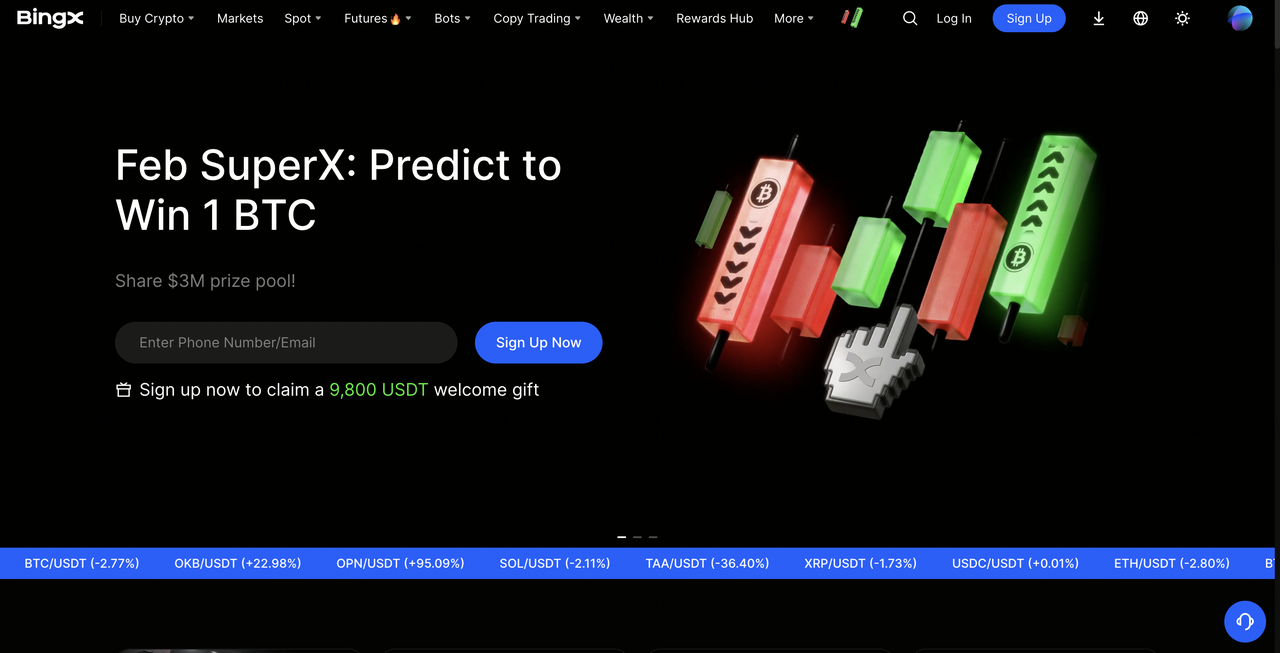
• Spot: 0.1% for makers and 0.1% for takers (reducible via VIP tiers)
• Futures: 0.02% for makers and 0.05% for takers on USDT perpetual contracts
• USDT withdrawals: from $0.5 to $2 depending on the network
• Discounts: trading volume, VIP program participation
• Liquidity Levels: Strong, with 24h volumes frequently exceeding $1.3 billion (including peaks over $2 billion in TradFi segments), deep order books in futures and copy trading pairs, supporting minimal slippage for active traders.
BingX stands out as the premier choice in 2026 for traders prioritizing low minimum deposits combined with high liquidity and cost efficiency. The platform requires only a $1 minimum deposit for most cryptocurrencies, enabling virtually anyone to begin trading immediately with minimal risk. It delivers strong liquidity with 24-hour volumes frequently surpassing $1.3 billion across spot and derivatives markets, supported by deep order books and advanced copy trading tools that have processed hundreds of billions in cumulative volume. BingX offers spot trading, perpetual futures, innovative copy trading, AI-powered bots like BingX AI, grid trading, and passive income products while emphasizing a vibrant social trading ecosystem.
Advantages: extremely low entry barriers with a $1 minimum deposit, user-friendly interface and mobile app, superior liquidity in futures and copy trading pairs, frequent zero-fee promotions on select spot markets, and broad jurisdictional support.
Disadvantages: certain services may be unavailable in restricted jurisdictions, and liquidity on niche altcoins may not match the depth of the absolute largest platforms.
Read more: Best 10 Crypto Spot Trading Platforms for Beginners in 2026
2. OKX
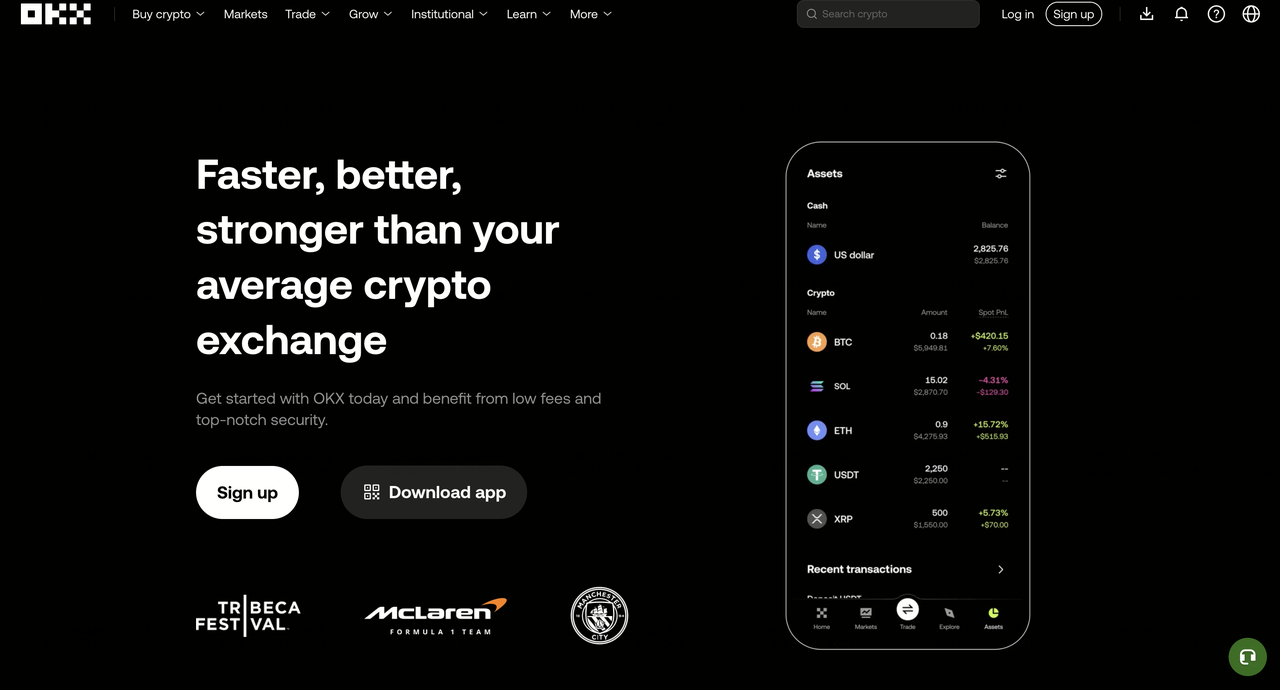
• Spot: 0.08% for makers and 0.10% for takers
• Futures: 0.02% for makers and 0.05% for takers when opening USDT contracts
• USDT withdrawals: from $0.000061 to $1.50 depending on the network
• Discounts: trading volume, participation in the VIP program, and using the OKB token
• Liquidity Levels: Top-tier, with 24h spot volumes around $2.2 billion and high average liquidity scores, providing excellent depth across major pairs and derivatives.
OKX is one of the largest international crypto exchanges with a broad ecosystem. The platform offers spot and margin trading, USDT futures, options, a robust P2P marketplace, as well as passive income products including staking, structured products, and Earn programs. In addition, OKX is actively developing its Web3 direction, including its own wallet and access to decentralized applications. With no minimum deposit requirement for crypto transfers and consistently high liquidity backed by billions in daily volume, it remains a strong contender.
Advantages: low base fees, a discount system, high liquidity, a wide range of instruments, a mature Web3 ecosystem, and a mobile app.
Disadvantages: the interface can be relatively complex for beginners, and there are restrictions in certain jurisdictions.
3. Binance
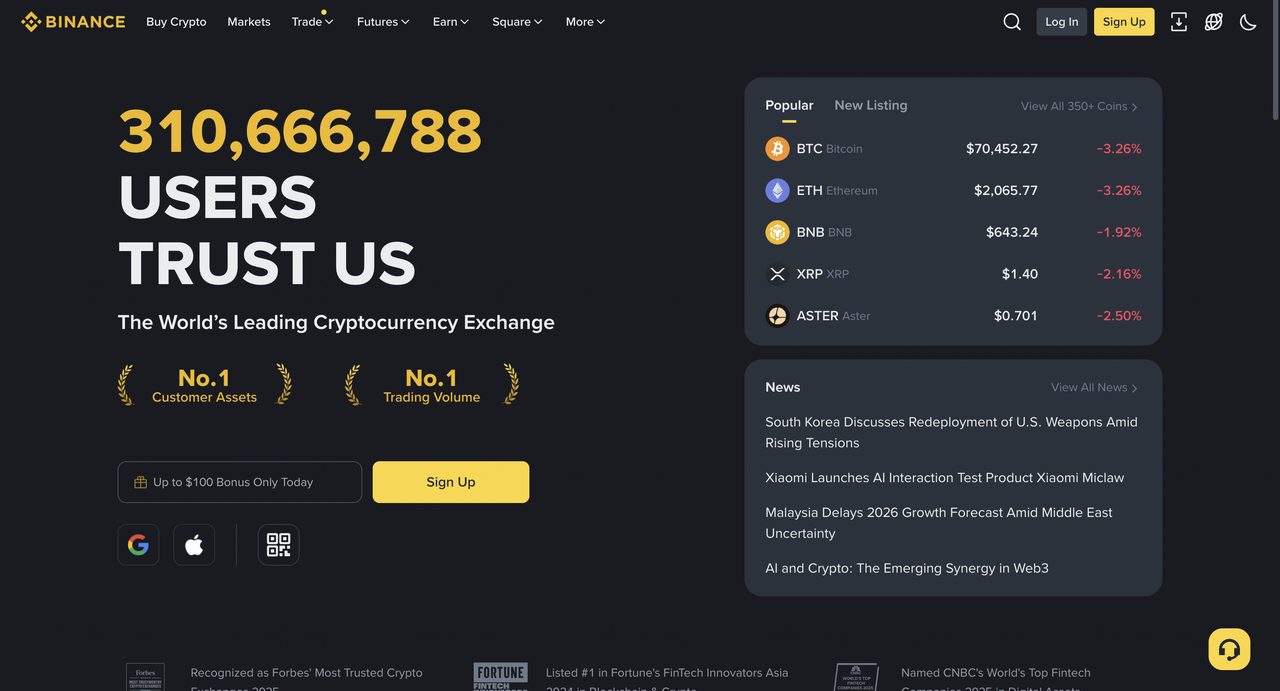
• Spot: 0.1% base fee for makers and takers
• Futures: 0.02% base fee for makers and 0.04% for takers
• USDT withdrawals: from $0.0012 to $1 depending on the network
• Discounts: trading volumes, VIP program participation, and using the BNB token
• Liquidity Levels: Highest globally, with 24h volumes often exceeding $10 billion and superior average liquidity scores (around 900+), offering unmatched depth and minimal slippage on thousands of pairs.
Binance is the largest crypto exchange by trading volume, with a global user base. The platform offers spot and derivatives trading, options, staking, a launchpad, a P2P service, an NFT platform, and a wide range of passive income products. The exchange is geared toward both beginners and professional traders who value advanced analytics and risk management tools. Minimum deposits are effectively zero for crypto, and its unmatched liquidity exceeds $10 billion daily on average.
Advantages: a large ecosystem, exceptionally high liquidity, and a wide selection of assets.
Disadvantages: a relatively complex interface for beginners, and restrictions in certain jurisdictions.
4. Gate
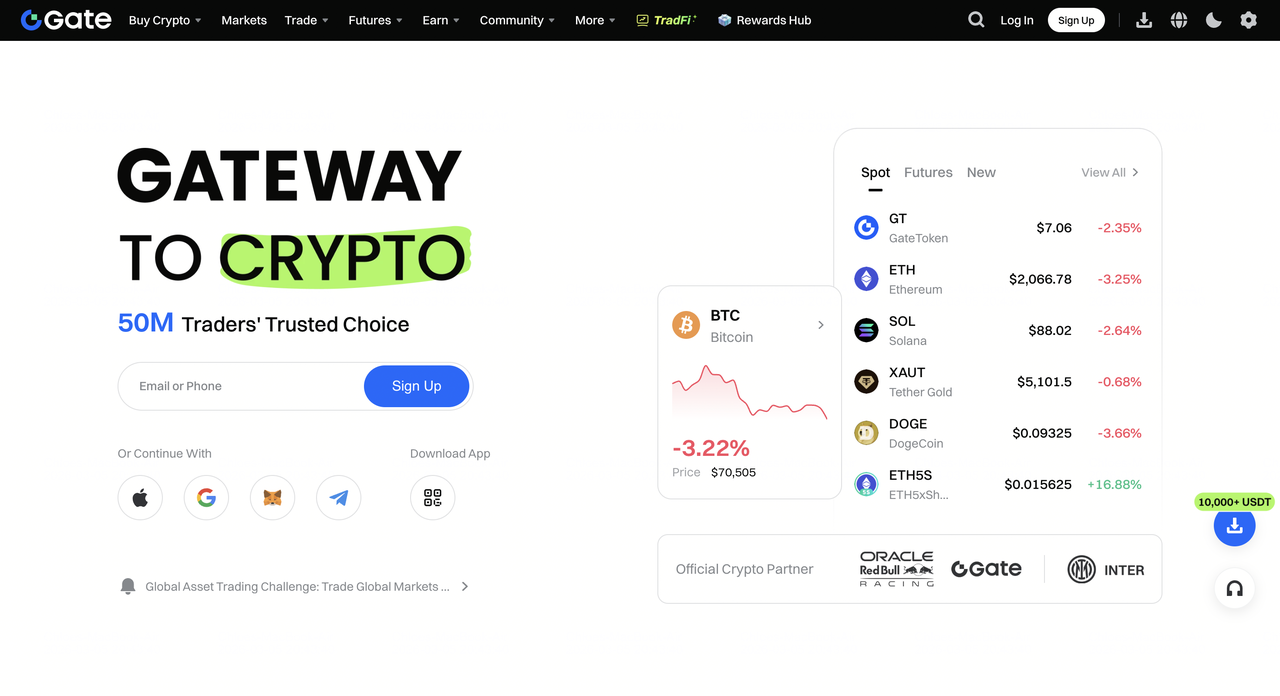
• Spot: 0.1% for makers and 0.09% for takers
• Futures: 0.02% for makers and 0.05% for takers
• USDT withdrawals: from $0.05 to $2 depending on the network
• Discounts: VIP program participation and using the GT token
• Liquidity Levels: Solid, with 24h volumes around $2.2-$2.4 billion, strong support for over 3,000 pairs and high liquidity in altcoin markets.
Gate stands out for its wide selection of digital assets and fast listings of new tokens. In addition to the spot market, the platform offers derivatives, margin trading, and additional investment tools. The exchange is also actively developing its launchpad, passive income services, and products for participating in early-stage projects. Crypto deposits have no minimum requirement, with solid liquidity supporting rapid execution.
Advantages: a large selection of cryptocurrencies, a broad toolset, and opportunities for staking and passive income.
Disadvantages: relatively expensive withdrawals on some networks, and regional restrictions when using fiat.
5. Bybit
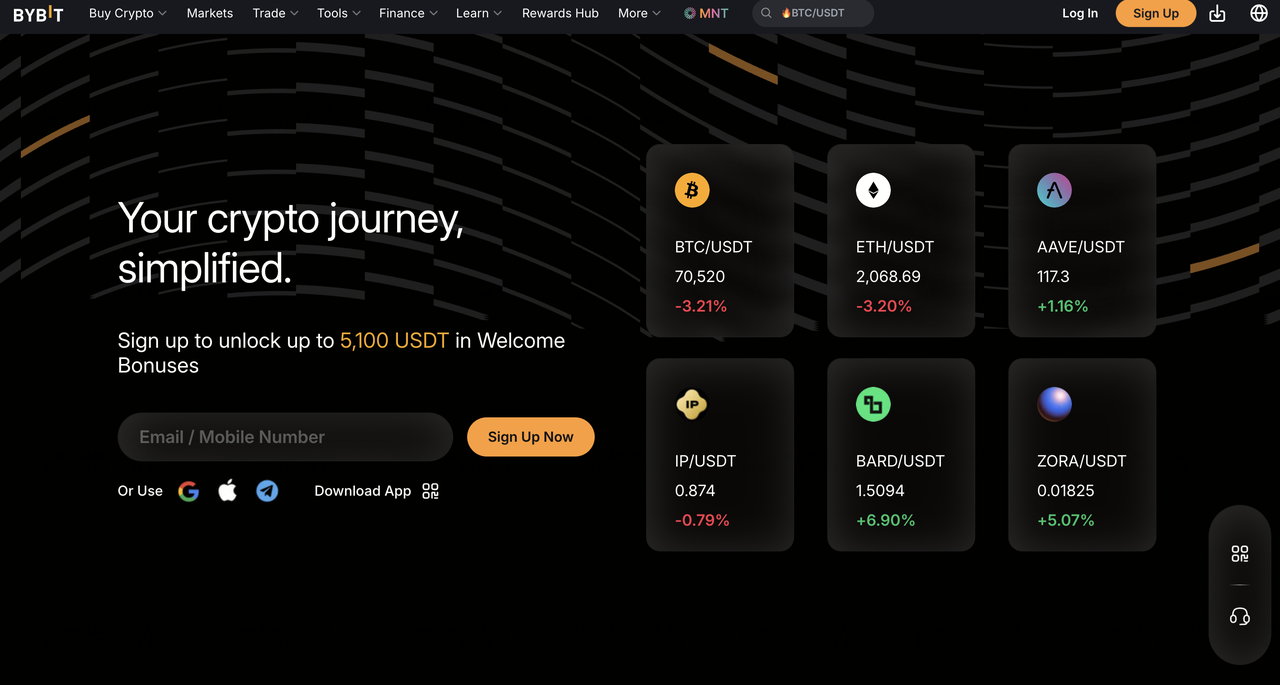
• Spot: 0.1% for makers and 0.1% for takers
• Futures: 0.02% for makers and 0.055% for takers on USDT contracts
• USDT withdrawals: from $0 to $1 depending on the network
• Discounts: trading volume, VIP program participation, and use of the MNT token
• Liquidity Levels: Deep in derivatives, with 24h volumes around $2.1 billion, excellent for futures and high-leverage trading with robust order execution.
Bybit has historically specialized in derivatives and continues to actively develop this segment. The exchange offers USDT and USDC futures, options, advanced position management tools, and high order execution speed. At the same time, the platform supports spot trading, a launchpad, copy trading, and other tools. Overall, the infrastructure is geared toward active and experienced market participants, with no minimum deposit and strong liquidity in derivatives markets.
Advantages: a well-developed derivatives market, fast execution, and a user-friendly interface for active trading.
Disadvantages: relatively weak fiat currency support and regional restrictions.
Read more: 8 Best Crypto Futures Platform for Beginners in 2026
Crypto Exchange Fee Comparison and Liquidity Table
|
Exchange |
Spot (Maker/Taker) |
Futures (Maker/Taker) |
USDT Withdrawal |
Min Deposit |
Liquidity Levels (24h Volume) |
|
BingX |
0.1% / 0.1% |
0.02% / 0.05% |
$0.5 - $2 |
$1 |
Strong ~$1.3B+, peaks over $2B in segments, excellent futures/copy trading depth |
|
OKX |
0.08% / 0.10% |
0.02% / 0.05% |
$0.000061 - $1.5 |
None/low |
Top-tier ~$2.2B, high avg. liquidity scores |
|
Binance |
0.1% / 0.1% |
0.02% / 0.04% |
$0.0012 - $1 |
None/low |
Highest ~$10B+, unmatched global depth |
|
Gate |
0.1% / 0.09% |
0.02% / 0.05% |
$0.05 - $2 |
None/low |
Solid ~$2.2B-$2.4B, strong altcoin support |
|
Bybit |
0.1% / 0.1% |
0.02% / 0.055% |
$0 - $1 |
None/low |
Deep derivatives ~$2.1B, robust execution |
Comparison of trading fees, minimum deposits, and liquidity on the leading crypto exchanges. Data: Incrypted and market reports, 2026.
Which Crypto Exchange Has the Lowest Fees?
When comparing base spot trading fees without discounts, OKX lists slightly lower maker rates at 0.08%, while most major exchanges, including Binance and BingX, start around 0.1% for spot trading. In the futures market, Binance offers some of the lowest taker fees at 0.04%, while BingX and OKX remain highly competitive at around 0.02% maker and 0.05% taker fees for USDT perpetual contracts.
However, the best exchange is not determined by fees alone. Minimum deposits, liquidity depth, execution quality, and additional trading tools all play a critical role in overall trading performance. This is where BingX stands out as one of the most balanced options in 2026, offering competitive fees, a $1 minimum deposit for easy entry, and consistently strong liquidity with daily trading volumes frequently exceeding $1.3 billion. Combined with advanced features such as copy trading, AI-powered trading tools, and a user-friendly interface, BingX provides one of the most cost-efficient and accessible environments for both beginners and experienced traders. USDT withdrawal fees across exchanges typically range from fractions of a cent to around $1–$2, depending on the selected network.
Conclusion: Which Is the Best Crypto Exchange with Low Fees and High Liquidity?
In 2026, the most successful crypto traders prioritize platforms that deliver the optimal combination of low minimum deposits for easy entry, high liquidity for reliable execution, and competitive fees to protect profits. BingX rises above the competition by offering one of the lowest entry barriers at just $1, robust liquidity across spot and derivatives markets (with strong volumes and depth in key segments) and a powerful ecosystem built around copy trading and social features. Whether you are a novice exploring crypto for the first time or a seasoned professional managing substantial positions, BingX provides accessibility, efficiency, and value that defines the best trading experience this year.
Related Reading
1. Best 10 Crypto Spot Trading Platforms for Beginners in 2026
2. BingX vs Binance vs Kraken: Which Exchange Is Better in 2026?
3. Top 5 Crypto Exchanges with the Best User Experience (UX) for Beginners in 2026
4. How to Trade Commodities With Crypto in 2026 as Oil, Gold, Silver, and TradFi Go On-Chain
5. What Are the Top 10 Tokenized Stocks (xStocks) to Trade in 2026?
