


Tesla (TSLA) reported second-quarter results on July 22 that split cleanly in two. Revenue reached a record $28.24 billion, up 26% and comfortably ahead of the roughly $26.4 billion consensus, crossing $100 billion in trailing twelve-month revenue for the first time. Non-GAAP EPS came in at $0.33 against the $0.53 the Street expected, down 18% year over year. Shares fell roughly 4% after hours and then 12.9% on July 23 to $325.60, an eleven-month low, taking the year-to-date decline to about 27%.
The volume was never the question. Tesla delivered 480,126 vehicles, up 25% and roughly 74,000 above consensus, its best second quarter ever and its first year-over-year delivery growth in two years. It also worked down inventory, delivering about 28,000 more cars than it built. What the market found was that the delivery surge did not reach the bottom line. Operating expenses rose 47% to $4.35 billion on AI infrastructure and R&D, capital expenditure jumped 142% to $5.79 billion, and operating margin fell to 1.4% from 4.1% a year earlier. Free cash flow swung to a deficit of $1.09 billion from a $1.44 billion surplus in Q1.
The TSLA stock forecast for 2026 now centers on two competing views:
- The industrial scale-up case: Bulls expect Cybercab production at Gigafactory Texas, a Robotaxi service now running in seven metropolitan areas, Optimus production lines being installed, and Semi and Megapack 3 on schedule to convert today's spending into new revenue streams.
- The margin case: Bears see a 1.4% operating margin, negative free cash flow, regulatory credit revenue collapsing from $439 million to $146 million, and a valuation near 300 times earnings that leaves no room for a business earning almost nothing on record volume.
This guide breaks down the TSLA stock forecast, 2026 price scenarios, key risks, and the July 22 shareholder deck and earnings call, plus how to trade TSLA stock futures on BingX TradFi with USDT collateral.
Top 5 Things for Tesla Investors to Know in July 2026
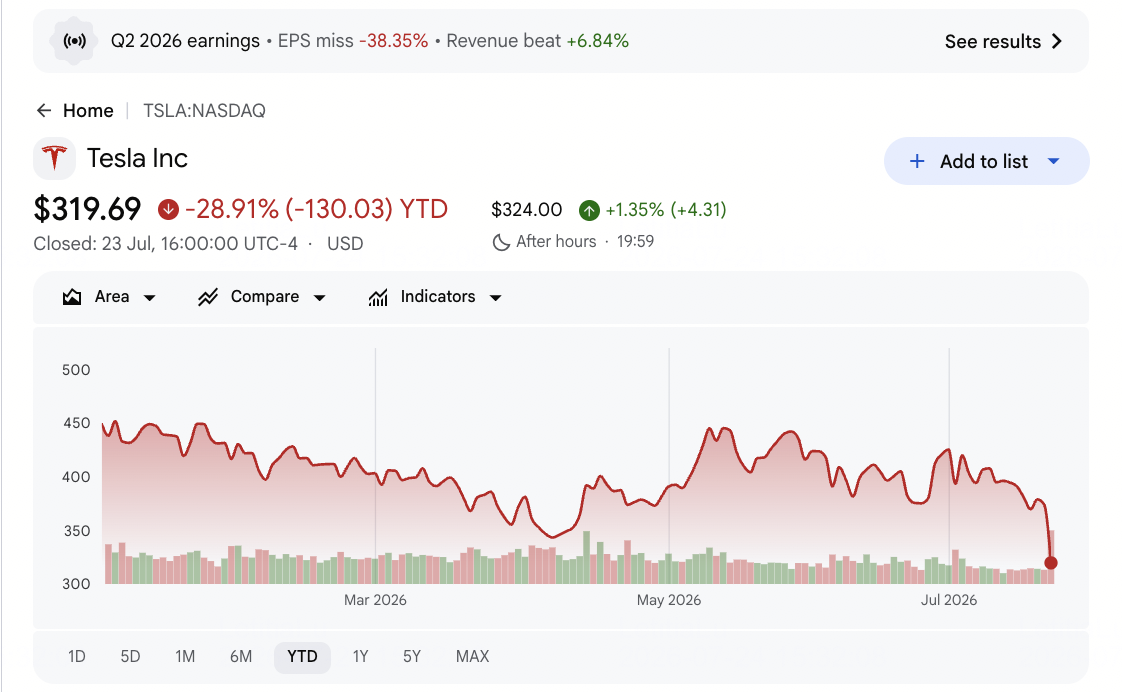
- Record revenue of $28.24 billion beat, EPS of $0.33 missed badly: Revenue grew 26% against a roughly $26.4 billion consensus, while non-GAAP EPS fell 18% year over year and landed well short of the $0.53 expected. Estimates had ranged from $0.27 to $0.74, so the disagreement was priced in advance.
- Deliveries hit 480,126, the best second quarter ever: Volume rose 25% year over year and roughly 74,000 above consensus, marking the first year-over-year delivery growth in two years, with production of 451,758 meaning Tesla drew down inventory rather than building it.
- Operating margin collapsed to 1.4% from 4.1%: Operating expenses rose 47% to $4.35 billion on AI infrastructure and R&D while capital expenditure jumped 142% to $5.79 billion. Automotive gross margin was 16.9%, or 16.3% excluding regulatory credits.
- Free cash flow turned negative at $1.09 billion: The deficit compares with a $1.44 billion surplus in Q1 2026 and $146 million a year ago, even though operating cash flow rose 85% to $4.70 billion.
- Services and energy grew while credits collapsed: Services and other revenue rose 50% to $4.58 billion with record gross profit and margin, energy generation and storage rose 13% to $3.14 billion on 13.5 GWh deployed, while regulatory credit revenue fell to $146 million from $439 million.
What Is Tesla (TSLA)?
Tesla is an electric vehicle manufacturer that has repositioned itself as an artificial intelligence and robotics company that also sells cars. Revenue still comes overwhelmingly from automotive, but the investment case increasingly rests on businesses that generate little or no revenue today.
The reported business has three segments. Automotive delivered 480,126 vehicles in the quarter at a 16.9% gross margin. Energy generation and storage produced $3.14 billion on 13.5 GWh of deployments, up more than 40% year over year. Services and other, which includes supercharging, insurance and used vehicles, grew 50% to $4.58 billion at record margins. Layered on top are the pre-revenue programs absorbing the capital: Cybercab production has begun at Gigafactory Texas, the Robotaxi service operates in seven major metropolitan areas, first-generation Optimus humanoid robot production lines are being installed at Fremont, and Tesla Semi and Megapack 3 remain scheduled for 2026 production. CEO Elon Musk described the spending as the fastest industrial scale-up since World War II in America, comparing it to Henry Ford and the Model T. Cash and short-term investments stood at $43.52 billion, down $1.2 billion sequentially.
Tesla (TSLA) Q2 2026 Earnings: What Caused Record Revenue and a Profit Miss
- Volume grew but did not convert. A 25% delivery increase and 26% revenue growth produced an 18% decline in non-GAAP EPS, which is the central fact of the quarter.
- Operating expenses outgrew revenue by a wide margin. Costs rose 47% to $4.35 billion against 26% revenue growth as Tesla funded AI compute, solar, battery material and semiconductor manufacturing initiatives simultaneously.
- Regulatory credits fell by two-thirds. Credit revenue dropped to $146 million from $439 million a year earlier, removing a high-margin contribution that had previously flattered automotive profitability.
- Capital expenditure more than doubled. Capex reached $5.79 billion, up 142%, pushing free cash flow to a $1.09 billion deficit despite operating cash flow rising 85% to $4.70 billion.
- The non-automotive businesses performed. Services and other grew 50% to $4.58 billion at record gross profit and margin, and energy storage deployments rose more than 40% to 13.5 GWh, both offsetting some automotive weakness.
Read More: Top AI Compute and GPU Stocks to Buy in 2026: The Shift to Inference and Custom Silicon
Tesla Q2 2026 Financial and Consensus Profile: Revenue, EPS and Margins
Tesla's Q2 print delivered the top line the bulls wanted and the profitability the bears warned about. The gap between the two is unusually wide even by Tesla's standards.
|
Financial Metric |
Consensus Estimate |
Reported / Actual |
Surprise |
|
Q2 2026 Revenue |
~$26.4 billion |
$28.24 billion |
Beat; up 26% year over year, an all-time high |
|
Q2 2026 Non-GAAP EPS |
~$0.53 |
$0.33 |
Missed badly; down 18% year over year |
|
Q2 2026 Deliveries |
~406,600 |
480,126 |
Beat by roughly 74,000; up 25%, best Q2 ever |
|
Q2 2026 Operating Margin |
— |
1.40% |
Down from 4.1% a year earlier |
|
Q2 2026 Automotive Gross Margin |
— |
16.90% |
16.3% excluding regulatory credits |
|
Q2 2026 Regulatory Credits |
— |
$146 million |
Down from $439 million a year earlier |
|
Q2 2026 Operating Expenses |
— |
$4.35 billion |
Up 47%, far outpacing revenue growth |
|
Q2 2026 Capital Expenditure |
— |
$5.79 billion |
Up 142% year over year |
|
Q2 2026 Free Cash Flow |
— |
Negative $1.09 billion |
From a $1.44 billion surplus in Q1 2026 |
For context, Q1 2026 delivered $22.39 billion of revenue with EPS of $0.41, and Tesla built roughly 50,000 vehicles it could not sell. Q2 reversed that, delivering about 28,000 more vehicles than it produced. Automotive gross margin excluding credits sat near 12.5% in Q1 and improved to 16.3% in Q2, so the automotive business itself moved the right way even as consolidated margin fell. Energy storage deployments reached 13.5 GWh, up more than 40%, and trailing twelve-month revenue crossed $100 billion for the first time. CFO commentary indicated operating expenditure will grow in 2026 and beyond, with commodity price increases and interest rate changes adding to costs.
Tesla (TSLA) 2026 Investment Outlook: $500 Bull Case vs. $298 Bear Case
Tesla's outlook for the rest of 2026 depends on one central question: whether a 1.4% operating margin is the temporary cost of building several new industries at once or the steady state of a maturing car company.
The Bull Case: Robotaxi and Optimus Push TSLA Toward $500
The bull case is that Tesla’s current spending is funding businesses that have not yet contributed meaningfully to revenue. Cybercab production has begun at Gigafactory Texas, Robotaxi service is operating in seven major metropolitan areas, Optimus production lines are being installed, and Semi and Megapack 3 remain scheduled for 2026. The latest margin therefore reflects much of the investment cost without the potential commercial benefit.
This scenario requires those programs to scale close to management’s timeline. The supporting evidence is that Tesla’s underlying businesses remain healthier than the headline margin suggests. Services and other revenue grew 50% to $4.58 billion at record margins, energy deployments increased more than 40%, and automotive gross margin excluding credits improved from roughly 12.5% in Q1 to 16.3% in Q2. If Robotaxi and Optimus begin generating meaningful revenue, investors could value Tesla more like a software and services platform. RBC Capital and Piper Sandler both maintained $500 targets, treating the margin weakness as temporary rather than structural.
The Base Case: Gradual Margin Recovery Keeps TSLA Between $326 and $445
In the base case, Tesla’s autonomy programs continue progressing but do not yet transform earnings. The stock remains driven mainly by vehicle deliveries and automotive gross margin, with volume improving against easier comparisons and free cash flow recovering as the current investment cycle begins to moderate.
That would likely keep TSLA range-bound and sensitive to quarterly headlines. Deliveries may recover faster than profitability because management expects operating expenses to remain elevated, while commodity costs, interest rates, and competitive pricing continue to pressure margins. JPMorgan cut its target to $445 from $475 while maintaining a Neutral rating, arguing that shares may remain range-bound until earnings estimates stabilize. Robotaxi expansion and the Cybercab ramp could provide downside support, but a larger re-rating would require clearer evidence of commercial returns.
The Bear Case: Weak Profitability Pulls TSLA Toward $298
The bear case is that investors begin valuing Tesla primarily on its current earnings rather than future autonomy revenue. A valuation near 300 times earnings is difficult to sustain alongside a 1.4% operating margin and negative free cash flow unless Robotaxi, Cybercab, and Optimus reach commercial scale.
The main trigger would be another quarter of negative free cash flow combined with slowing deliveries. Regulatory-credit revenue has already fallen from $439 million to $146 million, competition from BYD, Nio, and Xiaomi remains intense, and management has guided operating expenses higher. If deliveries flatten while investment continues, earnings estimates could fall further and force another valuation reset. After TSLA dropped to $325.60 on July 23, the 52-week low near $297.82 becomes the key downside level.
TSLA Stock Price Forecasts for 2026 By Wall Street Analysts
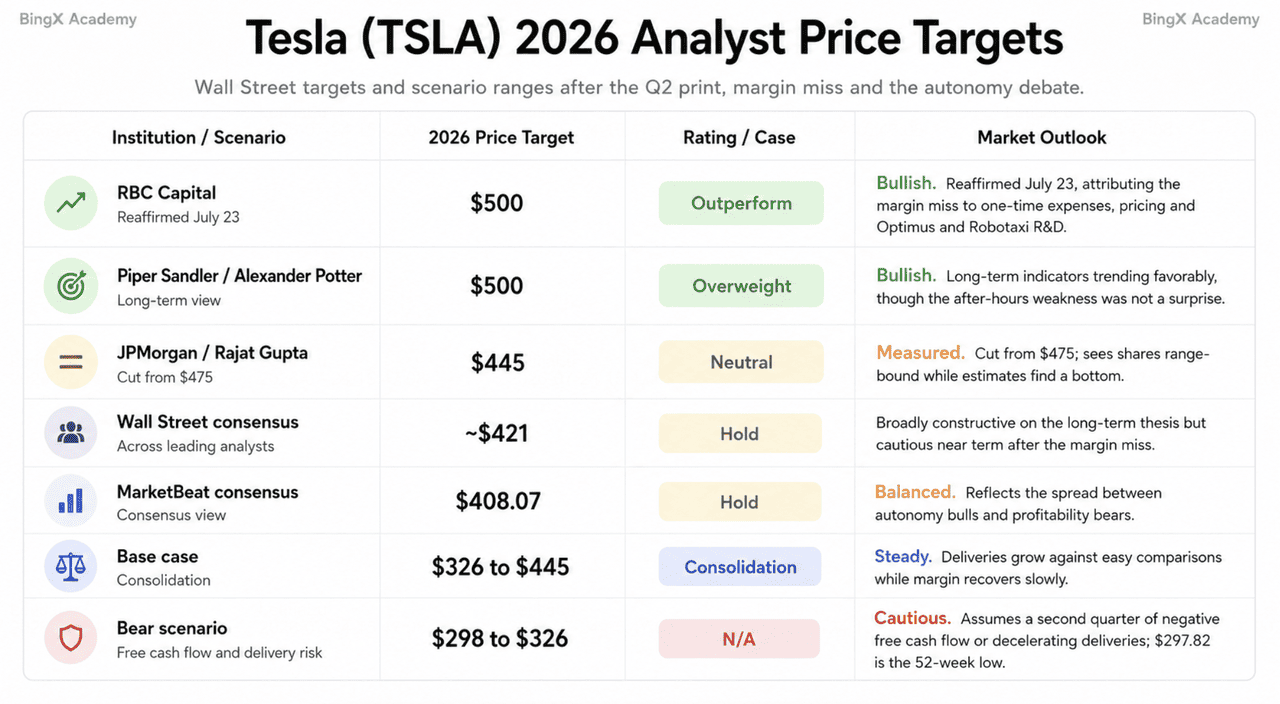
Wall Street cut targets broadly after the print while largely keeping constructive ratings, a pattern that reflects analysts lowering near-term estimates without abandoning the autonomy thesis. The consensus sits near $421 against a stock at $325.60, and ratings run roughly 23 Buy, 18 Hold and 6 Sell across 26 to 47 analysts with a Hold consensus.
|
Institution |
2026 Price Target |
Rating |
Market Outlook |
|
RBC Capital |
$500 |
Outperform |
Bullish. Reaffirmed July 23, attributing the margin miss to one-time expenses, pricing and Optimus and Robotaxi R&D. |
|
Piper Sandler / Alexander Potter |
$500 |
Overweight |
Bullish. Long-term indicators trending favorably, though the after-hours weakness was not a surprise. |
|
JPMorgan / Rajat Gupta |
$445 |
Neutral |
Measured. Cut from $475; sees shares range-bound while estimates find a bottom. |
|
Wall Street consensus |
~$421 |
Hold |
Broadly constructive on the long-term thesis but cautious near term after the margin miss. |
|
MarketBeat consensus |
$408.07 |
Hold |
Balanced. Reflects the spread between autonomy bulls and profitability bears. |
|
Base case |
$326 to $445 |
Consolidation |
Steady. Deliveries grow against easy comparisons while margin recovers slowly. |
|
Bear scenario |
$298 to $326 |
N/A |
Cautious. Assumes a second quarter of negative free cash flow or decelerating deliveries; $297.82 is the 52-week low. |
How to Trade Tesla (TSLA) Stock on BingX
Navigate the volatility of Tesla's earnings cycle using BingX TradFi and BingX AI tools. By leveraging AI-driven predictive analytics, you can better anticipate market sentiment shifts and price action around quarterly releases. BingX offers two routes to TSLA exposure: tokenized stock for direct spot ownership, and perpetual futures for leveraged long or short positions.
Spot Trading: Buy and Own TSLA Tokenized Stocks Directly
Spot trading is the most straightforward way to gain Tesla exposure on BingX. When users buy tokenized TSLA on the spot market, they hold the asset directly in their BingX spot account, with no leverage, no funding costs and no liquidation risk.
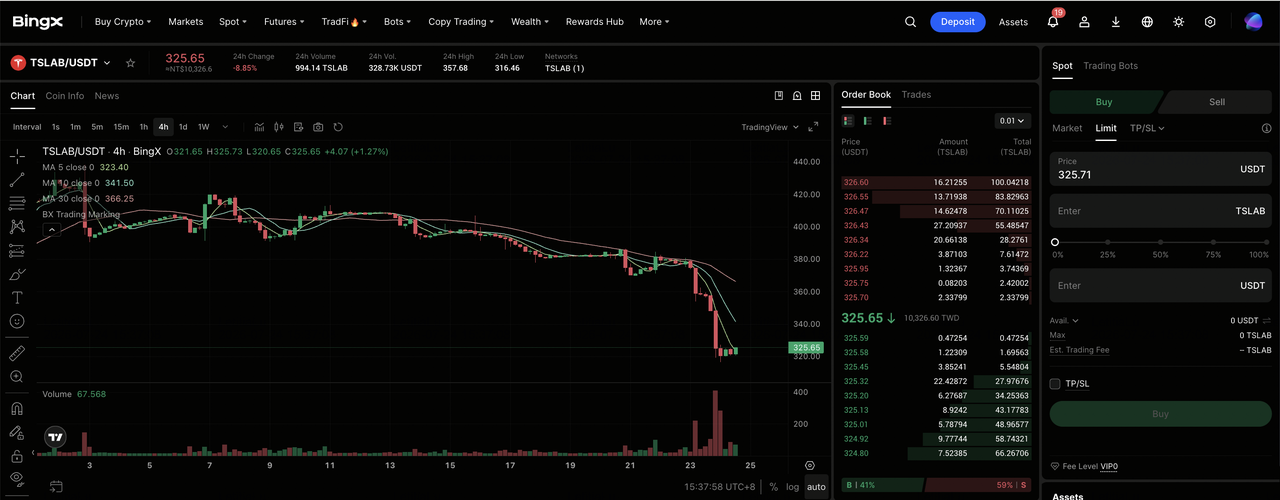
Step 1: Account setup and security. Sign up and log into your BingX account, complete the identity verification (KYC) required in your region, and enable two-factor authentication.
Step 2: Fund your spot account. Deposit USDT or another supported asset into your BingX spot account. Where available, users can also use supported fiat on-ramp options.
Step 3: Navigate to the spot market. Search for the TSLAB/USDT trading pair.
Step 4: Place your order. Choose a market order to buy tokenized TSLA immediately at the current price, or use a limit order to set the price you want to pay. Because Tesla fell 12.9% in a single session on July 23, a limit order lets you define your entry rather than chase a post-earnings move.
Step 5: Manage your position. Once filled, your tokenized TSLA appears in your spot account, where it tracks the underlying share price. Spot positions carry no liquidation risk, which makes them suitable for holding through an earnings release.
Futures Trading: Long or Short TSLA on BingX TradFi
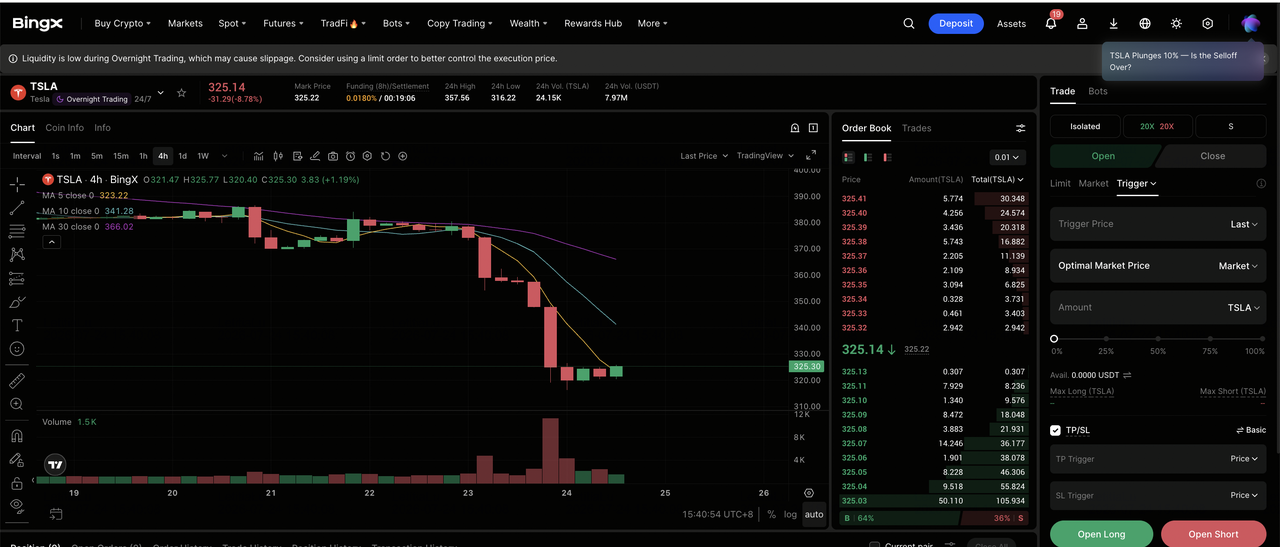
Step 1: Access BingX TradFi. Sign up and navigate to the specialized TradFi section on the main BingX exchange dashboard.
Step 2: Select Tesla (TSLA). Search for and select the TSLA-USDT perpetual futures contract.
Step 3: Choose your direction. Select Open Long if you expect Robotaxi and Cybercab to scale, Optimus to reach production, and automotive gross margin excluding credits to keep improving from 16.3%. Select Open Short if you expect operating expenses to keep outgrowing revenue, free cash flow to stay negative, or the market to reprice a 1.4% operating margin.
Step 4: Select leverage and margin mode. Choose Isolated or Cross-Margin based on your risk tolerance. Because Tesla fell 12.9% in a single session on July 23 and has historically fallen on strong quarters and risen on weak ones, conservative leverage and clear position sizing are important.
Step 5: Execute strict risk protocols. Set Take-Profit and Stop-Loss (TP/SL) levels before or immediately after entering the trade. TSLA can react quickly to quarterly delivery reports, earnings and margin disclosures, Robotaxi expansion announcements, Optimus and Cybercab milestones, regulatory decisions on autonomy, and commentary from Elon Musk.
Top 5 Risks to Watch for Tesla Investors in 2026
To navigate the second half of 2026, investors must weigh Tesla's autonomy optionality against these five structural and financial headwinds.
- Operating margin has fallen to 1.4%: Down from 4.1% a year earlier, on record revenue and record deliveries. A company earning almost nothing on its best-ever volume quarter has little cushion if volume flattens.
- Free cash flow has turned negative: A $1.09 billion deficit against a $1.44 billion surplus in Q1, with capital expenditure up 142% and management guiding operating expenditure higher in 2026 and beyond.
- Regulatory credits have largely disappeared: Credit revenue fell to $146 million from $439 million, removing a pure-margin contribution that had supported automotive profitability for years.
- Chinese competition continues to intensify: BYD, Nio and Xiaomi offer affordable, high-technology EVs in markets beyond the United States, and Tesla's 25% delivery growth came partly from an inventory drawdown rather than pure demand.
- The valuation prices businesses that do not yet earn: At roughly 300 times earnings, the multiple assumes Robotaxi, Cybercab and Optimus arrive on schedule. Any delay leaves the price supported by an automotive business at a 1.4% operating margin.
Final Thoughts: Should You Invest in Tesla in 2026?
Following its July 22 report, Tesla is spending aggressively on businesses that have not yet reached meaningful commercial scale. Revenue reached $28.24 billion, deliveries rose to 480,126 for the first year-over-year increase in two years, services revenue grew 50% at record margins, and trailing 12-month revenue crossed $100 billion. The debate is whether a 1.4% operating margin and negative free cash flow reflect temporary investment or a structurally weaker earnings profile.
The bull case is that Cybercab, Robotaxi, Optimus, Semi, and Megapack 3 are advancing together, while automotive gross margin excluding credits improved to 16.3%, suggesting the core vehicle business remains sound. The bear case is that operating expenses rose 47% against 26% revenue growth, costs are set to remain elevated, and a valuation near 300 times earnings leaves little room for delays. Investors confident in Tesla’s autonomy and robotics timeline may see the current price as justified, while more cautious traders may wait for a quarter showing both delivery growth and positive free cash flow.
Risk Reminder: Trading and investing in equities like TSLA involves a high risk of capital loss. Tesla is exposed to EV demand cycles, competitive pricing pressure, autonomy regulation, commodity and interest rate costs, and headline risk from its chief executive, any of which can move the stock independently of its earnings. Conduct independent research before allocating capital.
Related Reading
- Top Space Stocks to Buy Ahead of SpaceX IPO
- SpaceX (SPCX) Price Prediction 2026: $227 Street-High AI Fusion or Trillion-Dollar Valuation Bubble?
- Apple (AAPL) Stock Outlook for 2026: MacBook Neo Growth or AI Valuation Trap?
- Firefly Aerospace Stock Outlook 2026: Can Launch Vehicles, Spacecraft Services Drive FLY to $45+?
- GE Aerospace (GE) Price Prediction 2026: Can the $190B Backlog Defy Valuation Fears?
- Rocket Lab Stock Forecast 2026: Can RKLB's Space Infrastructure Play Break $150 After Its 400% Run?
