

Microsoft (MSFT) reported fiscal fourth-quarter results on July 29 that broke the earnings-season pattern decisively. Where Alphabet, Meta and Tesla fell on spending fears, Microsoft rose about 15.5% the next session, the largest single-day market value increase in stock market history, adding roughly $450 billion and trading near $427. Quarterly revenue reached $90 billion, up 18% and ahead of the roughly $87.7 billion consensus, with EPS of $4.74 against a $4.25 estimate.
The catalyst was Azure. Cloud growth accelerated to 43% for the quarter, crossed $100 billion in annual revenue for the first time, and management guided Azure to 45% growth in the current quarter, above the Street. Critically, quarterly capital expenditure of about $41 billion came in below the roughly $42 billion analysts feared, so Microsoft delivered accelerating cloud growth while spending slightly less than expected. After a year in which MSFT had fallen 29% from its high on the same AI-spending anxiety that hit its peers, the report resolved the central bear concern: the capacity is producing visible revenue.
The MSFT stock forecast for 2026 now centers on two competing views:
- The monetization case: Bulls expect Azure at 43% accelerating to 45%, Microsoft 365 Copilot above 30 million seats, a record $678 billion commercial backlog, and demand exceeding capacity to prove the AI investment is converting to revenue faster than at any peer, with targets running to $650.
- The spending case: Bears see FY2027 capex guided to roughly $255 billion to $260 billion, a 35% increase, operating margins guided slightly lower, and a valuation that has already re-rated on the single-day surge.
This guide breaks down the MSFT stock forecast, 2026 price scenarios, key risks, and research from Citi, Wells Fargo, Bernstein, Piper Sandler and Barclays, drawing on the July 29 earnings release and the Q4 investor call, plus how to trade MSFT stock futures on BingX TradFi with USDT collateral.
Top 5 Things for Microsoft Investors to Know in July 2026
- Revenue of $90 billion beat with EPS of $4.74: Revenue rose 18% year over year against a roughly $87.7 billion consensus, and EPS of $4.74 beat the $4.25 estimate, up from $3.65 a year earlier. Full-year revenue surpassed $331 billion, up 18%.
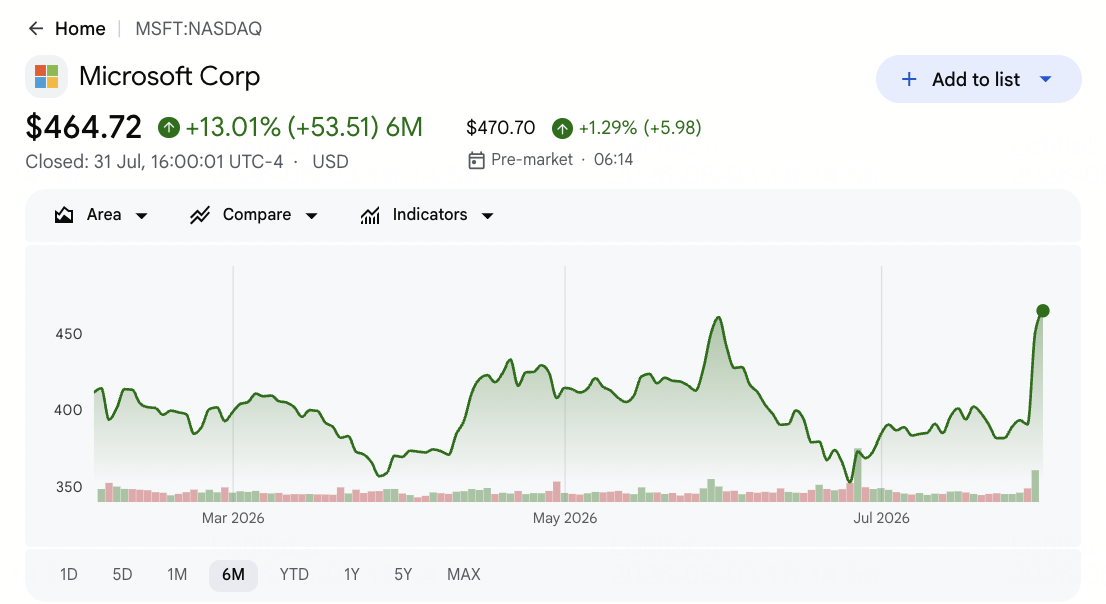
- The stock rose 15.5%, a record single-day value gain: Shares jumped to near $427, adding roughly $450 billion in market value, the largest single-day increase in stock market history, reversing much of a 29% decline from the prior high.
- Azure crossed $100 billion and accelerated to 43%: Azure grew 43% for the quarter, surpassed $100 billion in annual revenue for the first time at 41% full-year growth, and is guided to 45% in the current quarter, above the Street.
- Capex came in below the feared level: Quarterly capital expenditure of about $41 billion undershot the roughly $42 billion analysts expected, making Microsoft's spending discipline the clearest reward of earnings season against peers who were punished for raising spend.
- The backlog and Copilot scaled sharply: Commercial remaining performance obligation grew 84% to $678 billion, Microsoft 365 Copilot passed 30 million paid seats from 20 million in April, and GitHub Copilot reached 50 million users.
What Is Microsoft (MSFT)?
Microsoft is a diversified technology company and one of the two largest by market capitalization, operating across cloud infrastructure, enterprise software, productivity applications and consumer computing. It reports in three segments: Intelligent Cloud, Productivity and Business Processes, and More Personal Computing.
Intelligent Cloud, at $39.3 billion in the quarter and up 32%, houses Azure, the growth engine and the number Wall Street watches above all others. Azure has become the commercial backbone of the AI era, serving as primary infrastructure for OpenAI's products and for enterprise AI workloads, which is why 43% growth and the crossing of $100 billion in annual revenue moved the stock so violently. Productivity and Business Processes, at $37.8 billion and up 14%, covers Office, Dynamics and LinkedIn, and is where Microsoft 365 Copilot monetizes AI across more than 30 million paid seats. More Personal Computing, at $12.9 billion, covers Windows, devices, gaming and search, and faces a high-teens FY2027 revenue decline on weak PC demand and higher component costs. Under CEO Satya Nadella, the AI strategy spans model choice, enterprise data protection and the Copilot family, with GitHub Copilot at 50 million users. Cash flow from operations reached $55.4 billion, up 30%, and free cash flow was $19.6 billion, funding a capital programme that management frames as demand-constrained rather than speculative.
Read more: What Is Ondo's Microsoft Tokenized Stock (MSFTON) and How to Buy It?
Microsoft (MSFT) Q4 2026 Earnings: What Drove the Record One-Day Surge
- Azure acceleration resolved the bear case. Cloud growth of 43% for the quarter, up from 40% the prior quarter, with a 45% guide ahead, was the single most important number and the direct reason the stock surged.
- Azure crossed a symbolic threshold. Passing $100 billion in annual revenue for the first time, at 41% full-year growth, confirmed that AI capacity is translating into revenue at scale rather than sitting idle.
- Capex discipline was rewarded. At about $41 billion, quarterly spending came in below the feared $42 billion, so Microsoft grew cloud faster while spending less than expected, the opposite of the Alphabet and Meta setups.
- The backlog signalled durable demand. Commercial remaining performance obligation grew 84% to $678 billion, giving investors visibility into revenue that the capex is contracted against.
- Copilot monetization scaled. Microsoft 365 Copilot passed 30 million paid seats and GitHub Copilot reached 50 million users, evidence that AI is being sold into the productivity base, not just the cloud.
Read more: Microsoft (MSFT) Q4 2026 Earnings News: 43% Azure Growth Drives a 15.51% Price Rally
Microsoft Q4 2026 Financial and Consensus Profile: Revenue, EPS and Azure
Microsoft's Q4 print beat across the board and paired accelerating cloud growth with spending restraint, the combination the market had been waiting all season to see from a hyperscaler.
|
Financial Metric |
Consensus Estimate |
Reported / Actual |
Surprise |
|
Q4 2026 Revenue |
~$87.7 billion |
$90 billion |
Beat; up 18% year over year |
|
Q4 2026 EPS |
~$4.25 |
$4.74 |
Beat; up from $3.65, +23% adjusted for the OpenAI investment impact |
|
Q4 2026 Azure Growth |
~39% to 40% |
43% |
Above guidance; 45% guided for the current quarter |
|
FY2026 Azure Revenue |
— |
Over $100 billion |
First time; up 41% for the full year |
|
Q4 2026 Intelligent Cloud |
~$38.16 billion |
$39.3 billion |
Beat; up 32% year over year |
|
Q4 2026 Productivity & Business |
~$37.19 billion |
$37.8 billion |
Beat; up 14%; Copilot above 30 million seats |
|
Q4 2026 Capital Expenditure |
~$42 billion |
~$41 billion |
Below the feared level; rewarded by the market |
|
Q4 2026 Free Cash Flow |
— |
$19.6 billion |
Operating cash flow $55.4 billion, up 30% |
|
Commercial RPO |
— |
$678 billion |
Up 84%; contracted backlog behind the capex |
For context, Microsoft had beaten estimates for four straight quarters entering this print but traded 29% below its record high on AI-spending anxiety. Fiscal Q1 2027 revenue guidance of $89.85 billion to $90.95 billion topped Street models, and management guided Azure to 45% constant-currency growth. The counterweight sits in the outlook: FY2027 capital expenditure is guided to roughly $255 billion to $260 billion, up about 35% from FY2026's $190 billion, operating margins are expected to decline slightly on AI infrastructure and R&D investment, and Windows OEM and Devices revenue is guided to a high-teens FY2027 decline on weak PC demand and higher component costs. Full-year operating income rose 21% to more than $155 billion.
Read More: Top AI Hyperscaler Stocks to Watch in 2026: The $700 Billion Cloud Infrastructure Race
Microsoft (MSFT) 2026 Investment Outlook: $650 Bull Case vs. $512 Bear Case
Microsoft's outlook for the rest of 2026 depends on one central question: whether Azure can sustain low-40s growth to justify a FY2027 capex bill 35% larger than the year that just proved the model works.
The Bull Case: Azure Growth Pushes MSFT Toward $650
The bull case is that Microsoft answered the market’s main concern by combining 43% Azure growth with capex below expectations. AI investment produced visible cloud growth without weakening consolidated earnings, while operating income rose 21% for the year and backlog reached $678 billion.
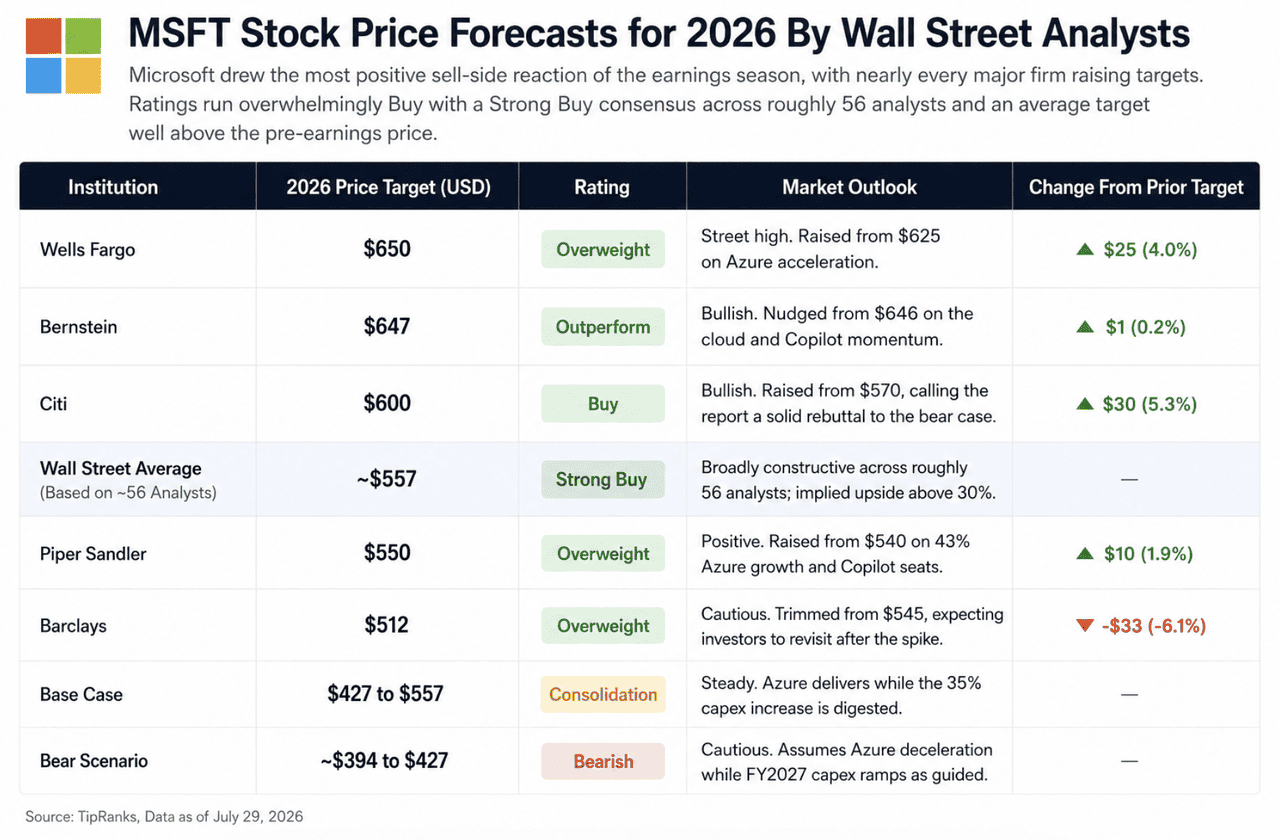
This scenario requires Azure to stay near the guided 45%. Wells Fargo raised its target to $650, Bernstein to $647, Citi to $600, and Piper Sandler to $550. With Copilot above 30 million seats, GitHub Copilot at 50 million users, and demand still exceeding capacity, Microsoft has one of the clearest AI monetization stories among hyperscalers.
The Base Case: Strong Earnings Keep MSFT Between $427 and $557
In the base case, Microsoft delivers Azure growth near guidance but the stock pauses after its 15.5% post-earnings surge. Fiscal Q1 2027 lands within guidance, Azure stays in the low-to-mid 40s, and investors weigh strong execution against a 35% capex increase.
Barclays cut its target to $512 while keeping an Overweight rating, arguing the shares may consolidate after the spike. Slightly lower FY2027 margins and weakness in More Personal Computing could keep MSFT between roughly $427 and $557 while the market evaluates returns on the next spending cycle.
The Bear Case: Rising Capex Pulls MSFT Toward $394
The bear case is that FY2027 capex grows faster than Azure revenue. Spending is expected to reach roughly $255 billion to $260 billion, up 35%, while operating margins are guided slightly lower.
The main trigger would be Azure growth missing expectations as capex continues to rise. Capacity limits, Windows weakness, higher component costs, and elevated post-rally expectations could amplify the reaction. Under that scenario, MSFT could retrace toward $394 and its 50-day moving average.
MSFT Stock Price Forecasts for 2026 By Wall Street Analysts
Microsoft drew the most positive sell-side reaction of the earnings season, with nearly every major firm raising targets. Ratings run overwhelmingly Buy with a Strong Buy consensus across roughly 56 analysts and an average target well above the pre-earnings price.
|
Institution |
2026 Price Target |
Rating |
Market Outlook |
|
Wells Fargo |
$650 |
Overweight |
Street high. Raised from $625 on Azure acceleration. |
|
Bernstein |
$647 |
Outperform |
Bullish. Nudged from $646 on the cloud and Copilot momentum. |
|
Citi |
$600 |
Buy |
Bullish. Raised from $570, calling the report a solid rebuttal to the bear case. |
|
Wall Street average |
~$557 |
Strong Buy |
Broadly constructive across roughly 56 analysts; implied upside above 30%. |
|
Piper Sandler |
$550 |
Overweight |
Positive. Raised from $540 on 43% Azure growth and Copilot seats. |
|
Barclays |
$512 |
Overweight |
Cautious. Trimmed from $545, expecting investors to revisit after the spike. |
|
Base case |
$427 to $557 |
Consolidation |
Steady. Azure delivers while the 35% capex increase is digested. |
|
Bear scenario |
~$394 to $427 |
N/A |
Cautious. Assumes Azure deceleration while FY2027 capex ramps as guided. |
How to Trade Microsoft (MSFT) Stock on BingX
Navigate the volatility of Microsoft's earnings cycle using BingX TradFi and BingX AI tools. By leveraging AI-driven predictive analytics, you can better anticipate market sentiment shifts and price action around quarterly releases. BingX offers two routes to MSFT exposure: tokenized stock for direct spot ownership, and perpetual futures for leveraged long or short positions.
Spot Trading: Buy and Own Tokenized MSFT Directly
Spot trading is the most straightforward way to gain Microsoft exposure on BingX. When users buy tokenized MSFT on the spot market, they hold the asset directly in their BingX spot account, with no leverage, no funding costs and no liquidation risk.
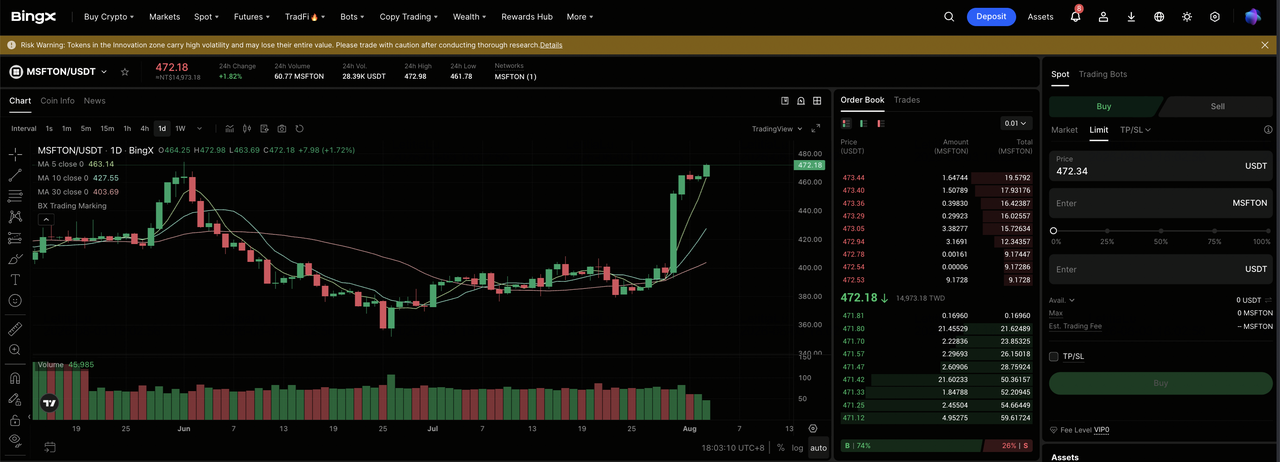
Step 1: Account setup and security. Sign up and log into your BingX account, complete the identity verification (KYC) required in your region, and enable two-factor authentication.
Step 2: Fund your spot account. Deposit USDT or another supported asset into your BingX spot account. Where available, users can also use supported fiat on-ramp options.
Step 3: Navigate to the spot market. Search for the MSFTON/USDT trading pair.
Step 4: Place your order. Choose a market order to buy tokenized MSFT immediately at the current price, or use a limit order to set the price you want to pay. Because Microsoft rose more than 15% in a single session on the Azure beat, a limit order lets you define your entry rather than chase a post-earnings move.
Step 5: Manage your position. Once filled, your tokenized MSFT appears in your spot account, where it tracks the underlying share price. Spot positions carry no liquidation risk, which makes them suitable for holding through an earnings release.
Futures Trading: Long or Short MSFT on BingX TradFi
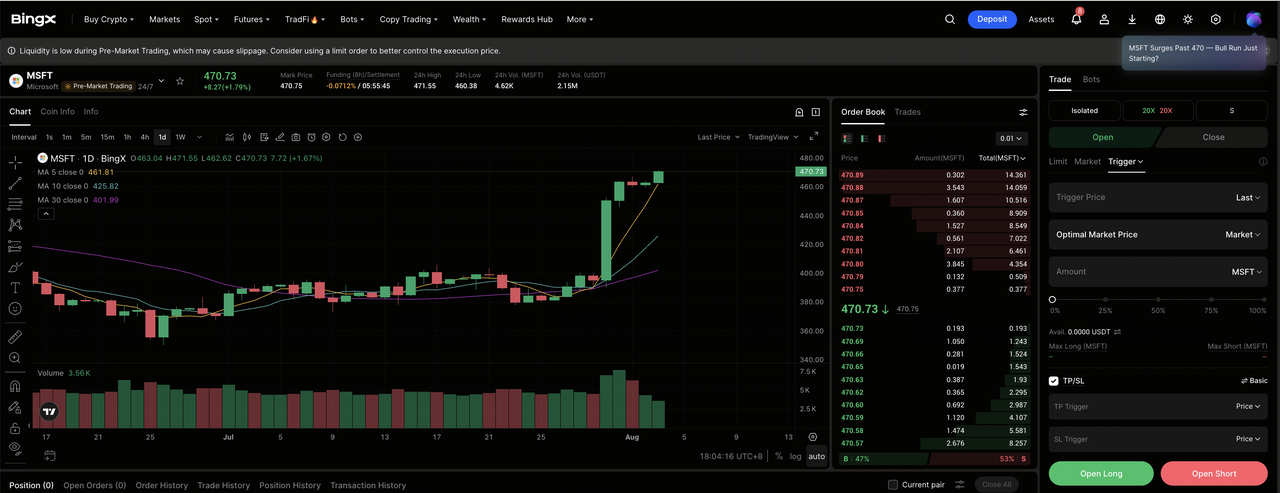
Step 1: Access BingX TradFi. Sign up and navigate to the specialized TradFi section on the main BingX exchange dashboard.
Step 2: Select Microsoft (MSFT). Search for and select the MSFT-USDT perpetual futures contract.
Step 3: Choose your direction. Select Open Long if you expect Azure to hold near the guided 45%, Copilot monetization to keep scaling, and the $678 billion backlog to validate the capex. Select Open Short if you expect FY2027 capex near $255 billion to outrun cloud growth, margins to compress, or the stock to give back part of its record surge.
Step 4: Select leverage and margin mode. Choose Isolated or Cross-Margin based on your risk tolerance. Because Microsoft posted the largest single-day value gain in market history and carries elevated expectations into every subsequent print, conservative leverage and clear position sizing are important.
Step 5: Execute strict risk protocols. Set Take-Profit and Stop-Loss (TP/SL) levels before or immediately after entering the trade. MSFT can react quickly to Azure growth disclosures, capital expenditure guidance, Copilot seat updates, commercial backlog changes, OpenAI partnership developments, and enterprise IT spending trends.
Top 5 Risks to Watch for Microsoft Investors in 2026
To navigate the rest of 2026, investors must weigh Microsoft's Azure momentum against these five structural and financial headwinds.
- FY2027 capex is guided up 35%: Roughly $255 billion to $260 billion against $190 billion in FY2026. That spending followed a 29% drawdown driven by exactly this anxiety, and the market will re-examine it every quarter.
- Operating margins are guided lower: Management expects FY2027 operating margins to decline slightly on AI infrastructure and R&D investment, so the spending has a visible earnings cost even if Azure holds.
- Azure capacity constraints cut both ways: Demand exceeding capacity supports the demand-led capex narrative but also means supply limits could cap near-term Azure growth regardless of appetite.
- The consumer segment is shrinking: Windows OEM and Devices revenue is guided to a high-teens FY2027 decline on weak PC demand and higher component costs, a persistent drag on More Personal Computing.
- Expectations are now extreme: After the largest single-day gain in market history, the bar for every future print is elevated, leaving little room for an Azure number that merely meets rather than beats.
Final Thoughts: Should You Invest in Microsoft in 2026?
Microsoft after the July 29 report is the earnings season's clearest winner, the one hyperscaler that proved its AI spending is producing revenue rather than just consuming cash. Revenue of $90 billion, EPS of $4.74, Azure at 43% crossing $100 billion, capex below the feared level, a $678 billion backlog and Copilot above 30 million seats are not in dispute. What is in dispute is whether a FY2027 capex bill 35% larger, against slightly lower guided margins, can be justified even by low-40s Azure growth.
The bull case is that this quarter answered the exact question that had held the stock down 29%, that demand exceeds capacity, and that Microsoft has the broadest AI monetization of any peer through Azure, Copilot and the OpenAI relationship. The bear case, voiced by Barclays alone against a wall of raised targets, is that a record one-day surge sets an extreme bar and that $255 billion of FY2027 spending must be re-earned every quarter. Investors who believe Azure sustains the mid-40s may find Microsoft the highest-quality expression of the AI infrastructure trade. More conservative traders might wait for the first FY2027 quarter to confirm Azure holds while capex ramps, using the $427 post-earnings level as support and the cluster near $557 as the near-term ceiling.
Risk Reminder: Trading and investing in equities like MSFT involves a high risk of capital loss. Microsoft is exposed to AI capital spending risk, Azure growth deceleration, margin compression and PC market weakness, any of which can move the stock independently of its earnings. Conduct independent research before allocating capital.
Related Reading
- Alphabet (GOOGL) Price Prediction 2026: Can 82% Cloud Growth and AI Push GOOGL Stock to $430?
- Amazon (AMZN) Stock Price Prediction 2026: Can AWS AI Re-acceleration Offset a $200B CapEx Gamble?
- Meta (META) Stock Price Prediction 2026: Can AI Efficiency and Custom Silicon Drive META to $900?
- Nvidia (NVDA) Stock Price Outlook for 2026: Can Blackwell and Vera Rubin Take NVDA Back to $300?
- Apple (AAPL) Stock Outlook for 2026: MacBook Neo Growth or AI Valuation Trap?
- TSMC (TSM) Price Prediction 2026: Can Record AI Demand Lift TSM Stock to $527?
