

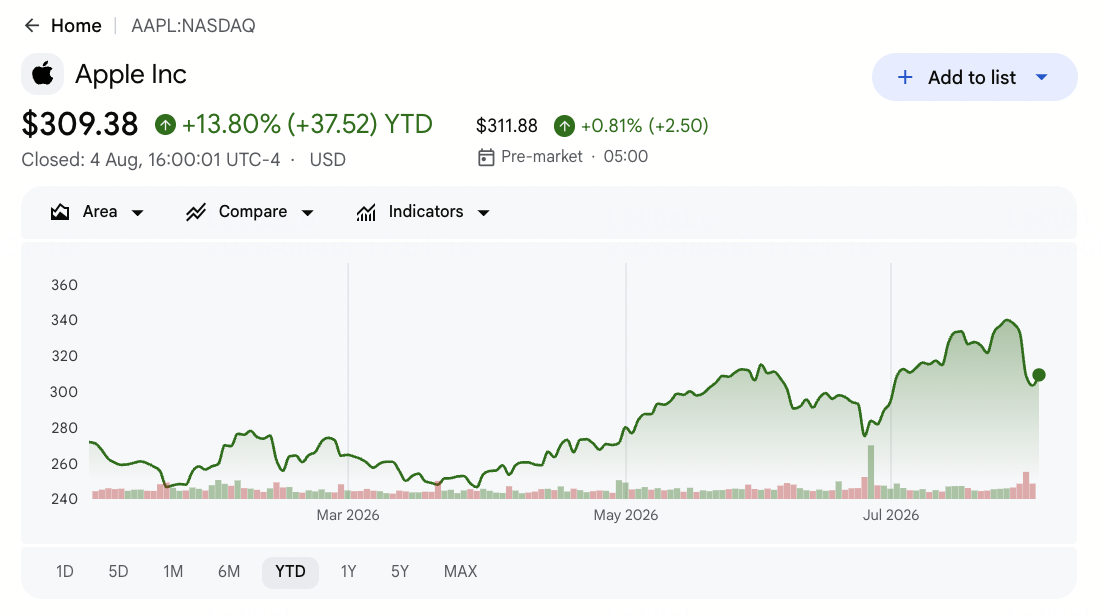
Apple (AAPL) entered August 2026 after one of the sharpest reactions to a record quarter in its recent history. On July 30, the company reported fiscal third-quarter revenue of $109.4 billion and diluted EPS of $2.02, both above expectations and its strongest June quarter ever, then guided September-quarter revenue growth to 9% to 11% while citing supply constraints on iPhone, Mac and iPad. AAPL shares fell about 9% after the print, pulling back from an all-time high above $340 reached in late July when the company briefly reclaimed a $5 trillion market value.
The results were not the problem. Revenue rose 16% with double-digit growth in every geographic segment, iPhone revenue grew 22% to a June-quarter record of $54.3 billion, and net income reached $29.8 billion. What unsettled the market was the forward look. Management flagged significant supply constraints on the advanced nodes used for its own chips, warned of exceptionally higher memory costs, and pointed to a 2.5 percentage point foreign exchange headwind, all of which pressure the September quarter at a moment when the stock had already gained more than 20% year to date.
The AAPL stock forecast for 2026 now centers on two competing views:
- The ecosystem case: Bulls expect the iPhone 17 cycle, a $1.5 billion paid-subscription base, Siri AI monetization and a widely anticipated foldable iPhone to sustain growth, with analyst targets running as high as $400.
- The cost and maturity case: Bears see slowing hardware growth, a services line that missed expectations, rising component costs and a valuation near 35 times forward earnings that leaves limited room for a guidance disappointment.
This guide breaks down the AAPL stock forecast, 2026 price scenarios, key risks, and research from TD Cowen, KeyBanc and the broader Street, drawing on the July 30 earnings release and the fiscal Q3 investor call, plus how to trade AAPL stock futures on BingX TradFi with USDT collateral.
Top 5 Things for Apple Investors to Know in July 2026
- June-quarter revenue of $109.4 billion set an all-time June record: Revenue grew 16% year over year and beat the roughly $108.7 billion consensus, with diluted EPS of $2.02 up 29% and ahead of the $1.89 estimate, extending a streak of 13 straight quarters topping expectations.
- iPhone growth of 22% carried the quarter: iPhone revenue reached a June-quarter record of $54.3 billion, ahead of estimates, driven by the iPhone 17 family and market share gains, while Mac revenue of $10.35 billion also beat.
- Services missed and China stayed mixed: Services revenue of $30.74 billion grew year over year but fell short of the $31.22 billion expected, and while Greater China revenue rose to $18.8 billion, the segment remained a swing factor in the reaction.
- September guidance implies deceleration on supply constraints: Management guided revenue growth of 9% to 11%, citing supply constraints on iPhone, Mac and iPad and a 2.5 point FX headwind, with gross margin guided to 47% to 48%.
- Analyst targets run from cautious to a Street-high $400: TD Cowen raised its target to a Street-high $400 while KeyBanc turned cautious after the print, against a broad consensus that clusters near $310 to $335.
What Is Apple Inc (AAPL)?
Apple Inc is a global technology company headquartered in Cupertino, California, and briefly the world's most valuable company at a near $5 trillion valuation. It designs and sells iPhone, Mac, iPad, Apple Watch and a growing services portfolio, supported by an installed base of more than 2.5 billion active devices and over 1.5 billion paid subscriptions, an all-time high.
The business has two engines. Products cover iPhone, Mac, iPad and Wearables, with iPhone alone contributing $54.3 billion in the June quarter. Services covers the App Store, advertising, iCloud, Apple Pay, AppleCare and licensing, a recurring high-margin stream that reached $30.74 billion in the quarter. Apple's strategy has centered on a capital-light approach to artificial intelligence, keeping capital expenditure near 2% of revenue while integrating AI features across its devices, including the new Siri AI introduced at WWDC 2026. The company also announced a new multi-year agreement with Broadcom expected to exceed $30 billion as part of its largest-ever American manufacturing commitment. Capital returns remain substantial, with $33 billion returned to shareholders in the quarter through $25.8 billion of buybacks and $4 billion of dividends, alongside a $0.27 quarterly dividend.
Apple (AAPL) Q3 2026 Earnings: What Drove the Record and the Sell-Off
- iPhone demand exceeded expectations. iPhone revenue grew 22% to $54.3 billion on strong iPhone 17 demand, the single largest reason revenue cleared the consensus estimate.
- Services growth slowed relative to the Street. Services reached $30.74 billion but missed the $31.22 billion analysts expected, raising questions about the pace of Apple's highest-margin segment.
- Guidance pointed to supply, not demand, as the constraint. Management guided September-quarter growth of 9% to 11% and described supply constraints on advanced chips and memory as the limiting factor, with demand running ahead of what the supply chain can meet.
- Memory costs emerged as an explicit headwind. Apple flagged sharply rising memory costs, a dynamic that has already pushed the company to raise prices on Macs and iPads and lengthen delivery times on some hardware.
- Research spending stepped up sharply. Research and development rose 32% to $11.7 billion as Apple expanded work across AI, custom silicon, software and new device categories, lifting operating expenses to $19.1 billion.
Read More: Apple (AAPL) Q3 2026 Earnings Overview: Softer 9% to 11% Growth Outlook Triggers a 7.35% Selloff
Apple Q3 2026 Financial and Consensus Profile: Revenue, EPS and Margins
Apple's June-quarter print showed a company beating on revenue and earnings while guiding to a slower, supply-constrained September quarter. The gap between the record result and the 9% share-price drop is the central fact of the quarter, and it placed the burden on component supply and margins rather than on demand.
|
Financial Metric |
Guidance / Consensus |
Reported / Actual |
Surprise |
|
Q3 2026 Revenue |
~$108.7 billion consensus |
$109.42 billion |
Beat; up 16% year over year |
|
Q3 2026 Diluted EPS |
~$1.89 consensus |
$2.02 |
Beat; up 29% year over year |
|
Q3 2026 iPhone Revenue |
~$53.9 billion expected |
$54.25 billion |
Beat; up 22% year over year |
|
Q3 2026 Mac Revenue |
~$8.74 billion expected |
$10.35 billion |
Well above expectations |
|
Q3 2026 iPad Revenue |
~$6.92 billion expected |
$6.19 billion |
Below expectations |
|
Q3 2026 Services Revenue |
~$31.22 billion expected |
$30.74 billion |
Missed |
|
Q3 2026 Net Income |
— |
$29.8 billion |
Up from $23.4 billion a year ago |
|
Q3 2026 Gross Margin |
— |
50.1% (with tariff refund benefit) |
Above the 47%-48% guide |
|
Q4 2026 Revenue Guidance |
— |
+9% to +11% growth |
Decelerates on supply constraints |
|
Q4 2026 Gross Margin Guidance |
— |
47% to 48% |
Includes one point of tariff-refund benefit |
For context, Apple returned $33 billion to shareholders in the quarter and generated roughly $117 billion of operating cash flow across the first nine months of fiscal 2026, up from $81.8 billion a year earlier. Cash and marketable securities ended at $147 billion against total debt of $84 billion. The company reclaimed the title of most valuable public company at a near $5 trillion valuation before the post-earnings pullback.
Apple (AAPL) 2026 Investment Outlook: $400 Bull Case vs. $300 Bear Case
Apple's outlook for the rest of 2026 depends on one central question: whether the memory and chip supply squeeze is a temporary constraint on a healthy demand cycle or the start of sustained margin pressure on a maturing hardware business.
The Bull Case: Siri AI and a Foldable iPhone Push AAPL Toward $400
The bull case rests on the durability of the ecosystem. iPhone grew 22%, every geographic segment set a record, the installed base crossed 2.5 billion devices, and paid subscriptions passed 1.5 billion. That breadth suggests demand is strong enough that supply, not appetite, is the limiting factor into the second half.
This scenario requires the memory and chip constraints to ease so Apple can convert demand into shipments. TD Cowen raised its target to a Street-high $400 following the print, and a widely anticipated foldable iPhone later in the year could expand the installed base and lift the high-margin services attach rate. Siri AI monetization, the $30 billion Broadcom manufacturing agreement, and a capital-light AI strategy that keeps capex near 2% of revenue add further support. A move back above the July high near $340 would strengthen the path toward the $400 Street-high target.
The Base Case: Apple Consolidates Between $300 and $340
In the base case, Apple absorbs the supply and cost pressure without a further major de-rating. September-quarter revenue grows within the 9% to 11% guide, gross margin holds inside the 47% to 48% range, and the stock digests a year-to-date gain that reached more than 20% before the pullback.
The buyback provides a floor while the valuation stays elevated. With $25.8 billion of stock repurchased in a single quarter and a $147 billion cash position, steady execution could keep AAPL in the low $300s to mid $330s as the market waits for the September quarter to confirm whether supply constraints ease. A broad consensus near $310 to $335 defines the middle of the range.
The Bear Case: Higher Costs Pull AAPL Toward $300
The bear case is that rising costs and slower growth outweigh Apple’s demand strength. AAPL trades near 35 times forward earnings, leaving limited room for weaker services growth or a margin miss.
The clearest trigger would be another quarter of higher memory and component costs. Apple has already raised some Mac and iPad prices, and further increases could weaken demand as U.S. growth normalizes. With KeyBanc turning cautious and Services growing below expectations, continued cost pressure into the holiday quarter could push AAPL back toward the low $300s.
AAPL Stock Price Forecasts for 2026 By Wall Street Analysts
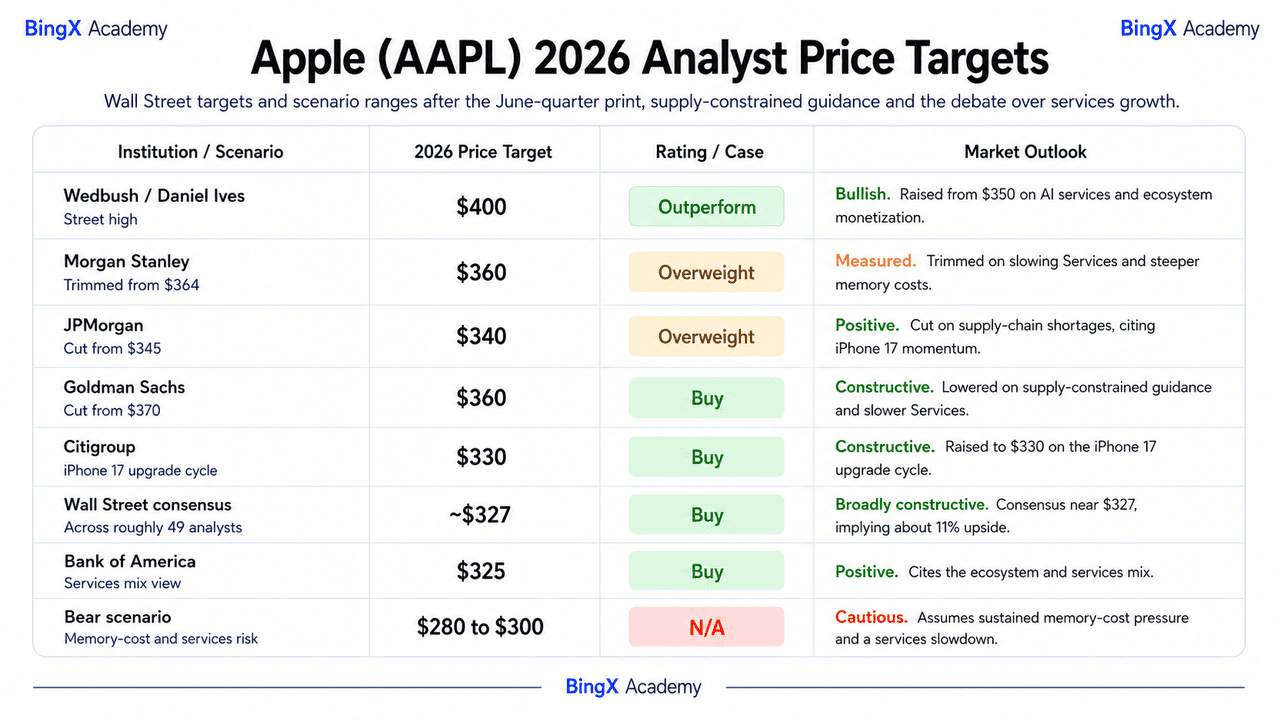
Wall Street stayed broadly positive on Apple after the June-quarter print, though several firms trimmed targets on supply-constrained guidance while the most bullish call moved higher. All of the major analysts covering AAPL carry a Buy or Hold, and the target range spans from a low near $82 to a Street high of $400, with a consensus near $327 across roughly 49 analysts.
|
Institution |
2026 Price Target |
Rating |
Market Outlook |
|
Wedbush / Daniel Ives |
$400 |
Outperform |
Street high. Raised from $350 on AI services and ecosystem monetization. |
|
Goldman Sachs |
$360 |
Buy |
Constructive. Cut from $370 on supply-demand guidance and slower Services. |
|
Morgan Stanley |
$360 |
Overweight |
Measured. Trimmed from $364 on slowing Services and steeper memory costs. |
|
JPMorgan |
$340 |
Overweight |
Positive. Cut from $345 on supply-chain shortages, citing iPhone 17 momentum. |
|
Citigroup |
$330 |
Buy |
Constructive. Raised to $330 on the iPhone 17 upgrade cycle. |
|
Wall Street consensus |
~$327 |
Buy |
Broadly constructive across roughly 49 analysts, +11% to the average target. |
|
Bank of America |
$325 |
Buy |
Positive. Cites the ecosystem and services mix. |
|
Bear scenario |
$280 to $300 |
N/A |
Cautious. Assumes sustained memory-cost pressure and a services slowdown. |
How to Trade Apple Inc (AAPL) Stock on BingX
Navigate the volatility of Apple's earnings cycle using BingX TradFi and BingX AI tools. By leveraging AI-driven predictive analytics, you can better anticipate market sentiment shifts and price action around quarterly releases. BingX offers two routes to AAPL exposure: tokenized stock for direct spot ownership, and perpetual futures for leveraged long or short positions.
Spot Trading: Buy and Own AAPL Tokenized Stocks Directly
Spot trading is the most straightforward way to gain Apple exposure on BingX. When users buy tokenized AAPL on the spot market, they hold the asset directly in their BingX spot account, with no leverage, no funding costs and no liquidation risk.
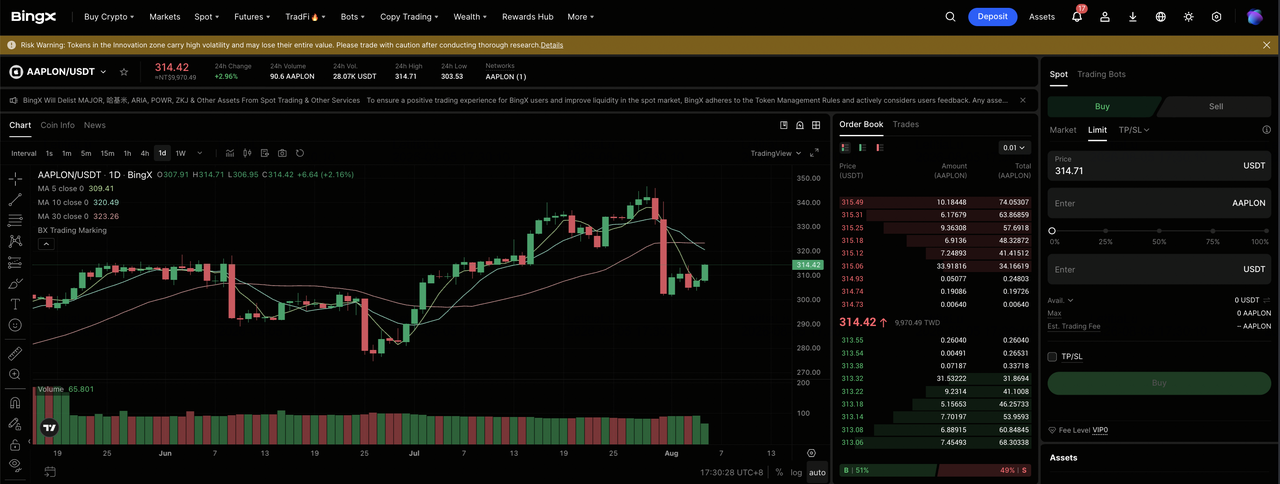
Step 1: Account setup and security. Sign up and log into your BingX account, complete the identity verification (KYC) required in your region, and enable two-factor authentication.
Step 2: Fund your spot account. Deposit USDT or another supported asset into your BingX spot account. Where available, users can also use supported fiat on-ramp options.
Step 3: Navigate to the spot market. Search for the AAPLON/USDT trading pair.
Step 4: Place your order. Choose a market order to buy tokenized AAPL immediately at the current price, or use a limit order to set the price you want to pay. Because Apple fell about 9% on the supply-constrained guidance despite beating on revenue and EPS, a limit order lets you define your entry rather than chase a post-earnings move.
Step 5: Manage your position. Once filled, your tokenized AAPL appears in your spot account, where it tracks the underlying share price. Spot positions carry no liquidation risk, which makes them suitable for holding through an earnings release.
Futures Trading: Long or Short AAPL on BingX TradFi
\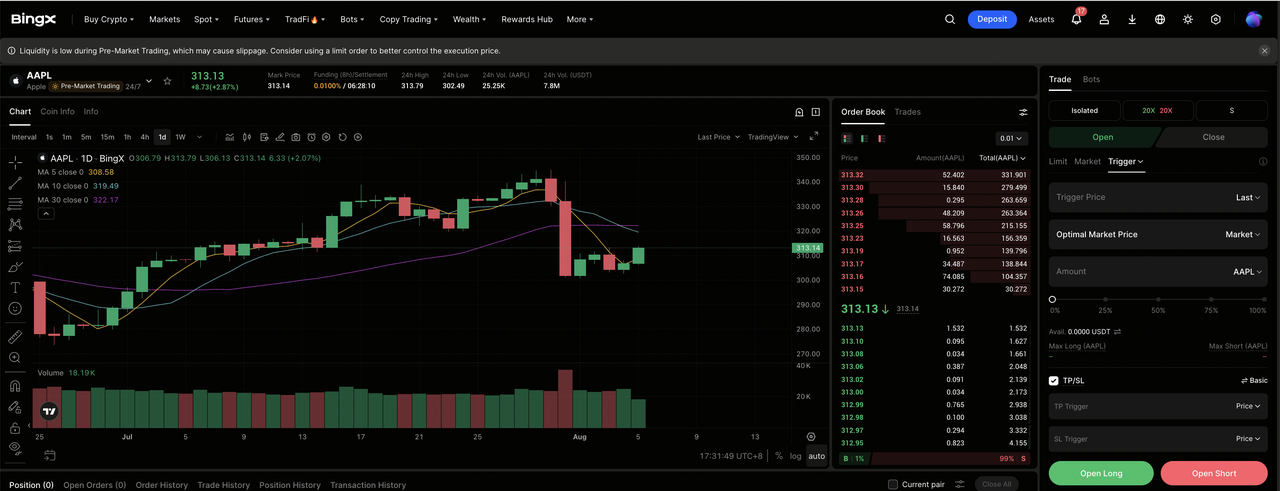
Step 1: Access BingX TradFi. Sign up and navigate to the specialized TradFi section on the main BingX exchange dashboard.
Step 2: Select Apple Inc (AAPL). Search for and select the AAPL-USDT perpetual futures contract.
Step 3: Choose your direction. Select Open Long if you expect the memory and chip supply constraints to ease, the foldable iPhone to expand the installed base, and Siri AI to lift services monetization. Select Open Short if you expect memory costs to keep rising, services growth to slow further, or the market to reprice a 35 times forward multiple.
Step 4: Select leverage and margin mode. Choose Isolated or Cross-Margin based on your risk tolerance. Because AAPL fell about 9% after the June-quarter print despite a revenue and EPS beat, conservative leverage and clear position sizing are important.
Step 5: Execute strict risk protocols. Set Take-Profit and Stop-Loss (TP/SL) levels before or immediately after entering the trade. AAPL can react quickly to quarterly earnings, memory and component pricing headlines, iPhone launch cadence, China demand signals, and regulatory and antitrust developments.
Top 5 Risks to Watch for AAPL Investors in 2026
To navigate the second half of 2026, investors must weigh Apple's ecosystem strength and capital returns against these five structural and macro headwinds.
- Memory and component costs are rising sharply: Apple has flagged exceptionally higher memory costs and has already raised prices on Macs and iPads. If the squeeze persists, gross margin and unit demand both come under pressure.
- Services growth missed and funds much of the profit: Services reached $30.74 billion but fell short of expectations. As the highest-margin segment, any sustained slowdown pressures earnings faster than a hardware miss.
- The valuation leaves little room for error: AAPL trades near 35 times forward earnings, a premium to its history and the market. A guidance miss or margin disappointment could trigger a de-rating regardless of the installed base.
- China remains an unresolved swing factor: Greater China revenue recovered to $18.8 billion, but the region has been a persistent source of volatility tied to competition and macro conditions.
- Growth is normalizing as hardware matures: With September growth guided to 9% to 11% and U.S. growth normalizing, the pace of the overall business is slowing even as investment in AI and new categories rises.
Final Thoughts: Should You Invest in Apple in 2026?
Apple after the July 30 report is a story of a record quarter met with a supply-constrained outlook. A $109.4 billion June quarter, 22% iPhone growth, records in every geographic segment, and $33 billion returned to shareholders are not in dispute. What is in dispute is what an investor should pay for a business whose near-term growth is capped by component supply and rising memory costs rather than by demand.
The bull case is that Apple is a 2.5 billion-device ecosystem with a capital-light AI strategy, a $30 billion U.S. manufacturing agreement, and a foldable iPhone that could expand the installed base and services attach rate. The bear case, held by more cautious analysts while others raised targets, is that near 35 times forward earnings the stock already reflects the ecosystem premium, and that memory costs and a services slowdown would hit margins before they hit the headline. Investors who believe the supply squeeze is temporary may find the post-earnings pullback an entry point. More conservative traders might wait for the September quarter to confirm whether supply eases, using the low $300s as support and the July high near $340 as the level that defines the range.
Risk Reminder: Trading and investing in equities like AAPL involves a high risk of capital loss. Apple is subject to component cost inflation, China demand cycles, antitrust and regulatory scrutiny, and a valuation that amplifies any disappointment. Conduct independent research before allocating capital.
Related Reading
- TSMC (TSM) Price Prediction 2026: Can Record AI Demand Lift TSM Stock to $527?
- Alphabet (GOOGL) Price Prediction 2026: Can 82% Cloud Growth and AI Push GOOGL Stock to $430?
- Microsoft (MSFT) Stock Outlook for 2026: Can Azure AI and Copilot Growth Drive MSFT Stock to $550+?
- Nvidia (NVDA) Stock Price Outlook for 2026: Can Blackwell and Vera Rubin Take NVDA Back to $300?
- Micron Stock Price Prediction 2026: $1,500 AI Supercycle or Peak Margin Cyclical Trap?
- Amazon (AMZN) Stock Price Prediction 2026: Can AWS AI Re-acceleration Offset a $200B CapEx Gamble?
