
Micron Technology (MU) is an integrated memory and storage manufacturer whose DRAM, NAND, NOR flash and solid-state drives serve data centers, PCs, smartphones, vehicles and industrial systems. Its established DRAM and NAND businesses supply broad computing markets, while high-bandwidth memory (HBM) is central to growth as AI accelerators require greater memory bandwidth and capacity. This positioning expands Micron’s exposure to AI infrastructure but leaves results sensitive to memory pricing, manufacturing costs and capital-intensive capacity cycles.
The latest quarter showed an AI-led revenue inflection alongside a sharp increase in reinvestment. Micron Q4 FY2026 revenue reached $54.23 billion, up 379%, and operating cash flow reached $43.97 billion; adjusted free cash flow totaled $33.20 billion. More than $50 billion of planned FY2027 capital spending and $32 billion in customer commitments give Micron a path to expand HBM capacity even as memory pricing and returns on new fabs remain cyclical.
The MU stock forecast for 2026 centers on two competing views:
- The AI-memory shortage and contract-visibility case: Record margins, $32 billion of customer commitments, about $150 billion of remaining performance obligations and 26 Strategic Customer Agreements could keep pricing and earnings above historical memory-cycle levels.
- The cycle-normalization and capital-intensity case: A 272.78% YTD rally, expected fiscal 2027 capital spending above $50 billion and the risk of later supply growth leave little room for weaker HBM demand, execution delays or lower memory prices.
This guide breaks down the MU stock forecast, 2026 price scenarios, key risks and analyst outlooks, drawing on Micron's September 30 fiscal Q4 earnings release, SEC filing and market data through October 5, plus how to trade MU stock futures on BingX TradFi with USDT collateral.
Top 5 Things for Micron Investors to Know in October 2026
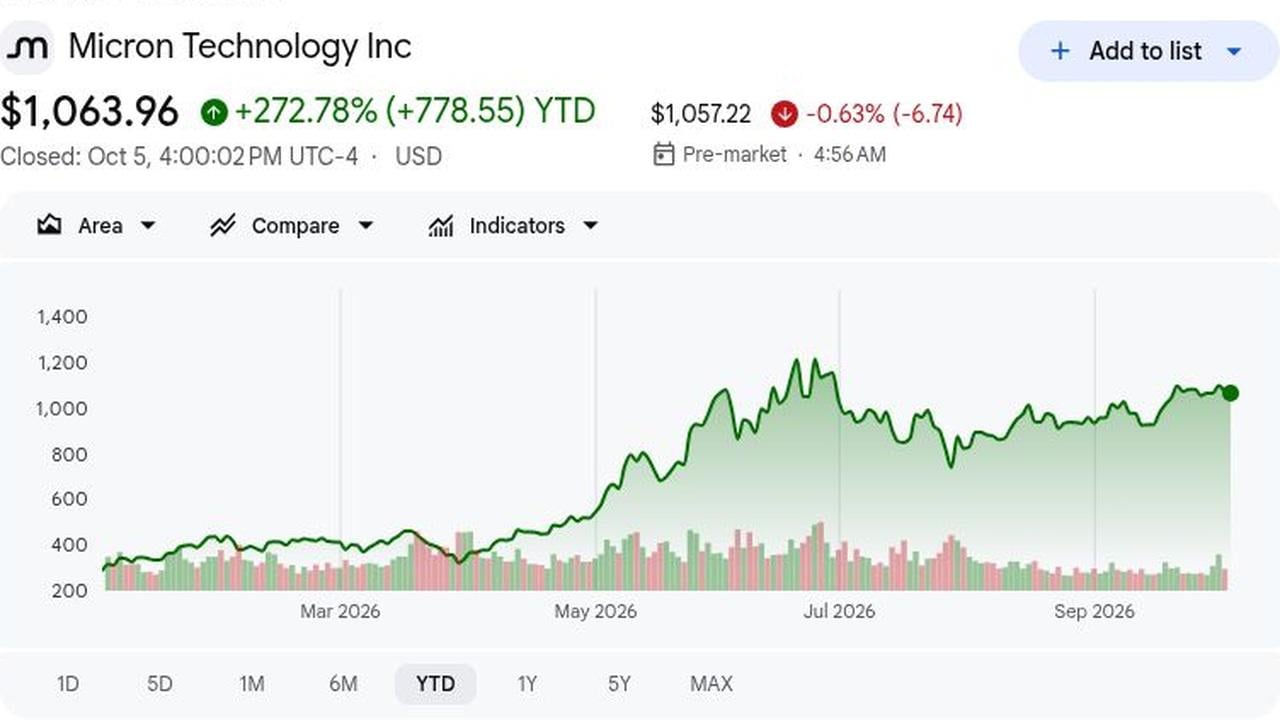
- MU closed at $1,063.96 on October 5 and was up 272.78% YTD: The rally reflects repricing around AI servers, HBM and tight DRAM supply. Further upside now needs estimate upgrades, not simply improving industry conditions. That raises execution expectations after a historic run.
- Fiscal Q4 revenue reached $54.23 billion, up 379% year over year: Revenue exceeded the $51.07 billion LSEG consensus by $3.16 billion. Non-GAAP diluted EPS of $33.42 also beat the tracked $31.41 estimate by $2.01, demonstrating that the demand surge converted into earnings at exceptional speed.
- Data-center business units generated $34.29 billion in Q4 revenue: Cloud Memory contributed $16.28 billion, up 258% year over year, while Core Data Center reached $18.00 billion versus $1.58 billion a year earlier. Together, they accounted for about 63% of quarterly revenue, making AI infrastructure demand the main earnings driver.
- Fiscal Q1 revenue guidance reached a $61.5 billion midpoint: The midpoint exceeded the $57.02 billion LSEG consensus by $4.48 billion; the $38.15 EPS outlook topped $35.40 by $2.75, extending the near-term demand signal and strengthening management’s forward confidence.
- Customer commitments reached $32 billion and RPO approached $150 billion: Micron said 26 Strategic Customer Agreements covered more than 75% of FY2027 output. This improves visibility, though shipment timing and customer absorption still matter as industry capacity expands further across segments.
What Is Micron Technology (MU)?

Micron Technology designs and manufactures DRAM, high-bandwidth memory (HBM), NAND and NOR flash, and solid-state storage used across data centers, PCs, smartphones, vehicles, and industrial equipment. As one of the few integrated memory producers, Micron operates its own wafer fabrication and packaging facilities, giving it more control over technology and supply. That manufacturing model also makes the business highly capital intensive and sensitive to yields, utilization, process transitions, and memory pricing cycles.
Micron's long-term growth strategy increasingly centers on AI infrastructure. HBM and advanced DRAM support accelerator and server platforms, while high-capacity SSDs serve cloud storage demand. Multi-year agreements with Anthropic, Ford, and General Motors support demand visibility, while Micron memory is also designed into NVIDIA accelerator platforms. On the supply side, Micron plans more than $250 billion of U.S. manufacturing and research investment through 2035 and has a 10-year silicon-wafer agreement with GlobalWafers, though new fabs and packaging capacity still take years to qualify and ramp.
Read More: NVIDIA (NVDA) Price Prediction 2026: Can AI Infrastructure Growth Drive NVDA Toward $420?
Micron Technology (MU) Q4 FY2026 Earnings Overview: Record Revenue and Strong Q1 Outlook
Micron delivered fiscal Q4 revenue of $54.23 billion, up 379%, non-GAAP EPS of $33.42 and 87.0% non-GAAP gross margin. Revenue beat LSEG consensus of $51.07 billion by $3.16 billion; its $61.5 billion Q1 midpoint exceeded consensus of $57.02 billion by $4.48 billion.
|
Financial Metric |
Guidance / Consensus |
Reported / Actual |
Surprise |
|
Q4 FY2026 revenue |
$51.07B |
$54.23B |
Beat. $3.16B above LSEG consensus; up 379% YoY. |
|
Q4 non-GAAP diluted EPS |
$31.41 |
$33.42 |
Beat. $2.01 above the cited estimate and up from $3.03 a year earlier. |
|
Q4 GAAP diluted EPS |
— |
$32.87 |
Expanded. Up from $2.83 in Q4 FY2025. |
|
Q4 GAAP net income |
— |
$37.70B |
Expanded. Up from $3.20B a year earlier. |
|
Q4 non-GAAP gross margin |
— |
87.00% |
Expanded. Up from 45.7% a year earlier. |
|
Q4 operating cash flow |
— |
$43.97B |
Improved. Up from $5.73B in Q4 FY2025. |
|
Q4 adjusted free cash flow |
— |
$33.20B |
Positive. Funded investment while liquidity increased. |
|
Cloud Memory revenue |
— |
$16.28B |
Grew. Up 258% from $4.54B a year earlier. |
|
Core Data Center revenue |
— |
$18.00B |
Accelerated. Up from $1.58B a year earlier. |
|
Mobile and Client revenue |
— |
$13.11B |
Recovered. Up from $3.76B a year earlier. |
|
Automotive and Embedded revenue |
— |
$6.82B |
Recovered. Up from $1.43B a year earlier. |
|
Q1 FY2027 revenue outlook |
$57.02B |
$61.5B ± $1.5B |
Above. Midpoint exceeded LSEG consensus by $4.48B. |
|
Q1 FY2027 non-GAAP EPS outlook |
$35.40 |
$38.15 ± $1.00 |
Above. Midpoint exceeded consensus by $2.75. |
|
Q1 FY2027 non-GAAP gross-margin outlook |
— |
About 86.25% |
Strong. Guidance remains near the record Q4 level. |
- Revenue of $54.23 billion grew 379% and exceeded consensus: Tight DRAM and NAND supply, rising HBM mix and stronger data-center demand show growth came from both pricing and shipments. The broad contribution reduces dependence on any single end market.
- Non-GAAP EPS reached $33.42, topping a tracked $31.41 estimate: Non-GAAP EPS was more than ten times the year-earlier $3.03. GAAP net income of $37.70 billion confirms profitability extended beyond non-GAAP adjustments, an important check on earnings quality.
- Data-center businesses became the central growth engine: Cloud Memory posted $16.28 billion, up 258%, while Core Data Center reached $18.00 billion versus $1.58 billion. AI infrastructure now drives more earnings than traditional memory cycles, broadening the mix of customer demand.
- Cash generation expanded alongside gross margin: Operating cash flow hit $43.97 billion and adjusted free cash flow $33.20 billion. The $73.48 billion cash and investment balance can fund leading-edge nodes, clean rooms and HBM packaging. It also leaves room to absorb construction costs.
- Fiscal Q1 guidance extended the earnings momentum: The $61.5 billion revenue and $38.15 non-GAAP EPS midpoints exceed consensus by $4.48 billion and $2.75. An 86.25% margin outlook signals slight normalization from Q4 while remaining historically elevated.
Micron Technology (MU) 2026 Investment Outlook: $2,100 Bull Case vs. $800 Bear Case
Micron's 2026 outlook depends on whether AI-driven demand for HBM, server DRAM, and data-center NAND can stay ahead of new supply while large customer commitments convert into revenue. The upside comes from tight memory supply, strong contract visibility, and sustained margins, while faster capacity growth, weaker pricing, and heavy capital spending remain the main risks.
The Bull Case: Tight AI Memory Supply Pushes MU Toward $2,100
The Bull Case assumes HBM, server DRAM, and data-center NAND remain undersupplied while 26 Strategic Customer Agreements convert into shipments. With more than 75% of fiscal 2027 output committed and RPO near $150 billion, Micron could keep margins well above historical cycle averages.
A move toward $2,100 would require further earnings upgrades, continued HBM qualification, and disciplined industry supply. Conversion of $32 billion in customer commitments into deposits and revenue, alongside strong free cash flow despite more than $50 billion of expected fiscal 2027 capex, would strengthen the case.
The Base Case: Strong Customer Commitments Keep MU Between $1,300 and $1,700
The Base Case assumes AI-memory demand stays strong, but pricing and gross margin normalize from exceptional fiscal Q4 levels. Strategic agreements and committed output support visibility, while higher capex, depreciation, and gradually increasing supply limit further earnings acceleration.
MU could trade mainly between $1,300 and $1,700 if HBM shipments remain stable, data-center growth continues, and gross margin stays near guidance. Slower estimate upgrades would likely limit a move toward the highest targets.
The Bear Case: Weaker Memory Pricing Pulls MU Toward $800
The Bear Case assumes AI capacity additions slow, competing HBM supply ramps faster, or conventional DRAM and NAND pricing weakens. Rising depreciation and operating commitments would then pressure earnings and free cash flow as gross margin retreats from 87.0%.
A move toward $800 would become more likely if customer commitments are delayed, fiscal 2027 guidance is cut, or capex remains high despite weaker demand. Lower forward estimates and valuation compression after the 272.78% YTD rally would add further pressure.
MU Stock Price Forecasts for 2026 By Wall Street Analysts
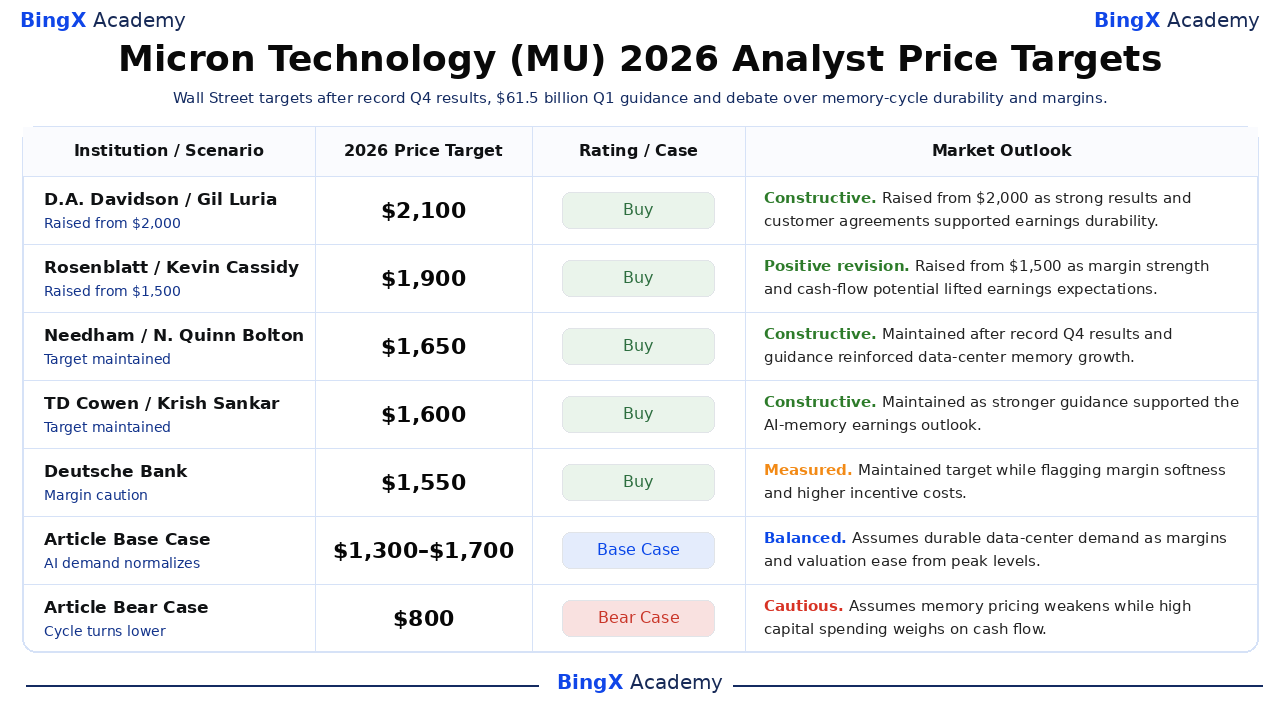
Post-earnings analyst targets remain well above Micron's October 5 close, but they also span a meaningful range. The selected actions below are dated October 1 and reflect how firms interpreted record margins, stronger guidance, customer commitments and capital needs immediately after the fiscal Q4 release.
|
Institution / Analyst |
2026 Price Target |
Rating / Case |
Market Outlook |
|
D.A. Davidson / Gil Luria |
$2,100 |
Buy |
Constructive. October 1: Raised from $2,000 as record results and customer agreements supported earnings durability. |
|
Rosenblatt / Kevin Cassidy |
$1,900 |
Buy |
Positive revision. October 1: Raised from $1,500 as margin strength and cash-flow potential lifted earnings expectations. |
|
Needham / N. Quinn Bolton |
$1,650 |
Buy |
Constructive. October 1: Maintained after record Q4 results and guidance reinforced data-center memory growth. |
|
TD Cowen / Krish Sankar |
$1,600 |
Buy |
Constructive. October 1: Maintained as stronger guidance supported the AI-memory earnings outlook. |
|
Deutsche Bank / Melissa Weathers |
$1,550 |
Buy |
Measured. October 1: Maintained the target while flagging margin softness and higher incentive costs. |
|
RBC Capital / Srini Pajjuri |
$1,500 |
Outperform |
Constructive. October 1: Maintained as strategic agreements supported multi-year revenue visibility. |
|
Article Base Case |
$1,300 to $1,700 |
Base Case |
Balanced. Assumes durable data-center demand as margins and valuation ease from peak levels. |
|
Article Bear Case |
$800 |
Bear Case |
Cautious. Assumes memory pricing weakens while high capital spending weighs on cash flow. |
How to Trade Micron Technology (MU) Stock on BingX
Trade Micron's HBM, memory-pricing and margin outlook using BingX TradFi and BingX AI tools. Because MU can react sharply to pricing updates, capacity plans, guidance and AI spending, traders should define both the catalyst and risk limits before entering a position.
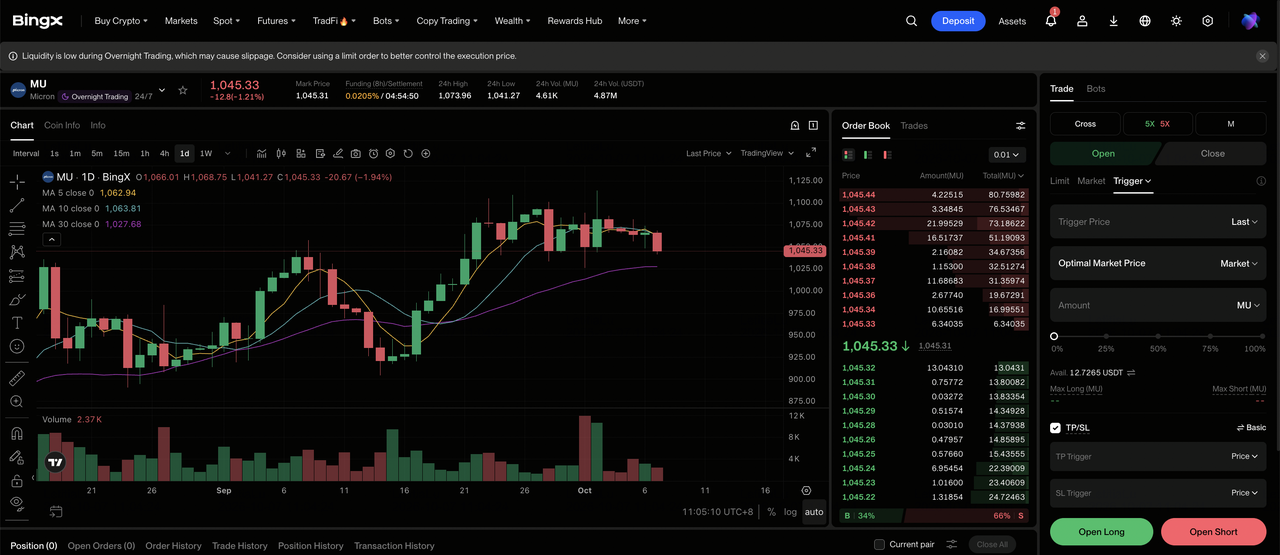
Step 1: Access BingX TradFi. Sign up and navigate to the specialized TradFi section on the BingX exchange dashboard.
Step 2: Select Micron Technology (MU). Search for and select the MU-USDT perpetual futures contract.
Step 3: Choose your direction. Select Open Long if AI-memory demand and margins remain firm. Select Open Short if pricing, HBM demand or contract conversion weakens.
Step 4: Select leverage and margin mode. Choose Isolated or Cross-Margin based on your risk tolerance. The 272.78% YTD advance shows why conservative leverage and clear position sizing are important.
Step 5: Execute strict risk protocols. Set Take-Profit and Stop-Loss (TP/SL) levels before or immediately after entering the trade. MU can react quickly to memory prices, capacity plans, customer commitments and earnings guidance.
Top 5 Risks to the Micron Technology (MU) Stock Forecast
Record results do not remove Micron's cyclical and valuation risks. Pricing, execution, trade policy, and capacity expansion can still materially affect earnings even if AI demand remains strong.
- Memory pricing can still reverse: The 87.0% non-GAAP gross margin reflects unusually tight supply and strong product mix. If DRAM or NAND supply grows faster than demand, pricing, revenue, and cash flow could weaken quickly.
- Heavy capital spending can pressure returns: Fiscal 2027 capex is expected to exceed $50 billion after $27.37 billion in fiscal 2026. Cost overruns or slower ramps could raise depreciation before new capacity produces adequate returns.
- HBM transitions carry execution risk: AI accelerators require faster memory, advanced packaging, and strict customer qualification. Delayed qualification, weaker yields, or architecture changes could shift HBM orders to competitors.
- China and trade policy remain important: Export controls, local Chinese memory investment, and restrictions on Micron products can affect addressable markets, equipment access, and customer demand across the U.S. and Asia.
- Valuation leaves less room for disappointment: MU's 272.78% YTD gain reflects strong expectations for AI demand and future earnings. Shares could fall if estimate upgrades slow, margins normalize earlier than expected, or investors assign a lower multiple.
Final Thoughts: Is MU a Good Investment in 2026?
Micron's fiscal Q4 strengthens the 2026 investment case because AI-driven demand is translating into both growth and stronger cash generation. Revenue reached $54.23 billion, non-GAAP gross margin hit 87.0%, and operating cash flow rose to $43.97 billion. The $61.5 billion Q1 revenue midpoint also suggests momentum is carrying into the next quarter rather than ending with one strong report.
The main question is whether that strength can last. MU is already up 272.78% YTD, while Micron plans more than $50 billion of FY2027 capex. The stronger case depends on HBM demand staying tight, the $32 billion of customer commitments converting into shipments and cash, and new capacity earning strong returns before industry supply catches up. If those conditions hold, the $1,300 to $1,700 Base Case remains supportable and the $2,100 Bull Case becomes more realistic. If pricing weakens while capex and depreciation stay high, downside toward $800 becomes easier to justify.
Risk Reminder: Stock and perpetual-futures trading involve substantial risk, including rapid losses and liquidation when leverage is used. Price targets and scenarios are analytical estimates, not guarantees or personalized financial advice.
Related Reading
- Top AI Memory Stocks to Buy in 2026: DRAM, HBM, and AI Storage Demand Explained
- Top High-Bandwidth Memory (HBM) Stocks to Buy in the 2026 Memory Supercycle
- Top 10 AI Infrastructure Stocks to Buy in 2026: Chip Manufacturing and Design Leaders
- Top AI Server Stocks to Buy in 2026: Rack-Scale Systems, GPU Servers, and AI Servers Infrastructure
- NVIDIA (NVDA) Price Prediction 2026: Can AI Infrastructure Growth Drive NVDA Toward $420?
- Sandisk (SNDK) Price Prediction 2026: Can AI Data Center Demand Push SNDK Toward $3,000?
