

Costco (COST) runs membership warehouses and e-commerce sites selling a limited assortment of groceries, household goods, apparel, electronics and services. Scale purchasing and efficient distribution support low prices, while recurring membership fees offset thin merchandise margins. Gasoline, pharmacy and other services reinforce visit frequency, but earnings remain sensitive to traffic, labor, fuel and sourcing costs.
The latest quarter showed resilient member spending alongside slower growth in recurring fees. Costco Q4 FY2026 revenue reached $95.72 billion, adjusted comparable sales rose 6.7% and digital sales grew 19.8%; membership fees increased 7.3% to $1.85 billion. Plans to open 33 warehouses in FY2027 extend Costco’s reach even though slower fee growth and a one-time $0.15 tariff-refund benefit qualify the quarter’s earnings strength.
The COST stock forecast for 2026 now centers on two competing views:
- The membership and expansion case: A 939-warehouse network, 19.8% adjusted digital comp growth and management's plan for 33 FY2027 openings can extend member reach and sales capacity, if new sites earn attractive returns.
- The valuation and fee-growth case: Q4 membership-fee growth slowed to 7.3%, and the $0.15 tariff-refund benefit lifted reported EPS. If fee income or traffic weakens, a roughly 44.5x trailing P/E leaves room for multiple compression.
This guide breaks down the COST stock forecast, 2026 price scenarios, key risks and analyst outlooks, drawing on Costco's September 24 Q4 FY2026 earnings release, SEC filing and market data through October 5, plus how to trade COST stock futures on BingX TradFi with USDT collateral.
Top 5 Things for Costco Investors to Know in October 2026
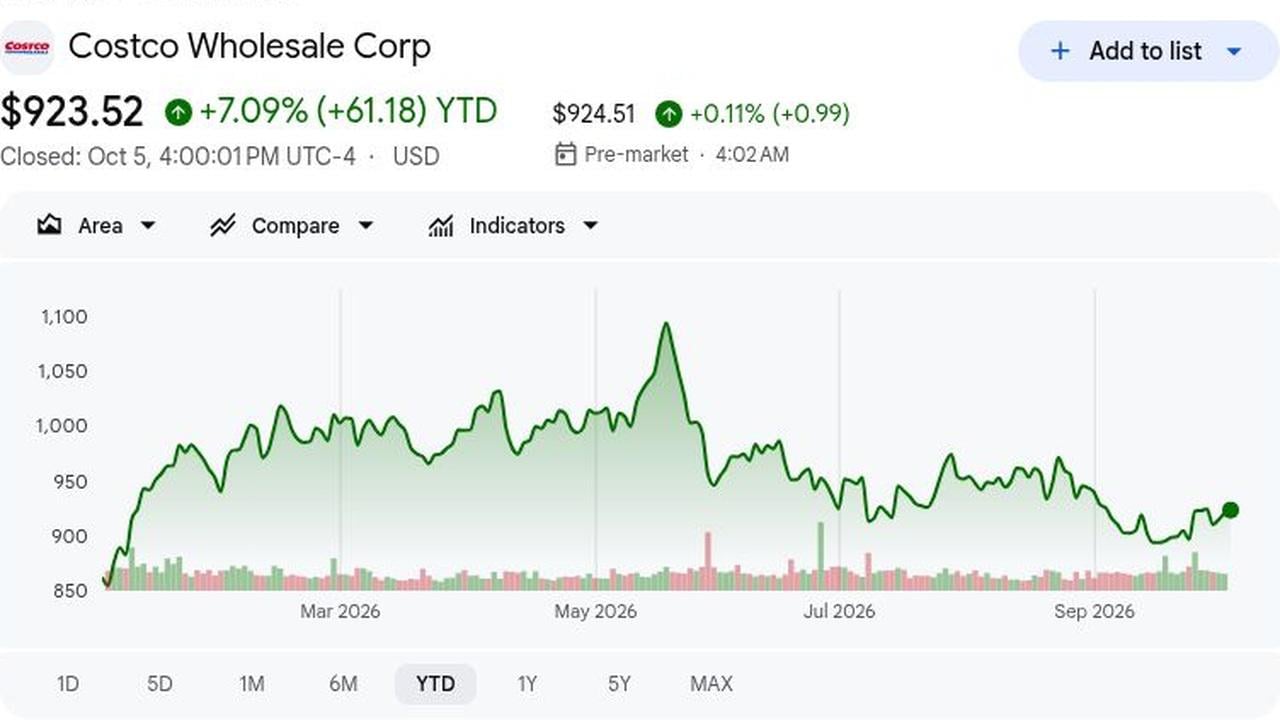
- COST closed at $923.52 and was up 7.09% YTD: The October 5 close rose 0.31% but stayed 15.8% below the May 19 high of $1,096.50. Valuation concerns remain, so earnings must catch up quickly.
- Q4 total revenue reached $95.72 billion and beat consensus by $860 million: Revenue rose 11.1% year over year versus the $94.86 billion LSEG estimate; net sales increased 11.2% to $93.87 billion. The beat confirms demand; repeat traffic must sustain it.
- Adjusted Q4 comparable sales grew 6.7%, 59 basis points above consensus: It excludes fuel and FX changes. U.S. adjusted comps rose 7.2%, showing value pricing attracts shoppers; adjusted comps better isolate demand than the 9.4% reported rate.
- Digitally enabled Q4 comps climbed 19.8% on an adjusted basis: That was nearly three times the 6.7% companywide rate. The app, website and delivery options extend the warehouse offer, but repeat orders and profitable baskets still need proof.
- Costco plans 33 warehouse openings in FY2027, including five relocations: That means 28 net additions to its 939-warehouse base. The September sales update is due October 7, testing traffic and member demand. Returns depend on productivity, local demand and cannibalization.
What Is Costco Wholesale (COST)?
Costco Wholesale operates membership warehouses and e-commerce sites that sell a deliberately limited assortment of groceries, fresh food, household goods, appliances, apparel, electronics and services. High-volume purchasing, efficient distribution and fast inventory turnover let the company offer low prices while operating at thinner merchandise margins than many retailers. Annual membership fees provide recurring income, and Kirkland Signature gives Costco a private-label range that reinforces its value proposition. Gasoline, pharmacy, optical, food court and travel services add reasons for members to visit. The model depends on renewal, traffic and disciplined costs, with suppliers accepting high-volume orders in exchange for access to a large member base.
Costco's long-term strategy is to preserve member value while extending warehouse reach and making shopping more convenient across stores and digital channels. Kirkland Signature and a focused assortment support differentiation and purchasing scale; its app, digital membership card, inventory lookup and Costco Wallet connect online discovery with warehouse visits. Delivery partnerships add another access point without replacing the membership relationship: in September 2026, Uber and Costco expanded U.S. delivery through Uber Eats to 47 states and nearly 600 warehouse locations, building on a global partnership that also spans Canada, Mexico, Japan, Taiwan, France and Spain. This combination lets Costco expand convenience around its core low-price club model, with member renewals, visit frequency and disciplined merchandising remaining central to the economics.
Read More: Walmart (WMT) Price Prediction 2026: Can E-Commerce and Advertising Push WMT Toward $155?
Costco (COST) Q4 FY2026 Earnings Overview: Strong Sales Meet Slower Fee Growth
Costco’s 16-week Q4 delivered $95.72 billion in revenue versus $94.86 billion expected and GAAP EPS of $6.75 included a $0.15 tariff-refund benefit; adjusted EPS of $6.60 beat $6.53 consensus. Adjusted comps rose 6.7%, digital comps advanced 19.8%, and fees reached $1.85 billion, up 7.3%. Slower fee growth and the one-time benefit qualify the beat.
|
Financial Metric |
Guidance / Consensus |
Reported / Actual |
Surprise |
|
Q4 FY2026 total revenue |
$94.86B LSEG consensus |
$95.72B |
Beat. $0.86B above consensus; up 11.1% YoY. |
|
Q4 FY2026 diluted EPS |
— |
$6.75 |
Beat. $0.23 above consensus; included $0.15 tariff benefit. |
|
Q4 adjusted diluted EPS |
$6.53 consensus |
$6.60 excluding refund benefit |
Beat. $0.07 above LSEG after excluding tariff refund. |
|
Q4 total comparable sales |
6.11% consensus, adjusted |
9.4% reported; 6.7% adjusted |
Beat. 59 bps above consensus. |
|
Q4 digitally enabled comps |
— |
19.5% reported; 19.8% adjusted |
Outgrew. Versus 6.7% adjusted company comps. |
|
Q4 membership fees |
$1.8B consensus |
$1.850B; +7.3% YoY |
Grew. Up from $1.724B; growth slowed again. |
|
FY2026 total revenue |
— |
$303.154B |
Increased. Up 10.1% from FY2025. |
|
FY2027 warehouse plan |
— |
33 openings, including 5 relocations |
Expanded. 28 net additions to a 939-site base. |
- Q4 revenue of $95.72 billion beat estimates by $860 million: Total revenue rose 11.1% from $86.16 billion. Traffic and ticket supported the beat, but comparable sales must persist beyond the seasonal quarter to confirm demand is durable.
- Diluted EPS of $6.75 exceeded consensus by 23 cents: It included a $0.15 tariff-refund benefit; adjusted EPS of $6.60 still topped LSEG's $6.53 estimate by seven cents. Underlying results were strong, though less than the headline beat suggests.
- Adjusted comparable sales rose 6.7% and beat the 6.11% forecast: U.S. adjusted comps grew 7.2%, Canada 4.6% and Other International 6.2%. This breadth supports the value-led traffic thesis, while adjusted comps give a cleaner demand measure than reported growth.
- Digital comps advanced 19.8% adjusted as membership fees rose 7.3%: Digital far outpaced 6.7% comps, but fees slowed from 11.7% in Q4 FY2025. This elevates digital as a growth engine while leaving recurring member income central to the low-markup model.
- FY2026 revenue reached $303.15 billion as Costco plans 33 FY2027 openings: Annual revenue rose 10.1%, and five planned openings are relocations, or 28 net additions. New sites add potential sales and members, but returns must justify investment. Investors need evidence of productive openings.
Costco Wholesale (COST) 2026 Investment Outlook: $1,200 Bull Case vs. $780 Bear Case
Costco's 2026 outlook depends on whether member growth, steady traffic, and digital expansion can keep earnings rising fast enough to support a premium valuation. The upside comes from recurring membership fees, productive new warehouses, and resilient spending, while slower comparable sales, weaker renewals, and multiple compression remain the main risks.
The Bull Case: Strong Membership Growth Pushes COST Toward $1,200
The Bull Case assumes adjusted comparable sales remain near FY2026's 6.6% rate, digital growth stays in the high teens, and paid memberships continue expanding. Costco's 939 warehouses and higher Executive-member penetration support recurring fee income without weakening its low-price model.
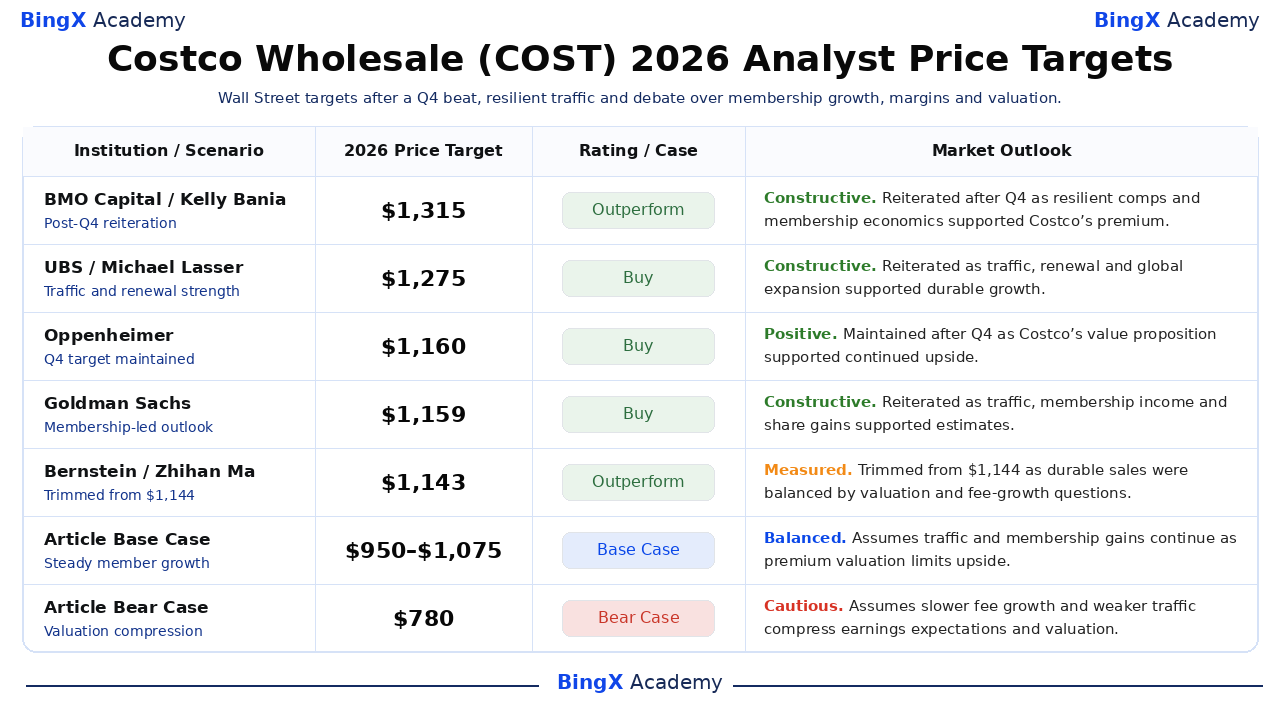
A move toward $1,200 would require double-digit membership-fee growth, stable renewal rates, and continued margin improvement after reinvestment. BMO's $1,315 and UBS's $1,275 targets illustrate the upside if those trends persist.
The Base Case: Steady Traffic Keeps COST Between $950 and $1,075
The Base Case assumes traffic remains positive, adjusted comparable sales settle in the mid-single digits, and digital sales continue growing faster than warehouse sales. Membership fees expand more gradually, while roughly $303 billion in annual revenue and $20.76 EPS support a premium valuation.
COST could trade mainly between $950 and $1,075 if renewals remain stable and new warehouses deliver healthy productivity. Fee growth below 8% or weaker traffic would likely limit the upper end.
The Bear Case: Slower Sales Growth Pulls COST Toward $780
The Bear Case assumes consumer pressure slows discretionary spending, membership-fee growth weakens, and fuel, tariff, or fulfillment costs pressure margins. Costco would remain profitable, but slower earnings growth would make a valuation near 44 times trailing EPS harder to defend.
A move toward $780 would become more likely if adjusted comparable sales fall below 4%, paid-member growth approaches 2%, or renewal rates weaken. Multiple compression could add further downside if investors begin assigning less value to Costco's recurring membership model.
COST Stock Price Forecasts for 2026 By Wall Street Analysts
Named targets range from $1,135 to $1,315 against the $923.52 October 5 close. The wider consensus spans $770 to $1,315 across 39 analysts. The mix captures Q4 sales strength alongside questions about membership growth and valuation.
|
Institution / Scenario |
2026 Price Target |
Rating / Case |
Market Outlook |
|
BMO Capital / Kelly Bania |
$1,315 |
Outperform |
Constructive. September 25: reiterated after Q4 as resilient comparable sales and member economics supported the premium. |
|
UBS / Michael Lasser |
$1,275 |
Buy |
Constructive. September 25: reiterated as traffic, renewal and international expansion supported durable growth. |
|
Oppenheimer / Rupesh Parikh |
$1,160 |
Buy |
Positive. September 25: maintained following Q4 as value and execution supported upside. |
|
Goldman Sachs / Kate McShane |
$1,159 |
Buy |
Constructive. September 8: reiterated as traffic, membership income and share gains supported estimates. |
|
Bernstein / Zhihan Ma |
$1,143 |
Outperform |
Measured. September 25: trimmed from $1,144 as durable sales faced valuation and fee-growth questions. |
|
Telsey Advisory Group / Joseph Feldman |
$1,135 |
Buy |
Constructive. October 5: reaffirmed ahead of monthly sales, forecasting 10.1% comps and 4% traffic growth. |
|
Article Base Case |
950–1,075 |
Base Case |
Balanced. Assumes traffic and membership gains continue as the premium valuation limits upside. |
|
Article Bear Case |
$780 |
Bear Case |
Cautious. Assumes slower fee growth and weaker traffic compress earnings expectations and valuation. |
How to Trade Costco (COST) Stock on BingX
Trade Costco's comparable-sales, membership-growth and valuation outlook using BingX TradFi and BingX AI tools. Because COST can react to monthly sales, earnings and margin updates, traders should define both the catalyst and risk limits before entering a position.
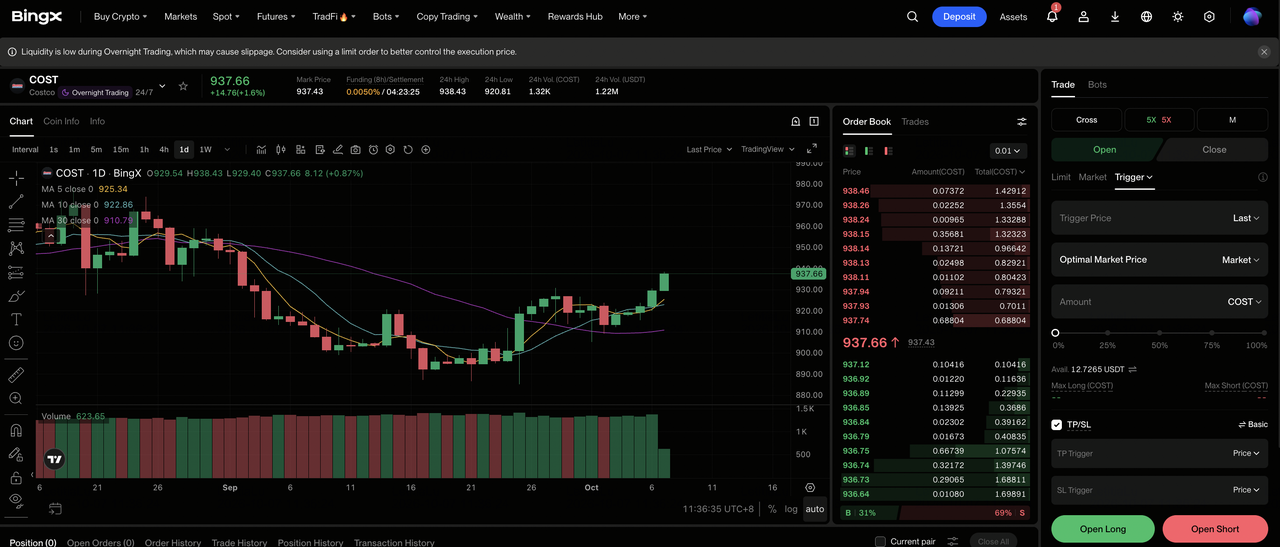
Step 1: Access BingX TradFi. Sign up and navigate to the specialized TradFi section on the BingX exchange dashboard.
Step 2: Select Costco (COST). Search for and select the COST-USDT perpetual futures contract.
Step 3: Choose your direction. Select Open Long if traffic, member growth and margins support higher earnings. Select Open Short if slower fee growth or weaker comps pressure valuation.
Step 4: Select leverage and margin mode. Choose Isolated or Cross-Margin based on your risk tolerance. The decline from $1,096.50 to below $900 during 2026 shows why conservative leverage and clear position sizing matter.
Step 5: Execute strict risk protocols. Set Take-Profit and Stop-Loss (TP/SL) levels before or immediately after entering the trade. COST can react quickly to monthly sales, traffic, fee income, earnings and analyst revisions.
Top 5 Risks to Watch for Costco Investors in 2026
Costco combines defensive demand with a premium valuation, so even modest execution misses can affect both earnings and the multiple investors are willing to pay.
- Premium valuation magnifies small misses: COST traded near 44 times trailing EPS of $20.76 at the October 5 close. If sales or earnings growth slows, multiple compression could outweigh otherwise healthy member and revenue growth.
- Membership growth could normalize: Q4 membership-fee revenue rose 7.3%, below earlier fiscal-2026 growth rates. Slower renewals or fewer Executive upgrades would weaken the recurring income that helps support Costco's low-markup model.
- A weaker discretionary mix can pressure margins: Food and essentials support traffic, but electronics, appliances, and seasonal goods contribute more to ticket size and margin. If spending shifts toward lower-margin categories, sales could stay positive while profit growth slows.
- Fuel, currency, and tariff effects can distort results: Reported comps were 9.4% versus 6.7% after adjusting for fuel and currency, while EPS included a $0.15 tariff-refund benefit. Reversals in those factors could make reported growth look weaker even if underlying demand remains stable.
- Expansion creates execution and cannibalization risk: Costco's 939-warehouse network supports scale, but new locations require capital, staff, and local member acquisition. Poor site economics or cannibalization could reduce incremental returns and cash productivity.
Final Thoughts: Should You Invest in Costco Wholesale in 2026?
Costco enters late 2026 with strong operating momentum. Q4 revenue reached $95.72 billion, adjusted comparable sales rose 6.7%, and adjusted digital comps increased 19.8%. FY2026 EPS reached $20.76, while membership-fee growth of 7.3% remained healthy but slower than earlier in the year. The next test is whether renewals, Executive upgrades, and the planned 33 new FY2027 locations can keep earnings growing fast enough to support Costco's premium valuation.
The $1,200 Bull Case becomes more credible if traffic stays firm, membership income accelerates, and new warehouses deliver attractive returns. The $780 Bear Case becomes more relevant if comps fall below 4%, fee growth weakens further, or margins come under pressure. Monthly sales, renewal trends, digital growth, and new-site productivity are the clearest indicators to watch as the holiday period tests demand.
Risk Reminder: Trading and investing in equities like COST involves a high risk of capital loss. Earnings misses, valuation changes, consumer weakness, and leveraged trading can produce rapid losses. Conduct independent research before allocating capital.
Related Reading
- Walmart (WMT) Price Prediction 2026: Can E-Commerce and Advertising Push WMT Toward $155?
- Amazon (AMZN) Price Prediction 2026: Can AWS and AI Growth Push AMZN Past $400?
- PepsiCo (PEP) Stock Outlook for 2026: Can PEP Cross $220 on Beverage Portfolio and Emerging Markets?
- Nike (NKE) Price Prediction 2026: $55.00 Turnaround Comeback or $39.00 Value Trap?
- AMC Stock Price Prediction 2026: Fundamental Turnaround or Massive Dilution Trap?
