



Applied Digital (APLD) builds and leases AI data centers for cloud customers. The legacy hosting business provides an operating base, while large power-ready campuses create a route to recurring high-performance computing rent. Leased capacity alone does not produce rent: construction, utility connections, customer handovers and financing terms determine when those campuses begin generating returns for existing shareholders.
The latest quarter showed rapid revenue growth alongside a costly buildout. Applied Digital Fiscal Q1 2027 sales reached $341.9 million, including $65.8 million of HPC base rent and $183.5 million of tenant fit-out revenue, while the GAAP common-holder loss widened to $221.0 million. Cash and restricted cash reached $3.7 billion against $6.4 billion of debt. Further handovers must increase recurring rent faster than interest and construction costs.
Two competing views frame the stock forecast for Applied Digital through the rest of 2026:
- The growth case: Leased AI campuses reach service dates, recurring base rent rises, and investors gain confidence in the approximately $36 billion base-term contracted revenue pipeline.
- The risk case: Delays, expensive financing, customer concentration and lumpy fit-out sales make the revenue surge less valuable to common shareholders.
This guide breaks down Applied Digital's business, latest results, Wall Street targets, three conditional price scenarios and how to trade APLD stock futures through BingX TradFi.
Top 5 Things for Applied Digital Investors to Know in October 2026
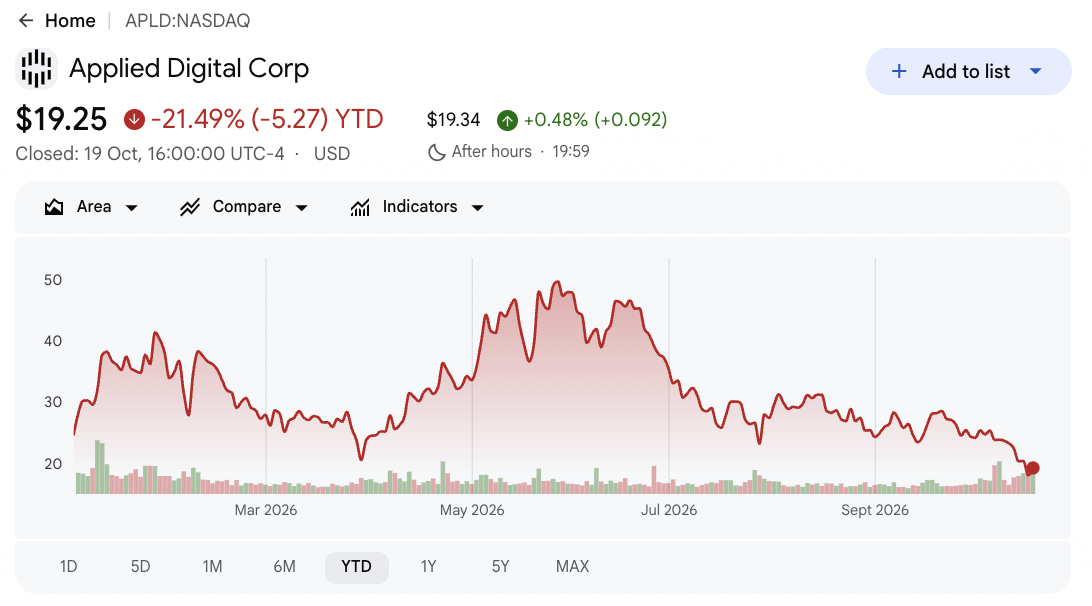
- The stock has lost ground despite fast growth. APLD shares closed October 19 at $19.25, down 21.49% year to date. The market is discounting project delivery and financing uncertainty rather than simply extrapolating the 322% year-over-year revenue increase.
- Revenue mix matters more than the headline. Fiscal Q1 revenue reached $341.9 million; HPC Hosting included $65.8 million of base rent and $183.5 million of fit-out services. Project work should not be treated as equally recurring lease revenue.
- Leased power is significant but takes time. Applied Digital reported 1.41 gigawatts under lease across five U.S. campuses and about $36 billion of base-term contracted revenue over those leases. This is future contractual value, not current reported revenue or cash.
- Physical handovers are the near-term test. Polaris Forge 1 had 175 megawatts live at August 31 and 250 megawatts after an October 1 phase. Management targeted 300 megawatts live across North Dakota by year-end 2026; investors can check delivered capacity against that milestone.
- Funding shapes the equity outcome. August 31 cash and restricted cash totaled $3.7 billion against $6.4 billion of debt, while quarterly interest expense reached $77.4 million. More leases add value only if financing does not absorb disproportionate returns.
What Is Applied Digital (APLD)?
Applied Digital is a Dallas-based AI infrastructure company that develops, owns, and operates large data centers for high-performance computing (HPC) and artificial intelligence. Its Polaris Forge and Delta Forge campuses provide the power, cooling, and infrastructure needed for high-density AI computing. CoreWeave leases capacity at Polaris Forge 1, while other hyperscalers have committed to additional campuses. Applied Digital generates revenue through long-term leases, tenant reimbursements, and construction-related services as contracted capacity becomes operational.
Originally known as Applied Blockchain, the company began with cryptocurrency mining before shifting toward data center hosting and AI infrastructure. Its legacy 286 MW crypto mining hosting business generated $37.8 million in fiscal Q1 revenue. Applied Digital also owns approximately 96% of publicly traded ChronoScale, a GPU computing platform with plans for a 50 MW Microsoft AI deployment. Together, these operations expand its exposure to AI data center leasing and GPU computing, with future growth depending on construction execution, customer demand, and converting contracted capacity into recurring revenue.
Read More: Top High-Performance Computing (HPC) Stocks to Watch in 2026: Accelerated Computing Market Leaders
Applied Digital (APLD) Q1 FY2027 Earnings Overview: AI Data Center Growth Drives 322% Revenue Surge
Applied Digital reported Q1 FY2027 revenue of $341.9 million, up 322% year over year, driven by $183.5 million in HPC tenant fit-out revenue and $65.8 million in base rent from AI data centers. Adjusted EBITDA reached $64.4 million, reflecting stronger operating performance. However, the GAAP loss attributable to common shareholders widened to $221.0 million, while $6.4 billion in debt and $3.7 billion in cash and restricted cash kept financing costs and recurring rental growth central to the outlook.
Read More: Applied Digital (APLD) Q1 FY2027 Earnings Overview: 322% Revenue Growth Drives a 0.17% Price Rally
|
Financial Metric |
Guidance / Consensus |
Reported / Actual |
Surprise |
|
Revenue |
$80.9M year earlier |
$341.9M |
Expanded. Up 322%; fit-out drove much of the gain. |
|
Adjusted revenue |
$64.2M year earlier |
$300.4M |
Expanded. Excludes ChronoScale operations. |
|
HPC base rental revenue |
$0 a year earlier |
$65.8M |
Started. Recurring hosting rent is now visible. |
|
HPC tenant fit-out revenue |
— |
$183.5M |
Large. Up $157.2M year over year. |
|
GAAP net loss |
$18.5M a year earlier |
$221.0M |
Widened. Loss increased $202.5M. |
|
Adjusted net loss |
$7.6M a year earlier |
$4.1M |
Narrowed. Loss reduced $3.5M. |
|
Adjusted EBITDA |
$0.5M a year earlier |
$64.4M |
Improved. Up $63.9M year over year. |
|
Debt |
— |
$6.4B |
Levered. Versus $3.7B cash and restricted cash. |
- Fit-out was the main growth engine. HPC Hosting contributed $262.6 million, comprising $183.5 million of tenant fit-out, $65.8 million of base rent and $13.3 million of recoveries. Track recurring rent as additional phases enter service across the campus.
- Delivery progressed after quarter end. Polaris Forge 1’s first 100-megawatt building entered service in October 2025. Two 75-megawatt phases followed in July and October 2026, bringing live capacity to 250 megawatts. Other campuses remain under construction, so rent lags leases.
- GAAP and adjusted results diverge. Adjusted net loss narrowed to $4.1 million, or $0.01 per share, while the GAAP common-holder loss widened to $221.0 million, or $0.76. ChronoScale is consolidated in GAAP but excluded from adjusted measures; financing and valuation effects also matter.
- Operating progress carries an interest bill. Adjusted EBITDA rose from $0.5 million to $64.4 million, but interest expense jumped from $8.0 million to $77.4 million. EBITDA excludes principal; rising recurring rent must outgrow project funding costs.
- Liquidity and leverage need joint scrutiny. Cash, equivalents and restricted cash totaled $3.7 billion at August 31 against $6.4 billion of debt. The $36 billion base-term lease figure spans future years and is not immediately collectible; commissioning dates and funding terms govern equity returns.
Read More: Top AI Data Center Stocks to Buy in 2026: Cloud, Servers, and AI Compute Infrastructure
Applied Digital (APLD) 2026 Investment Outlook: $45 Bull Case vs. $14 Bear Case
Applied Digital's 2026 outlook depends on converting its 1.41 GW of contracted AI data center capacity into operational facilities and recurring rental income. While $65.8 million in quarterly base rent shows early progress, construction schedules, financing costs, and cash generation remain central to valuation. The following scenarios reflect how campus deliveries and lease conversion could shape APLD's performance through year-end.
The Bull Case: Faster AI Data Center Expansion Pushes APLD Toward $45
The Bull Case assumes Applied Digital reaches its 300 MW year-end operational capacity target in North Dakota, with additional facilities beginning to generate recurring rent. Progress across other campuses and reliable project financing would strengthen confidence in converting its roughly $36 billion long-term lease commitments into future revenue.
A move toward $45 would require timely facility handovers, rising HPC base rental income, and manageable financing costs. Stronger cash generation and limited shareholder dilution would provide further support for a higher valuation.
The Base Case: Steady Rental Growth Keeps APLD Between $22 and $32
The Base Case assumes completed data center capacity gradually enters service while larger campuses advance through construction. Tenant fit-out revenue remains uneven, but long-term hyperscaler contracts and additional rental income support growth. Financing requirements may limit valuation expansion until recurring cash flow becomes more established.
APLD could trade between $22 and $32 if operational capacity increases, base rent grows, and project funding remains manageable. Faster lease conversion could support the upper end, while slower rental growth or higher financing costs would pressure the range.
The Bear Case: Construction and Financing Delays Pull APLD Toward $14
The Bear Case assumes power availability, equipment shortages, or construction delays postpone data center handovers and recurring rental income. Fit-out revenue may remain substantial, but slower lease conversion would prolong financing expenses before facilities become fully operational. Additional borrowing or share issuance could further reduce returns for existing shareholders.
A move toward $14 would become more likely if campus deliveries slip, base rental income grows below expectations, or funding costs increase. Weaker project cash returns and greater dilution risk could pressure valuation despite the company's large contracted pipeline.
APLD Stock Price Forecasts for 2026 By Wall Street Analysts
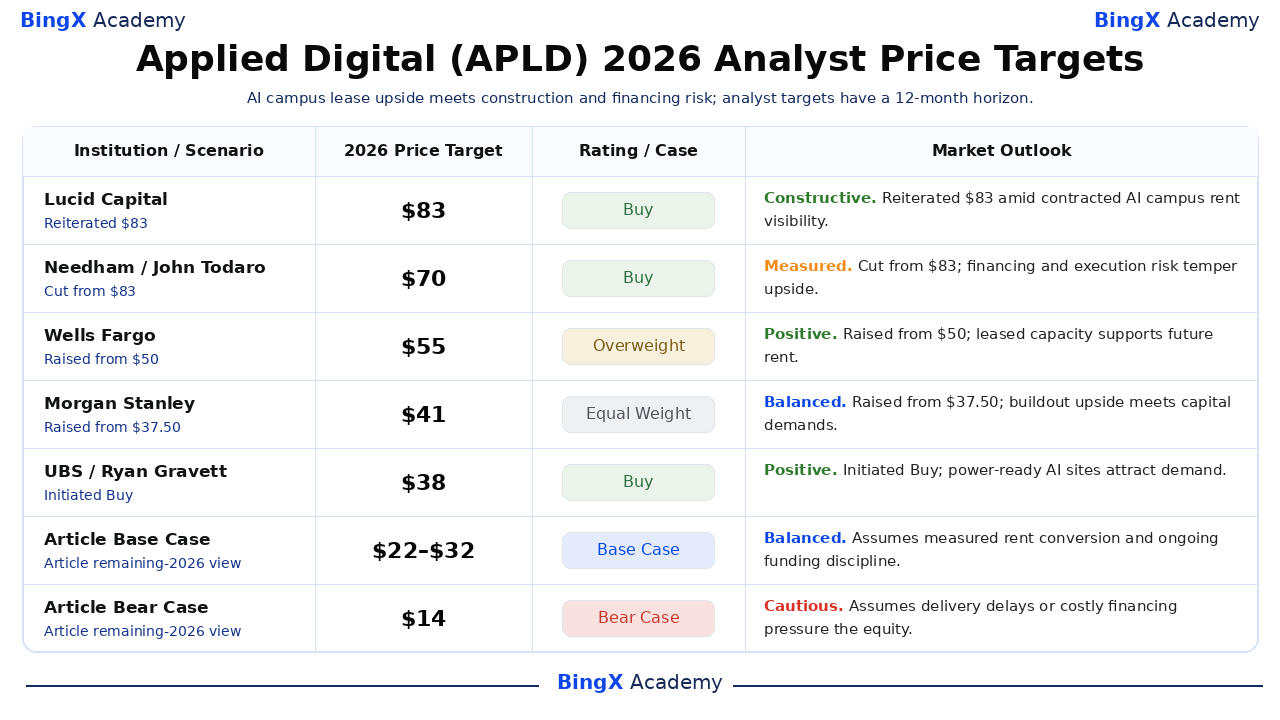
These six named third-party targets carry roughly 12-month horizons extending beyond December 2026. The dated actions and ratings are reported; brief market-outlook explanations are editorial interpretations. The final two rows are this article’s separate remaining-2026 scenarios, so high analyst targets should not be treated as year-end promises.
|
Institution / Scenario |
2026 Price Target |
Rating / Case |
Market Outlook |
|
Lucid Capital |
$83 |
Buy |
Constructive. October 8: Darren Aftahi reiterated Buy with an $83 target. Editorial view: Reiterated $83 amid contracted AI campus rent visibility. |
|
Needham |
$70 |
Buy |
Measured. October 8: John Todaro cut the target from $83 to $70, maintaining Buy. Editorial view: Financing and execution risk temper upside. |
|
Wells Fargo |
$55 |
Overweight |
Positive. October 8: Eric Luebchow raised the target from $50 to $55, maintaining Overweight. Editorial view: Leased capacity supports future rent. |
|
Morgan Stanley |
$41 |
Equal Weight |
Balanced. October 9: Stephen Byrd raised the target from $37.50 to $41, maintaining Equal Weight. Editorial view: Buildout upside meets capital demands. |
|
UBS |
$38 |
Buy |
Positive. September 23: Ryan Gravett initiated Buy with a $38 target. Editorial view: Power-ready AI sites attract demand. |
|
Rothschild & Co Redburn |
$22 |
Neutral |
Cautious. September 21: Alexander Haissl initiated Neutral with a $22 target. Editorial view: Financing and project timing narrow the margin for error. |
|
Article Base Case |
22–32 |
Base Case |
Balanced. Assumes measured rent conversion and funding discipline through December 2026. |
|
Article Bear Case |
$14 |
Bear Case |
Cautious. Assumes delayed handovers or costly financing reduce equity value. |
How to Trade Applied Digital (APLD) Stock on BingX
BingX TradFi lists APLD-USDT perpetuals for traders monitoring site deliveries and financing. Perpetuals differ from owning Nasdaq shares. Define size, leverage and exits; BingX AI can organize signals, but independent research remains essential.
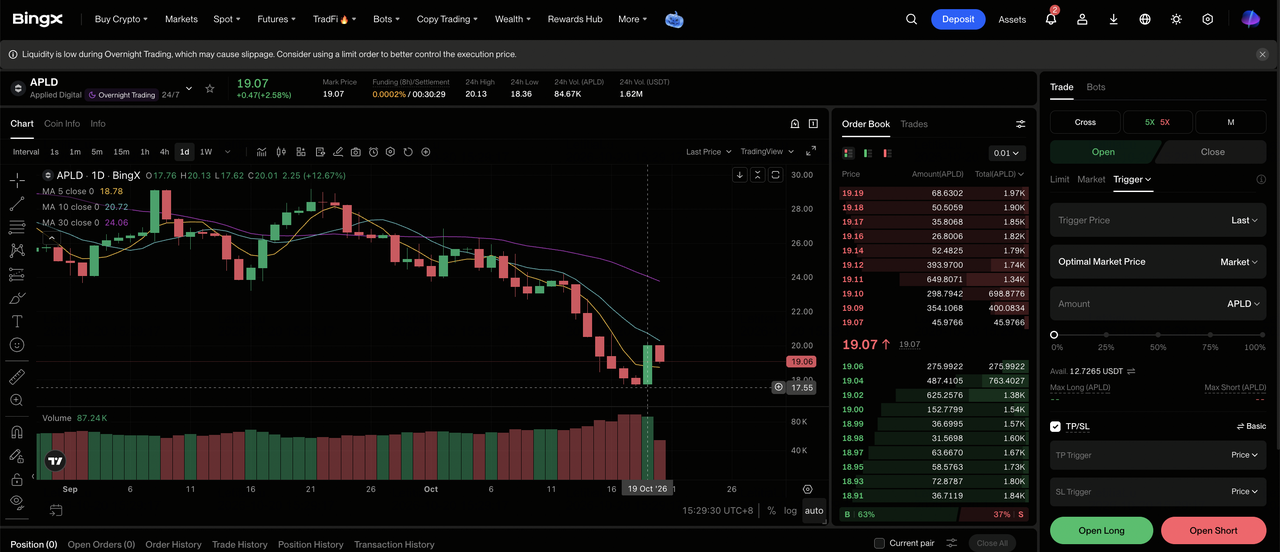
Step 1: Access BingX TradFi. Sign up and navigate to the specialized TradFi section on the BingX exchange dashboard.
Step 2: Select Applied Digital (APLD). Search for and select the APLD-USDT perpetual futures contract.
Step 3: Choose your direction. Select Open Long if you expect on-time site handovers and rising base rent. Select Open Short if you expect project delays, financing stress or dilution.
Step 4: Select leverage and margin mode. Choose Isolated or Cross-Margin based on your risk tolerance. Tenant and construction announcements can move APLD sharply.
Step 5: Execute strict risk protocols. Set Take-Profit and Stop-Loss (TP/SL) levels before or immediately after entering the trade. Monitor rent, capacity and funding milestones.
Top 5 Risks to Watch for Applied Digital Investors in 2026
The largest risk is a mismatch between the pace of capital spending and the timing of durable rental receipts. Five operational checks deserve attention as the AI campuses scale.
- Construction and power schedules can slip. The leased 1.41 gigawatts span sites still being built. Utility connections, equipment, cooling and customer acceptance determine when capacity becomes billable rent. Delays prolong financing costs and defer the lease income investors expect.
- Debt can consume project returns. August debt was $6.4 billion, with quarterly interest expense of $77.4 million. More campuses need funding before full rent begins. If terms deteriorate, incremental sales may support lenders before common shareholders.
- Equity issuance can dilute holders. Financing a multigigawatt pipeline may require shares or equity-like securities. Even if operating assets gain value, a substantially larger share count can lower per-share upside. Compare new capital raised with rent attributable to existing holders.
- Customer concentration magnifies setbacks. CoreWeave occupies Polaris Forge 1, while a small group of hyperscaler customers leases further campuses. Strong counterparties add demand visibility, but tenant acceptance or spending changes at a large project can affect results materially.
- Fit-out sales can obscure recurring progress. Tenant fit-out provided $183.5 million of quarterly HPC revenue against $65.8 million of base rent. Project work fluctuates. Revenue growth without rising capacity and rent is weaker evidence.
Final Thoughts: Should You Invest in Applied Digital in 2026?
Applied Digital has 1.41 gigawatts of AI campuses under lease and roughly $36 billion of future base-term contracted revenue. Polaris Forge 1 reached 250 live megawatts after October’s handover, and quarterly HPC base rent was $65.8 million. Yet a $221 million GAAP loss, $6.4 billion debt and substantial fit-out sales mean the order book alone does not establish common-shareholder returns.
The $45 editorial bull case needs on-time handovers and per-share returns; the $14 bear case reflects delays or costly funding. The $22 to $32 base range assumes gradual rent growth. Against the October 19 close of $19.25, track live capacity, base rent, interest expense and dilution. Twelve-month analyst targets and construction fit-out sales are weak substitutes for those milestones.
Risk Reminder: Equity and leveraged perpetual trading can result in substantial capital loss. Project delays, power constraints, concentration, financing terms, leverage and market volatility can change outcomes quickly. Conduct independent research and manage position size.
Related Reading
- Top AI Data Center Stocks to Buy in 2026: Cloud, Servers, and AI Compute Infrastructure
- Top High-Performance Computing (HPC) Stocks to Watch in 2026: Accelerated Computing Market Leaders
- Top Bitcoin Mining Stocks to Buy in 2026: BTC Hashrate Meets the AI Infrastructure Pivot
- CoreWeave (CRWV) Price Prediction 2026: Can AI Cloud Demand Push CRWV Toward $175?
- Nebius Group (NBIS) Price Prediction 2026: Can AI Cloud Growth Push NBIS Toward $350?
- IREN Limited (IREN) Price Prediction 2026: Can the AI Cloud Pivot Push IREN Toward $131?
