

Pieverse (PIEVERSE) is a Web3 AI agent and agentic commerce platform that enables autonomous agents to manage wallets, execute transactions, and make payments through messaging apps. Its infrastructure combines secure agent wallets, developer tools, and smart contract interactions across major blockchains, reducing the need for manual transaction management.
PIEVERSE is the ecosystem's utility and governance token, launched on November 14, 2025, following $10 million in private funding from investors including Animoca Ventures and CMS Holdings. Pieverse integrates agent deployment, monetizable skills, and automated payments through its A2A Commerce Protocol and x402b settlement infrastructure. This guide explains how Pieverse works, its tokenomics, key risks, and how to trade PIEVERSE on BingX.
What Is Pieverse (PIEVERSE)?
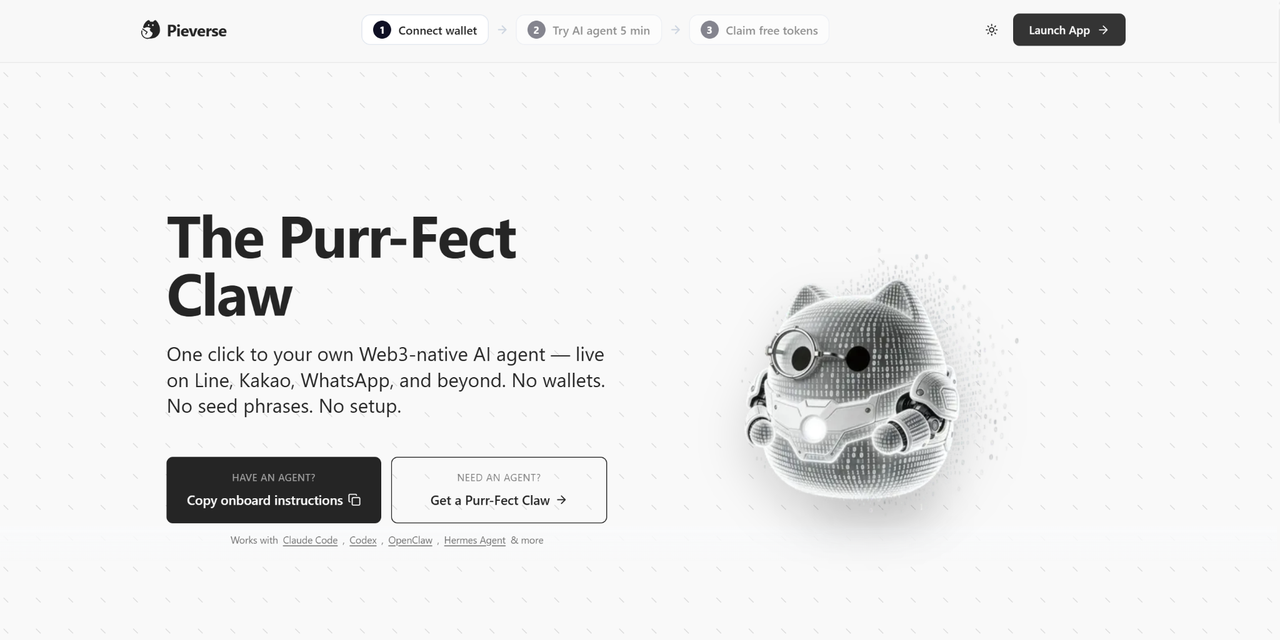
Pieverse is a Web3 infrastructure platform for autonomous AI agents, operating primarily across BNB Smart Chain and Ethereum. Originally focused on TimeFi and payment compliance, it has expanded into an ecosystem where AI agents can hold funds, verify on-chain identities, and transact autonomously. Through its purr CLI and Purr-Fect Claw interface, private keys are stored inside hardware-isolated Trusted Execution Environments (TEEs), separate from third-party skill execution.
PIEVERSE has a fixed maximum supply of 1 billion tokens, designed for agentic payments, staking, governance, and ecosystem incentives, although some functions remain under development. Pieverse also supports integrations with LINE, Kakao, WhatsApp, and AI developer runtimes, but availability does not necessarily indicate active usage. Its main components include:
- Purr-Fect Claw: A one-click interface for deploying Web3-native AI agents across messaging apps and developer runtimes.
- TEE-Secured Keyless Wallet: Uses the purr CLI to store private keys in hardware-isolated environments, away from third-party skill code.
- ERC-8004 and ERC-6551 Agent Identity: Supports verifiable on-chain agent identities and programmable spending permissions.
- Purr-Fect Skill Stores: A marketplace developed with OpenSea for free, paid, and enterprise AI agent capabilities.
- A2A Commerce Protocol and x402b Rails: Enables agent-to-agent (A2A) commerce, where AI agents autonomously discover services, negotiate terms, and pay other agents through x402b gasless payment rails, with portable reputation records and auditable on-chain invoices.
How Does Pieverse Work?
Pieverse combines secure agent wallets, identity verification, developer tools, and payment protocols to automate transactions across supported blockchains. Its workflow involves five main steps:
- TEE-secured wallet provisioning: Purr-Fect Claw creates agent wallets through the purr CLI, keeping private keys in hardware-isolated environments. Agents can sign transactions, transfer tokens, and execute DeFi operations without exposing keys to third-party skills.
- Agent identity and authorization: ERC-8004 links on-chain identities to agent runtimes, while ERC-6551-based authorization is designed to support spending limits and expiration settings for existing wallets.
- Modular skill installation: Purr-Fect Skill Stores lets developers publish free, paid, and enterprise capabilities that users can install to extend agent functionality.
- Agent-to-agent payments: The A2A Commerce Protocol enables agents to discover services, negotiate transactions, and settle payments through x402b gasless rails, with portable reputation records.
- Transaction records and fiat access: On-chain invoices and receipts support payment verification, while planned fiat integrations aim to connect agent transactions with traditional payment services.
Pieverse vs. PayAI Network: What Are the Differences in AI Agent Payments?
Pieverse and PayAI Network both build Web3 payment infrastructure for autonomous AI agents around the x402 standard, but they target different layers of the stack. Pieverse focuses on an end-to-end consumer and developer agent environment, combining chat-app deployment, TEE keyless wallets, and skill marketplaces, while PayAI Network specializes in multi-chain x402 facilitator routing for sub-second API and service microtransactions.
|
Comparison |
Pieverse |
PayAI Network |
|
Core model |
Full-stack Web3 AI agent runtime, TEE wallet, skill store, and x402b A2A commerce |
Multi-chain x402 payment facilitator handling /verify and /settle endpoints |
|
Main users |
Messaging-app users, AI agent operators, and skill developers |
Web3 API providers, developers, and autonomous agent builders |
|
Token demand |
PIEVERSE utility for settlement, staking, incentives, and planned governance |
PAYAI utility for facilitator economics, liquidity, rewards, and fee discounts |
|
Main use case |
Deploying chat-native agents with keyless wallets, skills, and A2A invoices |
Routing instant stablecoin micropayments across web servers and AI agents |
|
Main advantage |
One-click onboarding in LINE, Kakao, and WhatsApp with built-in TEE custody |
Lightweight HTTP-native facilitator across Solana, Base, Polygon, and other chains |
|
Main tradeoff |
Broader stack adds execution complexity and evolving token utility |
Narrower infrastructure scope without consumer chat-agent custody |
For example, a user who wants a personal AI agent running inside WhatsApp or LINE with a built-in wallet and installable DeFi skills would look to Pieverse. In contrast, a developer adding pay-per-request USDC micropayments to an existing API endpoint would use PayAI Network's facilitator.
Read More: What Is PayAI Network (PAYAI) x402 Token and How Does It Work?
What Are the Pieverse (PIEVERSE) Tokenomics?
PIEVERSE has a fixed maximum supply of 1 billion tokens, with scheduled vesting from November 14, 2025, to November 14, 2028. Its tokenomics support agentic commerce payments, staking, governance, and ecosystem incentives. Community Growth and Ecosystem & Marketing account for 55% of total supply, while Team & Advisors, Investors, and the Foundation Reserve hold the remaining 45%.
PIEVERSE Token Utility and Supply Mechanisms
- Agentic commerce payments: PIEVERSE is designed to support agent services, subscription payments, and transactions through the A2A Commerce Protocol.
- Staking and ecosystem rewards: Token holders can stake PIEVERSE to access premium features and participate in incentive programs, subject to availability and program terms.
- Governance participation: PIEVERSE is intended for voting on protocol upgrades, integrations, and ecosystem initiatives as governance features develop.
- Fee discounts and platform benefits: PIEVERSE is designed to provide discounted transaction fees, subscriptions, and access to selected platform features.
- Fixed supply and scheduled unlocks: Maximum supply is capped at 1 billion PIEVERSE, with allocation-specific vesting schedules extending through November 2028. Token unlocks increase available supply but do not necessarily enter circulation immediately.
PIEVERSE Token Allocation
PIEVERSE's 1 billion-token supply is distributed across five allocation categories, with different initial unlocks, lockup periods, and vesting schedules.
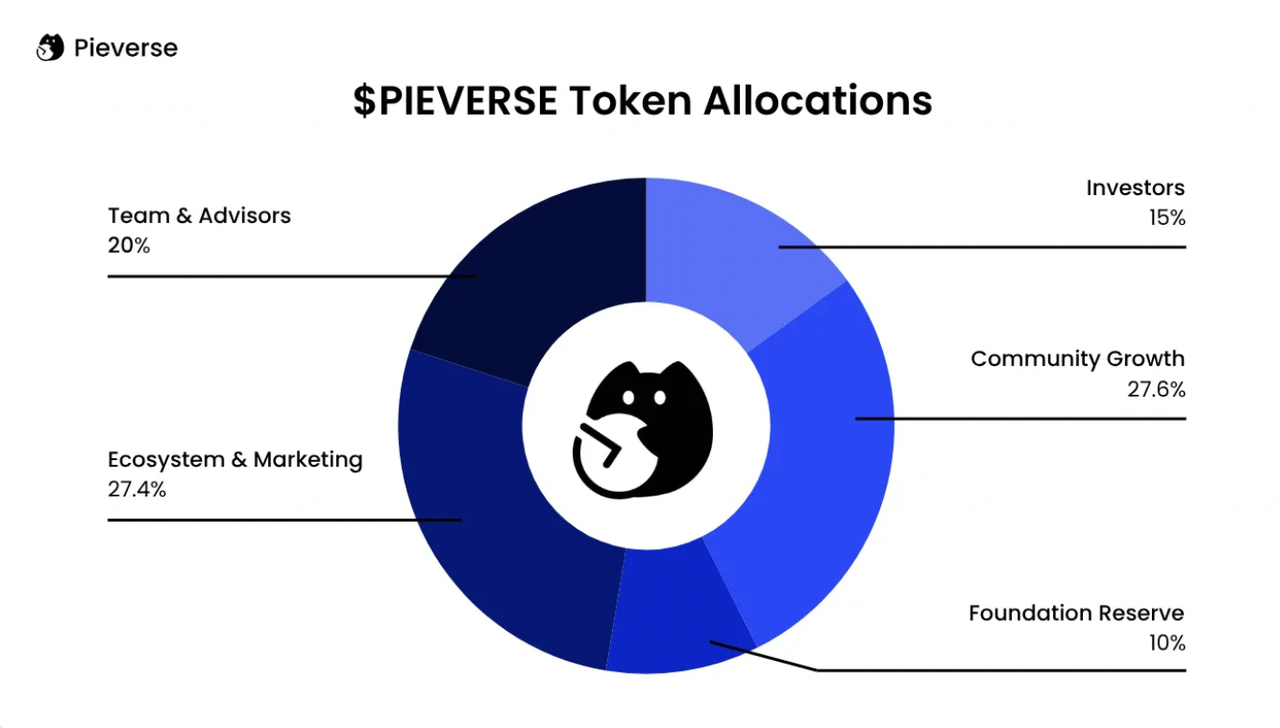
- Community Growth: 27.6%, or 276 million PIEVERSE. Supports user incentives, adoption campaigns, and community rewards. 14.5% of this allocation unlocked at TGE, with the remainder vesting linearly over 36 months.
- Ecosystem and Marketing: 27.4%, or 274 million PIEVERSE. Funds developer grants, ecosystem development, and partnerships. 49.3% unlocked at TGE, followed by 30 months of linear vesting.
- Team and Advisors: 20%, or 200 million PIEVERSE. Reserved for core contributors and advisors, subject to a 12-month cliff and 24 months of linear vesting.
- Investors: 15%, or 150 million PIEVERSE. Allocated to private-round investors, with a 12-month cliff and 18 months of linear vesting.
- Foundation Reserve: 10%, or 100 million PIEVERSE. Supports long-term ecosystem development and strategic reserves, with a 6-month cliff and 18 months of linear vesting.
PIEVERSE's team and investor lockups ended on November 14, 2026, introducing additional scheduled token releases alongside ongoing community and ecosystem emissions. Investors should monitor monthly unlocks, circulating supply, and market demand, as increased token availability could create selling pressure if adoption and liquidity fail to keep pace.
How to Trade Pieverse (PIEVERSE) on BingX
BingX offers two ways to gain exposure to Pieverse. Spot trading is for users who want to buy and hold PIEVERSE directly, while perpetual futures are for active traders who want long or short exposure to PIEVERSE price movements.
Spot Trading: Buy and Own PIEVERSE Directly
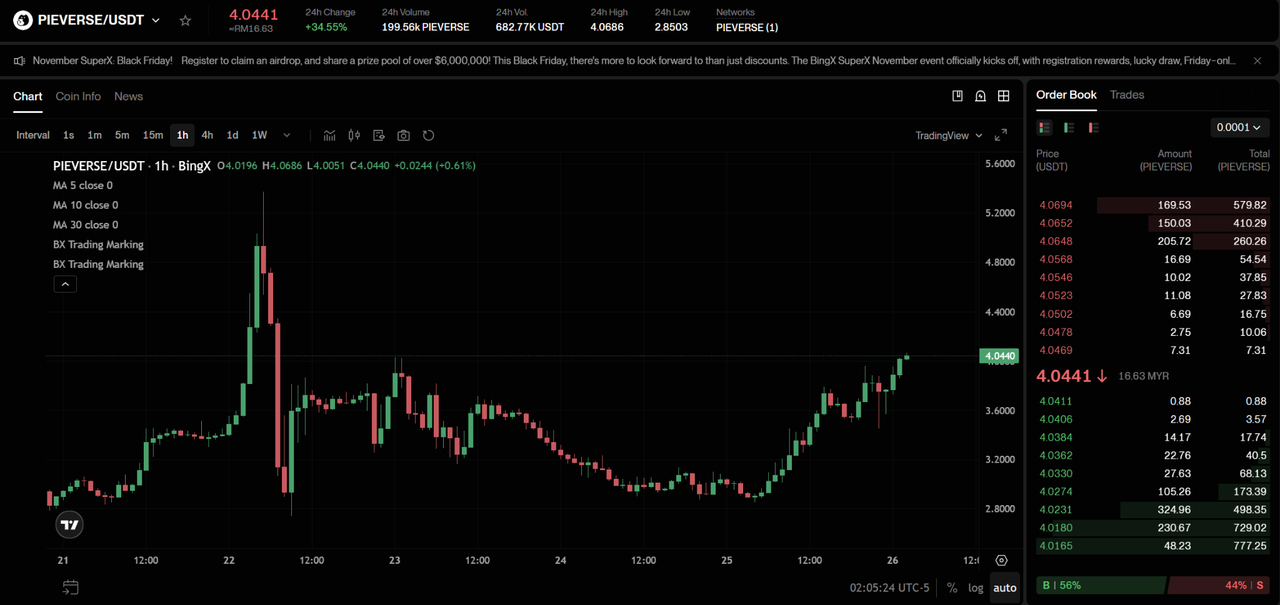
Step 1: Account setup and security. Sign up and log into BingX, complete the identity verification (KYC) required in your region, and enable two-factor authentication.
Step 2: Fund your spot account. Deposit USDT or another supported asset into the spot account. Where available, supported fiat on-ramp options may also be used.
Step 3: Open the spot market. Search for the PIEVERSE/USDT pair.
Step 4: Choose an order type. Use a market order to buy PIEVERSE at the available market price, or a limit order to set a target purchase price.
Step 5: Manage your PIEVERSE. After the order fills, PIEVERSE appears in the spot account. It can remain on BingX or be withdrawn to a BNB Smart Chain-compatible self-custody wallet if withdrawals are supported on the relevant network.
Futures Trading: Trade PIEVERSE Price Movements
BingX lists a USDT-margined PIEVERSE perpetual. Because leverage can amplify both gains and losses, futures are intended for traders who understand liquidation and have a defined risk plan.
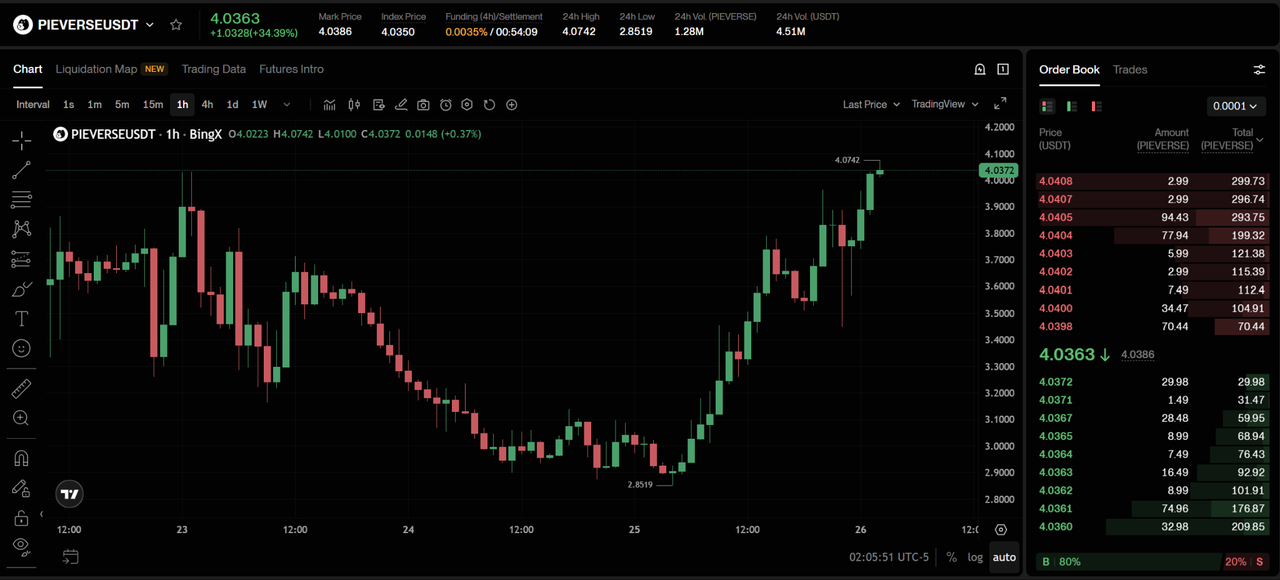
Step 1: Transfer collateral. Move USDT from the spot account to the futures account, where it is used as margin.
Step 2: Select the contract. Open the PIEVERSE-USDT perpetual.
Step 3: Set direction and leverage. Open long or short based on the trading thesis. Select leverage and position size within the defined risk limit.
Step 4: Execute the trade. Enter the order amount and use a market or limit order according to the trading plan.
Step 5: Manage risk. Set stop-loss and take-profit controls before or immediately after entry. Profit and loss settle dynamically in USDT.
Risks and Considerations Before Investing in Pieverse (PIEVERSE)
Pieverse's outlook depends on whether AI agent adoption and x402b transaction activity can generate sustainable token demand as scheduled unlocks increase supply. Investors should consider five key risks:
- Token unlocks may increase selling pressure: Approximately 63.5% of PIEVERSE's 1 billion-token supply remained locked as of November 2026, with releases continuing through November 2028. Selling pressure could rise if demand fails to absorb new supply.
- Agent adoption may not drive token demand: Users can access agent services and make stablecoin payments without holding PIEVERSE, so higher transaction volume does not guarantee greater token demand.
- Evolving token utility creates execution risk: Some payment, staking, and governance functions remain under development. Delays could weaken PIEVERSE's long-term utility.
- TEE wallets and third-party skills carry security risks: Hardware vulnerabilities, flawed wallet permissions, or malicious skills could expose user funds to unauthorized transactions.
- PIEVERSE faces high market volatility: Speculative AI agent demand, changing liquidity, and token unlocks can trigger sharp price fluctuations. Past rallies do not guarantee future returns.
Final Thoughts: Should You Invest in Pieverse (PIEVERSE) ?
Pieverse combines TEE-secured keyless wallets, messaging-app integrations across LINE, Kakao, and WhatsApp, and gasless x402b agent-to-agent payments within one Web3 ecosystem. Its growth potential depends on making AI agent deployment more accessible while enabling developers to monetize services through Purr-Fect Skill Stores.
The key question is whether sustained agent adoption and on-chain transaction activity can generate enough PIEVERSE demand to offset scheduled token unlocks. While its wallet infrastructure and ERC-8004 identity integration support its long-term development, the token remains exposed to supply pressure and AI-sector volatility. Investors should monitor monthly unlocks, active agent wallets, x402b transaction volume, and developer adoption to assess ecosystem growth.
Risk Reminder: PIEVERSE is a speculative cryptocurrency subject to substantial price volatility, token dilution, and technical security risks. Growing platform adoption does not guarantee token appreciation, and planned features may face development delays. Investors should evaluate circulating supply, liquidity, and their risk tolerance before trading PIEVERSE.
Related Reading
- What Is PayAI Network (PAYAI) x402 Token and How Does It Work?
- Top x402 Payment Protocol Projects for Blockchain-Based AI Agents
- What Are the Top 10 AI Agent Crypto Projects of 2026?
- What Are the Top 7 DeFAI (AI + DeFi) Projects to Watch in 2026?
- What Is Virtuals Protocol (VIRTUAL), the Economic Engine of the AI Agent Society and How to Buy?
- What Is Warden Protocol (WARD), the Foundation for the "Do-It-For-Me" Agentic Internet?
FAQs About Pieverse (PIEVERSE)
1. What Makes Pieverse Different From Other Web3 AI Agent Projects?
Pieverse combines TEE-secured wallets, messaging-app AI agents, ERC-8004 identities, and Purr-Fect Skill Stores. Its x402b payment rails also support automated agent-to-agent transactions.
2. What Blockchain Is PIEVERSE On?
PIEVERSE operates on BNB Smart Chain (BEP-20) and Ethereum. Its BNB Smart Chain contract address is 0x0e63b9c287e32a05e6b9ab8ee8df88a2760225a9. Always verify the network and contract before transferring.
3. Is PIEVERSE's Token Supply Publicly Disclosed?
Yes. PIEVERSE has a maximum supply of 1 billion tokens, allocated to Community Growth (27.6%), Ecosystem and Marketing (27.4%), Team and Advisors (20%), Investors (15%), and Foundation Reserve (10%). Vesting extends through November 2028.
4. Which Wallets Support PIEVERSE?
PIEVERSE can be stored in compatible EVM wallets, including MetaMask, on supported networks. Pieverse also offers TEE-secured agent wallets. Always confirm network compatibility before transferring.
