


Abbott Laboratories (ABT) delivered the rarest outcome of the July 2026 earnings season: a beat, a guidance raise, and a stock that actually went up. On July 16, the company reported second-quarter sales of $12.59 billion, up 13.0% on a reported basis, with adjusted diluted EPS of $1.31 against a consensus near $1.28. Shares rose more than 11% in morning trading toward $99.59, with some measures putting the move as high as 14%.
The size of the reaction came from context rather than magnitude. Both the revenue and EPS figures deviated by less than 2% from estimates, which the market normally treats as neutral. What changed the tone was that Abbott raised full-year adjusted EPS guidance to $5.45 to $5.60 from $5.38 to $5.58, just one quarter after cutting that same guidance because of dilution from its $21 billion acquisition of Exact Sciences. CEO Robert Ford framed the quarter as a building block and said momentum should drive accelerating sales and earnings growth through the second half.
The ABT stock forecast for 2026 now centers on two competing views:
- The launch case: Bulls expect four major product launches, Diagnostics growth from Exact Sciences, and 8.5% Medical Devices growth to drive accelerating results, with analyst targets running as high as $134.
- The competition case: Bears see continuous glucose monitoring competition intensifying, Nutrition sales declining, US mitral share pressure inside Structural Heart, and a China business still expected to shrink on volume-based procurement.
This guide breaks down the ABT stock forecast, 2026 price scenarios, key risks, and research from BTIG, RBC Capital and Evercore ISI, drawing on the July 16 earnings release and the Q2 investor call, plus how to trade ABT stock futures on BingX TradFi with USDT collateral.
Top 5 Things for Abbott Investors to Know in July 2026
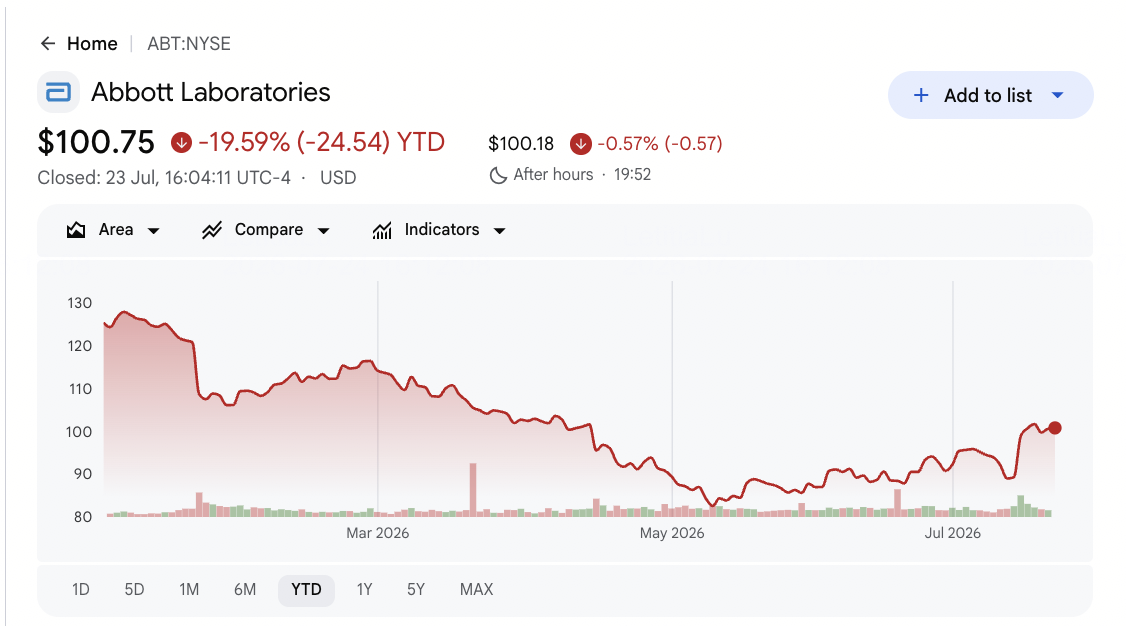
- Q2 sales of $12.59 billion grew 13.0% with adjusted EPS of $1.31: Revenue rose 13.0% on a reported basis and 4.8% on a comparable basis, while adjusted EPS beat the $1.28 consensus and rose from $1.26 a year earlier. GAAP diluted EPS was $0.53, with net profit of $928 million.
- Full-year EPS guidance was raised one quarter after being cut: Abbott lifted adjusted EPS guidance to $5.45 to $5.60 from $5.38 to $5.58, having reduced it in Q1 on dilution from the $21 billion Exact Sciences acquisition. Comparable sales growth guidance was reaffirmed at 6.5% to 7.5%.
- The stock rose more than 11% in a single session: Shares traded toward $99.59, a move that stands out because both headline figures deviated less than 2% from estimates. The market was reacting to the guidance reversal and the second-half acceleration message.
- Diagnostics grew 42.3% on a reported basis: The Exact Sciences contribution drove the reported figure, though comparable growth was 2.9%, with Cancer Diagnostics up 13% while Rapid and Molecular Diagnostics fell 8% on a weak respiratory virus season.
- Four major product launches are queued: Abbott secured CE Mark for the Libre Duo dual glucose-ketone sensor, submitted the next-generation Amulet 360 LAAO device to the FDA, completed enrollment in the TECTONIC intravascular lithotripsy trial, and is preparing the TactiFlex Duo pulsed field ablation catheter for the U.S.
What Is Abbott Laboratories (ABT)?

Abbott Laboratories is a diversified healthcare company operating across four business segments, a structure that distinguishes it from single-focus pharmaceutical or device peers. Medical Devices is the largest growth engine, growing 9.0% on a reported basis and 8.4% comparable in the quarter, spanning Diabetes Care, Electrophysiology, Structural Heart, Rhythm Management, Heart Failure, Neuromodulation and Vascular.
Diagnostics has been transformed by the $21 billion Exact Sciences acquisition, which lifted reported segment growth to 42.3% while comparable growth ran 2.9%. Established Pharmaceuticals sells branded generics into emerging markets and grew 8.4% reported on demand in India, Latin America and Southeast Asia. Nutrition, covering pediatric and adult nutrition products, declined 3.1% reported. Within Medical Devices, continuous glucose monitoring passed $2 billion in quarterly sales at 9.5% growth, Rhythm Management grew 9.5%, Heart Failure grew 9%, and Electrophysiology grew in the low teens. Adjusted gross margin reached 58.0% of sales, up 100 basis points year over year. Abbott returned $2.1 billion to shareholders in the quarter through dividends and buybacks and declared its 410th consecutive quarterly dividend.
Abbott (ABT) Q2 2026 Earnings: What Drove the Beat and the Guidance Raise
- Medical Devices carried the comparable growth. The segment grew 8.5% with Electrophysiology in the low teens, Rhythm Management up 9.5%, Heart Failure up 9%, and continuous glucose monitoring passing $2 billion at 9.5% growth.
- Exact Sciences transformed the Diagnostics optics. Reported Diagnostics growth of 42.3% reflected the acquisition, with Cancer Diagnostics up 13% and the U.S. business up 7.5%, though comparable growth was a more modest 2.9%.
- Gross margin expanded 100 basis points. Adjusted gross margin reached 58.0% of sales, which is what allowed an EPS raise on reaffirmed rather than raised sales guidance.
- Emerging markets pharmaceuticals held up. Established Pharmaceuticals grew 8.4% reported and 8.7% comparable, driven by India, Latin America and Southeast Asia, providing a counterweight to the China headwind.
- Management signalled second-half acceleration. Ford said the quarter represents an important building block and that momentum should drive accelerating sales and earnings growth in the second half, which BTIG read as evidence of stability in underlying procedure volumes.
Abbott Laboratories Q2 2026 Financial and Consensus Profile: Sales, EPS and Segments
Abbott's Q2 print was close to in line on the headline numbers and decisive on guidance. The distinction matters because the guidance raise reversed a cut made only one quarter earlier.
|
Financial Metric |
Consensus Estimate |
Reported / Actual |
Surprise |
|
Q2 2026 Sales |
~$12.50 to $12.62 billion |
$12.59 billion |
In line to slightly ahead; up 13.0% reported, 4.8% comparable |
|
Q2 2026 Adjusted EPS |
~$1.28 |
$1.31 |
Beat; up from $1.26 a year earlier, above the guidance midpoint |
|
Q2 2026 GAAP EPS |
— |
$0.53 |
Net profit of $928 million after specified items |
|
Q2 2026 Medical Devices |
— |
Up 9.0% reported |
8.4% comparable; CGM sales passed $2 billion at 9.5% growth |
|
Q2 2026 Diagnostics |
— |
Up 42.3% reported |
2.9% comparable; Rapid and Molecular fell 8% |
|
Q2 2026 Established Pharma |
— |
Up 8.4% reported |
8.7% comparable on India, Latin America and Southeast Asia |
|
Q2 2026 Nutrition |
— |
Down 3.1% reported |
Down 3.6% comparable; sequential increase of $125 million |
|
Q2 2026 Adjusted Gross Margin |
— |
58.0% of sales |
Up 100 basis points year over year |
|
FY2026 Adjusted EPS Guidance |
$5.38 to $5.58 prior |
$5.45 to $5.60 |
Raised; brackets the $5.49 consensus |
For context, Abbott cut this same guidance one quarter earlier because of dilution from the Exact Sciences acquisition, which makes the reversal the single most important element of the release. Full-year comparable sales growth guidance was reaffirmed at 6.5% to 7.5%, and third-quarter adjusted EPS was guided to $1.38 to $1.46. Analyst estimates for full-year 2026 revenue sit near $50.70 billion. Abbott returned $2.1 billion to shareholders in the quarter and declared its 410th consecutive quarterly dividend, one of the longest such records in the market.
Abbott (ABT) 2026 Investment Outlook: $134 Bull Case vs. $85 Bear Case
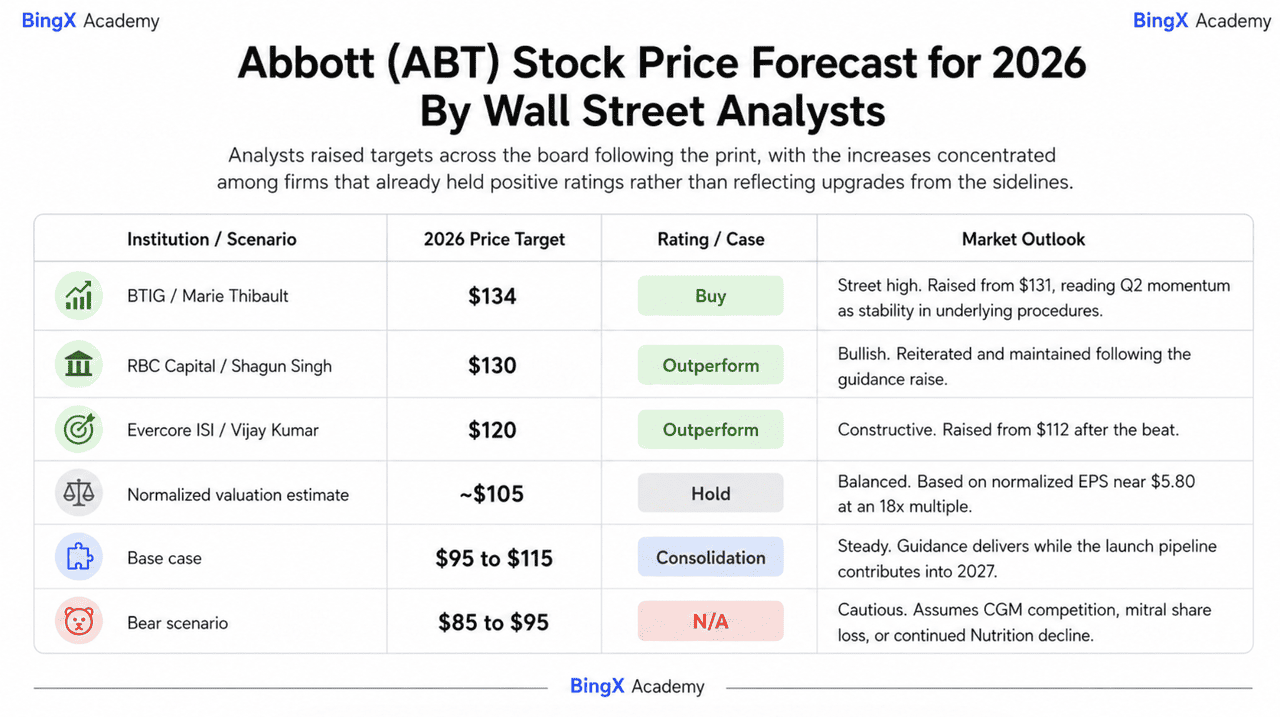
Abbott's outlook for the rest of 2026 depends on one central question: whether the four-product launch pipeline can accelerate growth enough to outrun competitive pressure in its two largest device franchises.
The Bull Case: New Product Launches Push ABT Toward $134
The bull case rests on a pipeline that could begin contributing within the next 12 months. Abbott has secured CE Mark approval for the Libre Duo dual glucose-ketone sensor, submitted the next-generation Amulet 360 device to the FDA, completed enrollment in the TECTONIC intravascular lithotripsy trial, and is preparing TactiFlex Duo pulsed field ablation for the U.S. market. Together, these launches create an unusually active catalyst calendar for a company of Abbott’s size.
This scenario requires the second-half acceleration outlined by management to materialize. BTIG raised its target to $134, RBC Capital maintained $130, and Evercore ISI increased its target to $120. Abbott also has a solid financial base, with adjusted gross margin expanding 100 basis points to 58.0%, emerging-market pharmaceutical sales growing 8.7%, and Exact Sciences adding a cancer diagnostics business growing 13%. If the launch pipeline converts as expected, ABT could move toward the mid-$130s.
The Base Case: Raised Guidance Keeps ABT Between $95 and $115
In the base case, Abbott delivers its higher full-year outlook but the stock does not extend much beyond its post-earnings gain. Adjusted EPS reaches $5.45 to $5.60, comparable sales growth finishes between 6.5% and 7.5%, and the new product pipeline contributes more meaningfully in 2027.
The main limitation is valuation. An 11% to 14% single-session gain on results that differed only modestly from expectations suggests much of the near-term optimism has already been priced in. Abbott’s 410 consecutive quarterly dividends and $2.1 billion of quarterly shareholder returns provide downside support, while its diversified business mix reduces execution risk. That combination supports steady compounding, but not necessarily another rapid re-rating.
The Bear Case: Competitive and Segment Pressure Pull ABT Toward $85
The bear case is that margin pressure builds in Abbott’s most important growth businesses. Continuous glucose monitoring now generates more than $2 billion in quarterly revenue, but its 9.5% growth trails the broader medical devices segment. Management has also acknowledged stronger competition in the U.S. mitral market.
The main trigger would be continued weakness in Nutrition and slower underlying Diagnostics growth. Nutrition declined 3.1% reported and 3.6% comparable, while Rapid and Molecular Diagnostics fell 8% because of a weak respiratory season. Excluding Exact Sciences, Diagnostics grew only 2.9% comparable, meaning the headline growth rate overstates the core trend. If procedure volumes soften or product launches are delayed, ABT could give back part of its post-earnings rally and fall toward $85.
Abbott (ABT) Stock Price Forecasts for 2026 By Wall Street Analysts
Analysts raised targets across the board following the print, with the increases concentrated among firms that already held positive ratings rather than reflecting upgrades from the sidelines.
|
Institution |
2026 Price Target |
Rating |
Market Outlook |
|
BTIG / Marie Thibault |
$134 |
Buy |
Street high. Raised from $131, reading Q2 momentum as stability in underlying procedures. |
|
RBC Capital / Shagun Singh |
$130 |
Outperform |
Bullish. Reiterated and maintained following the guidance raise. |
|
Evercore ISI / Vijay Kumar |
$120 |
Outperform |
Constructive. Raised from $112 after the beat. |
|
Normalized valuation estimate |
~$105 |
Hold |
Balanced. Based on normalized EPS near $5.80 at an 18x multiple. |
|
Base case |
$95 to $115 |
Consolidation |
Steady. Guidance delivers while the launch pipeline contributes into 2027. |
|
Bear scenario |
$85 to $95 |
N/A |
Cautious. Assumes CGM competition, mitral share loss, or continued Nutrition decline. |
How to Trade Abbott Laboratories (ABT) Stock on BingX
Navigate the volatility of Abbott's earnings cycle using BingX TradFi and BingX AI tools. By leveraging AI-driven predictive analytics, you can better anticipate market sentiment shifts and price action around quarterly releases.
Spot Trading: Buy and Own Tokenized ABT Directly
Spot trading is the most straightforward way to gain Abbott exposure on BingX. When users buy tokenized ABT on the spot market, they hold the asset directly in their BingX spot account, with no leverage, no funding costs and no liquidation risk.
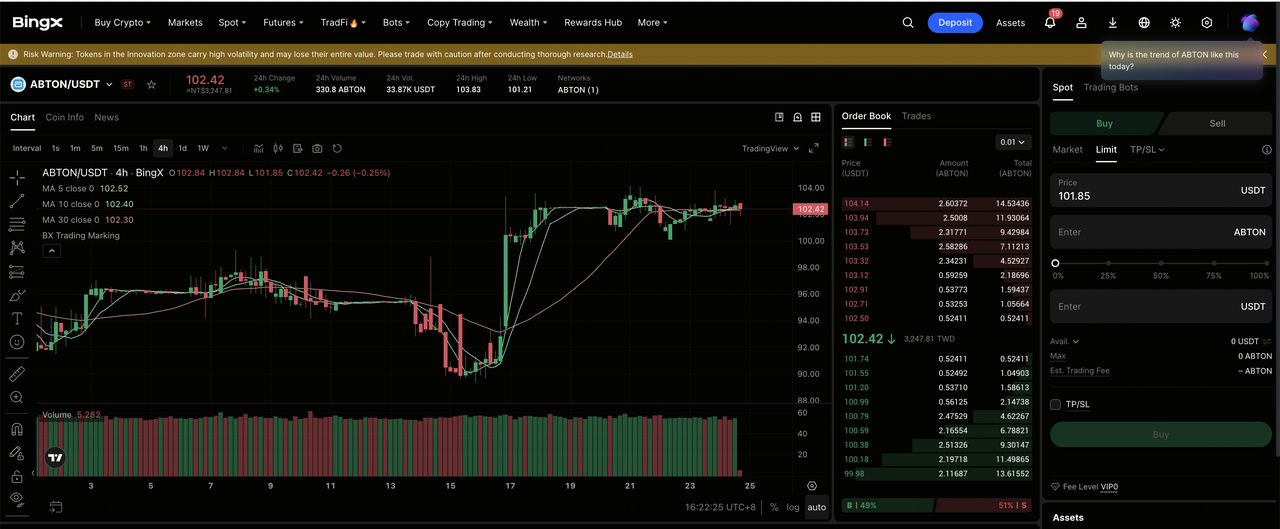
Step 1: Account setup and security. Sign up and log into your BingX account, complete the identity verification (KYC) required in your region, and enable two-factor authentication.
Step 2: Fund your spot account. Deposit USDT or another supported asset into your BingX spot account. Where available, users can also use supported fiat on-ramp options.
Step 3: Navigate to the spot market. Search for the ABTON/USDT trading pair.
Step 4: Place your order. Choose a market order to buy tokenized ABT immediately at the current price, or use a limit order to set the price you want to pay. Because Abbott rose more than 11% in a single session on figures within 2% of consensus, a limit order lets you define your entry rather than chase a post-earnings move.
Step 5: Manage your position. Once filled, your tokenized ABT appears in your spot account, where it tracks the underlying share price. Spot positions carry no liquidation risk, which makes them suitable for holding through an earnings release.
Top 5 Risks to Watch for Abbott Investors in 2026
To navigate the second half of 2026, investors must weigh Abbott's diversification against these five competitive and structural headwinds.
- Continuous glucose monitoring faces intensifying competition: CGM sales passed $2 billion quarterly at 9.5% growth, slower than the 8.5% device segment average would suggest for a franchise this central, and competitive pressure is building.
- Diagnostics growth is largely acquired: Reported growth of 42.3% falls to 2.9% on a comparable basis. Rapid and Molecular Diagnostics declined 8% on a weak respiratory season, a variable outside Abbott's control.
- Nutrition continues to shrink: The segment declined 3.1% reported and 3.6% comparable despite a $125 million sequential increase, remaining a persistent drag on consolidated comparable growth.
- US mitral competition is pressuring Structural Heart: Management explicitly acknowledged competitive intensity in the U.S. mitral segment as a factor limiting growth in one of its higher-margin device franchises.
- China remains in decline on volume-based procurement: Abbott continues to forecast a shrinking China business as government procurement policy compresses pricing, a structural headwind that no product launch offsets.
Final Thoughts: Should You Invest in Abbott in 2026?
Following its July 16 report, Abbott regained credibility by reversing its earlier guidance cut. Sales rose 13.0% to $12.59 billion, adjusted EPS reached $1.31, gross margin expanded 100 basis points to 58.0%, Medical Devices grew 8.5%, and management raised its full-year outlook. The main question is whether an 11% post-earnings rally has already priced in the expected second-half acceleration.
The bull case is that four major product launches are approaching, Exact Sciences adds a cancer diagnostics business growing 13%, and procedure volumes appear to be stabilizing. The bear case is that underlying Diagnostics growth was only 2.9% excluding the acquisition, Nutrition remains weak, and competition is intensifying in CGM and the U.S. mitral market. Investors seeking defensive healthcare exposure with a meaningful launch pipeline may still find Abbott attractive, while more cautious traders may wait for Q3 to confirm that growth is accelerating before adding.
Risk Reminder: Trading and investing in equities like ABT involves a high risk of capital loss. Abbott is exposed to medical device competition, FDA approval timelines, respiratory season variability and international procurement policy, any of which can move the stock independently of its earnings. Conduct independent research before allocating capital.
Related Reading
- Johnson & Johnson (JNJ) Price Prediction 2026: Can Oncology Growth Carry JNJ Past $100 Billion?
- UnitedHealth (UNH) Stock Price Prediction 2026: AI-Driven Recovery or Regulatory Trap at $306?
- Eli Lilly (LLY) Stock Outlook 2026: Can Mounjaro and Zepbound Momentum Drive LLYON Stock to $1,200+?
- Goldman Sachs (GS) Price Prediction 2026: Record Quarter Momentum or Valuation Ceiling at $1,140?
- JPMorgan Chase (JPM) Price Prediction 2026: Fortress Defense or AI-Driven Alpha at $341?
- Accenture (ACN) Outlook 2026: Can AI Transformation and Consulting Demand Drive ACN Stock to $450+?
