
Arrow Finance (ARROW) is a decentralized lending protocol built natively on Robinhood Chain, an Ethereum-compatible Layer 2 focused on tokenized real-world assets. Its core idea is to let people borrow liquidity against assets they already hold, including tokenized public stocks and ETFs, without selling them or giving up future exposure to those assets. The tax treatment of borrowing and collateralized positions depends on the user’s jurisdiction and circumstances. Arrow describes itself as a collateralized debt position (CDP) protocol built to accept tokenized equities as collateral, positioning itself as an early DeFi gateway for the Robinhood Chain narrative.
Arrow has introduced its ARROW token and is testing its CDP product as Robinhood Chain, tokenized stocks, and real-world asset (RWA) narratives become more visible in 2026. The ecosystem has several key parts: ARROW is the governance token, aUSD is the overcollateralized stablecoin users mint, veARROW is the vote-escrowed governance token, and Arrow Pad is a launchpad for new Robinhood Chain projects. However, Arrow’s official protocol documentation states that veARROW governance is planned and not yet live, while the production borrowing interface is still marked “coming soon.” This guide explains what Arrow Finance is, how the protocol works, how ARROW tokenomics functions, the main risks to consider, and how to buy ARROW using BingX as an on-ramp.
What Is Arrow Finance (ARROW)?
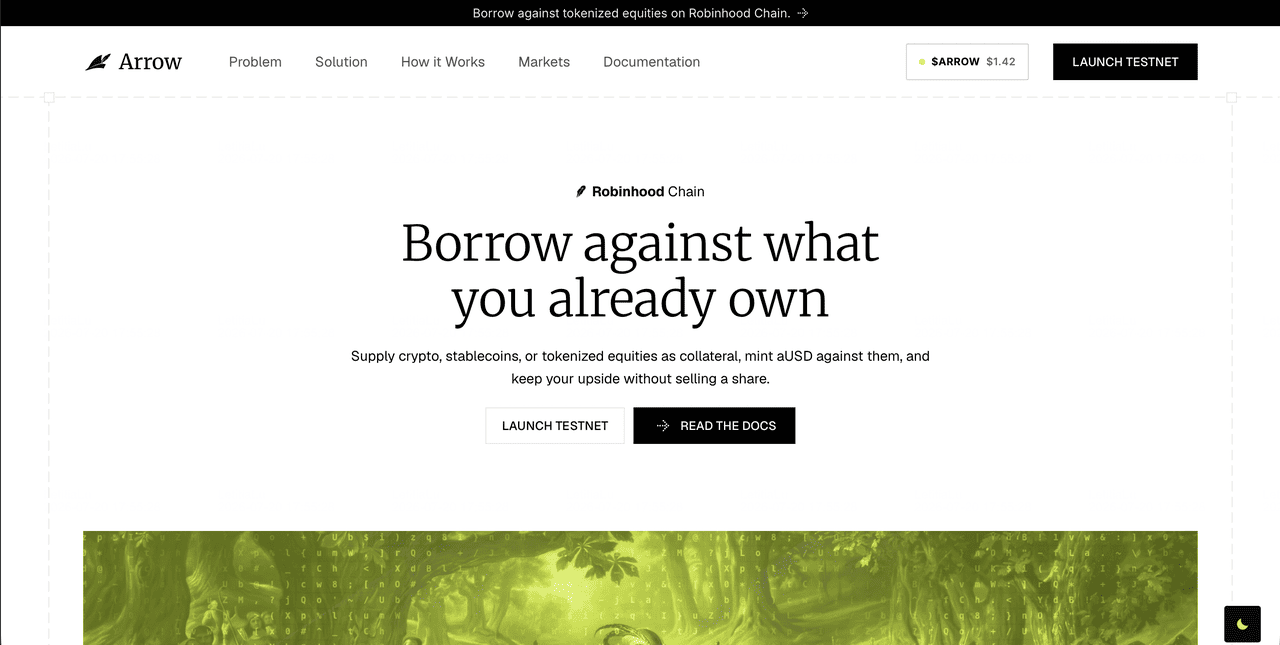
Source: Arrow Finance
Arrow Finance (ARROW) is a single-chain, overcollateralized CDP protocol deployed on Robinhood Chain, an Arbitrum Orbit Layer 2 built for tokenized real-world assets. Users deposit approved collateral into an isolated vault and mint aUSD, a USD-denominated overcollateralized stablecoin, against it. Each vault is independently collateralized, independently liquidated, and independently priced, so a risky position in one vault does not spill over into others by default.
What makes Arrow distinct from a typical crypto CDP is its collateral set. Alongside major crypto and stablecoin collateral, Arrow Finance is designed to accept tokenized public equities and ETFs as collateral, settled natively on Robinhood Chain. A holder of tokenized shares can borrow liquidity against that position without selling the underlying asset or leaving the chain where those shares are issued. ARROW is the governance token of this lending ecosystem, and holders will be able to lock it to receive veARROW, a vote-escrowed token that grants greater voting power the longer it is locked once governance launches.
The core idea behind Arrow is simple: long-term holders should be able to unlock liquidity from their assets instead of selling them. ARROW coordinates governance and long-term alignment across the protocol.
Key components of the Arrow Finance ecosystem include:
- ARROW token: The governance token of the protocol, intended to be used for decisions through the veARROW system once governance launches.
- aUSD: The USD-pegged, overcollateralized stablecoin users mint by depositing collateral into vaults.
- veARROW: The vote-escrowed governance token created by locking ARROW, giving longer locks more voting power. This governance mechanism is planned but not yet live.
- Isolated vaults: Independent collateral positions with their own loan-to-value ratios and liquidation thresholds.
- Arrow Pad: A launchpad designed to simplify token creation and fundraising on Robinhood Chain.
What Is Robinhood Chain?
Robinhood Chain is a permissionless, Ethereum-compatible Layer 2 developed by financial services company Robinhood Markets using Arbitrum technology. It is designed for tokenized real-world assets, including public equities, ETFs, private assets, and other financial instruments. The network uses ETH for gas and aims to offer faster, lower-cost transactions while allowing third-party developers to deploy independent DeFi applications such as Arrow Finance.
Read More: What Is Robinhood Chain? A Beginner’s Guide to Robinhood’s Blockchain Strategy in 2026
How Does Arrow Finance Work?
Arrow Finance works as a Robinhood Chain-native CDP protocol whose lending markets, stablecoin, and governance are shaped by collateralized vaults, risk parameters, and the ARROW token. The core borrowing and liquidation loop is currently available through Arrow’s testnet, while several governance and risk-management components remain planned.
- Users deposit collateral into isolated vaults: Approved collateral, including crypto, stablecoins, and tokenized equities and ETFs, is locked into individual vaults, each priced and managed independently.
- Borrowers mint aUSD against collateral: Users mint aUSD, an overcollateralized USD-denominated stablecoin, while every position keeps collateral worth more than the outstanding debt.
- Risk parameters protect solvency: Each supported asset has a defined loan-to-value ratio and liquidation threshold, and a vault can be liquidated if collateral value drops below the specified level.
- A stability pool and surplus buffer absorb losses: The protocol uses a stability pool to repay undercollateralized vaults and a surplus buffer, funded by protocol fees, to absorb losses before users are affected. Arrow states that the Stability Pool is the first liquidation backstop. Additional redistribution and treasury-funded liquidation mechanisms remain planned rather than active.
- veARROW governs the protocol: ARROW holders are expected to be able to lock tokens for veARROW to vote on collateral onboarding, loan-to-value settings, liquidation parameters, fees, approved oracle feeds, and Surplus Buffer allocation. Until governance launches, the team manages these protocol parameters.
Arrow Finance vs. Sky Protocol (Formerly MakerDAO): Key Differences
Arrow Finance and Sky Protocol (Formerly MakerDAO) both use overcollateralized collateralized debt positions to issue stablecoins, but they differ in collateral focus, ecosystem, and operating history.
|
Comparison |
Arrow Finance |
MakerDAO |
|
Core model |
CDP-based stablecoin protocol |
CDP-based stablecoin protocol |
|
Main collateral |
Tokenized public equities, ETFs, and other RWAs |
Primarily crypto assets, with additional RWA exposure |
|
Target ecosystem |
Robinhood Chain and tokenized asset markets |
Ethereum and the broader DeFi ecosystem |
|
Main use case |
Borrow against tokenized stocks and ETFs |
Mint a stablecoin against established collateral types |
|
Main advantage |
Direct integration with tokenized traditional assets |
Longer operating history, deeper liquidity, and broader adoption |
|
Main tradeoff |
Early-stage protocol and ecosystem execution risk |
More established but less focused on tokenized equity collateral |
Arrow Finance focuses on borrowing against tokenized stocks and ETFs, while MakerDAO offers a more established stablecoin system with deeper liquidity and a longer operating history. The choice depends on whether users prioritize RWA-focused collateral or the maturity of an established DeFi protocol.
Read More: What Is Sky (SKY)? A Beginner's Guide to How Sky Protocol Works (2026)
Arrow Finance Ecosystem in 2026: CDP Mainnet, Arrow Pad, and RWA Interest
Arrow has emerged as an early project associated with Robinhood Chain. Its 2026 story is shaped by three developments: testing its CDP lending product, the Arrow Pad launchpad, and growing interest in tokenized real-world assets.
The CDP product is the most important driver to watch. Arrow’s documentation lists 24 configured collateral markets covering WETH, USDG, tokenized equities, and ETFs, including assets such as AAPL, TSLA, NVDA, COIN, SPY, and QQQ. However, Arrow’s official interface identifies the current borrowing environment as a testnet, uses mock or forked price feeds, and shows several collateral markets as coming soon. The production borrowing interface also states that borrowing will become available once lending launches. Arrow's long-term strength depends on whether the CDP attracts real borrowing volume after production launch and whether Robinhood Chain activity keeps growing.
Read More: What Is USDG? A Beginner's Guide to How the Global Dollar Network Works (2026)
What Are the Arrow Finance (ARROW) Tokenomics?
ARROW tokenomics center on a governance-first design built around vote-escrow locking rather than payments. ARROW is the governance token of Arrow Finance, and its main utility is intended to be coordinating protocol decisions through the veARROW system. The official documentation confirms that ARROW has a fixed supply established at genesis, but it does not disclose the numerical total supply or provide a public allocation and vesting schedule on the protocol documentation page. Governance is also not yet live.
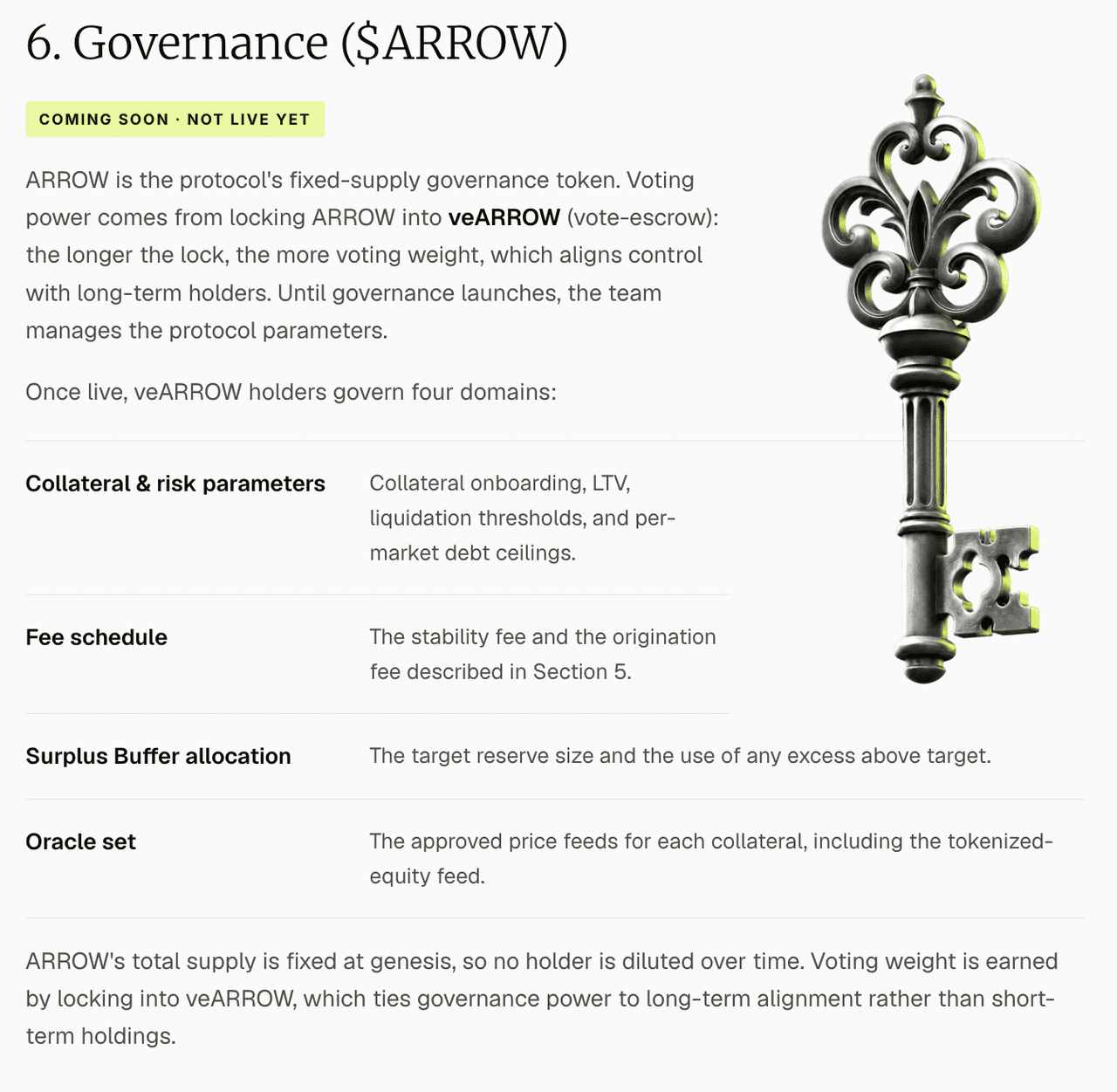
Source: Arrow Finance Docs
ARROW Token Utility and Governance
ARROW is the governance and coordination asset of the protocol. Its utility centers on long-term governance participation and ecosystem alignment.
- Governance: ARROW holders will be able to lock tokens to receive veARROW, gaining voting power over protocol upgrades, collateral onboarding, loan-to-value ratios, liquidation parameters, fees, oracle selection, and Surplus Buffer allocation once governance launches.
- Vote-escrow alignment: Locking ARROW for longer periods is designed to grant greater voting power, encouraging long-term commitment rather than short-term speculation.
- Liquidity incentives: The protocol has offered staking of ARROW liquidity-provider tokens to earn WETH rewards funded by protocol revenue. The staking page states that the team funds the reward balance and can adjust the distribution rate, so rewards are not fixed or guaranteed.
- Ecosystem role: ARROW anchors the broader Arrow suite, including the Arrow Pad launchpad, tying token relevance to ecosystem growth on Robinhood Chain.
- Protocol customization: Once governance is live, veARROW holders will be able to adjust collateral, fees, approved oracle feeds, and risk parameters, giving long-term participants influence over how the lending system evolves.
ARROW Supply Considerations
ARROW has a reported fixed supply of 10 million tokens, with external trackers estimating about 9 million in circulation. However, Arrow Finance has not published an official allocation or vesting schedule, so the status of the remaining 1 million tokens is unclear.
Investors should treat circulating supply and market-cap figures cautiously, verify the official contract, and avoid relying on wallet-concentration data without checking whether large addresses belong to liquidity pools, treasury wallets, or other protocol contracts.
How to Buy Arrow Finance (ARROW)
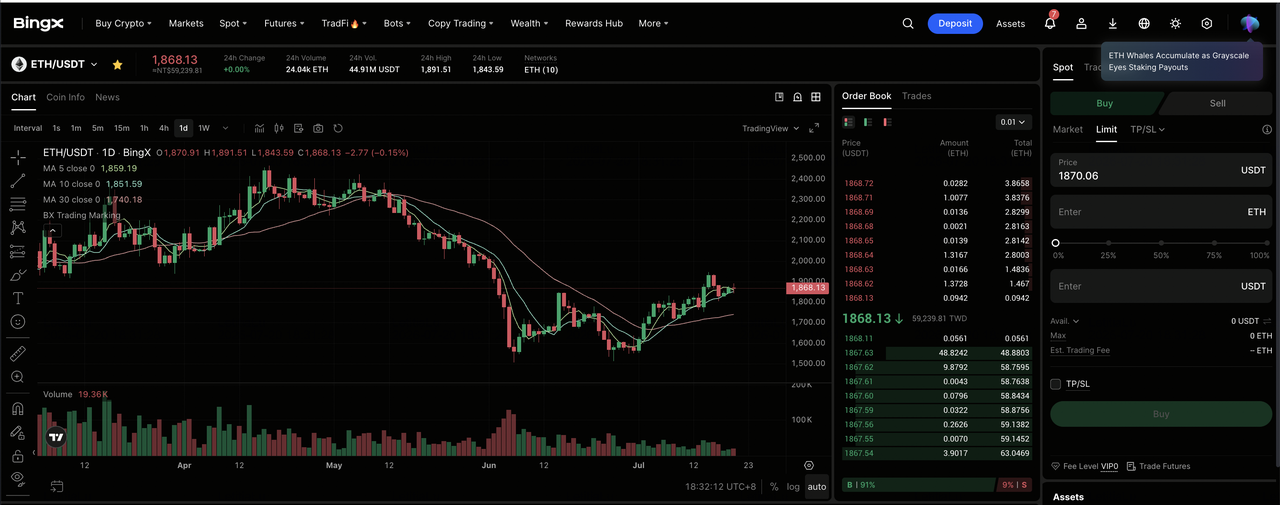
Arrow Finance (ARROW) is not currently listed on BingX, so users cannot buy or trade ARROW directly on the BingX spot or futures markets. Because Arrow is a new protocol on Robinhood Chain, ARROW trades primarily through decentralized exchange liquidity on its native chain. BingX can still be used as a secure on-ramp to acquire the USDT you need before bridging and swapping. Always confirm the correct network and verify the official contract before trading.
Using BingX as an On-Ramp, Then Buying ARROW on a DEX
The most direct way to acquire ARROW is to fund a self-custody wallet through BingX, bridge a supported asset to Robinhood Chain, and swap it for ARROW on Uniswap.
Step 1: Account setup and security. Sign up and log into your BingX account, complete the identity verification (KYC) required in your region, and enable two-factor authentication.
Step 2: Buy and withdraw a supported asset. Buy ETH or another bridge-supported asset on BingX, then withdraw it to an EVM-compatible self-custody wallet such as MetaMask.
Step 3: Bridge to Robinhood Chain. Add Robinhood Chain to your wallet and use the bridge linked by Arrow Finance to transfer ETH to the network. Keep enough ETH on Robinhood Chain to pay gas fees. Arrow’s documentation currently directs users to Relay for bridging.
Step 4: Swap ARROW on Uniswap. Open Uniswap, connect your wallet, switch to Robinhood Chain, and select the asset you bridged as the payment token. Paste the official ARROW contract address, review the exchange rate, price impact, and slippage, then confirm the swap.
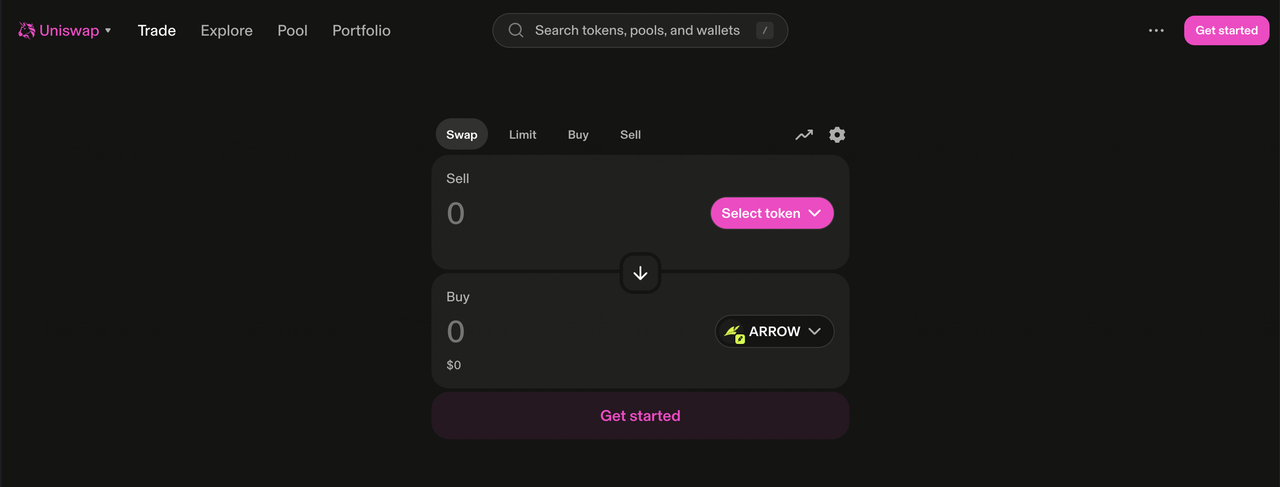
Step 5: Manage your ARROW. Once the transaction is confirmed, ARROW will appear in your self-custody wallet. Verify the token contract before adding it manually. Do not assume ARROW can already be locked for veARROW, as Arrow’s governance system is not yet live.
Note: Exchange listings and available liquidity can change. Always confirm the official ARROW contract, use the correct Robinhood Chain network, and check liquidity and price impact before swapping.
Risks and Considerations Before Investing in Arrow Finance (ARROW)
Arrow Finance has a distinctive RWA lending model, but it remains an early-stage protocol on a new chain.
- Testnet and execution risk: Arrow’s lending product is still in testnet, so its vault, aUSD, liquidation, and Stability Pool systems have limited production history.
- Liquidity risk: Robinhood Chain is still developing, and ARROW liquidity may be thin or concentrated on decentralized exchanges.
- Supply and valuation risk: Arrow confirms a fixed supply, but its official documentation does not publish a full allocation or vesting schedule. Third-party supply and valuation figures should therefore be treated carefully.
- Wallet concentration risk: Large wallets may belong to liquidity pools, treasury addresses, bridges, or protocol contracts rather than individual holders.
- Smart contract and oracle risk: Arrow depends on reliable price feeds, collateral thresholds, liquidations, and Robinhood Chain infrastructure. Several safeguards remain under development.
- Ticker-copy risk: Other projects use the ARROW name or ticker, so users should always verify the official contract address.
Final Thoughts: Should You Invest in Arrow Finance (ARROW) in 2026?
Arrow Finance is an early CDP protocol designed to let users borrow against tokenized stocks, ETFs, stablecoins, and crypto on Robinhood Chain. Its potential depends on whether the production lending system attracts real borrowing volume and durable liquidity.
Its RWA collateral focus sets it apart, but ARROW remains exposed to testnet-stage execution risk, thin liquidity, limited supply disclosures, and uncertainty around veARROW governance. Investors should monitor the production launch, aUSD supply, borrowing activity, liquidity, audits, and official token disclosures.
Related Reading
- What Is Robinhood Chain? A Beginner’s Guide to Robinhood’s Blockchain Strategy in 2026
- Robinhood Stock Forecast 2026: $130 Hyper-Growth or Valuation Correction?
- What Is Sky (SKY)? A Beginner's Guide to How Sky Protocol Works (2026)
- What Are the Top 10 DeFi Lending Protocols to Watch in 2026?
- What Are Tokenized Stocks On-Chain, Could They Be the Next Big Trend in 2026?
- What Are the Top 10 Tokenized Stocks (xStocks) to Trade in 2026?
FAQs About Arrow Finance (ARROW)
1. What Makes Arrow Finance Different From Other Lending Protocols?
Arrow Finance is designed to let users mint aUSD against tokenized public equities, ETFs, stablecoins, and crypto on Robinhood Chain. Its public lending environment is still in testnet.
2. What Chain Is ARROW On?
Arrow Finance is built on Robinhood Chain, an Ethereum-compatible Arbitrum Orbit Layer 2 focused on tokenized assets.
3. What Is aUSD?
aUSD is an overcollateralized stablecoin minted against assets deposited in Arrow’s isolated vaults. Stability Pool liquidations help support solvency, while direct redemptions remain planned.
4. Is ARROW’s Token Supply Publicly Disclosed?
Arrow states that ARROW has a fixed supply, but its official documentation does not publish a complete allocation or vesting schedule. External figures should be treated cautiously.
5. Is Arrow Finance the Same as Arrow Markets?
No. Arrow Finance is a lending protocol on Robinhood Chain, while Arrow Markets is a separate project. Always verify the official contract address.
6. Is Arrow Finance Connected to Robinhood?
Arrow Finance is built independently on Robinhood Chain, but there is no verified evidence that it is operated by, affiliated with, or officially endorsed by Robinhood Markets. Robinhood Chain is permissionless, meaning third-party developers can deploy applications without forming a partnership with Robinhood.
