

Spacecoin (SPACE) is a decentralized physical infrastructure network, or DePIN, being built to connect satellite bandwidth providers with users through blockchain-based settlement. Its roadmap, reviewed on November 17, 2026, reports four spacecraft launched across 2024 and 2025 and protocol tests involving 50,000 simulated nodes in 2026. Those figures describe hardware milestones and simulation scale, not global commercial internet coverage.
Spacecoin introduced its SPACE token on January 23, 2026, with planned uses that include paying for connectivity, staking by operators, and rewarding network participation. The broader ecosystem also includes SpaceRouter Proxy, a service that routes web traffic through residential internet connections and uses signed receipts to settle bandwidth payments on-chain. This guide explains how Spacecoin works, how SPACE tokenomics are structured, what deployment and token supply risks to consider, and how to trade SPACE perpetual futures on BingX.
What Is Spacecoin (SPACE)?
Spacecoin is a decentralized physical infrastructure network (DePIN) designed to let independent satellite operators sell internet bandwidth through a shared payment system. Its proposed Open Constellation would allow operators that meet protocol standards to contribute capacity from low-Earth-orbit satellites. Creditcoin provides the blockchain layer for holding user payments in escrow and releasing them once the network verifies that an operator delivered the service.
SPACE is the utility token designed for connectivity payments, operator staking and participation incentives. Under the proposed staking model, operators would put up SPACE as collateral and could lose part of their stake for misconduct. As of November 2026, Spacecoin’s roadmap still listed testing with independently operated nodes and broader constellation participation as upcoming work.
Key components of the Spacecoin ecosystem include:
- Open Constellation — The proposed model for bringing independent satellite operators into the network to supply bandwidth.
- Creditcoin settlement — The blockchain layer that records transactions and hosts smart contracts for SPACE payments.
- Proof of Orbit and Proof of Location — Verification mechanisms designed to check orbital information and support geographic claims, respectively.
- SpaceRouter Proxy — A separate service that routes web requests through residential internet connections and uses signed receipts to support on-chain bandwidth payments.
How Does Spacecoin Work?
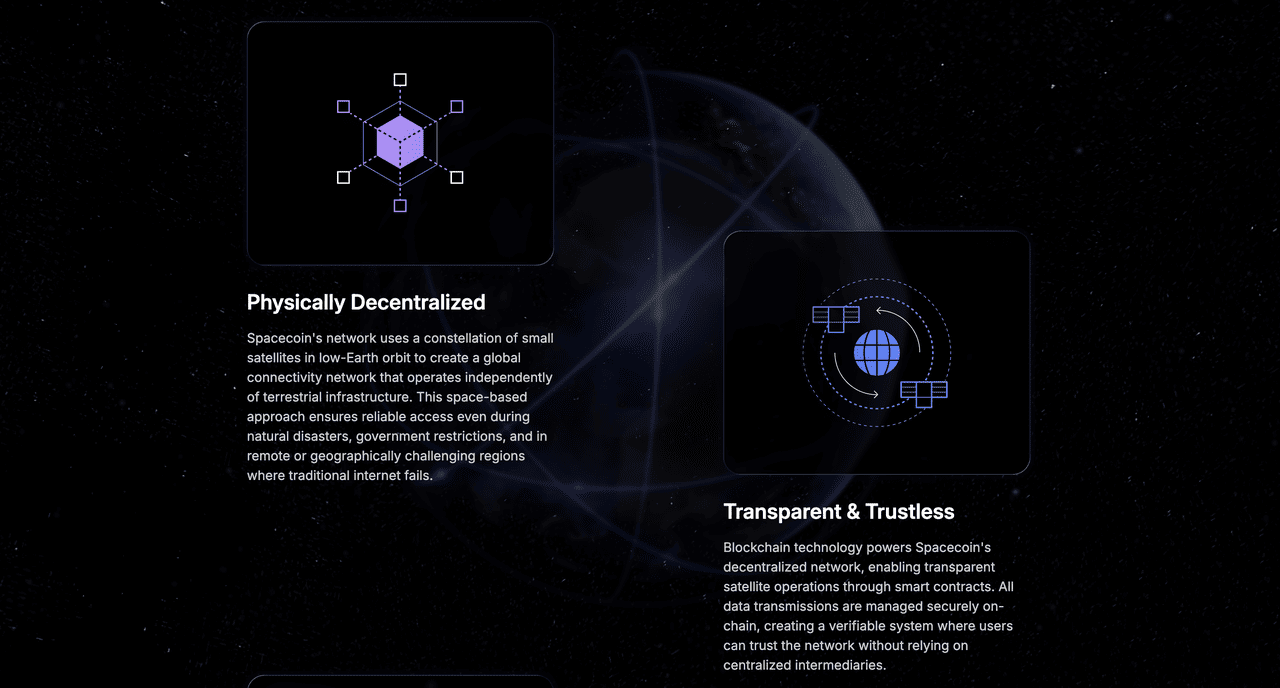
Spacecoin’s proposed satellite network combines an open constellation with SPACE staking and smart contract payments on Creditcoin. Independent satellite operators would supply bandwidth, while users would fund service requests in advance. The payment contract would release SPACE to the operator once the network verifies that the service was delivered.
- Satellite operators supply bandwidth. Operators that meet Spacecoin’s protocol standards would contribute low-Earth-orbit satellite capacity through the proposed Open Constellation.
- Operators stake SPACE as collateral. Under the proposed staking model, operators would lock up SPACE and could lose part of their stake for misconduct through a process called slashing.
- Users prepay for connectivity. Before requesting service, users would deposit SPACE into a smart contract on Creditcoin. The contract would hold the funds in escrow pending verification.
- Operators submit proof of delivery. After providing connectivity, the operator would submit cryptographic evidence of the service delivered. Spacecoin’s broader verification design includes Proof of Orbit and Proof of Location to check orbital and geographic claims.
- The contract releases payment. Once the settlement contract verifies the service proof, it would release the escrowed SPACE to the operator, tying payment to verified delivery.
Spacecoin vs. Helium: How Do Their DePIN Networks Work Differently?
Spacecoin and Helium both aim to let independent operators supply wireless connectivity. Spacecoin’s proposed Open Constellation would bring satellite operators into a shared system for verifying service and settling bandwidth payments. Helium uses community-operated Hotspots on the ground to connect low-power IoT devices and offload mobile data onto Wi-Fi.
|
Comparison |
Spacecoin |
Helium |
|
Core model |
Proposed network of independent satellite operators |
Network of community-operated terrestrial Hotspots |
|
Infrastructure |
Low-Earth-orbit satellites |
LoRaWAN and Wi-Fi Hotspots |
|
Who supplies coverage |
Satellite operators that meet protocol standards |
Individuals and businesses that deploy Hotspots |
|
Token model |
SPACE is designed for service payments and operator staking |
HNT rewards eligible Hotspot operators for providing coverage and carrying traffic |
|
Main use case |
Extending connectivity beyond the reach of terrestrial infrastructure |
Connecting low-power IoT devices and offloading mobile traffic onto Wi-Fi |
|
Main tradeoff |
Potential reach beyond ground networks depends on satellite deployment and operator participation |
Coverage depends on where operators install Hotspots |
The practical difference is where each network can provide coverage. Spacecoin is designed for areas beyond the reach of ground networks, and its roadmap still lists testing with independently operated nodes as upcoming work. Helium serves devices within range of deployed Hotspots, so its usefulness depends on local coverage.
Read More: What Are the Top 10 DePIN Crypto Projects to Know in 2026?
What Are the Spacecoin (SPACE) Tokenomics?
SPACE is the utility token of the Spacecoin ecosystem. It is designed for connectivity payments, operator staking and participation rewards, with settlement on Creditcoin. Spacecoin’s token overview sets a fixed supply of 21 billion SPACE, with 46% allocated to growth and rewards. Each allocation has its own unlock schedule, which determines when those tokens become available to circulate.
SPACE Token Utility and Supply Mechanisms
- Connectivity payments. Users would deposit SPACE into smart contract escrow before requesting service. The contract would release the payment to the operator once it verifies delivery.
- Operator staking. Satellite operators would stake SPACE as collateral to participate in the network. Under the proposed model, operators could lose part of their stake for misconduct.
- Participation rewards. Spacecoin allocated SPACE to ecosystem growth, user airdrops, satellite node rewards and incentives for residential bandwidth providers.
- Governance. Spacecoin’s token overview says governance is planned to activate once the network reaches full functionality.
- Fixed supply. The token overview specifies no additional issuance beyond the 21 billion SPACE supply. Vesting releases tokens from existing allocations, while staking can temporarily reduce the amount available to trade.
SPACE Token Allocation
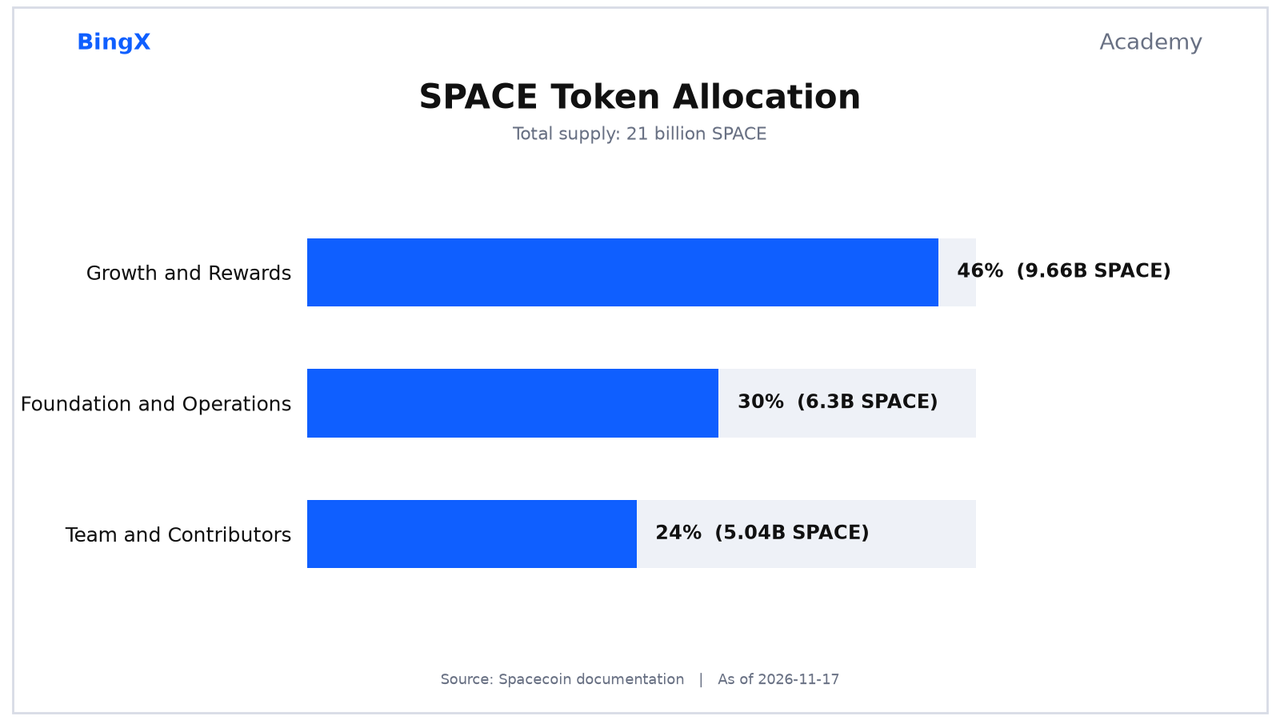
- Growth and Rewards — 46%, or 9.66 billion SPACE. The ecosystem receives 20% over 48 months. Season 1 airdrops account for 5%, with a quarter of that allocation unlocked at the token generation event (TGE) and the balance on a three-month schedule. Season 2 airdrops account for 6%, released over three months starting one month after TGE. Satellite node rewards receive 10%, with a 12-month cliff followed by 48 months of linear releases. VPN rewards receive 5% over 48 months.
- Foundation and Operations — 30%, or 6.30 billion SPACE. The foundation receives 15%, with a 12-month cliff followed by 24 months of linear releases. Operations and development each receive 5% over 36 months, while marketing receives 5% over 12 months.
- Team and Contributors — 24%, or 5.04 billion SPACE. Partner support accounts for 9%, fully unlocked at TGE. Investors receive 10%, and advisors and contributors receive 5%. Both allocations have a 12-month cliff followed by 24 months of linear releases.
Spacecoin’s token overview puts initial circulating supply at approximately 2.15 billion SPACE, or about 10.25% of total supply. The unlock schedule matters for evaluating potential supply pressure because some allocations became available at launch, while others release gradually after a cliff. Actual circulating supply also depends on how much unlocked SPACE is committed to staking as the network develops.
How to Trade Spacecoin (SPACE) on BingX
BingX lists Spacecoin as a USDT-margined perpetual futures contract. The trading interface displays SPACEUSDT, and the market link uses SPACECOIN-USDT. The contract lets traders take long or short exposure to SPACE price movements without owning the token.
Futures Trading: Trade SPACE Price Movements
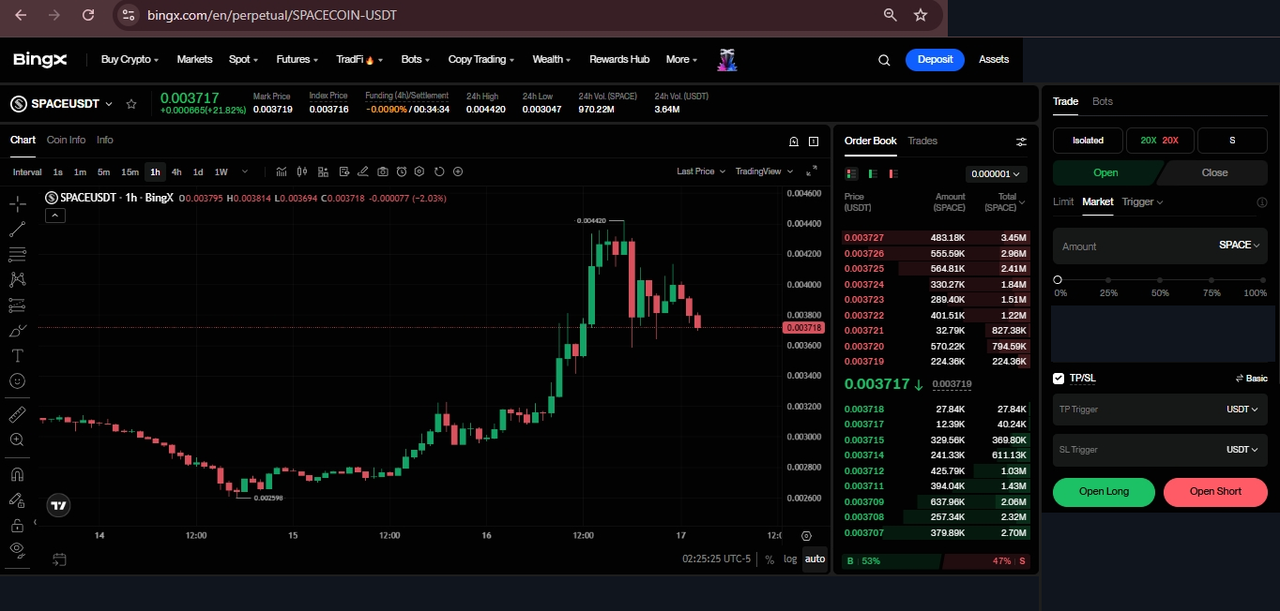
BingX lists a USDT-margined SPACE perpetual. Because leverage can amplify both gains and losses, futures are intended for traders who understand liquidation and have a defined risk plan.
Step 1: Account setup and security. First, Sign up and log into BingX, complete the identity verification (KYC) required in your region, and enable two-factor authentication.
Step 2: Transfer collateral. Move USDT from the spot account to the futures account, where it is used as margin.
Step 3: Select the contract. Open the SPACE-USDT perpetual.
Step 4: Set direction and leverage. Then, Open long or short based on the trading thesis. Select leverage and position size within the defined risk limit.
Step 5: Execute the trade. Enter the order amount and use a market or limit order according to the trading plan.
Step 6: Manage risk. Set stop-loss and take-profit controls before or immediately after entry. Profit and loss settle dynamically in USDT.
Risks and Considerations Before Investing in Spacecoin (SPACE)
Spacecoin’s outlook depends on whether it can turn early satellite launches and protocol tests into reliable commercial coverage that users will pay for.
- Commercial satellite deployment is still early. Continuous coverage depends on further satellite deployment, spectrum permissions, reliable hardware and ground infrastructure.
- Token unlocks can increase selling pressure. SPACE has a fixed supply, but scheduled vesting can increase the amount available to trade. Selling pressure could rise if tradable supply grows faster than demand for the token.
- Payments depend on reliable service verification. Spacecoin’s proposed escrow system relies on smart contracts and cryptographic proofs to verify bandwidth delivery. A flaw in either could delay legitimate payments or release funds for service that was never delivered.
- Residential proxy participation carries separate risks. SpaceRouter Proxy providers route third-party traffic through their home internet connections, raising privacy, acceptable-use and local compliance considerations.
- SPACE volatility can amplify futures losses. SPACE may react sharply to deployment updates, token unlocks and changes in market liquidity. Leveraged positions can be liquidated if the price moves against the trader.
Final Thoughts: Should You Invest in Spacecoin (SPACE) in 2026?
Spacecoin enters late 2026 with four spacecraft launches and protocol tests involving 50,000 simulated nodes reported on its roadmap. Its proposed satellite network would let independent operators supply bandwidth, stake SPACE as collateral and receive payment through Creditcoin once service delivery is verified. SpaceRouter Proxy applies on-chain bandwidth settlement to a separate service that runs over residential internet connections.
The next test is commercial adoption. Spacecoin needs to bring independent satellite operators onto the network, deliver reliable coverage and show that customers will pay for bandwidth repeatedly. Investors can track active satellite operators, paid bandwidth usage, SPACE settled for connectivity and scheduled token unlocks. Growth in paid usage and on-chain settlements would give investors a clearer basis for judging whether demand for connectivity can translate into sustained demand for SPACE as more tokens enter circulation.
Related Reading
- What Are the Top 10 DePIN Crypto Projects to Know in 2026?
- What Is peaq (PEAQ), the Backbone of the Machine Economy and How Does It Work?
- What Is World Mobile Token (WMTX), the DePIN Powering Global Connectivity?
- What Is ShareX Network (SHARE) DePIN Protocol for the Sharing Economy and How to Buy?
- What Is XPIN Network (XPIN) AI-Powered DePIN and How Does It Work?
FAQs About Spacecoin (SPACE)
1. What makes Spacecoin different from other connectivity projects?
Spacecoin is designed to let independent satellite operators sell bandwidth through a shared payment system on Creditcoin. Its proposed smart contracts would release payments once the network verifies service delivery. SpaceRouter Proxy is a separate service that uses residential internet connections.
2. What blockchain is SPACE on?
SPACE is issued on Creditcoin. Before transferring SPACE, confirm the official token contract address and check that the receiving wallet or exchange supports SPACE on Creditcoin.
3. What is the total supply of SPACE?
Spacecoin’s token overview specifies a fixed supply of 21 billion SPACE with no additional issuance. The amount in circulation can increase as scheduled allocations unlock.
4. Which wallets support SPACE?
You can use MetaMask configured for the Creditcoin network or another wallet that supports SPACE on Creditcoin. Before receiving or sending tokens, confirm that Creditcoin is selected and use the official SPACE contract address when importing the token.
