
Gram (GRAM) is the native token of The Open Network (TON), the blockchain closely associated with the messaging app Telegram. In June 2026, the TON community voted to rename Toncoin as Gram, restoring the original name Telegram selected for its token in 2018. After the proposal passed, the rebrand officially took effect on June 15, 2026, with the native token adopting the Gram name, GRAM ticker, and updated logo. The change did not create a new token or blockchain, so holders did not need to complete a token swap or migration.
The blockchain continues to use the name The Open Network and the abbreviation TON, while its native token is now officially known as Gram (GRAM). The new name draws on TON’s early history and comes as Telegram takes a larger role in the network’s ecosystem. This guide explains what Gram is, why Toncoin was renamed, how The Open Network works, what the rebrand means for holders, the main risks to consider, and how to trade GRAM on BingX.
What Is Gram (GRAM)? Understanding Toncoin’s Original Name and Rebrand
Source: Ton Website
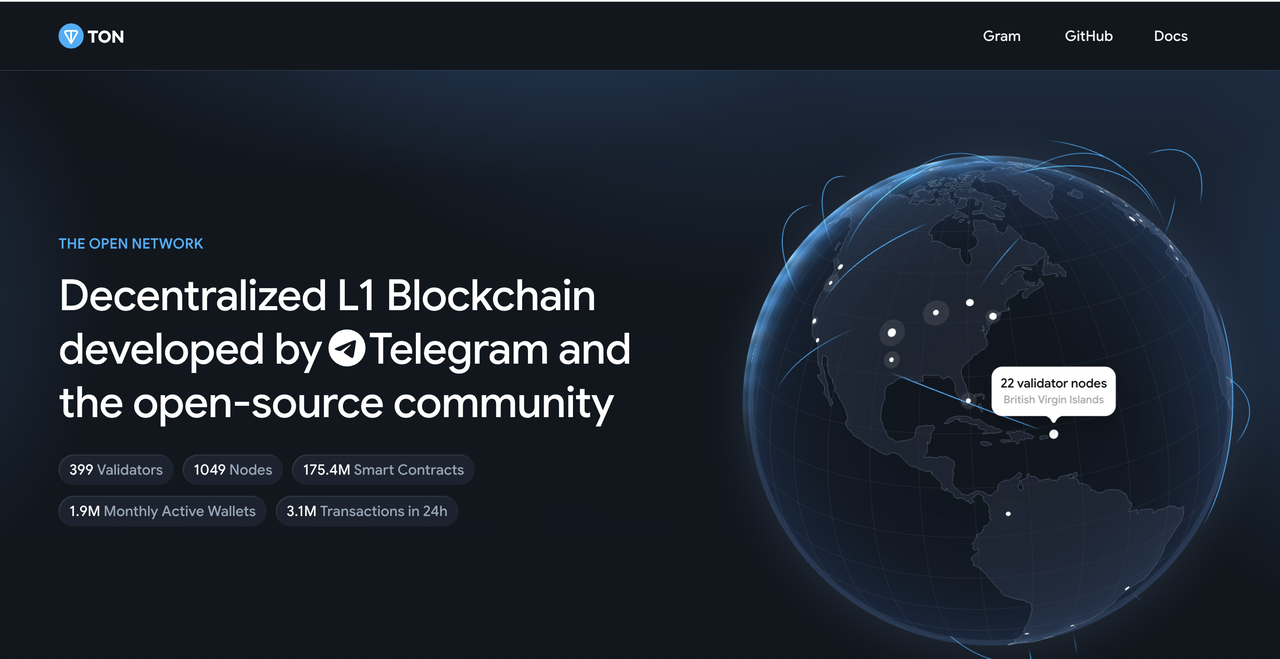
Gram (GRAM) is the native cryptocurrency of The Open Network, a Layer 1 proof-of-stake blockchain designed for fast, low-cost transactions and closely linked to Telegram. GRAM is used to pay network fees, support validator staking, participate in governance, and power payments and interactions across Telegram mini apps and other TON-based applications. As TON expands within Telegram’s ecosystem, GRAM serves as the main asset for transferring value, accessing dApps, and paying for on-chain services.
Telegram originally named the token Gram when it developed the blockchain in 2018. After a regulatory dispute with the U.S. Securities and Exchange Commission, Telegram withdrew from the project, while the community continued its development under the name The Open Network and renamed the token Toncoin. A community governance vote in June 2026 approved the return of the original Gram name, with the rebrand later becoming official. The token retains the same role within TON, coordinating transaction fees, network security, governance, and value transfer across the ecosystem.
Key components of the Gram and TON ecosystem include:
- GRAM token: The native token used for transaction fees, staking, and governance across The Open Network.
- The Open Network (TON): The Layer 1 proof-of-stake blockchain that keeps the TON name even after the token rebrand.
- Telegram integration: Deep ties to Telegram, which now acts as the network's largest validator and supports GRAM for in-app services.
- Staking and validators: A proof-of-stake system where validators and stakers help secure the network and earn rewards.
- TON ecosystem tools: Services such as TON Connect, TON DNS, and a growing set of mini-apps and DeFi projects built on the network.
Read More: Top 7 Telegram Mini-Apps in the TON Ecosystem (2026)
How Does Gram (GRAM) Work?
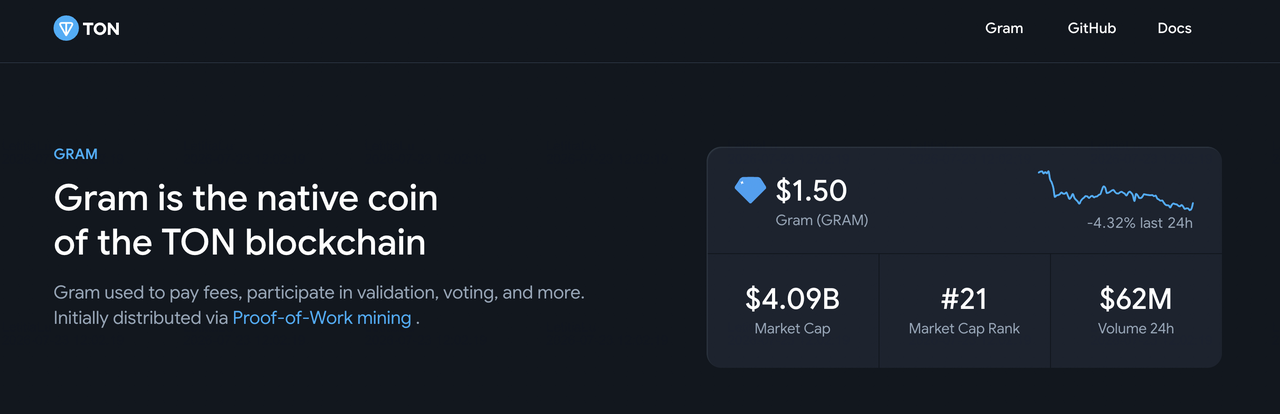
Gram works as the native asset of The Open Network, a proof-of-stake Layer 1 designed for speed, low fees, and scalability, with deep Telegram integration.
Source: Ton Website
- Proof-of-stake secures the network: The Open Network uses a proof-of-stake consensus model, where validators stake GRAM to help validate transactions and secure the chain, earning rewards in return.
- Sharding supports scalability: The network uses a multi-layered, sharded structure that distributes processing across chains to reduce congestion and support high transaction throughput.
- GRAM pays for network activity: GRAM is used for transaction fees, validator rewards, and smart contract execution, giving it direct utility across the network.
- Staking enables passive rewards: Holders can stake GRAM directly or through staking pools, allowing participants with smaller amounts to earn a share of validation rewards.
- Telegram anchors demand: As the token behind Telegram's mini-app and payment ecosystem, GRAM is tied to in-app payments, dApp interactions, and ecosystem services across a very large user base.
Why Did Toncoin Rebrand to Gram?
Source: TON Vote
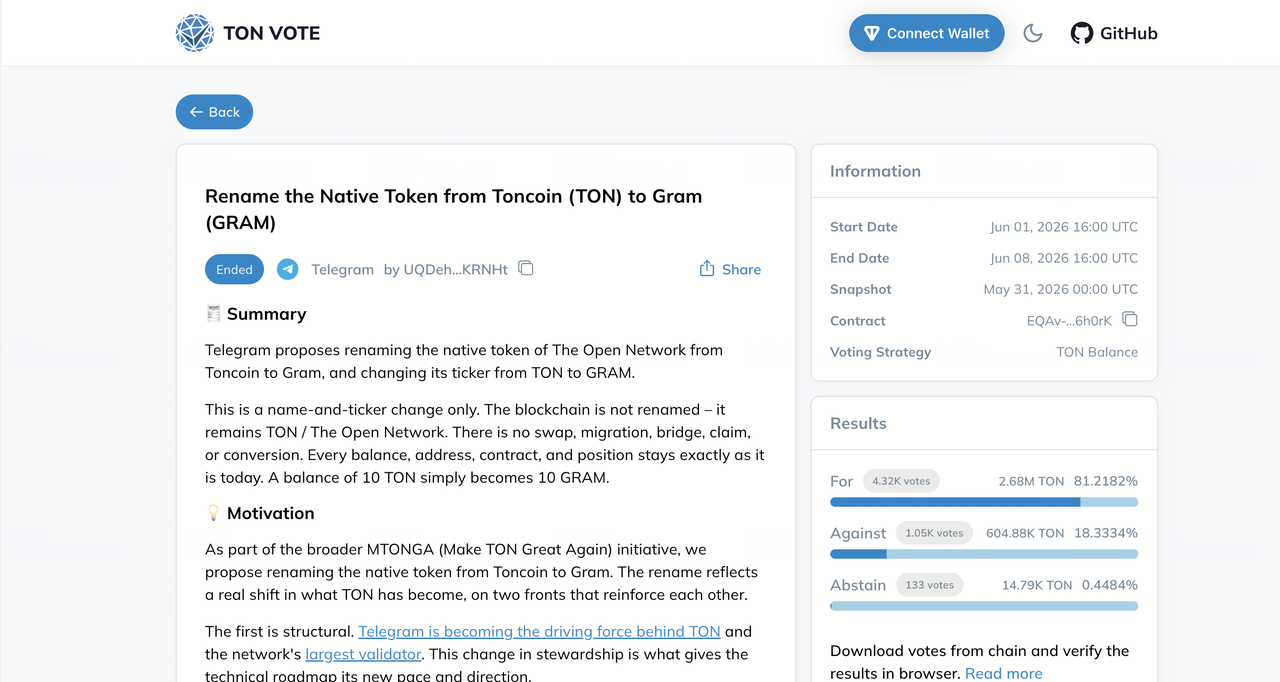
Toncoin was renamed Gram to restore the token’s original identity and strengthen its connection with Telegram’s early blockchain vision. Gram was the name selected for Telegram’s original cryptocurrency in 2018 before the project was halted following its dispute with the U.S. Securities and Exchange Commission. After the community continued developing the blockchain as The Open Network, the native token became known as Toncoin. A community governance vote held from June 1 to June 8, 2026 approved the return of the Gram name with 81.22% of participating voting power, and the rebrand officially took effect on June 15, 2026. The change updated the token’s name and ticker from Toncoin (TON) to Gram (GRAM) without creating a new token or blockchain, and its role in transaction fees, staking, governance, payments, and value transfer across the TON ecosystem remained unchanged.
Toncoin (TON) vs. Gram (GRAM): What Are the Differences?
Toncoin and Gram are not separate cryptocurrencies. Gram is the new name of Toncoin following the 2026 community-approved rebrand. The underlying asset, blockchain, supply, balances, wallet addresses, staking positions, and smart-contract interactions remain the same. The main changes are the token’s name, ticker, and branding.
|
Feature |
Toncoin |
Gram |
|
Status |
Former token name |
Current official token name |
|
Ticker |
TON |
GRAM |
|
Blockchain |
The Open Network |
The Open Network |
|
Token utility |
Fees, staking, governance, payments, and dApp interactions |
Unchanged |
|
Token swap required |
No |
No |
|
Official transition |
Used before June 15, 2026 |
Official from June 15, 2026 |
For anyone holding the token, the practical answer is straightforward: no action is required. The rebrand changed only the token's name, ticker, and logo, while everything else about the asset remained identical.
- Balances are unchanged: A balance of 10 Toncoin now simply displays as 10 Gram at a one-to-one ratio, with nothing reset.
- No swap or migration: There is no new contract, no token swap, no bridge, and no migration step of any kind for existing holders.
- Wallets and contracts continue working: Wallet addresses, smart contracts, staking positions, NFTs, Jettons, and DeFi assets all continue to function as before.
- Exchanges handled relabeling: Most exchanges relabeled pairs such as TON/USDT to GRAM/USDT on the back end, so custodial holders typically needed to do nothing.
- Watch for scams: The official announcement warned that any site, bot, or message asking users to claim GRAM, convert TON, or migrate to a new contract is fraudulent, since no legitimate migration exists.
What Are the Gram (GRAM) Tokenomics, Formerly Toncoin?
The 2026 rebrand did not change Gram’s tokenomics. GRAM remains the native coin of The Open Network and retains the same supply structure, utility, and staking mechanics it had as Toncoin. It is used to pay transaction fees, participate in validation and governance, transfer value, and interact with applications across the TON ecosystem. Most of the initial supply was distributed through Proof-of-Work mining, while the network now uses a proof-of-stake validation system.
GRAM Token Utility and Supply Mechanisms
GRAM serves as the utility and security asset of The Open Network. Its main functions include:
- Transaction fees: GRAM pays for transfers, smart-contract execution, and other on-chain activity.
- Network validation: Validators stake GRAM to process transactions, produce blocks, and secure the network.
- Staking rewards: Token holders can delegate GRAM through staking pools, while validators and participating nominators earn rewards for supporting network security.
- Governance and voting: GRAM can be used in network voting and community governance processes, including proposals such as the 2026 rebrand vote.
- Payments and applications: GRAM supports wallet transfers, payments, dApp interactions, and services built on TON, including those available through Telegram Mini Apps.
GRAM Supply Considerations
GRAM launched with an initial supply of 5 billion tokens. About 1.45% went to early developers and testers, while 98.55% was distributed through Proof-of-Work mining. TON now uses proof-of-stake validation, with new GRAM issued through validator rewards.
GRAM has no fixed maximum supply or conventional team and investor allocation schedule. Network fees and validator penalties may offset part of the new issuance, while long-term demand depends on TON adoption, staking, payments, and ecosystem activity.
|
Tokenomics Feature |
Details |
|
Native coin |
Gram |
|
Ticker |
GRAM |
|
Initial supply |
5 billion GRAM |
|
Maximum supply |
No fixed maximum |
|
Initial distribution |
1.45% to early developers and testers; 98.55% distributed through Proof-of-Work mining |
|
Current validation model |
Proof of Stake |
|
New issuance |
Validator and staking rewards |
|
Scheduled unlocks |
No conventional token unlock schedule |
|
Main utility |
Fees, validation, staking, voting, payments, and dApp interactions |
How to Trade Gram (GRAM) (prev. Toncoin) on BingX
BingX offers two practical ways to gain exposure to Gram, depending on whether the goal is direct ownership or short-term trading. Spot trading is better suited for users who want to buy and hold GRAM directly, while futures trading is designed for active traders who want long or short exposure to GRAM price movements. Because of the rebrand, users should confirm that pairs are displayed under the GRAM ticker rather than the old TON ticker.
Spot Trading: Buy and Own GRAM Directly
Spot trading is the most straightforward way to buy Gram on BingX. When users buy GRAM on the spot market, they own the asset directly and can hold it in the BingX spot account, transfer it, or withdraw it to a self-custody TON wallet.
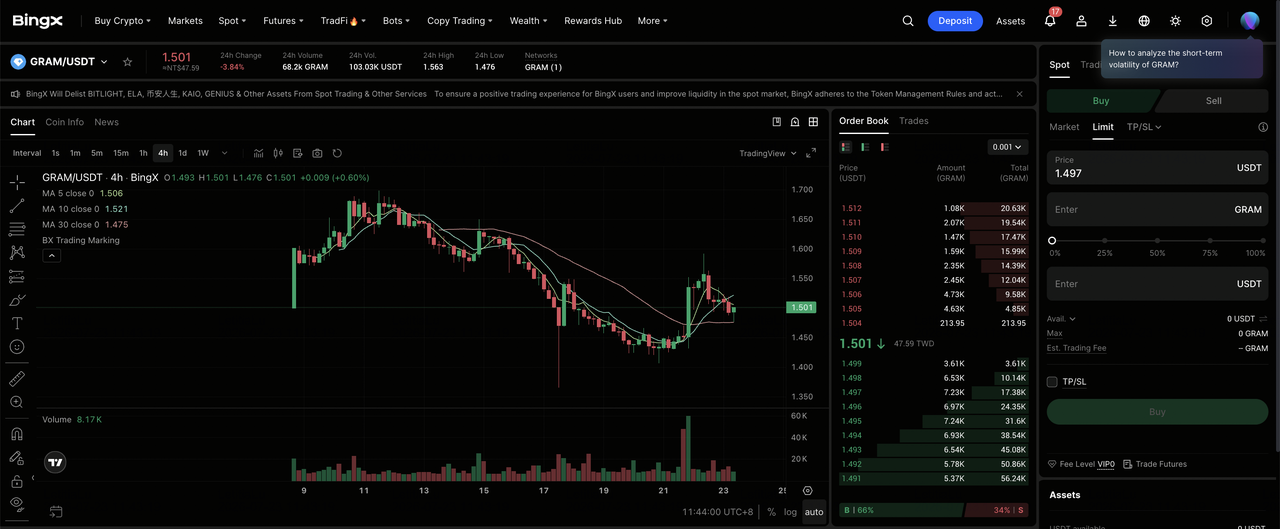
Step 1: Account setup and security. Sign up and log into your BingX account, complete the identity verification (KYC) required in your region, and enable two-factor authentication.
Step 2: Fund your spot account. Deposit USDT or another supported asset into your BingX spot account. Where available, users can also use supported fiat on-ramp options.
Step 3: Navigate to the spot market. Search for the GRAM/USDT trading pair.
Step 4: Place your order. Choose a market order to buy GRAM immediately at the current price, or use a limit order to set the price you want to pay.
Step 5: Manage your GRAM. Once filled, your GRAM appears in your spot account. You can keep it on BingX for convenience or withdraw it to a TON-compatible self-custody wallet for staking or ecosystem participation.
Futures Trading: Trade GRAM Price Movements
For active traders, BingX offers USDT-margined GRAM perpetual futures. Futures allow users to trade GRAM price movements without holding the underlying asset, with the flexibility to open long positions if they expect GRAM to rise or short positions if they expect GRAM to fall.
Because futures involve leverage, they can amplify both gains and losses. This approach is more suitable for traders who already have a clear risk plan and understand liquidation risk, particularly for an asset like GRAM that is sensitive to Telegram ecosystem news, broader market moves, and TON-linked headlines.
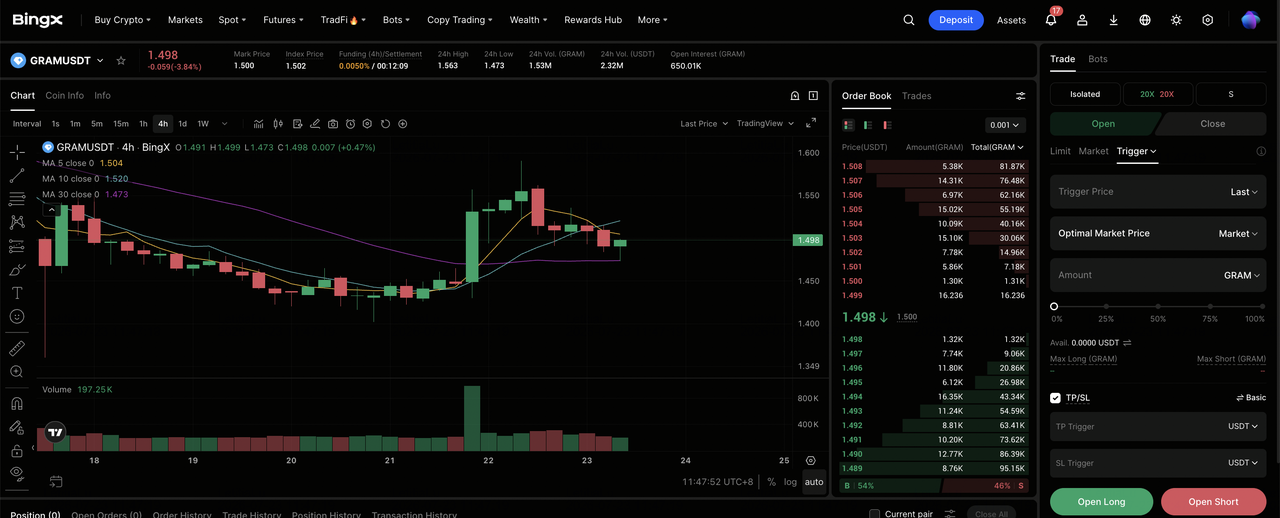
Step 1: Transfer collateral. Move USDT from your spot account into your futures account, where it will serve as margin.
Step 2: Select the contract. Search for the GRAM-USDT perpetual contract.
Step 3: Set direction and leverage. Open long if you expect GRAM to rise, or open short if you expect GRAM to decline. Choose leverage based on your risk tolerance and position size.
Step 4: Execute the trade. Enter the order amount and choose a market or limit order depending on your trading plan.
Step 5: Manage risk. Set stop-loss and take-profit orders before or immediately after entering the position. Profit and loss settle dynamically in USDT.
Risks and Considerations Before Investing in Gram (GRAM)
Gram is the native asset of an established Layer 1 with deep Telegram ties and a large user base. However, GRAM still carries risks tied to sentiment, regulation, ecosystem dependency, and market volatility.
- The rebrand adds no new fundamentals: A name and ticker change does not create new utility, supply mechanics, or demand, so any price moves around the rebrand have been sentiment-driven rather than fundamental.
- Regulatory history and uncertainty: The Gram name is tied to a landmark SEC action, and while the current network is decentralized, regulation of crypto and Telegram-linked assets can still evolve and affect sentiment.
- Ecosystem dependency on Telegram: GRAM's demand is closely linked to Telegram's continued integration and usage; a change in that relationship would directly affect the token.
- Market volatility: GRAM trades well below its all-time high and tends to move with broader market conditions, including Bitcoin's direction, so it can experience sharp swings.
- Scam risk during the transition: Fraudulent claim or migration schemes have targeted holders around the rebrand, so users must remember that no legitimate migration exists and should never connect wallets to claim pages.
Final Thoughts: Should You Invest in Gram (GRAM) in 2026?
Gram is the native token of The Open Network, now trading under a name that reconnects it to Telegram's original 2018 vision. Its 2026 story is anchored by the rebrand from Toncoin, Telegram's deepening role as the network's largest validator, and growing institutional and treasury interest, all set against a token whose underlying economics were unchanged by the rename.
The key question for 2026 is whether Telegram-native usage and payments can grow enough to drive real demand for GRAM, since the rebrand itself adds no new fundamentals. Its large user base, established Layer 1, and deep Telegram integration set it apart from many smaller ecosystem tokens, but GRAM remains exposed to market sentiment, regulatory history, and its dependence on Telegram. For investors and traders, the most important metrics to watch are Telegram integration and payment adoption, staking participation, network activity, treasury accumulation, and broader market sentiment.
Related Reading
- Top 7 Telegram Mini-Apps in the TON Ecosystem (2026)
- What Are the Best TON Wallets for Toncoin and Jetton Tokens in 2026?
- How to Create and Set Up a Tonkeeper Wallet for the TON Ecosystem
- What Is the Blum Telegram Trading Mini App and How to Claim the $BLUM Airdrop
FAQs About Gram (GRAM)
1. Is Gram a new token, or the same as Toncoin?
Gram is the same token as Toncoin, simply renamed. On June 15, 2026, following a community vote, Toncoin was rebranded to Gram, changing only the name, ticker, and logo. Balances, addresses, contracts, and staking positions all stayed the same at a one-to-one ratio.
2. Do I need to swap or migrate my Toncoin?
No. There is no token swap, bridge, or migration required. A balance of Toncoin automatically displays as Gram at a one-to-one ratio. Any site or message asking you to claim or migrate GRAM is a scam, since no legitimate migration exists.
3. What blockchain is GRAM on?
GRAM is the native token of The Open Network (TON), a Layer 1 proof-of-stake blockchain. The blockchain kept the name The Open Network, still abbreviated TON, while only the token was renamed to Gram.
4. Why did the token change its name back to Gram?
The community voted to restore the original name Telegram chose for the token in 2018, before it was renamed Toncoin following a regulatory dispute. Telegram founder Pavel Durov backed the change to reconnect the token with Telegram's brand and expand its use across the platform.
5. Which wallets support GRAM?
GRAM can be stored in TON-compatible wallets, including Telegram's TON Space and other wallets that support The Open Network. Users should always confirm they are using the TON network before transferring GRAM to avoid loss of funds.
