
Canopy (CNPY) is an AI-native blockchain infrastructure platform designed to help developers launch application-specific networks called Nested Chains. Rather than assembling consensus, validator infrastructure, security and deployment tools separately, teams can use Canopy’s stack to build and launch dedicated blockchain environments from one platform. As of September 18, 2026, Canopy reported 350,000 testnet users and 25,000 testnet developers, giving the project an early base of developer and user activity ahead of broader mainnet adoption.
Canopy launched its mainnet on September 7, 2026, with CNPY serving as the network token for transaction fees and staking. The broader platform combines Canopy Stack for development, Canopy Terminal for launching completed applications as live networks, and Canopy Network for shared infrastructure and validator security. Together, these components are designed to make appchain deployment simpler from development through launch and operation. This guide explains how Canopy works, how CNPY tokenomics are structured, the main risks to consider and how to trade CNPY on BingX.
What Is Canopy (CNPY)?
Canopy is an AI-native blockchain infrastructure platform that helps developers build application-specific blockchains called Nested Chains. The “AI-native” part refers to its development workflow. Canopy is designed to work with coding assistants such as Claude Code, Cursor and Codex, allowing developers to use AI to create or modify applications in familiar languages like Go, Python, TypeScript, C# and Kotlin. Canopy then handles much of the blockchain infrastructure underneath, including consensus, validators, security and deployment.
CNPY is the native token used for staking and network security. New Nested Chains can initially rely on security from the broader Canopy network and become more independent as they grow. Canopy’s NestBFT consensus combines proof of stake with Proof-of-Age, which is designed to protect against long-range attacks and help connected chains confirm their state. Canopy also raised $8.5 million in June 2026 to support its mainnet launch and developer tools.
Key components of the Canopy ecosystem include:
- Canopy Stack: The development framework for building appchains in mainstream languages including Go, TypeScript, Python, Kotlin and C#.
- Canopy Terminal: A web application that brings together chain launching, token launch tools, trading, explorer functions and wallet access.
- Canopy Network: The shared-security layer where validators can extend staked CNPY security to newly launched Nested Chains.
- NestBFT: Canopy’s consensus system, combining proof of stake with Proof-of-Age to provide finality, long-range attack protection and checkpointing for Nested Chains.
How Does Canopy Work?
Canopy combines an appchain development framework with shared security and CNPY-based staking. Developers can launch application-specific Nested Chains without building every part of the blockchain stack from scratch, while validators on the Canopy root chain can extend security to those networks through restaking.
- Builders create a Nested Chain: Canopy Stack provides the framework for launching application-specific blockchains, allowing teams to start with shared infrastructure rather than assembling an independent network from the ground up.
- Nested Chains begin with shared security: New chains can rely on a Canopy Security Root while they build their own users, validator set and economic activity. Over time, they can gain greater independence or move to another Security Root.
- Validators secure multiple chains through restaking: Validators can reuse bonded CNPY collateral to secure more than one Nested Chain. This helps new networks access economic security without immediately building a large standalone validator base.
- CNPY rewards validators and delegators: CNPY is used for staking, transaction fees and network incentives. Validators securing eligible Nested Chains can receive CNPY rewards alongside rewards from the Nested Chain itself.
- Nested Chains qualify for protocol subsidies through stake: A committee becomes eligible for Canopy block-reward subsidies when more than 33% of the network's total stake is committed to that chain. This gives newer chains an incentive mechanism for attracting validator security.
Canopy vs. Avalanche: What Are the Differences Between Nested Chains and Avalanche L1s?
Canopy and Avalanche both give developers a way to launch application-specific blockchains, but they take different approaches to security and network independence. Canopy's Nested Chains can begin with shared validator security from the Canopy network, while Avalanche L1s operate as sovereign networks with their own validator sets and token economics.
|
Comparison |
Canopy |
Avalanche |
|
Core model |
Nested Chains built with an integrated appchain stack |
Sovereign Avalanche L1s |
|
Security |
Shared security through CNPY staking and validator restaking |
Each L1 manages its own validator set |
|
Development |
Canopy Stack supports mainstream programming languages |
Avalanche L1s commonly use Subnet-EVM and Solidity |
|
Token model |
CNPY supports staking, fees and security incentives |
Each L1 can define its own token economics |
|
Autonomy |
Chains can begin with shared security and gain more independence over time |
L1s are designed as independent networks from launch |
|
Main tradeoff |
Earlier ecosystem with less proven adoption |
More mature tooling but greater validator and network-management responsibility |
Canopy is more focused on reducing the work needed to launch and secure a new appchain, especially during its early stages. Avalanche gives teams greater control over validator membership, token economics and network rules from the start. The practical difference is therefore shared security and an integrated development path with Canopy versus greater upfront sovereignty with an Avalanche L1.
Read More: What Is Avalanche (AVAX) in 2026? Complete Beginner's Guide to the Subnet Powered Layer 1
What Are the Canopy (CNPY) Tokenomics?
CNPY is the native token of the Canopy Network and is used to coordinate transactions, staking and validator incentives across the root network and Nested Chains. Canopy uses an emission-based reward model, with new CNPY distributed through protocol block rewards rather than relying only on a conventional preallocated token pool.
CNPY Token Utility and Supply Mechanisms
- Transaction fees: CNPY is used to pay transaction fees across the Canopy Network, linking token demand to activity on the base network and connected Nested Chains.
- Validator staking: Validators stake CNPY as economic collateral when participating in consensus and providing security services to Canopy and Nested Chains.
- Delegation: CNPY holders can delegate tokens without running validator infrastructure and receive a share of protocol rewards.
- Restaking security: Validators can assign the same bonded CNPY across multiple Nested Chain committees, allowing one stake position to help secure more than one network.
- Block rewards and emissions: New CNPY enters circulation through protocol block rewards, which are distributed across eligible validators, delegators and Nested Chain committees. Canopy's published monetary model also uses periodic reward reductions to slow issuance over time.
CNPY Token Allocation
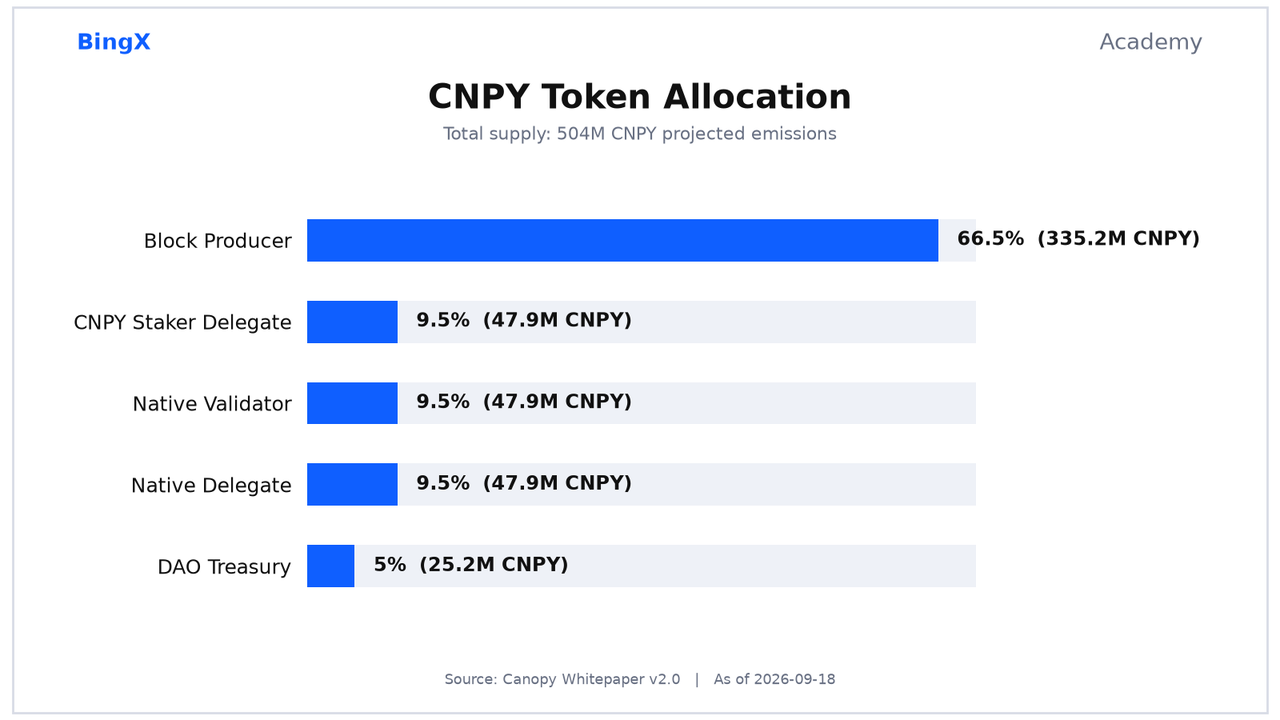
- Block Producer: 66.5%, or 335.2M CNPY. This is the 70% default share of the 95% of each block reward remaining after the DAO allocation.
- DAO Treasury: 5%, or 25.2M CNPY. The whitepaper says the treasury share is set aside from each block reward for project budgeting through validator-governed decisions.
- CNPY Staker Delegate: 9.5%, or 47.9M CNPY. This is the default 10% committee share applied to the non-treasury block-reward pool.
- Native Validator: 9.5%, or 47.9M CNPY. This is the default 10% committee share for the native-token staker validator, applied to the non-treasury block-reward pool.
- Native Delegate: 9.5%, or 47.9M CNPY. This is the default 10% committee share for the native-token staker delegate, applied to the non-treasury block-reward pool.
By 2026, CNPY supply dynamics depend on block emissions, halving intervals, and the share of rewards directed to validators, delegates, and the DAO. Because the published figures describe emission rewards rather than a conventional pre-mint allocation, investors should monitor realized issuance and staking participation when evaluating potential supply pressure.
How to Trade Canopy (CNPY) on BingX
BingX offers two ways to gain exposure to Canopy. Spot trading is for users who want to buy and hold CNPY directly, while perpetual futures are for active traders who want long or short exposure to CNPY price movements.
Spot Trading: Buy and Own CNPY Directly
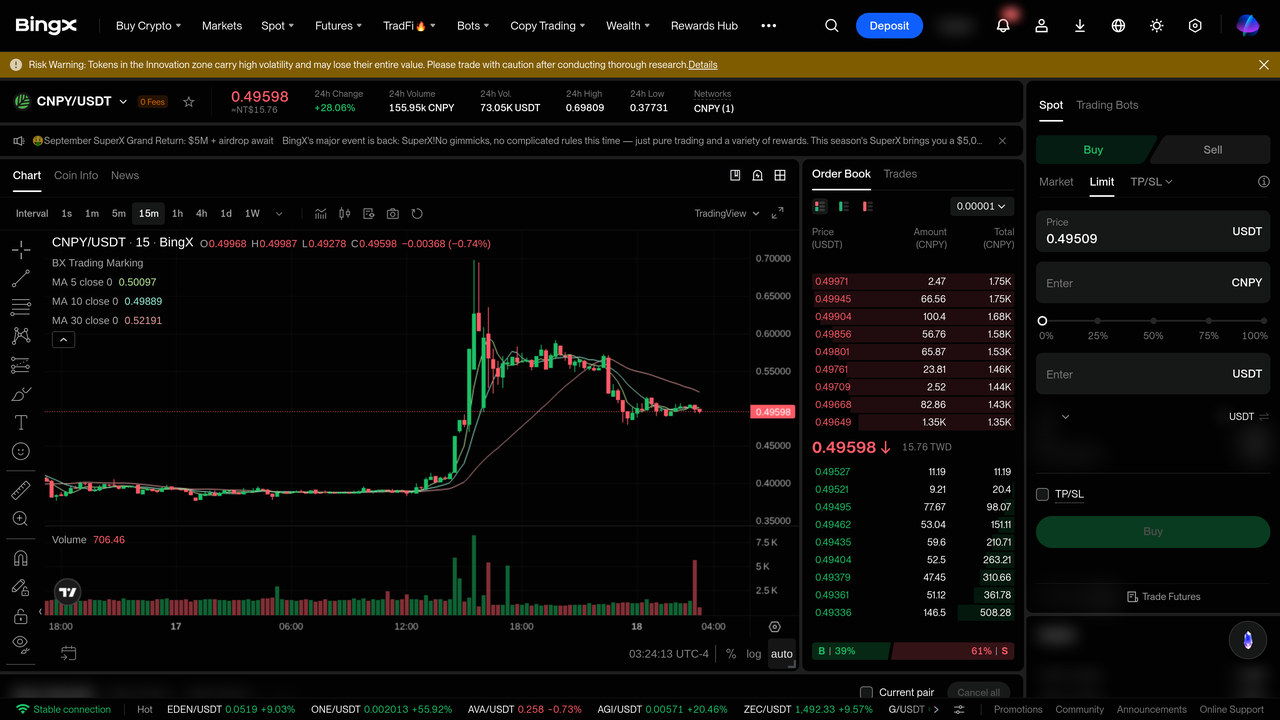
Step 1: Account setup and security. Sign up and log into your BingX account, complete the identity verification (KYC) required in your region, and enable two-factor authentication.
Step 2: Fund your spot account. Deposit USDT or another supported asset into your BingX spot account. Where available, users can also use supported fiat on-ramp options.
Step 3: Open the spot market. Search for the CNPY/USDT pair.
Step 4: Choose an order type. Use a market order to buy CNPY at the available market price, or a limit order to set a target purchase price.
Step 5: Manage your CNPY. After the order fills, CNPY appears in the spot account. It can remain on BingX or be withdrawn only after confirming the correct supported network and official contract.
Futures Trading: Trade CNPY Price Movements
Because futures involve leverage, they can amplify both gains and losses. This approach is more suitable for traders who already have a clear risk plan and understand liquidation risk.
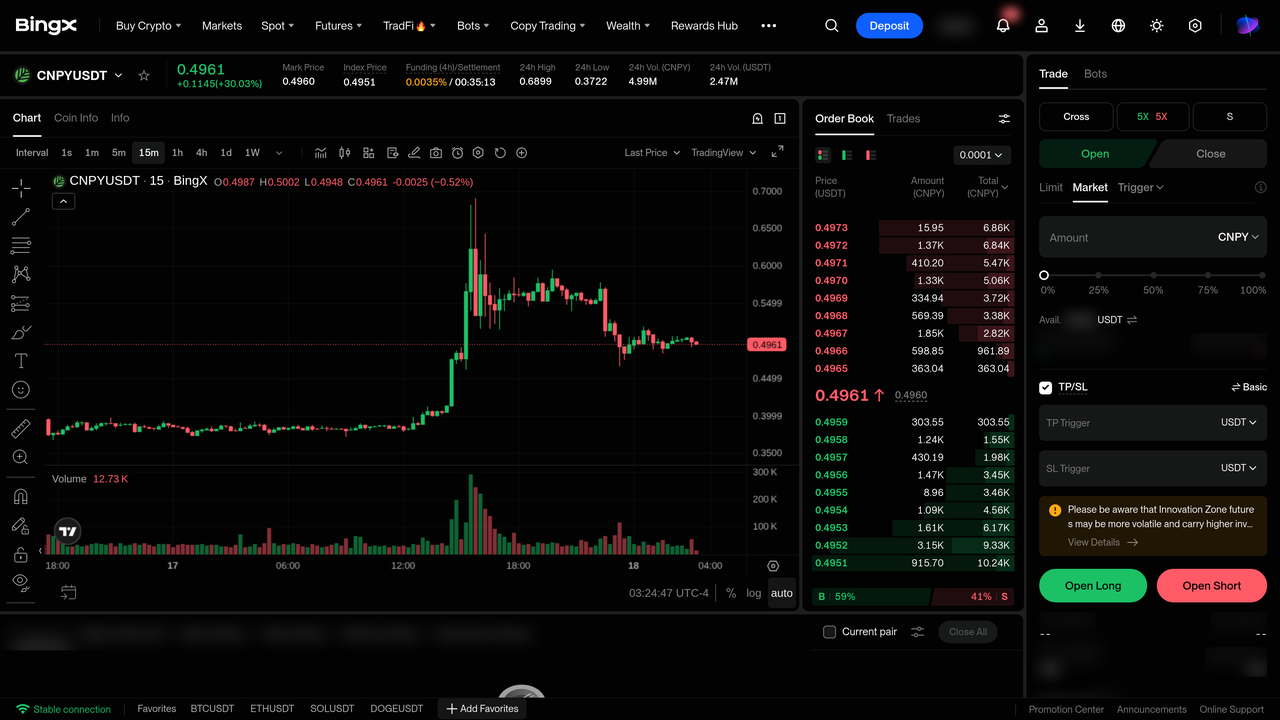
Step 1: Account setup and security. Sign up and log into your BingX account, complete the identity verification (KYC) required in your region, and enable two-factor authentication.
Step 2: Transfer collateral. Move USDT from your spot account into your futures account, where it will serve as margin.
Step 3: Select the contract. Search for the CNPY-USDT perpetual contract.
Step 4: Set direction and leverage. Open long if you expect CNPY to rise, or open short if you expect CNPY to decline. Choose leverage based on your risk tolerance and position size.
Step 5: Execute the trade. Enter the order amount and choose a market or limit order based on your trading plan.
Step 6: Manage risk. Set stop-loss and take-profit orders before or immediately after entering the position. Profit and loss settle dynamically in USDT.
Risks and Considerations Before Investing in Canopy (CNPY)
Canopy’s outlook depends on whether early developer interest turns into sustained mainnet activity and CNPY demand.
- Mainnet adoption is still early: Canopy launched on September 7, 2026, so Nested Chains, validator activity and user adoption still have limited history.
- Block rewards can increase supply: New CNPY enters circulation through protocol rewards. If demand grows more slowly than issuance, selling pressure could increase.
- Restaking adds security complexity: Validators can reuse bonded CNPY across multiple Nested Chains. Problems affecting one committee or validator set could create wider risks.
- Shared security depends on validator participation: Low staking participation or validator concentration could weaken security across connected Nested Chains.
- CNPY can remain highly volatile: As a newly launched token, CNPY may react sharply to adoption, liquidity, listings and broader crypto-market sentiment.
Final Thoughts: Should You Invest in Canopy (CNPY) in 2026?
Canopy enters the rest of 2026 with its mainnet live and its first major protocol upgrade already deployed. The platform combines an AI-native development stack, shared security and progressive sovereignty for application-specific blockchains. Banyan v2.0 also added in-place upgrades, giving developers a way to update live applications without redeploying them or moving users to a new version.
The next test is adoption. Canopy needs to turn its early developer activity into live Nested Chains, sustained validator participation and growing network usage. Investors can watch the number of active mainnet applications, CNPY staked or delegated, transaction fees, token issuance and the pace of new Nested Chain launches. Stronger activity across those metrics would provide clearer evidence that Canopy’s integrated appchain model is gaining traction beyond its initial launch.
Related Reading
- What Are the Top 10 AI Crypto Projects to Watch in 2026?
- What Is Avalanche (AVAX) in 2026? Complete Beginner's Guide to the Subnet Powered Layer 1
- What Are the Top Layer-1 (L1) Blockchains to Know in 2026?
- What Are the Top Ethereum Layer-2 Projects of 2026?
- What Is KiiChain (KII)? A Beginner’s Guide to Onchain FX and Cross-Border Payments in 2026
FAQs About Canopy (CNPY)
1. What makes Canopy different from other appchain projects?
Canopy combines appchain development, shared security and launch tools in one platform. Nested Chains can use Canopy validators and restaked CNPY for security when they launch, then gain more independence as their own network grows.
2. What blockchain is CNPY on?
CNPY is the native token of the Canopy Network. A BEP-20 version is also available on BNB Smart Chain, so users should confirm the supported network and verified contract address before transferring tokens.
3. What is the CNPY supply?
Canopy projects a maximum supply of 560 million CNPY, including a 56 million one-time mint and up to 504 million from block rewards. The initial reward is 80 CNPY per block, with rewards halving roughly every two years.
4. Which wallets support CNPY?
Native CNPY requires a wallet that supports the Canopy Network. The BEP-20 version can be used with BNB Smart Chain-compatible self-custody wallets such as MetaMask or Rabby, provided the correct contract and network are selected.
