

At the center of every high-performance computing (HPC) system is the compute layer: the GPUs, CPUs, and specialized accelerators that perform the calculations behind supercomputing, scientific simulation, modeling, and AI workloads. These processors power everything from national-lab systems running climate and physics models to large-scale clusters training advanced AI models. In 2026, rising demand for accelerated computing has made the companies designing these chips some of the most closely watched names in the semiconductor market.
This guide focuses on the pure compute layer of HPC, grouped into merchant GPUs, CPUs and processor architecture, and novel or edge compute. Rather than covering servers, memory, or networking, it examines the processors doing the actual computation, the companies behind them, and how selected names can be traded on BingX TradFi through USDT-margined perpetual contracts.
What Is HPC Compute? The Chips Behind AI and Supercomputing
High-performance computing (HPC) compute refers to the chips that perform the mathematical operations behind supercomputing, scientific workloads, and AI models. Different types of processors handle this in different ways, which is why several distinct kinds of company compete in the same market. Understanding the categories explains why one company makes GPUs, another makes CPUs, and another builds an entirely different kind of chip.
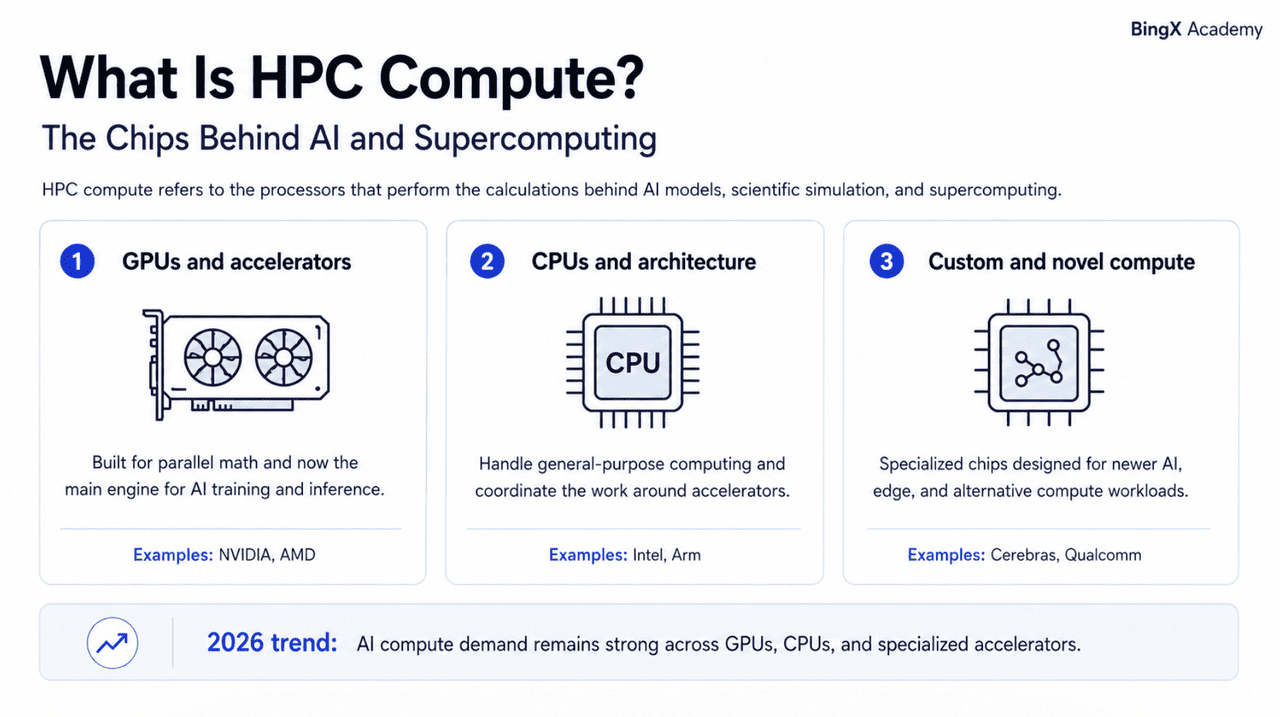
- GPUs and accelerators. Graphics processing units, originally built for rendering images, turned out to be ideal for the parallel math behind AI. They are now the dominant engine for training and running large models, and the leaders are NVIDIA and AMD.
- CPUs and architecture. Central processing units handle general-purpose computing and orchestrate the work around accelerators, while chip architectures define how processors are designed. Intel builds server CPUs and accelerators, while Arm licenses the architecture used across much of the industry.
- Custom and novel compute. Beyond standard GPUs and CPUs, some companies build entirely different chips for AI, from wafer-scale processors to specialized accelerators and edge chips. Cerebras and Qualcomm represent this newer, fast-moving frontier of AI compute.
The central story of 2026 is that AI compute demand keeps exceeding supply across every category, giving pricing power to the companies that can design and ship the most capable processors, while newer architectures challenge the established GPU-and-CPU model.
2026 HPC Market Overview: Why AI Compute Demand Keeps Rising
The 2026 HPC and AI compute cycle is being shaped by one broad trend: demand for more computing power is still rising faster than supply. GPU makers, CPU designers, and newer accelerator companies are benefiting in different ways as AI spending spreads across the compute stack.
- AI compute demand is still exceeding supply. NVIDIA, now valued at roughly $5.4 trillion, expects its next-generation Vera Rubin platform to remain supply-constrained through much of its lifecycle. Similar capacity pressure across GPUs, CPUs, and specialized accelerators continues to support pricing and investment across the sector.
- AI is reviving growth at established chipmakers. Intel reported its strongest revenue growth in more than fifteen years, with Data Center and AI revenue up 59%. AI-related businesses now account for a much larger share of growth, showing how the HPC cycle is extending beyond the largest GPU suppliers.
- New compute architectures are winning major contracts. Cerebras has shown that alternative processor designs can compete for large AI workloads, including a multi-year OpenAI agreement valued at more than $20 billion. Its $6.4 billion IPO also highlighted growing investor demand for companies challenging the traditional GPU model.
- Compute is expanding beyond the data center. AI processing is moving into vehicles, devices, and industrial systems as edge workloads grow. Qualcomm is targeting $5 billion of data-center revenue by fiscal 2027 and $15 billion by fiscal 2029, while its automotive business grew 61% year over year, showing how AI compute demand is broadening into new markets.
Read More: Top AI Compute and GPU Stocks to Buy in 2026: The Shift to Inference and Custom Silicon
2026 HPC Stocks Overview and Comparison by Chip Type
HPC stocks span merchant GPUs, CPUs and architecture, and novel or edge processors. This comparison shows how NVIDIA, AMD, Intel, Arm, Cerebras, and Qualcomm compete across the 2026 high-performance computing market.
|
Company |
Ticker |
Primary Role |
Key Advantages |
What to Watch in 2026 |
|
NVIDIA |
NVDA |
AI GPUs and accelerators |
Dominant AI compute platform supported by CUDA |
Q1 beat, Vera Rubin launch, ~$5.4T market cap |
|
AMD |
AMD |
GPUs and server CPUs |
Main GPU challenger plus a strong server CPU franchise |
Data center +57%, Meta 6GW deal, MI450 ramp |
|
Intel |
INTC |
Server CPUs and foundry |
Large CPU base with an expanding chipmaking business |
Strongest growth in 15 years, 18A node, 2026 recovery |
|
Arm Holdings |
ARM |
CPU architecture and IP |
Processor architecture used across much of the industry |
Data center royalties, Arm AGI CPU demand, licensing growth |
|
Cerebras Systems |
CBRS |
Wafer-scale AI chips |
Wafer-scale architecture designed as an alternative to GPUs |
Revenue growth, OpenAI deal, post-IPO execution |
|
Qualcomm |
QCOM |
Edge and data center chips |
Strong mobile and edge position with growing AI data-center ambitions |
Data-center targets, automotive growth, AI expansion |
What Are the Top HPC Stocks in 2026?
Six companies stand out across the main layers of high-performance computing:
- AI GPUs and accelerators: NVIDIA (NVDA), AMD (AMD)
- CPUs and processor architecture: Intel (INTC), Arm Holdings (ARM)
- Novel and edge compute: Cerebras Systems (CBRS), Qualcomm (QCOM)
Together, these companies cover the core processor technologies powering AI and supercomputing, from established GPU and CPU platforms to newer architectures competing for the next generation of compute workloads.
A. GPUs and Accelerators
Graphics processing units are the dominant engine of AI, handling the parallel math behind training and inference. These companies design the accelerators that power most of the world's AI workloads.
1. NVIDIA (NVDA)
Core Role: Dominant AI GPU and accelerator platform
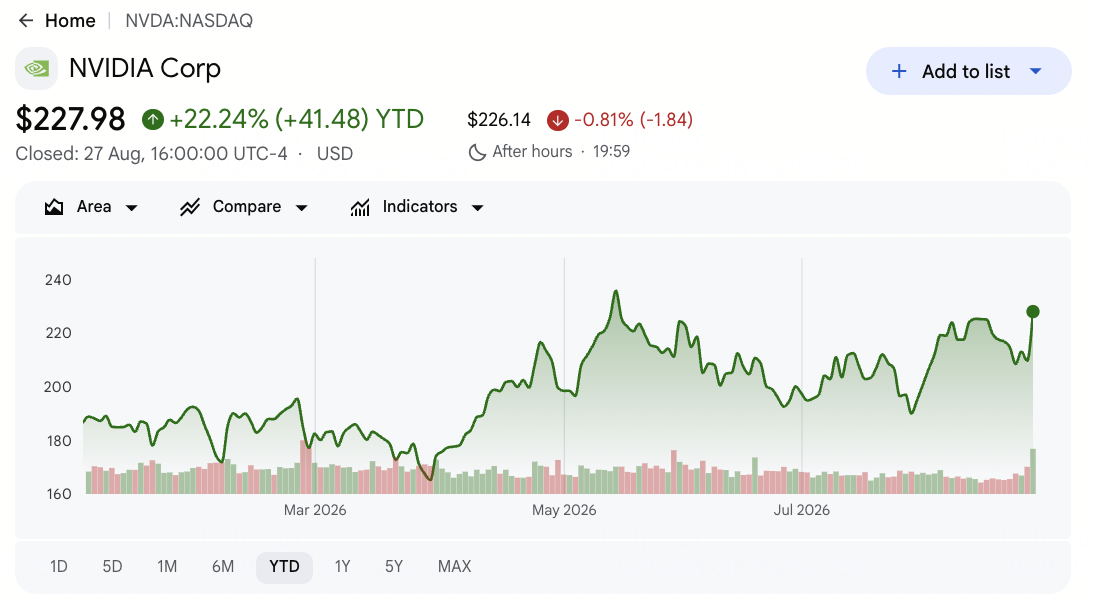
NVIDIA is the central compute supplier for AI, with GPUs that power most frontier training workloads and a growing share of inference, while its CUDA software acts as a moat that keeps developers, AI frameworks, and enterprise infrastructure tied to NVIDIA hardware. This combination of leading silicon and an entrenched software ecosystem makes NVIDIA the most important company in AI compute and the clearest large-cap way to invest in the theme.
Q2 FY2027 results reinforced that position, with revenue of $81.6 billion, ahead of consensus, and the next major catalyst is the Vera Rubin platform in the second half of 2026, which management expects to stay supply-constrained throughout its lifecycle. With a market cap near $5.4 trillion, NVIDIA remains the most direct exposure to AI compute demand. The main risks are hyperscaler custom silicon reducing GPU reliance for some inference and the stock's size, but most AI frameworks still optimize for CUDA first, making custom chips an incremental pressure rather than a replacement.
Read More: Nvidia (NVDA) Stock Price Outlook for 2026: Can Blackwell and Vera Rubin Take NVDA Back to $300?
NVDA Price Trend (2020-2026 YTD)
|
Year |
Yearly High |
Yearly Low |
Annual Return |
Market Conditions |
|
2020 |
$15.06 |
$4.83 |
122% |
Pandemic-era gaming and data center demand |
|
2021 |
$33.36 |
$11.50 |
125% |
Crypto mining peak; data center momentum |
|
2022 |
$30.04 |
$10.81 |
-50% |
Crypto bust; mining card glut; Fed rate hikes |
|
2023 |
$50.41 |
$14.10 |
239% |
ChatGPT moment; Hopper ramp; AI rally begins |
|
2024 |
$152.89 |
$45.95 |
171% |
Blackwell launch; market cap surpasses $3T |
|
2025 |
$190.95 |
$86.62 |
26% |
Consolidation year; Blackwell shipments scale |
|
2026 YTD |
~$220 (May) |
~$140 (Jan) |
+45% YTD (est.) |
Q1 FY27 beat; Rubin ramp positioning; $5.4T cap |
2. Advanced Micro Devices (AMD)
Core Role: Alternative AI GPUs and server CPU leader
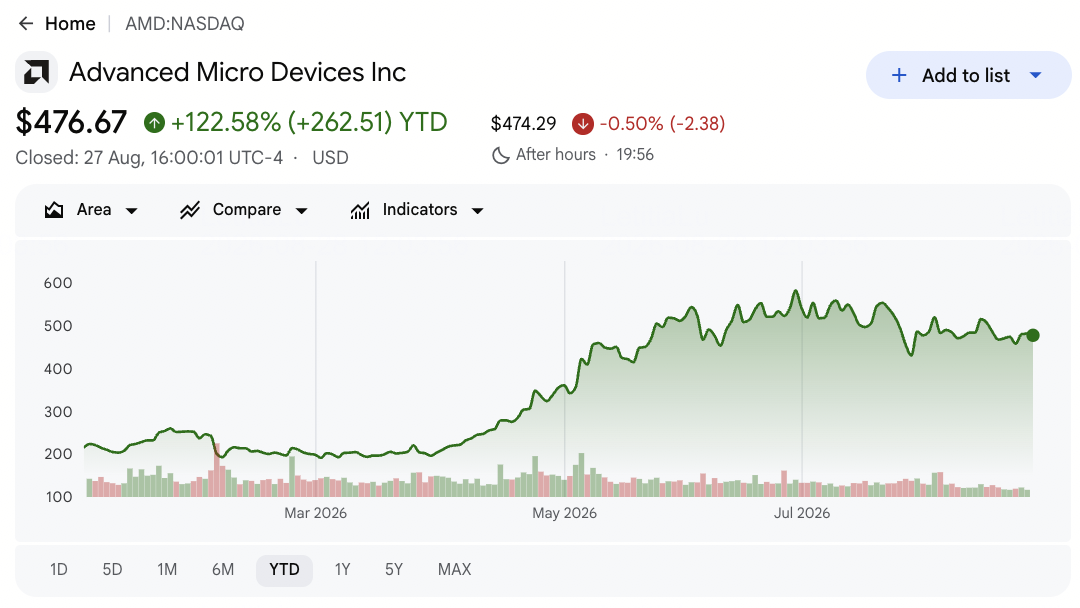
AMD is the primary commercial alternative to NVIDIA in AI accelerators, while its EPYC server CPU franchise gives it a strong position in general-purpose data center compute regardless of which accelerator a customer chooses. The MI300 series built momentum through 2025, and the upcoming MI450 platform anchors a multi-year Meta agreement to deploy up to 6 gigawatts of AMD Instinct GPUs, making AMD the clearest challenger across both AI GPUs and CPUs.
Q1 2026 revenue reached $10.3 billion, up 38% year over year, with Data Center revenue up 57%, and management guided Q2 above consensus. The underappreciated part of AMD's thesis is the CPU side: agentic AI workloads raise host-CPU requirements for every accelerator deployed, supporting server CPU revenue growth of more than 70% in 2026. The main risks are NVIDIA's CUDA moat and execution on the MI450 ramp, but AMD offers dual exposure to the two largest categories of AI compute, GPUs and server CPUs.
Read More: AMD Price Prediction 2026: $525 AI Sovereignty or $300 Valuation Trap?
AMD Price Trend (2020-2026 YTD)
|
Year |
Yearly High |
Yearly Low |
Annual Return |
Market Conditions |
|
2020 |
$97.98 |
$36.75 |
100% |
Pandemic gaming and data center surge |
|
2021 |
$164.46 |
$72.50 |
57% |
EPYC share gains; data center growth |
|
2022 |
$155.42 |
$54.57 |
-55% |
Tech sell-off; PC market weakness |
|
2023 |
$151.05 |
$60.05 |
128% |
AI rally; MI300 launch expectations |
|
2024 |
$227.30 |
$116.37 |
-18% |
MI300 shipments begin but margin disappoints |
|
2025 |
$215.00 |
$78.21 |
22% |
Stabilization; Meta GPU deal speculation |
|
2026 YTD |
~$352 (Apr) |
~$210 (Jan) |
+66% YTD |
Meta 6GW deal; Q1 rev +38%; Data Center +57% |
B. CPUs and Architecture
Central processors and chip architectures form the foundation of computing, orchestrating workloads and defining how chips are designed. These companies supply the CPU backbone and the blueprints the whole industry builds on.
3. Intel (INTC)
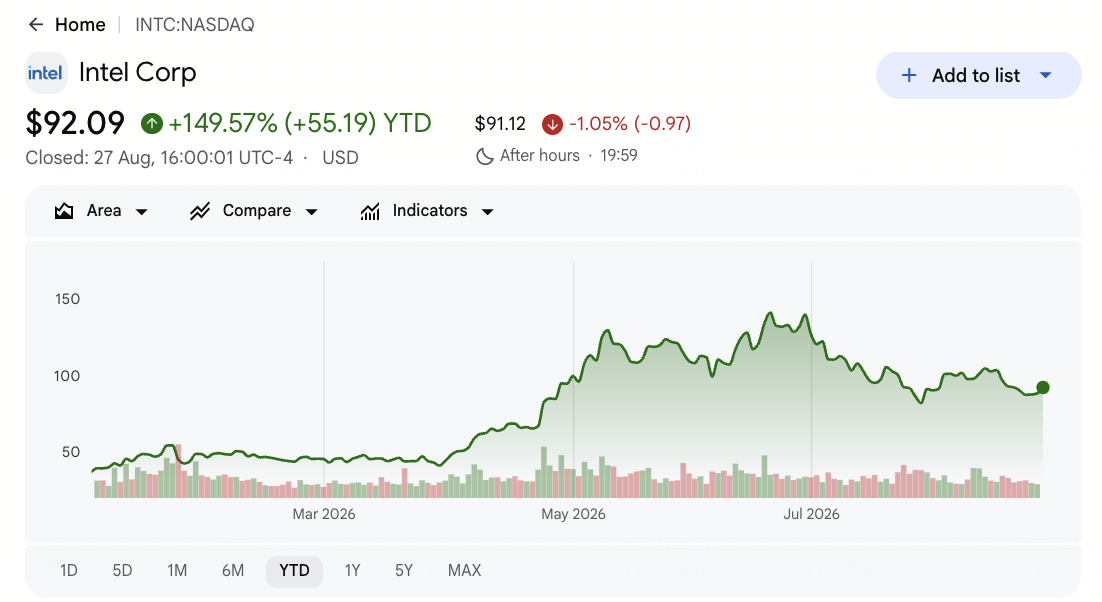
Core Role: Server CPUs, accelerators, and foundry
Intel is the classic CPU giant in the middle of a turnaround, combining its Xeon server processors and Gaudi AI accelerators with an ambitious effort to become a leading-edge contract chipmaker through Intel Foundry. After years of losing ground, Intel is being revitalized by AI-driven demand for data center CPUs, while its 18A manufacturing node aims to restore its process leadership and attract external foundry customers.
Q2 2026 delivered Intel's strongest revenue growth in more than fifteen years, with revenue of $16.1 billion, up 25% year over year, and Data Center and AI revenue up 59% to $6.3 billion, while AI-driven businesses contributed roughly 70% of total revenue. Its 18A node exceeded internal output targets with yields reaching around 85%, and the stock is up about 163% in 2026 on turnaround optimism. The main risks are heavy capital spending, an unproven external foundry business where outside customers remain a small share of revenue, and ongoing losses, but Intel offers leveraged exposure to both an AI-CPU recovery and a potential foundry comeback.
Read More: Intel (INTC) Stock Forecast 2026: Foundry Breakthrough to $89 or Value Trap?
INTC Price Trend (2020-2026 YTD)
|
Year |
Yearly High |
Yearly Low |
Annual Return |
Market Conditions |
|
2020 |
$69.00 |
$43.00 |
-17% |
Pandemic; process delays; share loss |
|
2021 |
$68.00 |
$47.00 |
3% |
Turnaround begins; foundry ambitions |
|
2022 |
$56.00 |
$25.00 |
-49% |
Share loss; margin collapse; PC downturn |
|
2023 |
$51.00 |
$24.00 |
90% |
Foundry strategy; AI PC narrative |
|
2024 |
$51.00 |
$18.00 |
-60% |
Turnaround struggles; dividend cut |
|
2025 |
$28.00 |
$18.00 |
5% |
Restructuring; new CEO; stabilization |
|
2026 YTD |
~$40 (Aug) |
~$19 (Jan) |
+163% YTD |
Strongest growth in 15 years; 18A node; DCAI +59% |
4. Arm Holdings (ARM)
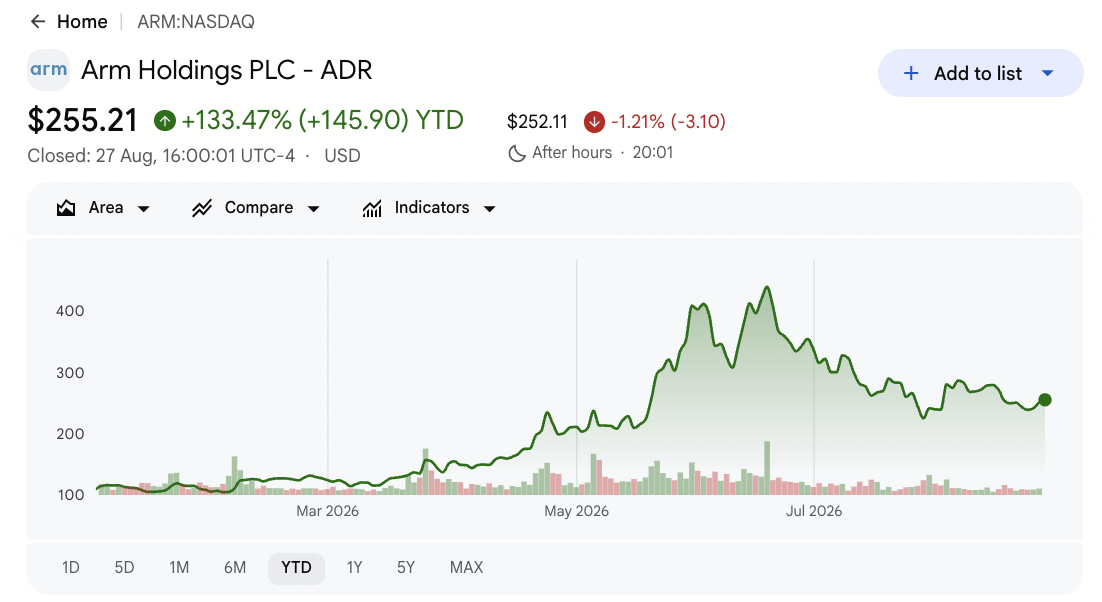
Core Role: CPU architecture and chip design IP
Arm Holdings designs the processor architecture that most of the world's chips are built on, licensing its designs and instruction sets to companies including Apple, NVIDIA, Amazon, and Qualcomm. Rather than making chips itself, Arm earns licensing fees and per-chip royalties, giving it exposure to the entire compute market. Its Neoverse cores and Compute Subsystems increasingly power data center CPUs, while the new Arm AGI CPU targets cloud and AI directly, making Arm an architecture-level bet on all AI compute.
Arm Holdings Q1 FY2027 was a record, with revenue up 22% year over year, data center royalty revenue more than doubling, and Arm AGI CPU demand for FY2027 and FY2028 exceeding $2 billion. Its high-margin, royalty-based model means Arm benefits whenever more chips ship, regardless of which company makes them. The main near-term drag is smartphone weakness tied to higher memory prices, which trimmed royalty growth expectations, though data center strength is expected to offset it. For investors, Arm offers a high-margin, architecture-level way to play the entire AI compute transition.
Read More: Arm Holdings (ARM) Stock Outlook 2026: AI Licensing and the $200+ Price Target
ARM Price Trend (2023 IPO-2026 YTD)
Note: Arm began trading on Nasdaq in September 2023, so multi-year historical data prior to the IPO is not directly comparable.
|
Year |
Yearly High |
Yearly Low |
Annual Return |
Market Conditions |
|
2023 |
$69.00 |
$46.50 |
+47% (partial) |
Nasdaq IPO in September; AI licensing interest |
|
2024 |
$164.00 |
$46.50 |
64% |
Armv9 ramp; data center royalty growth begins |
|
2025 |
$175.00 |
$80.00 |
-11% |
CSS adoption; Neoverse hyperscaler share gains |
|
2026 YTD |
~$290 (Jul) |
~$110 (Jan) |
+120% YTD |
Record Q1 FY27; data center royalties double; AGI CPU >$2B |
|
2024 |
$51.00 |
$18.00 |
-60% |
Turnaround struggles; dividend cut |
|
2025 |
$28.00 |
$18.00 |
5% |
Restructuring; new CEO; stabilization |
|
2026 YTD |
~$40 (Aug) |
~$19 (Jan) |
+163% YTD |
Strongest growth in 15 years; 18A node; DCAI +59% |
C. Novel and Edge Compute
Beyond standard GPUs and CPUs, some companies build entirely different kinds of AI chips, from wafer-scale processors to edge and automotive silicon. These names represent the fast-moving frontier of AI compute, with higher growth and higher risk.
5. Cerebras Systems (CBRS)
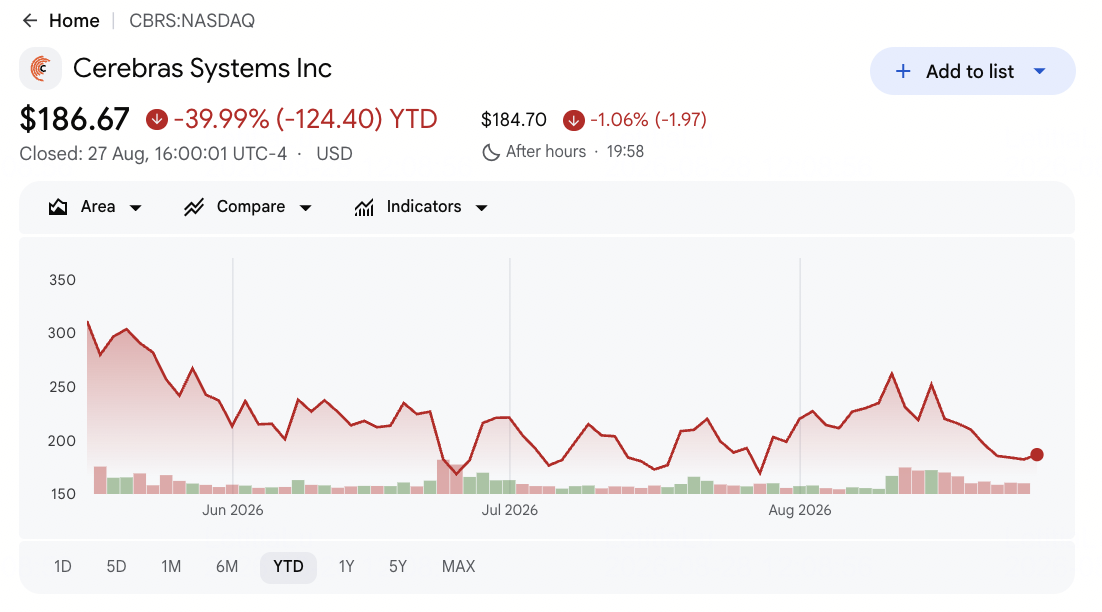
Core Role: Wafer-scale AI chips and fast inference
Cerebras Systems builds the Wafer-Scale Engine, the largest computer chip ever made, using an entire silicon wafer as a single processor rather than cutting it into many smaller chips. This radical architecture is designed to deliver extremely fast AI inference and training, positioning Cerebras as one of the most direct challengers to NVIDIA's GPU dominance, with a focus on speed for large language models and a growing cloud inference business.
Cerebras reported Q1 2026 revenue of $193.4 million, up 92% year over year, and announced a multi-year deal with OpenAI for 750 megawatts valued at more than $20 billion, plus a partnership to bring its fast inference to Amazon Web Services. It raised $6.4 billion in Q2 in what it called the largest semiconductor IPO of all time. The main risks are significant: heavy customer concentration, an unproven ability to scale against NVIDIA, ongoing losses, and post-IPO volatility, but Cerebras offers the most direct exposure to a novel, non-GPU approach to AI compute.
Read More: Cerebras Systems (CBRS) Price Prediction 2026: $340 Wafer-Scale Boom or Valuation Trap?
CBRS Price Trend (2026 IPO-YTD)
Note: Cerebras completed its IPO in 2026, so no multi-year historical trading data exists. The company remains unprofitable and highly volatile.
|
Year |
Yearly High |
Yearly Low |
Annual Return |
Market Conditions |
|
2026 YTD |
~$220 (est.) |
~$150 (est.) |
-30% since IPO |
Record IPO ($6.4B); $20B OpenAI deal; revenue +92% |
6. Qualcomm (QCOM)
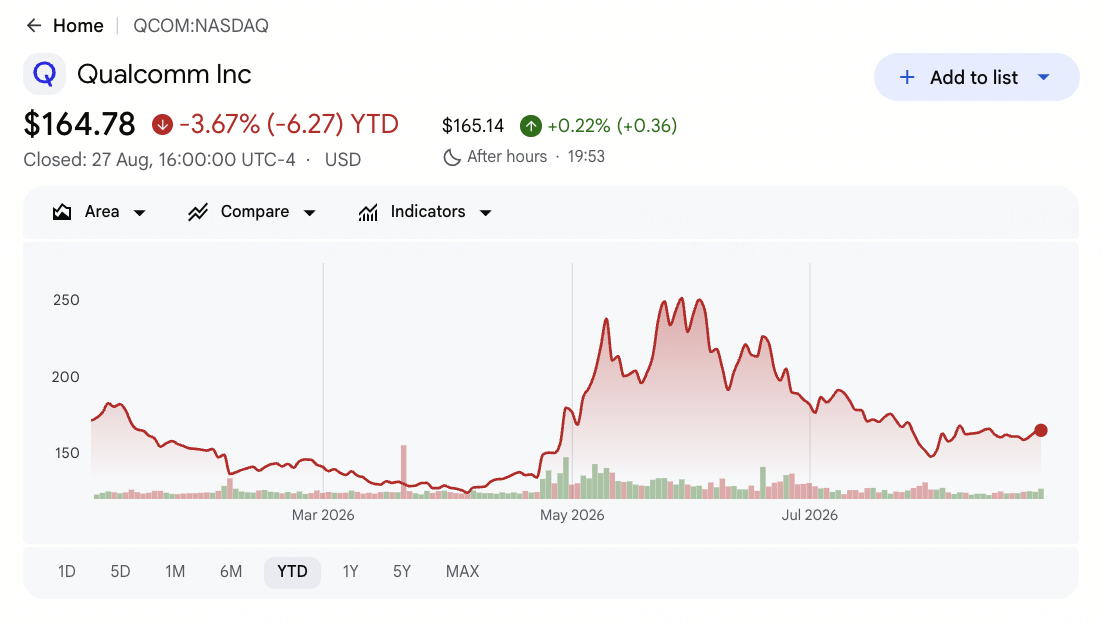
Core Role: Edge AI chips expanding into the data center
Qualcomm is the leader in mobile and edge compute, best known for its Snapdragon chips that power smartphones, and it is now pushing into new markets including automotive, IoT, and AI data centers. As AI moves from central data centers toward devices and the edge, Qualcomm's efficient on-device compute becomes increasingly valuable, while a new multi-product data center strategy aims to turn the company into a meaningful player in AI infrastructure compute.
Qualcomm's fiscal Q3 2026 revenue reached $9.9 billion at the high end of guidance, with non-GAAP EPS of $2.21, as record automotive revenue up 61% and IoT growth offset handset weakness. Qualcomm set data center revenue targets of $5 billion by fiscal 2027 and $15 billion by fiscal 2029, completed the tape-out of its High Bandwidth Compute chip, and secured two custom-silicon wins with hyperscalers ramping from the December quarter. The main risks are declining Apple modem revenue, handset-market pressure from high memory prices, and an unproven data center business, but Qualcomm offers exposure to both edge AI compute and an emerging data center push.
Read More: Qualcomm (QCOM) Stock Forecast 2026: Can AI and Diversification Push QCOM Above $200?
QCOM Price Trend (2020-2026 YTD)
|
Year |
Yearly High |
Yearly Low |
Annual Return |
Market Conditions |
|
2020 |
$153.00 |
$58.00 |
73% |
5G ramp; licensing strength |
|
2021 |
$193.00 |
$122.00 |
20% |
5G demand; chip shortage pricing |
|
2022 |
$193.00 |
$101.00 |
-40% |
Tech sell-off; smartphone downturn |
|
2023 |
$160.00 |
$102.00 |
32% |
AI PC narrative; recovery |
|
2024 |
$231.00 |
$149.00 |
8% |
Edge AI positioning; auto growth |
|
2025 |
$180.00 |
$120.00 |
-8% |
Apple modem loss concerns; diversification |
|
2026 YTD |
~$175 (est.) |
~$120 (est.) |
+5% YTD |
Data center pivot; auto +61%; HBC tape-out |
How to Trade HPC Stocks on BingX
BingX offers a crypto-native way to gain exposure to leading high-performance computing stocks without using a traditional brokerage account. The main execution path is through USDT-margined perpetual contracts on BingX TradFi, which allow active traders to go long or short and trade around earnings, product launches, AI demand commentary, and broader compute-cycle trends.
Long or Short HPC Stock Futures with USDT on BingX TradFi
For active traders looking to capitalize on short-term momentum, earnings volatility, or HPC catalysts, BingX TradFi allows users to trade compute-linked stock futures with USDT. These USDT-settled perpetual contracts mirror the price movements of underlying equities, offering flexible long and short exposure without requiring users to hold the physical stock.
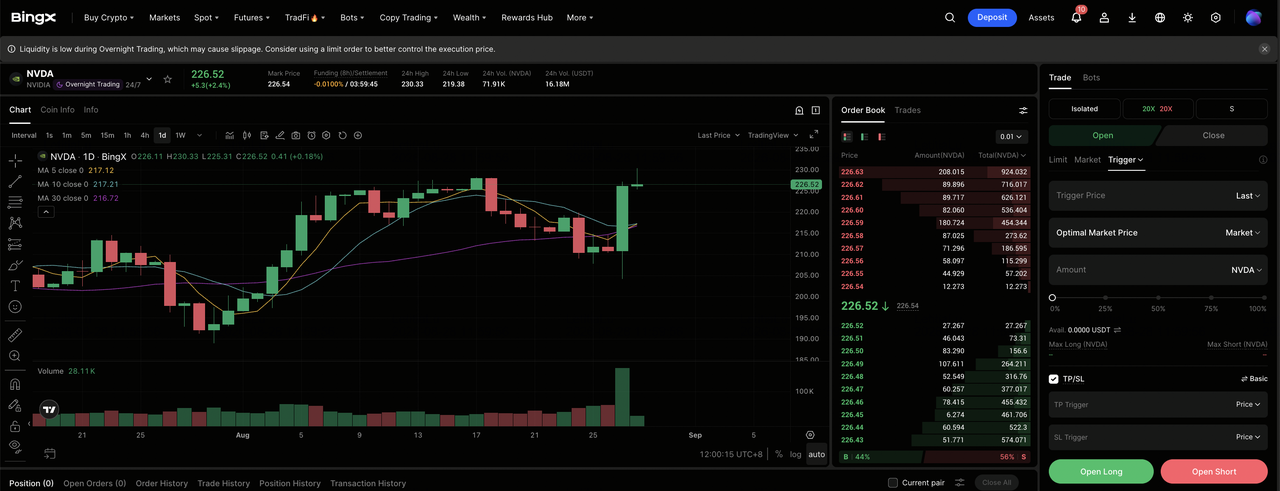
Step 1: Account setup and security. Sign up and log into your BingX account, complete the identity verification (KYC) required in your region, and enable two-factor authentication.
Step 2: Allocate trading capital. Transfer USDT from your spot wallet into your futures account, where it will serve as collateral.
Step 3: Select your contract. Navigate to the TradFi markets page or the futures trading section. Choose compute-linked perpetual contracts such as NVDA-USDT, AMDUS-USDT, INTC-USDT, ARM-USDT, CBRS-USDT, or QCOM-USDT.
Step 4: Set direction and leverage. Open long if you expect the stock price to rise, or open short if you expect a pullback. Choose leverage based on your risk plan.
Step 5: Execute and manage risk. Set stop-loss and take-profit orders before submitting the trade. PnL settles dynamically in USDT.
Risks and Core Considerations When Trading HPC Stocks
HPC stocks offer exposure to the processors powering AI and high-performance computing, but they also carry risks tied to competition, valuation, execution, and market cycles.
- Competition and custom silicon could pressure market share. Hyperscalers are building more in-house accelerators, which could reduce reliance on merchant GPUs and pressure NVIDIA, AMD, and other suppliers.
- Valuations can fall quickly after strong rallies. Several HPC names trade on high growth expectations, so weaker guidance, slower AI demand, or product delays can trigger sharp re-ratings.
- Execution risk varies widely across companies. Intel must prove its foundry strategy and 18A process, while Cerebras and Qualcomm still need to scale newer compute businesses against larger incumbents.
- Semiconductors remain cyclical and supply-sensitive. Memory, packaging, substrates, and manufacturing capacity can affect shipment timing, costs, and margins even when end demand remains strong.
- Leverage increases downside risk. HPC stocks can move sharply around earnings, product launches, AI spending updates, and policy headlines, making position sizing and stop-loss discipline especially important for futures traders.
Final Thoughts: Should You Add HPC Stocks to Your 2026 Portfolio?
The six names above offer different ways to participate in the 2026 high-performance computing market across chip types. NVIDIA and AMD lead merchant GPUs and accelerators, Intel and Arm anchor CPUs and architecture, and Cerebras and Qualcomm represent novel and edge compute. Together they span the dominant GPU platforms, the CPU and architecture backbone, and the newer challengers reshaping how AI computation is done.
The trade-off is that each stock carries a different risk profile. NVIDIA and AMD offer scale and leadership at premium valuations, Intel and Arm offer a turnaround and a high-margin royalty model, and Cerebras and Qualcomm offer higher-growth, higher-risk bets on novel and edge compute. For traders using BingX TradFi, conservative position sizing, leverage control, and stop-loss orders are essential when trading HPC stock futures through USDT-margined perpetual contracts.
Related Reading
- Top AI Server Stocks to Buy in 2026: Rack-Scale Systems, GPU Servers, and AI Servers Infrastructure
- Top AI Data Center Stocks to Buy in 2026: Cloud, Servers, and AI Compute Infrastructure
- Top AI Networking Stocks 2026: AI Fabric, Switches, Copper, Fiber, and Optics Connectivity
- Top AI Compute and GPU Stocks to Buy in 2026: The Shift to Inference and Custom Silicon
- Top AI Memory Stocks to Buy in 2026: DRAM, HBM, and AI Storage Demand Explained
- Top 10 AI Hardware Stocks to Watch in 2026: The Architecture Driving Next-Gen Intelligence
