
The S&P 500 (SPX) tracks large U.S. companies across technology, financial services, healthcare and other industries. Its 2026 outlook depends on whether earnings growth and cash generation can justify valuations while AI infrastructure investment absorbs substantial capital. Interest rates, export controls and fiscal policy influence that balance, making investment returns and the breadth of company profits central to sustained index performance.
AI infrastructure profitability is a central valuation question for S&P 500 investors. BofA’s November 2026 survey showed net technology overweight falling from 37% to 12%. FactSet’s November 13 snapshot recorded 31.9% blended Q3 earnings growth. Amazon’s negative $42.4 billion trailing free cash flow illustrates why strong cloud demand must generate adequate returns to support infrastructure spending and shareholder value.
The SPX forecast for 2026 now centers on two competing views:
- The stabilization case: Profitable AI usage, resilient non-technology demand and improving market breadth could support SPX valuations, while workable export approvals and manageable financing costs support a recovery.
- The deeper repricing case: Doubts about AI investment returns could spread through suppliers, financing and consumer confidence, while export delays and post-midterm policy uncertainty keep investors unwilling to restore earlier valuation multiples.
This guide breaks down the SPX forecast, index scenarios, key risks and institutional outlooks using official index materials, dated financial disclosures and research on AI investment, financing and policy, plus how to access S&P 500 index exposure on BingX TradFi with USDT-funded USDx margin.
Top 5 Things for S&P 500 Investors to Know in 2026
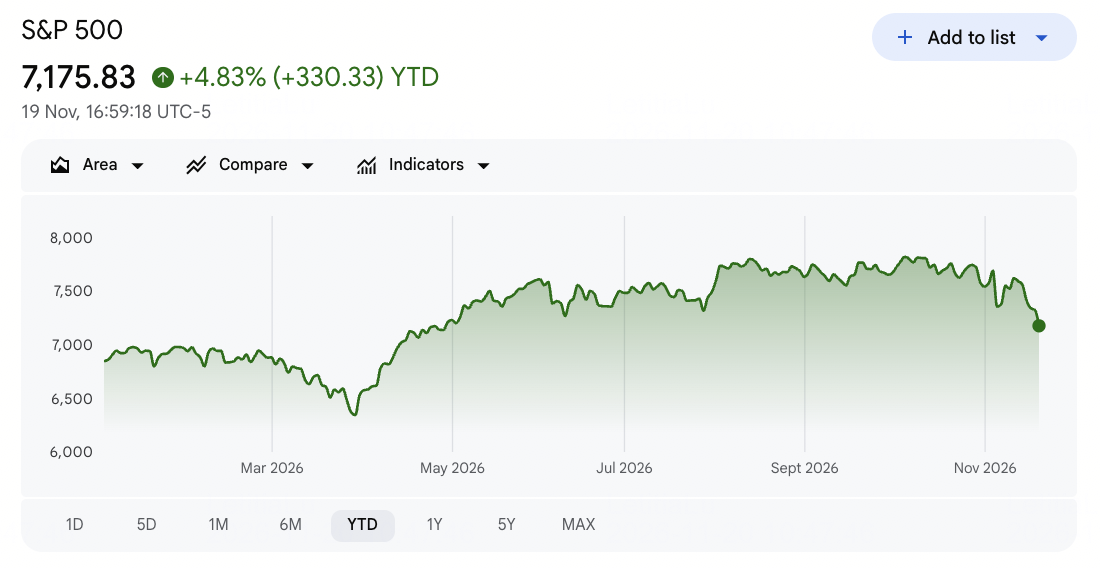
- SPX closed at 7,175.83 on November 19, up approximately 4.8% YTD: The index fell 2.0% during the session, reflecting renewed selling across technology and other sectors. Reaching the 8,000-point bull scenario will require stronger earnings, sustainable cash generation, and broader market participation.
- Technology positioning fell sharply in November's fund-manager survey: BofA reported a net technology overweight of 12%, down from 37% in October, the largest monthly reduction since 2006. The shift highlights concerns about AI overinvestment and crowded valuations, even as recession expectations remain limited.
- Strong earnings growth remains exposed to the AI investment cycle: FactSet's November 13 update showed 31.9% blended Q3 earnings growth and 14.4% revenue growth. Goldman Sachs estimates AI investment accounts for nearly half of 2026 S&P 500 EPS growth, making future profitability increasingly sensitive to infrastructure spending returns.
- Midterm election results and export controls create policy uncertainty: Democratic majorities take office in January 2027, while November's BIS restrictions expand licensing requirements for advanced chips. Congressional oversight and export approvals could influence AI infrastructure investment, corporate spending, and equity valuations.
- NVIDIA's $115.8 billion quarter reinforces AI demand but raises the payback question: NVIDIA guided Q4 FY2027 revenue to $130 billion, supporting expectations for continued AI infrastructure spending. However, investors must assess whether hyperscalers can translate rising computing investments into sustainable profits and cash flow.
What Is the S&P 500 (SPX)?
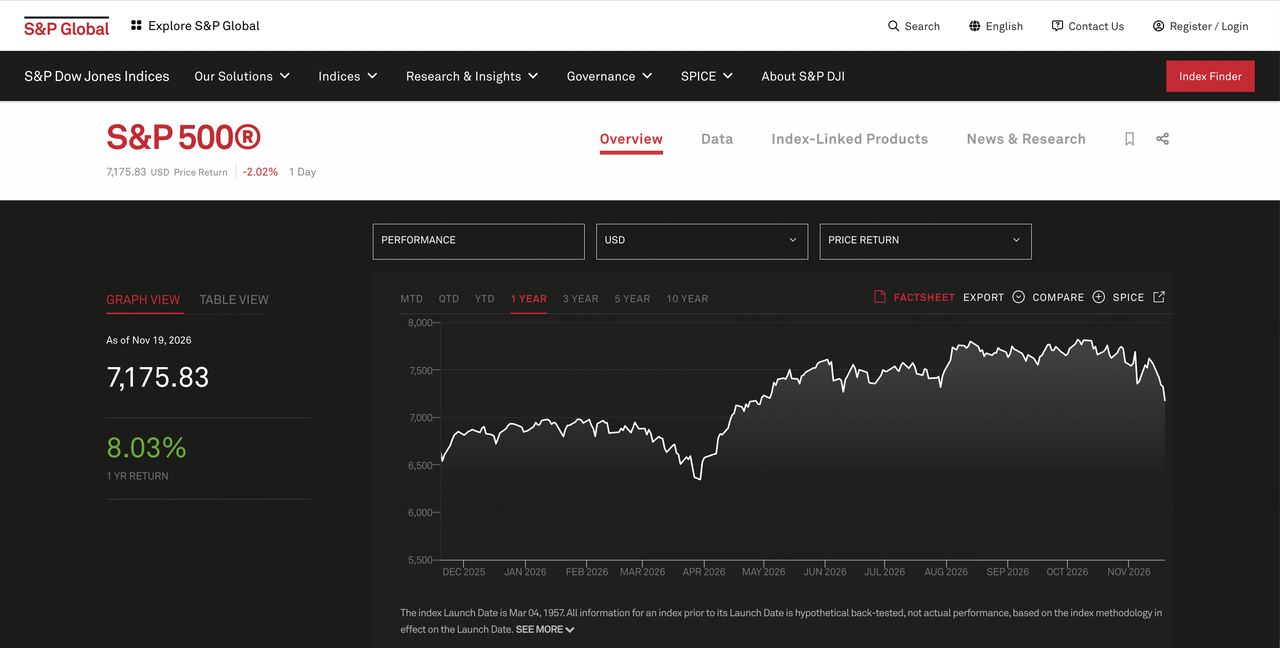
The S&P 500 is a major U.S. stock market index maintained by S&P Dow Jones Indices, representing 500 leading companies across technology, financial services, healthcare, and other industries. Its float-adjusted market-capitalization weighting gives larger companies greater influence based on the value of publicly available shares. Covering approximately 80% of available U.S. market capitalization, the index serves as a benchmark for investment funds, derivatives, and institutional portfolios. SPX is measured in index points, while its price-return version excludes reinvested dividends.
The S&P 500 is regularly reviewed to reflect changes in the U.S. equity market, with quarterly updates to share counts and float adjustments. On March 23, 2026, Vertiv, Lumentum, Coherent, and EchoStar joined the index. As of September 30, the benchmark contained 503 securities, with its top 10 holdings accounting for 37.3% of its weight, highlighting the influence of major technology companies. Index performance ultimately depends on constituent earnings, stock valuations, and broader market conditions.
Read More: How to Invest in S&P 500 in 2026: A Guide for Beginners and Crypto Users
S&P 500 Market Drivers: 8.2% Sell-Off Raises AI Bubble Fears Despite Strong Earnings
The S&P 500 closed at 7,175.83 on November 19, down 8.2% from its October record and up just 4.8% YTD, as AI bubble concerns, elevated technology valuations, and uncertain infrastructure returns triggered broader selling. Despite the correction, corporate earnings remain strong, with FactSet reporting 31.9% blended Q3 earnings growth. The key question is whether profitability and cash generation can support a recovery amid weaker technology sentiment, export restrictions, and post-midterm uncertainty. Financial observations below retain their stated reporting periods.
Read More: Top AI Semiconductor Stocks to Buy in 2026: AI Chips and Supply Chain Complete Guide
|
Market Driver / Scope |
Comparison / Basis |
Latest Observation |
Index Implication |
|
S&P 500 performance |
October 2026 record |
7,175.83 (Nov. 19) |
Weakened. Down 8.2% from record; up 4.8% YTD. |
|
Q3 blended earnings growth |
29.1% at September 30 |
31.9% YoY |
Improved. Up 2.8 percentage points. |
|
Q3 blended revenue growth |
12.2% at September 30 |
14.4% YoY |
Improved. Up 2.2 percentage points. |
|
Aggregate EPS surprise |
7.5% five-year average |
3.10% |
Lower. Below historical average. |
|
Forward 12-month P/E |
19.8× five-year average |
18.3× (Nov. 13) |
Lower. 1.5 turns below average. |
|
Amazon Q3 AWS sales |
Q3 2025 |
$46.0B |
Expanded. Up 39.3% YoY. |
|
Amazon trailing free cash flow |
+$14.8B year earlier |
−$42.4B |
Weakened. Infrastructure spending absorbed cash. |
|
Microsoft adjusted diluted EPS |
$4.13 Q1 FY2026 |
$4.89 |
Improved. Up 18% YoY. |
|
Trailing S&P 500 buybacks |
Twelve months to June 2026 |
$1.10T |
Record. Earlier-period capital-return support. |
- S&P 500 falls 8.2% from its record despite 31.9% earnings growth. The index declined for six consecutive sessions through November 19, with over 90% of constituents falling on the final day. Despite strong Q3 profits, EPS surprises of 3.1%, below the 7.5% five-year average, may limit investor confidence.
- AI bubble concerns drive the sharpest technology positioning cut since 2006. BofA's November survey showed net technology overweight falling from 37% to 12%, with 38% of respondents citing AI overinvestment. Amazon's $17.8 billion in AWS operating income highlights demand, but its $42.4 billion negative free cash flow raises concerns about infrastructure returns.
- Midterm election results and interest rates influence market valuations. Democratic congressional majorities begin in January 2027, potentially increasing AI oversight and affecting fiscal priorities. Persistent inflation and the Fed's 3.75%–4.00% policy rate could keep financing costs elevated despite resilient earnings.
- Five-country chip export controls threaten overseas AI infrastructure growth. November's BIS rule expands licensing requirements involving Indonesia, Malaysia, Singapore, Thailand, and Brazil, with exceptions for qualifying U.S.-headquartered users. Delayed approvals could weaken semiconductor shipments, data center investment, and AI earnings expectations.
- NVIDIA's $115.8 billion revenue faces leadership and AI spending uncertainties. NVIDIA's strong Q3 results support AI demand, but Jensen Huang's departure, export restrictions, and hyperscaler spending concerns could pressure valuations. Walmart's consumer performance provides another test of broader S&P 500 earnings resilience.
S&P 500 (SPX) 2026 Investment Outlook: 8,000 Bull Case vs. 6,900 Bear Case
The S&P 500's 2026 outlook has weakened following an 8.2% decline from its October record, with SPX closing at 7,175.83 on November 19. Strong corporate earnings provide support, but AI bubble fears, infrastructure spending, and tighter financing conditions have reduced investor confidence. Three key developments could influence the index through December 31:
- AI bubble fears and infrastructure spending: Concerns about hyperscaler capital expenditures, AI investment returns, and rising debt could pressure technology valuations despite strong earnings.
- Federal Reserve policy and financing costs: The November 18 Fed minutes highlighted AI-related financial risks, while the 3.75%–4.00% policy rate range could constrain infrastructure investment and equity valuations.
- Export controls and post-midterm uncertainty: New BIS licensing requirements across five countries could delay overseas AI deployments, while potential congressional scrutiny in 2027 adds policy uncertainty.
The Bull Case: Improving AI Returns Lift SPX Toward 8,000
Improving AI investment returns and broader earnings participation could support an S&P 500 recovery. FactSet's 31.9% blended Q3 earnings growth provides a strong operating foundation, while sustained cloud demand, resilient consumer spending, and manageable financing costs could restore confidence. Clearer export approvals and profitable infrastructure deployments would also help reduce AI valuation concerns.
The 8,000-point bull case assumes stronger corporate guidance, renewed technology demand, and wider participation across financial, industrial, and consumer stocks. Evidence of improving hyperscaler cash flow and stable credit conditions could support higher valuations, although persistent inflation or weaker customer spending may limit upside.
The Base Case: Gradual Recovery Keeps SPX Between 7,300 and 7,700
Resilient corporate earnings could support a gradual rebound from November's sell-off, although AI investment concerns and financing costs may prevent a full valuation recovery. Microsoft's $63.9 billion in quarterly cloud revenue demonstrates continued demand, while Amazon's negative $42.4 billion trailing free cash flow highlights infrastructure funding pressure. Mixed export approvals and uncertainty over future AI returns may keep investors selective.
The 7,300–7,700 base case assumes earnings remain stable, AI infrastructure spending continues, and recent selling gradually eases. Stronger cash generation and clearer policy guidance could support the upper end, while elevated interest rates, cautious institutional positioning, and slower overseas deployments may limit gains.
The Bear Case: AI Repricing Pulls SPX Toward 6,900
Disappointing AI investment returns, tighter financing, and further technology-sector selling could extend the S&P 500's correction. Amazon's $42.4 billion trailing free cash outflow illustrates the capital required before AI infrastructure investments generate sufficient returns. Export delays, weaker hyperscaler spending, or persistent leadership uncertainty at NVIDIA could further pressure technology earnings and valuations.
The 6,900-point bear case assumes continued AI valuation compression alongside weaker corporate guidance and broader market selling. Higher borrowing costs, delayed infrastructure returns, and reduced consumer spending could undermine earnings confidence, potentially extending losses beyond technology even without a broad economic recession.
S&P 500 Index Forecasts for 2026 by Wall Street Strategists
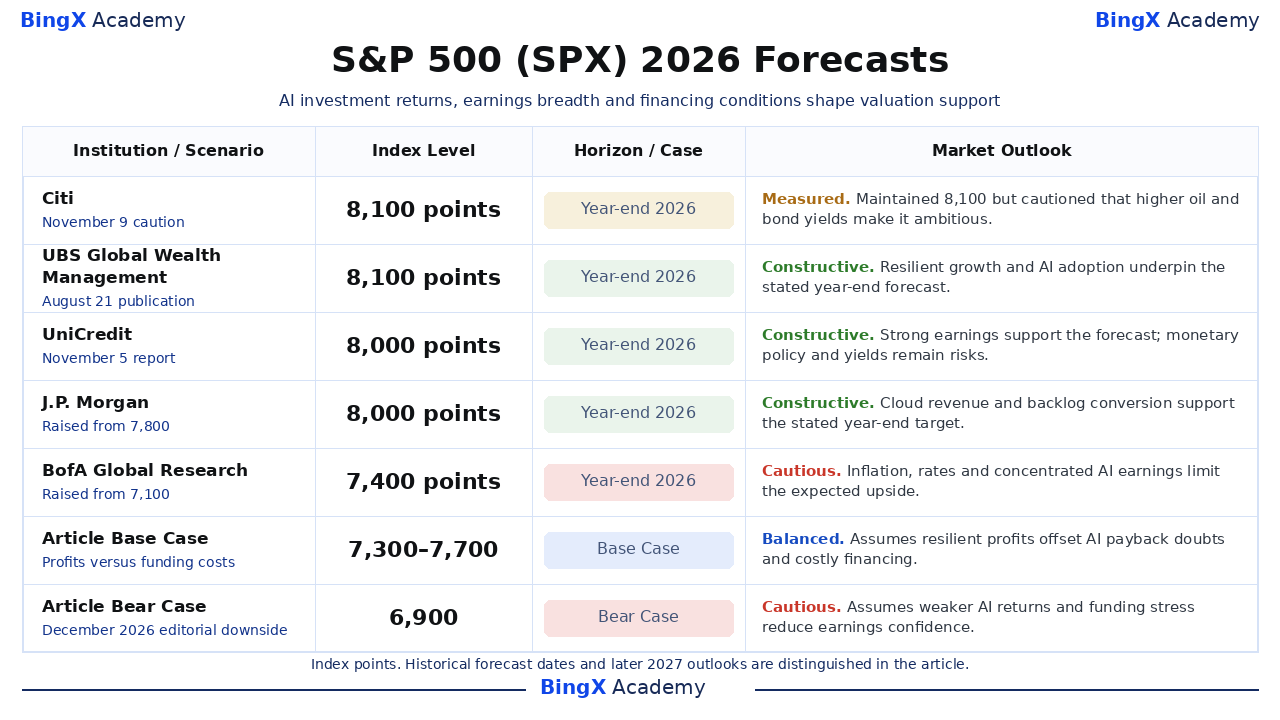
Five institutional forecasts place the S&P 500 between 7,400 and 8,100 points by December 2026, reflecting different expectations for AI investment returns, corporate earnings, inflation, and interest rates. Following the index's 8.2% correction from its October record, these targets imply varying degrees of recovery. The published forecasts retain their original dates, while the final two rows represent this article's separate year-end scenarios.
|
Institution / Scenario |
Index Level |
Forecast Horizon |
Market Outlook |
|
Citi |
8,100 |
December 2026 |
Measured. November 9: Maintained its target but called it ambitious as higher oil prices and bond yields challenged broader market gains. |
|
UBS Global Wealth Management |
8,100 |
December 2026 |
Constructive. August 21: Resilient growth, monetary policy, and AI adoption supported its outlook, alongside a separate 8,400 mid-2027 target. |
|
UniCredit |
8,000 |
December 2026 |
Constructive. November 5: Strong earnings and AI spending supported equities, although monetary policy and Treasury yields remained risks. |
|
J.P. Morgan |
8,000 |
December 2026 |
Constructive. August 10: Raised its target from 7,800 as cloud revenue and AI investment returns improved, retaining a roughly 20× forward valuation assumption. |
|
BofA Global Research |
7,400 |
December 2026 |
Cautious. September 14: Raised its target by 300 points while highlighting inflation, interest rates, and concentrated AI earnings risks. |
|
Article Base Case |
7,300–7,700 |
December 2026 |
Balanced. Resilient earnings support a partial recovery despite AI investment concerns and elevated financing costs. |
|
Article Bear Case |
6,900 |
December 2026 |
Cautious. Weak AI returns, tighter financing, and broader selling pressure earnings expectations and valuations. |
How to Trade the S&P 500 Index With CFDs on BingX
The S&P 500 is a stock market index that cannot be purchased directly as a company share. Eligible users can trade its price movements through SP500 index CFDs on BingX TradFi, using leverage and a dedicated CFD account funded in USDx. These contracts support long and short positions without ownership of the underlying index constituents.
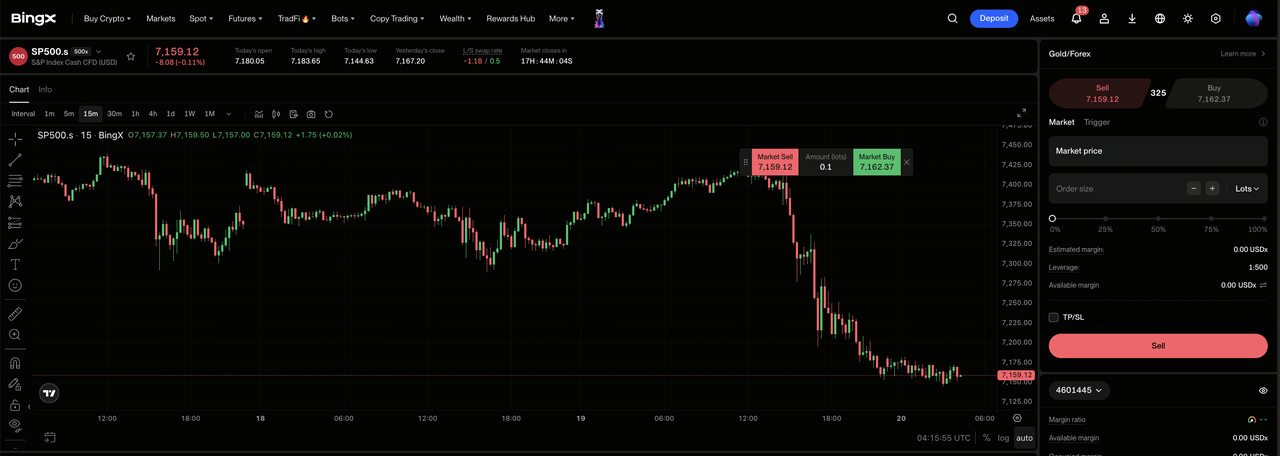
Step 1: Set Up Your Account and Security. Sign up or log in to BingX, complete the required identity verification (KYC), and enable two-factor authentication (2FA). Confirm that index CFDs are available in your region.
Step 2: Open BingX CFD Trading. Navigate to "TradFi > CFD" and activate your dedicated CFD account if needed. You can trade directly through the BingX App or website, with optional MetaTrader 5 (MT5) access for advanced charting and trading tools.
Step 3: Fund Your Account and Select SP500. Transfer USDT into your CFD account, where it is displayed as USDx at a 1:1 ratio for trading margin. Search for S&P 500 (SP500) and review the contract price, lot size, leverage, and margin requirements.
Step 4: Choose Your Direction and Place Your Trade. Select a Market Order for immediate execution or a Trigger Order to enter when the specified condition is met. Enter your position size in lots, then select "Buy (Long)" if you expect the index to rise or "Sell (Short)" if you expect it to fall. Review spreads, commissions, and overnight swap fees before confirming.
Step 5: Manage and Close Your Position. Monitor unrealized profit or loss, available margin, and liquidation risk under "Positions". Set Take-Profit and Stop-Loss (TP/SL) levels or close your position manually. Market gaps and leverage can increase potential losses, while stop-loss execution is not guaranteed.
Top 5 Risks to Watch for S&P 500 Investors in 2026
The S&P 500's diversified earnings base supports its long-term investment outlook, but the recent market correction highlights growing concerns about AI valuations, infrastructure spending, and financing costs. Export restrictions, concentrated technology earnings, and post-midterm uncertainty could further pressure market confidence and index returns.
- AI bubble fears could pressure technology valuations: BofA's November survey showed net technology overweight falling from 37% to 12%, reflecting reduced investor exposure. Disappointing AI investment returns or hyperscaler spending cuts could trigger further selling across major technology stocks.
- Export restrictions could weaken AI infrastructure growth: November's BIS rule expands chip licensing requirements across five countries, with exceptions for qualifying U.S.-headquartered users. Delayed approvals could reduce semiconductor shipments, cloud deployments, and expected earnings.
- Higher financing costs could pressure corporate investment: Amazon reported negative $42.4 billion in trailing free cash flow amid infrastructure expansion. Persistent interest rates, rising bond yields, or tighter credit could reduce investment returns and weaken broader market sentiment.
- Concentrated AI earnings could amplify market declines: Goldman Sachs estimates AI investment contributes nearly half of 2026 S&P 500 EPS growth. Weaker demand or reduced spending could pressure technology suppliers and related industries, limiting diversification benefits.
- Post-midterm policy uncertainty could affect valuations: Democratic congressional majorities begin in January 2027, potentially bringing greater AI oversight and changes in fiscal priorities. Uncertain regulation or delayed investment decisions could weaken earnings expectations and market recovery.
Final Thoughts: Should You Invest in the S&P 500 in 2026?
The S&P 500's 31.9% blended Q3 earnings growth demonstrates strong corporate profitability, but the recent 8.2% correction highlights concerns about AI bubble risks, elevated technology valuations, and infrastructure spending. While cloud demand remains strong, Amazon's $42.4 billion trailing free cash outflow raises questions about sustainable AI investment returns. Export restrictions, persistent financing costs, and post-midterm policy uncertainty could further pressure valuations, making broader earnings growth and cash generation essential to a recovery.
The 8,000-point bull case assumes improving AI returns and broader market participation, while the 7,300–7,700 base case reflects gradual stabilization despite policy and financing concerns. The 6,900-point bear case accounts for weaker AI spending, tighter credit, and continued technology-sector selling. With SPX closing at 7,175.83 on November 19, investors should assess whether corporate earnings and improving market sentiment can support a sustainable recovery through year-end.
Risk Reminder: The S&P 500's diversification does not eliminate investment risk. AI spending slowdowns, concentrated technology losses, export restrictions, and higher financing costs could weaken earnings and index returns. Investors should evaluate valuations, corporate cash generation, and their risk tolerance before taking S&P 500 exposure.
Related Reading
- What Is BingX CFD and How to Trade CFD on BingX? A Beginner's Guide (2026)
- How to Trade Index CFDs on BingX: S&P 500, Nasdaq 100, Nikkei 225, and More (2026)
- Best Gold CFD Trading Platforms in 2026: Fees, Features and Trading Experience Compared
- CFDs vs. Perpetual Futures: What Are the Differences and How to Trade on BingX? (2026)
- How to Invest in S&P 500 in 2026: A Guide for Beginners and Crypto Users
