



Palo Alto Networks (PANW) is an enterprise cybersecurity company spanning network security, cloud protection, security operations and identity. Its next-generation firewalls remain an important foundation, while recurring software platforms such as Prisma, Cortex and the newly expanded Idira identity business are becoming more important to long-term growth. That wider platform gives PANW exposure to vendor consolidation and AI security spending, though it also increases integration, execution and valuation risk.
The latest quarter showed rapid expansion with a widening gap between reported and underlying profitability. Palo Alto Networks Fiscal Q4 2026 revenue rose 34% to $3.41 billion, Next-Generation Security ARR increased 63% to $9.10 billion and RPO grew 34% to $21.2 billion. Non-GAAP EPS reached $1.02, though a $282 million GAAP net loss showed how acquisition accounting and financing can complicate the earnings picture.
The PANW stock forecast for 2026 now centers on two competing views:
- The AI-security and platformization case: customers could consolidate network, cloud, operations and identity security on Palo Alto Networks while acquired businesses add recurring revenue and operating leverage.
- The integration and organic-growth case: cloud costs, dilution and integration spending could pressure margins if acquired growth masks weaker organic bookings or slows cross-selling.
This guide breaks down the PANW stock forecast, 2026 price scenarios, key risks and analyst outlooks, drawing on Palo Alto Networks' September 1 fiscal Q4 2026 earnings release, annual filing and market data through September 18, plus how to trade PANW stock futures on BingX TradFi with USDT collateral.
Top 5 Things for Palo Alto Networks Investors to Know in September 2026
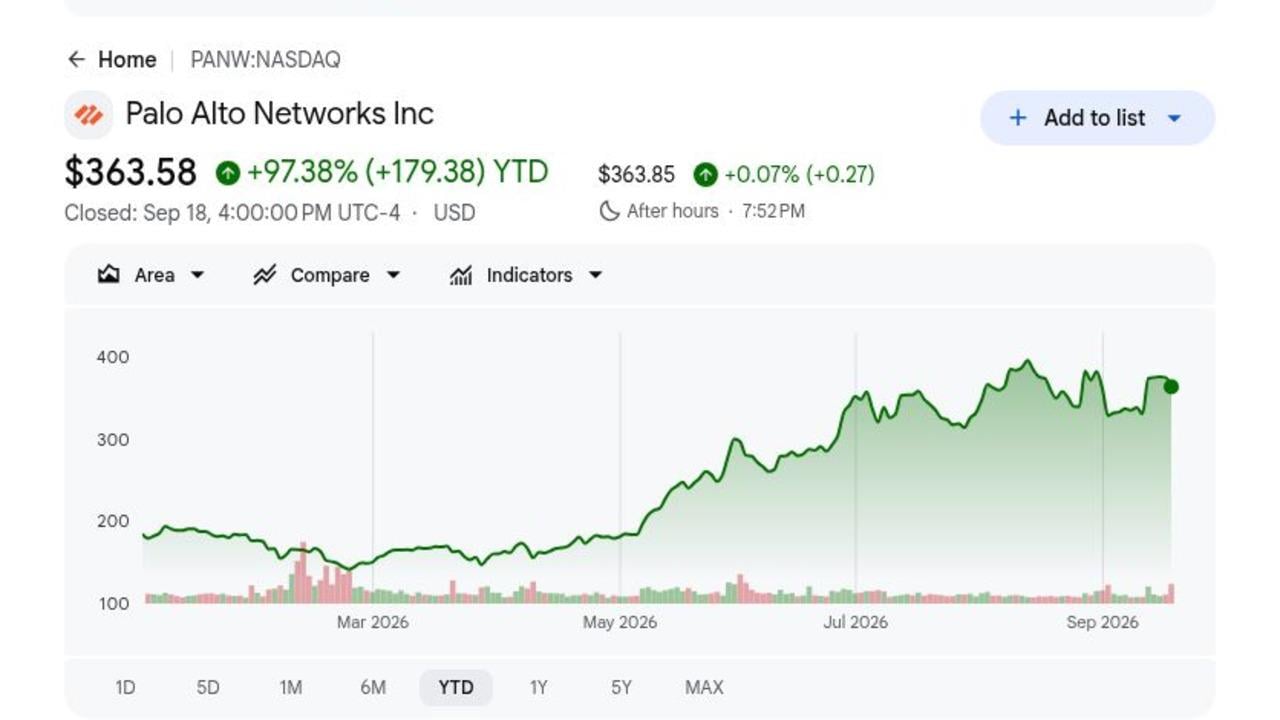
- PANW closed at $363.58 after gaining 97.38% in 2026: The September 18 close remained below Google Finance's $408.53 average analyst target despite nearly doubling year to date. Further upside now depends more on estimate increases and execution than sector enthusiasm alone.
- Q4 revenue reached $3.410 billion, up 34%: Revenue beat the $3.35 billion consensus by about $58 million. Subscription and support contributed $2.672 billion, or 78% of total revenue, showing that recurring software and services now dominate the business.
- Next-Generation Security ARR rose 63% to $9.10 billion: Palo Alto Networks added nearly $1 billion of net new NGS ARR in Q4, while RPO increased 34% to $21.2 billion. The acceleration supports the platform strategy, though acquisitions make organic growth an important metric to watch.
- Adjusted free cash flow reached $1.289 billion in Q4: Cash generation rose 35% year over year, while full-year adjusted free-cash-flow margin reached 38.4%. Management guided fiscal 2027 margin to 38.0% as cloud-hosting and acquisition costs remain elevated.
- Fiscal 2027 revenue guidance reached $14.10 billion to $14.20 billion: The midpoint stands about $310 million above the $13.84 billion FactSet consensus cited after earnings. Management also expects NGS ARR of $11.075 billion to $11.175 billion and continues targeting $20 billion by fiscal 2030.
What Is Palo Alto Networks (PANW)?

Palo Alto Networks develops cybersecurity products used by enterprises, governments and service providers to protect networks, cloud workloads, endpoints, applications, data and identities. The company sells hardware firewalls alongside software subscriptions, support and cloud-delivered services, creating a mix of product revenue and recurring contract revenue. Its main platforms include Network and AI Security, Cortex security operations, Prisma Cloud and the Idira identity-security portfolio. More than 70,000 customers use its products, while Unit 42 supplies threat intelligence and incident-response expertise that informs product development and customer engagements.
The long-term strategy centers on platformization, which encourages customers to consolidate separate security tools onto fewer integrated Palo Alto Networks platforms. CyberArk expands privileged-access and identity security, Chronosphere adds cloud observability, and Console extends Cortex into agentic enterprise operations. Prisma AIRS passed $100 million of ARR within four quarters, XSIAM exceeded $700 million of ARR with more than 1,000 customers, and management disclosed large Q4 platform deals worth $126 million, $72 million and $53 million. These additions broaden the opportunity beyond firewalls, though successful integration determines whether the expanded portfolio creates durable cross-selling rather than higher complexity.
Palo Alto Networks (PANW) Q4 FY2026 Earnings Overview: Revenue, ARR and Cash Flow Growth
Palo Alto Networks delivered $3.410 billion of revenue against $3.35 billion expected, non-GAAP EPS of $1.02 against $0.98 expected and NGS ARR of $9.10 billion, up 63%. RPO rose 34% to $21.2 billion, while adjusted free cash flow reached $1.289 billion. Fiscal 2027 revenue guidance of $14.10 billion to $14.20 billion exceeded the $13.84 billion FactSet consensus, though a $282 million GAAP net loss and lower gross margin kept acquisition quality and profitability central to the debate.
|
Financial Metric |
Guidance / Consensus |
Reported / Actual |
Surprise |
|
Q4 FY2026 revenue |
$3.35B consensus |
$3.410B |
Beat. About $58M above consensus and up 34% YoY. |
|
Q4 non-GAAP diluted EPS |
$0.98 consensus |
$1.02 |
Beat. Four cents above consensus and seven cents above the prior year. |
|
Q4 GAAP diluted EPS |
$0.36 a year earlier |
$(0.35) |
Declined. Acquisition and convertible-note items drove a GAAP loss. |
|
Next-Generation Security ARR |
$5.58B a year earlier |
$9.10B |
Accelerated. ARR grew 63% and added nearly $1B during Q4. |
|
Remaining performance obligations |
$15.8B a year earlier |
$21.2B |
Expanded. Contracted backlog grew 34% YoY. |
|
Q4 non-GAAP operating income |
$768M a year earlier |
$1.011B |
Improved. Operating income rose 32% despite integration costs. |
|
Q4 adjusted free cash flow |
$954M a year earlier |
$1.289B |
Improved. Cash generation rose 35% YoY. |
|
Q1 FY2027 revenue outlook |
— |
$3.300B-$3.310B |
Growth outlook. Management expects 33%-34% YoY growth. |
|
FY2027 revenue outlook |
$13.84B FactSet consensus |
$14.10B-$14.20B |
Above consensus. The midpoint implies 23%-24% growth. |
|
FY2027 adjusted free-cash-flow margin |
38.4% in FY2026 |
38.00% |
Resilient. Guidance absorbs integration and cloud investment. |
- Revenue of $3.410 billion beat consensus by about $58 million: Revenue grew 34% from $2.536 billion a year earlier. Subscription and support revenue reached $2.672 billion, confirming that recurring services remain the main growth engine even as acquisitions complicate the organic comparison.
- Non-GAAP EPS of $1.02 beat consensus by $0.04: Non-GAAP operating income rose to $1.011 billion from $768 million, supporting a 29.6% margin. The $0.35 GAAP loss per share shows why investors still need to track acquisition-related adjustments alongside operating progress.
- NGS ARR reached $9.10 billion and grew 63%: Palo Alto Networks added nearly $1 billion of NGS ARR in one quarter, while platformized customers posted net revenue retention above 120%. About 220 additional platformizations in Q4 support the cross-selling story, though fiscal 2027 ARR growth is expected to slow to 22% to 23%.
- Adjusted free cash flow rose 35% to $1.289 billion: Full-year adjusted free cash flow reached $4.414 billion with a 38.4% margin. Management's 38.0% fiscal 2027 outlook suggests cash generation should remain strong despite higher cloud-hosting and integration costs.
- Fiscal 2027 revenue guidance of $14.10 billion to $14.20 billion implies 23% to 24% growth: Cortex revenue is expected to grow about 30%, while Idira is expected to generate about $1.5 billion with high-teens to 20% pro forma growth. Execution now depends on smooth integration and durable organic network-security demand.
Palo Alto Networks (PANW) 2026 Investment Outlook: $475 Bull Case vs. $300 Bear Case
Palo Alto Networks' 2026 outlook depends on whether platform consolidation, AI security demand and recent acquisitions can sustain strong ARR growth without weakening margins. The upside comes from deeper cross-selling and faster integration, while slower organic demand and valuation compression remain the main risks.
The Bull Case: Strong AI Security Demand Pushes PANW Toward $475
The Bull Case assumes customers keep consolidating security spending across Network and AI Security, Cortex, cloud and Idira. NGS ARR would need to finish fiscal 2027 above the $11.175 billion guidance ceiling, while large contracts and more than 120% retention among platformized customers support stronger cross-selling.
A move toward $475 would require CyberArk and Chronosphere integration to remain three to six months ahead of plan, operating margin to exceed 29.5% and free-cash-flow margin to stay near 38%. Continued growth from Prisma AIRS, XSIAM and observability would show that AI is expanding the revenue opportunity without weakening profitability.
The Base Case: Steady Security Growth Keeps PANW Between $380 and $420
The Base Case assumes fiscal 2027 revenue lands near the $14.15 billion midpoint and NGS ARR reaches roughly $11.1 billion. Platformization remains effective, though investors separate the 63% reported ARR growth from slower organic growth and wait for clearer proof that acquired revenue can sustain current margins.
PANW could trade mainly between $380 and $420 under these conditions. RPO growth near 20%, operating margin near 29.5% and adjusted free-cash-flow margin around 38% would support the range. Weaker organic bookings or delayed acquisition synergies would limit further upside.
The Bear Case: Slower Growth and Higher Costs Pull PANW Toward $300
The Bear Case assumes organic demand slows after the acquisition-driven acceleration, while cloud-hosting, hardware and integration costs pressure margins. NGS ARR growth below 22%, RPO growth below 19% or weaker retention among platformized customers would challenge the consolidation strategy.
A move toward $300 would become more likely if fiscal 2027 revenue falls below $14.1 billion, operating margin misses 29.5% or dilution weakens per-share earnings growth. PANW could still expand under this scenario, but a lower valuation multiple would reflect weaker confidence in the quality and profitability of that growth.
PANW Stock Price Forecasts for 2026 By Wall Street Analysts
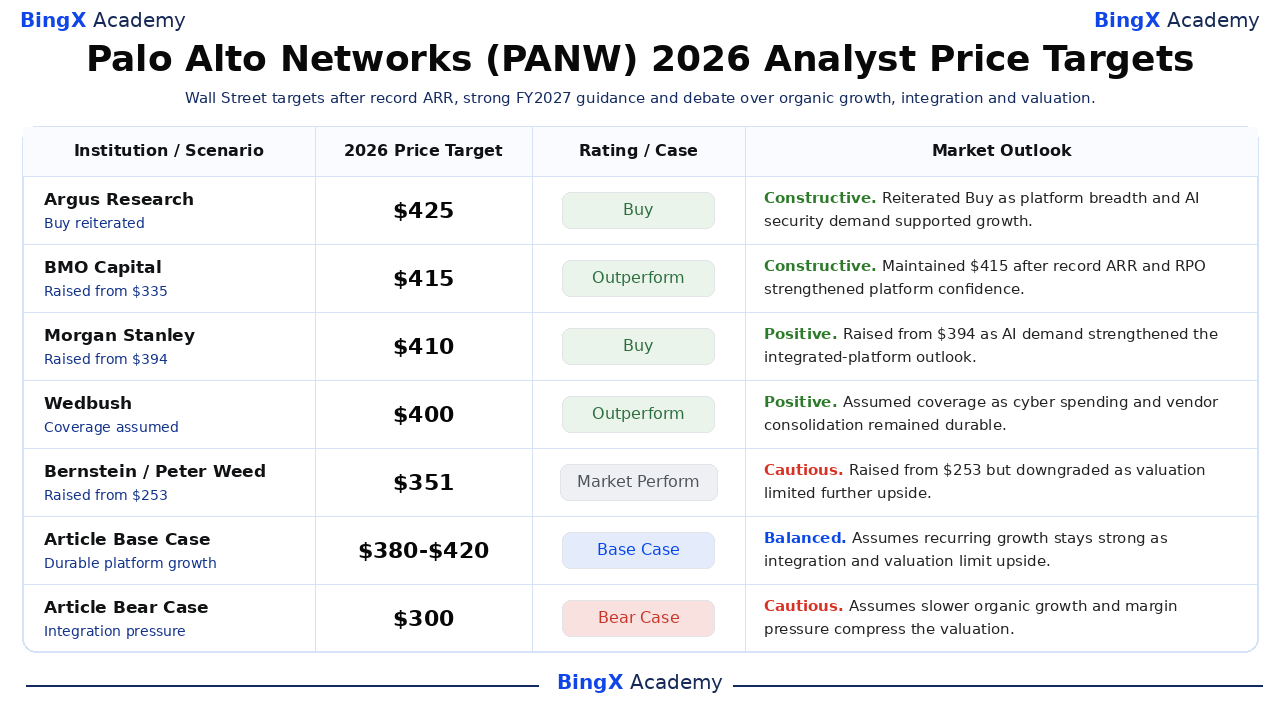
Wall Street remained broadly constructive after Q4, though targets from $351 to $425 show disagreement over acquisition-led growth and valuation. Google Finance listed an average target of $408.53 across 41 analysts as of September 21, compared with the September 18 close of $363.58. The table keeps analyst actions separate from the article's editorial Base and Bear scenarios.
|
Institution / Scenario |
2026 Price Target |
Rating / Case |
Market Outlook |
|
Argus Research |
$425 |
Buy |
Constructive. September 3: reiterated Buy as platform breadth and AI-driven security demand supported a premium growth outlook. |
|
BMO Capital |
$415 |
Outperform |
Constructive. September 2: maintained $415 after record ARR and RPO reinforced platformization confidence. |
|
Morgan Stanley |
$410 |
Buy |
Positive. September 20: raised from $394 as AI security demand and integrated platforms supported further upside. |
|
Wedbush |
$400 |
Outperform |
Positive. September 10: assumed coverage as durable cybersecurity spending supported vendor consolidation. |
|
Bernstein |
$351 |
Market Perform |
Cautious. September 17: raised from $253 but downgraded as valuation and acquisition-led growth limited upside. |
|
Article Base Case |
$380-$420 |
Base Case |
Balanced. Assumes recurring growth stays strong as integration costs and valuation limit upside. |
|
Article Bear Case |
$300 |
Bear Case |
Cautious. Assumes slower organic growth and margin pressure compress the valuation. |
How to Trade Palo Alto Networks (PANW) Stock on BingX
Trade Palo Alto Networks' AI security, platformization and integration outlook using BingX TradFi and BingX AI tools. Because PANW can react sharply to earnings, analyst actions, acquisitions and security-sector valuation changes, traders should define both the catalyst and risk limits before entering a position.
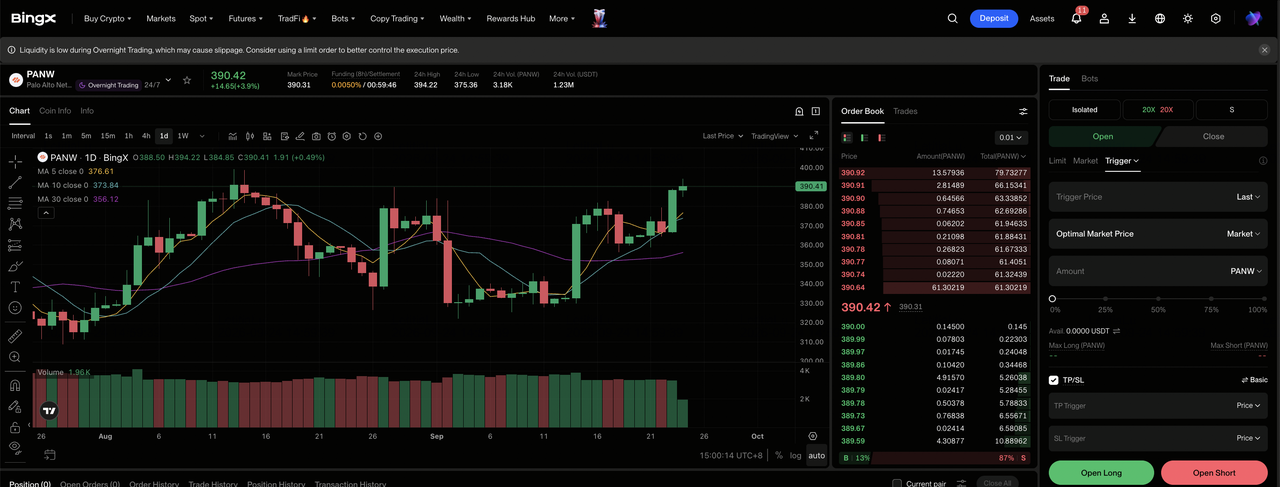
Step 1: Access BingX TradFi. Sign up and navigate to the specialized TradFi section on the BingX exchange dashboard.
Step 2: Select Palo Alto Networks (PANW). Search for and select the PANW-USDT perpetual futures contract.
Step 3: Choose your direction. Select Open Long if ARR growth and platform integration support higher estimates. Select Open Short if organic bookings, margins or integration progress weaken.
Step 4: Select leverage and margin mode. Choose Isolated or Cross-Margin based on your risk tolerance. The 97.38% YTD rise and sharp post-earnings swings show why conservative leverage and clear position sizing matter.
Step 5: Execute strict risk protocols. Set Take-Profit and Stop-Loss (TP/SL) levels before or immediately after entering the trade. PANW can move quickly after earnings, cybersecurity incidents, acquisition news and analyst rating changes.
Top 5 Risks to Watch for Palo Alto Networks Investors in 2026
Palo Alto Networks still has strong growth and cash generation, but acquisition execution, organic demand, margin pressure, competition and valuation remain the main risks to the 2026 outlook.
- Acquisition integration could weaken the value of $14.15 billion revenue guidance: CyberArk and Chronosphere are the company's two largest acquisitions. Product overlap, slower cross-selling or employee disruption could reduce expected synergies and make the reported 23% to 24% growth less valuable.
- Organic growth could trail the reported 63% ARR increase: Acquisitions contributed to the jump in NGS ARR to $9.10 billion. If underlying customer growth or platformization slows, investors may assign a lower valuation to acquisition-driven growth.
- Lower gross margins could offset strong cash flow: Q4 gross margin fell 100 basis points to 74.8% despite $1.289 billion of adjusted free cash flow. Higher cloud-hosting, memory and storage costs could limit operating leverage.
- Competition could slow cross-selling: CrowdStrike, Microsoft, Zscaler and cloud providers compete across major security categories. Better integrated tools or lower pricing could weaken Palo Alto Networks' ability to expand spending across platformized customers.
- Valuation could fall even if revenue keeps growing: PANW had gained 97.38% YTD by September 18. Higher bond yields, slower estimate growth or greater reliance on acquisitions could compress the software multiple and pull the stock closer to the $300 Bear Case.
Final Thoughts: Should You Invest in Palo Alto Networks in 2026?
Palo Alto Networks exits fiscal 2026 with $9.10 billion of NGS ARR, $21.2 billion of RPO and $4.414 billion of full-year adjusted free cash flow. Those figures support the argument that platformization and AI security demand are creating a larger recurring business. The investment test is whether integration converts acquired capabilities into durable organic growth without sacrificing margins or per-share economics.
The Bull Case needs ARR above guidance, sustained retention and faster synergies to support $475. The Bear Case reflects slower organic growth, margin pressure and valuation compression toward $300. Conservative traders may monitor organic net new ARR, RPO growth, gross margin, adjusted free-cash-flow margin and CyberArk integration before treating the current growth rate as durable.
Risk Reminder: Trading and investing in equities like PANW involves a risk of capital loss. Acquisition execution, cybersecurity competition, valuation shifts and leveraged trading can produce rapid losses. Conduct independent research before allocating capital.
Related Reading
- Adobe (ADBE) Price Prediction 2026: Can AI Monetization Push ADBE Toward $520?
- IBM Stock Price Prediction 2026: Can Software and Quantum Growth Push IBM Toward $350?
- Cisco (CSCO) Stock Price Outlook for 2026: Can AI Growth and Splunk Drive CSCO Back to $90?
- CrowdStrike (CRWD) Price Prediction 2026: Can AI Security and Falcon Flex Push CRWD Toward $280?
- Palantir (PLTR) Stock Price Prediction 2026: Can 149% U.S. Commercial Growth Push PLTR Toward $255?
