



NVIDIA (NVDA) develops GPUs, CPUs, networking systems and software for cloud providers, enterprises, gamers and industrial customers. Its CUDA ecosystem supports accelerated computing, while Vera Rubin expands the opportunity across AI training, inference and complete data-center systems. Leadership continuity after Jensen Huang’s return, overseas export approvals and customer cash generation now determine whether AI growth supports shareholder returns.
The latest quarter showed accelerating AI infrastructure sales while product transitions continued pressuring margins. NVIDIA Q3 FY2027 revenue reached $115.8 billion, up 103%, with Data Center sales increasing 110%. GAAP diluted EPS reached $2.70, while gross margin eased to 74.8% from 75.0% sequentially. The next test is whether Rubin deliveries support higher revenue without sacrificing profitability or extending customer-payment cycles.
The NVDA stock forecast for 2026 now centers on two competing views:
- The Rubin and leadership-recovery case: Strong customer deployments, Huang’s return and workable export approvals could preserve cash generation while reducing the valuation discount created by November’s leadership turmoil.
- The export and oversight pressure case: Licensing delays, ongoing investigations and congressional interviews could weaken overseas growth expectations, particularly if governance concerns or poor customer AI investment returns undermine confidence.
This guide breaks down the NVDA stock forecast, 2026 price scenarios, key risks and analyst outlooks, drawing on NVIDIA’s November 17 results, November 23 reinstatement announcement, current BIS controls, congressional schedules and November 23 market data, plus how to buy NVDA Stocks on BingX TradFi with USDT or USDC.
Top 5 Things for NVIDIA Investors to Know in November 2026
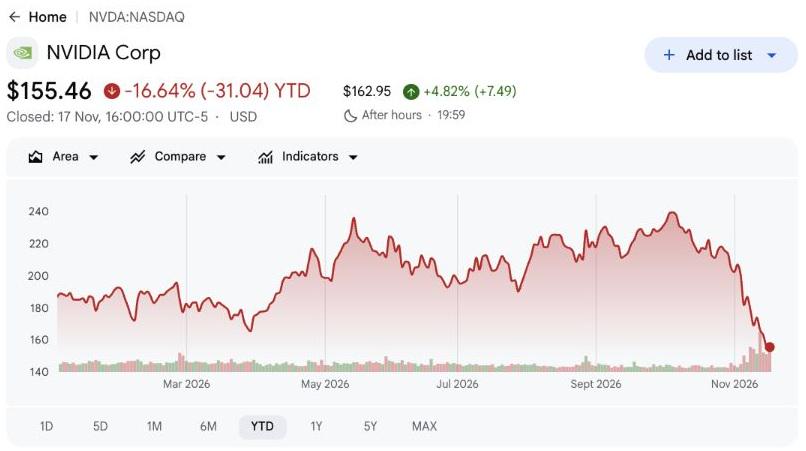
- NVDA closed at $165.05 on November 23, down 11.50% YTD: Shares jumped 31.48% that session following Huang’s reinstatement, but the $200 bull scenario still requires further recovery. Sustaining gains depends on Rubin execution, workable export approvals and confidence that ongoing investigations will not disrupt customer spending.
- Q3 revenue rose to $115.8 billion from $57.0 billion a year earlier: Sales also increased from $96.2 billion in Q2, showing sequential expansion. Within that result, Data Center supplied most revenue, making customer infrastructure spending more important than a recovery across every end market.
- Data Center revenue reached $107.6 billion as Rubin shipments expanded: Q3 sales increased 21% sequentially, with racks running at CoreWeave, Google Cloud and Microsoft Azure. Customer acceptance, payment collection and production costs will determine how much of that scale translates into sustainable cash returns.
- New export controls extend licensing to five countries: The rule covers Indonesia, Malaysia, Singapore, Thailand and Brazil, with publication and effectiveness on November 19. Qualifying U.S.-headquartered end users may use a reporting-based exception, but licensing delays could still disrupt overseas deployments.
- Huang returned, but governance scrutiny remains: NVIDIA announced his reinstatement on November 23, while its SEC filing dates the board action to November 22. Independent and government investigations continue, and scheduled December congressional interviews could affect compliance costs, customer confidence and valuation.
What Is NVIDIA (NVDA)?
NVIDIA is a semiconductor and computing-platform company headquartered in Santa Clara, California, serving cloud providers, enterprises, developers and consumers. Its integrated approach combines processors, interconnects, software and complete systems to accelerate demanding workloads rather than supplying a single interchangeable chip. CUDA, GeForce graphics, data-center infrastructure and edge-computing platforms support AI development, gaming, scientific computing and industrial applications. The company generates revenue from computing products, systems and related software services, with Data Center supplying approximately 93% of Q3 sales.
NVIDIA’s growth strategy focuses on scaling Vera Rubin systems, expanding Vera CPUs and increasing AI training and inference adoption. Its November 17 results identified Rubin racks running at CoreWeave, Google Cloud, Microsoft Azure and Oracle Cloud Infrastructure, demonstrating deployed customer systems. Huang has resumed the CEO role, Colette Kress continues as CFO, and Harvey Jones remains board chair while the National Security and Export Control Committee oversees compliance risks. With Q3 Data Center revenue reaching $107.6 billion, customer execution and credible regulatory controls will determine whether growth produces durable cash returns.
Read More: AMD vs. Nvidia Comparison 2026: Which AI Computing Stock Is the Better Buy?
NVIDIA (NVDA) Q3 FY2027 Earnings Overview: AI Infrastructure Growth Drives 115% Operating Profit Increase
NVIDIA reported Q3 FY2027 revenue of $115.8 billion, up 103% year over year and 20% sequentially, driven primarily by $107.6 billion in Data Center sales. GAAP operating income increased 115% to $77.5 billion, while gross margin declined 0.2 percentage points sequentially to 74.8% as the initial Rubin ramp affected product economics. With Q4 revenue guided to $130 billion, plus or minus 3%, and gross margin expected at 71%–72%, sustaining earnings growth will depend on infrastructure deliveries, cost management, and cash generation.
Read More: NVIDIA Q3 2027 Earnings Overview: Data Center Sales Surge 110% as CEO Transition Raises Uncertainty
|
Financial Metric |
Guidance / Consensus |
Reported / Actual |
Surprise |
|
Revenue |
$57.0B Q3 FY2026 |
$115.8B |
Expanded. Up 103% YoY. |
|
Data Center revenue |
$51.2B Q3 FY2026 |
$107.6B |
Expanded. Up 110% YoY. |
|
GAAP diluted EPS |
$1.30 Q3 FY2026 |
$2.70 |
Improved. Up 108% YoY. |
|
Non-GAAP diluted EPS |
$1.27 Q3 FY2026 |
$2.68 |
Improved. Up 111% YoY. |
|
GAAP gross margin |
75.0% Q2 FY2027 |
74.80% |
Lower. Down 0.2 percentage points. |
|
GAAP operating income |
$36.0B Q3 FY2026 |
$77.5B |
Improved. Up 115% YoY. |
|
Operating cash flow |
$23.8B Q3 FY2026 |
$48.3B |
Improved. About twice the prior-year amount. |
|
Q4 revenue guidance |
$115.8B Q3 actual |
$130B ±3% |
Outlook. Includes an additional reporting week. |
|
Q4 gross-margin guidance |
74.8% Q3 GAAP |
71%–72% |
Lower. Below the Q3 margin. |
- Q3 revenue surged 103% to $115.8 billion. Revenue also increased 20% sequentially, driven by accelerating AI infrastructure shipments. Sustained cloud demand and enterprise AI adoption remain important to maintaining growth momentum.
- Data Center revenue jumped 110% to $107.6 billion. Rubin infrastructure, standalone Vera CPUs, and continued Blackwell Ultra growth supported performance. Expanding AI deployments could sustain demand, although higher production costs may pressure margins.
- GAAP operating income rose 115% to $77.5 billion. Operating expenses increased 57% to $9.2 billion, while gross margin eased slightly sequentially. Revenue growth strengthened profitability, but maintaining margins will be important as Rubin production scales.
- Supply commitments increased to $390 billion from $279 billion. The increase primarily reflects multi-year memory procurement agreements supporting future computing platforms. Securing critical components strengthens production capacity, although returns depend on sustained demand and profitable deliveries.
- Q4 revenue guidance reached $130 billion, plus or minus 3%. The outlook includes an additional reporting week and excludes Data Center compute revenue from China. Gross margin guidance of 71%–72% also signals potential near-term profitability pressure during the Rubin ramp.
NVIDIA (NVDA) 2026 Investment Outlook: $200 Bull Case vs. $130 Bear Case
NVIDIA's 2026 outlook depends on Rubin demand, leadership credibility, customer AI investment returns, and U.S. export restrictions. Its $130 billion Q4 revenue guidance supports AI infrastructure growth, while three developments could influence NVDA's valuation through December 31:
- Leadership recovery: Huang’s reinstatement restores the founder to daily leadership, but NVIDIA says its independent investigation continues and it is searching for a Chief Compliance Officer.
- Export restrictions: The five-country licensing rule took effect November 19. BIS also filed a November 23 Entity List rule covering Megaspeed and six other entities, with license applications subject to a presumption of denial.
- Regulatory scrutiny: Huang and General Counsel Tim Teter are scheduled for congressional interviews on December 1 and 2. The incoming Democratic Congress begins in January 2027, extending oversight risk beyond the immediate leadership rebound.
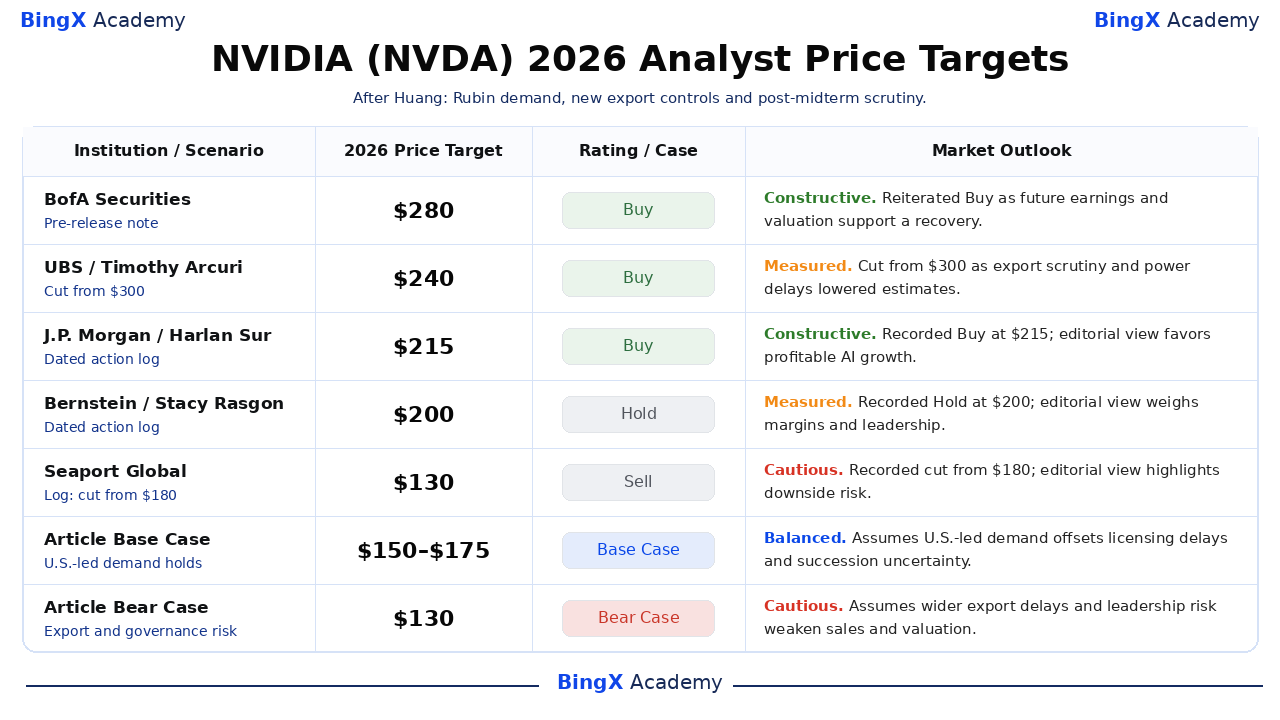
The Bull Case: Rubin Growth and Leadership Stability Push NVDA Toward $200
Continued Rubin deployments and renewed leadership continuity could support NVIDIA's earnings growth and valuation recovery. Q3 Data Center revenue reached $107.6 billion, while operating cash flow totaled $48.3 billion. Effective leadership under reinstated CEO Jensen Huang, combined with sustained cloud infrastructure demand, could preserve revenue momentum without relying on renewed direct China sales.
The $200 bull case assumes licensed overseas deployments proceed, NVIDIA maintains its $130 billion Q4 revenue outlook, and investigation outcomes do not undermine customer confidence. Strong customer AI investment returns, improving regulatory clarity, and sustained cash generation could support a higher valuation multiple.
The Base Case: U.S.-Led AI Demand Keeps NVDA Between $150 and $175
Sustained U.S. AI infrastructure spending could support earnings growth, although overseas licensing restrictions and ongoing investigations may limit valuation upside. NVIDIA projects $130 billion in Q4 revenue, with gross margin expected at 71%–72%. The base case assumes customer commitments remain intact despite additional compliance requirements and near-term margin pressure.
The 150–175 base case reflects continued Rubin adoption, resilient U.S. demand, and manageable export restrictions. Greater clarity on compliance safeguards and overseas approvals could support the upper end, while higher compliance costs or slower deployments may limit further gains.
The Bear Case: Export Delays and Governance Risks Pull NVDA Toward $130
Broader export restrictions, delayed infrastructure deployments, or persistent governance concerns could weaken investor confidence and compress NVIDIA's valuation. Multi-year supply commitments increased to $390 billion, while accounts receivable reached approximately $81 billion. Slower customer payments or disruptions to overseas deployments could increase financial pressure despite strong reported revenue growth.
The $130 bear case assumes licensing delays threaten NVIDIA's Q4 revenue outlook while investigations or weak customer AI investment returns erode confidence. Weaker cash conversion, higher compliance costs, or prolonged regulatory scrutiny could reduce earnings expectations and push investors toward a lower valuation multiple.
NVDA Stock Price Forecasts for 2026 By Wall Street Analysts
These named targets refer to Nasdaq-listed NVIDIA shares and generally cover roughly twelve months, extending beyond December 2026. The five selected November 23 actions range from $200 to $270, reflecting renewed confidence after Huang’s return. These are selected analyst views, not a complete market consensus; the final two rows are separate article scenarios for December 31, 2026.
|
Institution / Scenario |
Price Target |
Rating / Case |
Market Outlook |
|
StoneX |
$270 |
Buy |
Constructive. November 23, 2026: Upgraded from Hold to Buy at $270 after Huang’s return. Acree emphasized restored leadership and key customer and manufacturing relationships. |
|
Oppenheimer |
$250 |
Outperform |
Constructive. November 23, 2026: Upgraded from Perform to Outperform with a $250 target. The dated action records a more positive rating; it is not a December 2026 price commitment. |
|
Citi |
$240 |
Buy |
Constructive. November 23, 2026: Maintained Buy and raised the target from $225 to $240. The revision signals greater upside expectations; licensing, governance and delivery execution remain article-level risks. |
|
Melius Research |
$220 |
Buy |
Constructive. November 23, 2026: Upgraded from Hold to Buy and raised the target from $185 to $220. The change follows Huang’s reinstatement and replaces the earlier cautious rating. |
|
Bernstein |
$200 |
Outperform |
Measured. November 23, 2026: Upgraded from Market Perform to Outperform while retaining a $200 target. Rasgon remained concerned about governance, showing that the upgrade does not remove the stock’s overhangs. |
|
Article Base Case |
150–175 |
Base Case |
Balanced. Resilient U.S. AI demand offsets licensing friction, margin pressure and ongoing investigations through December 31, 2026. |
|
Article Bear Case |
$130 |
Bear Case |
Cautious. Export restrictions, weaker cash conversion or governance setbacks pressure NVDA’s valuation through December 31, 2026. |
How to Buy NVIDIA (NVDA) Stock on BingX
Buy and hold NVIDIA shares through BingX Stocks Trading using USDT or USDC, subject to listing and account eligibility. NVIDIA offers exposure to AI computing, data-center infrastructure, graphics and accelerated-computing software. Eligible users can size holdings according to their investment goals without using leverage or paying perpetual funding fees.
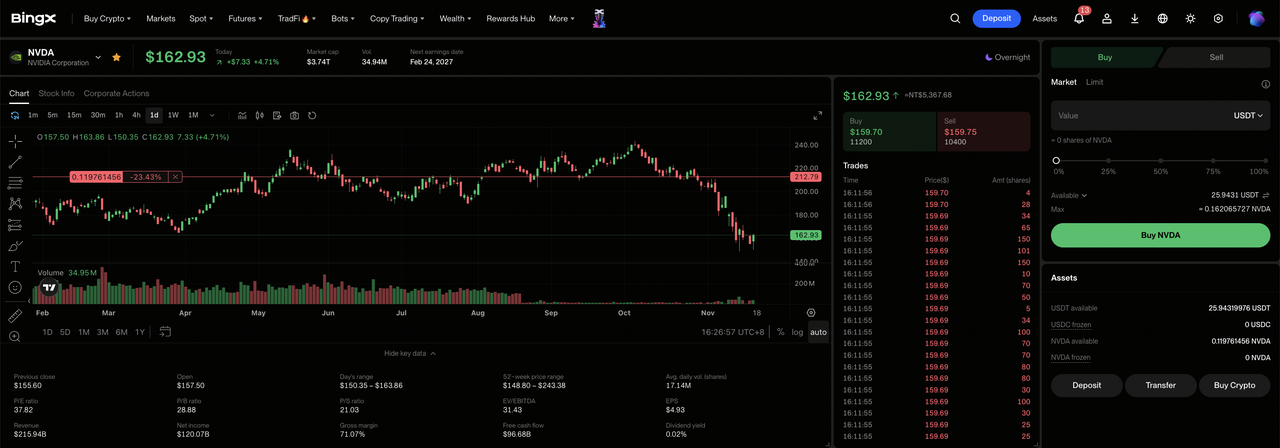
Step 1: Access BingX Stocks Trading. Sign up or log in to BingX, complete the required identity verification, and navigate to “TradFi > Stocks”. Accept the Stock Trading Risk Disclosure if accessing the product for the first time.
Step 2: Prepare USDT or USDC. Ensure your Spot Account has sufficient funds for the purchase. Transfer USDT or USDC from your Fund Account or Wealth Account if needed. Review the selected stock’s minimum order amount and fractional eligibility before choosing the investment size.
Step 3: Select NVIDIA (NVDA). Open the Stocks market, search for NVIDIA (NVDA), and confirm that the share is available to your account. Review the company identity, current share price, trading session and available order types.
Step 4: Buy NVIDIA Shares. Select “Buy”, enter an allowed investment amount or share quantity, and choose a supported market or limit order. Market orders use available prices during supported sessions, while limit orders require the specified price or better and sufficient liquidity to execute.
Step 5: Review and Manage Your Holdings. Open “Stocks > Positions” to monitor your NVDA shares and unrealized profit or loss. Use All Orders to review transactions or sell shares when needed. T+1 settlement generally affects when sale proceeds become withdrawable, rather than when purchased shares can be sold.
Top 5 Risks to Watch for NVIDIA Investors in 2026
NVIDIA's CUDA ecosystem, expanding Rubin platform, and strong operating cash flow support its earnings outlook. However, export restrictions, margin pressure, financial commitments, and ongoing investigations could affect profitability, cash generation, and shareholder returns.
- Export restrictions could reduce revenue: The BIS rule effective November 19 expands licensing requirements across five countries and certain overseas remote-computing arrangements. Delayed approvals or restricted AI infrastructure deployments could weaken sales and cash generation.
- Lower gross margins could pressure profitability: Q4 gross margin guidance of 71%–72% is below Q3's 74.8%. Higher component costs and the Rubin ramp could weigh on earnings if revenue growth slows.
- Ongoing investigations could disrupt growth: NVIDIA says its independent review and government inquiries continue despite Huang’s reinstatement. Adverse findings, compliance failures or damaged customer confidence could delay orders and reduce future revenue visibility.
- Customer financing guarantees could limit cash returns: NVIDIA disclosed $118 billion in maximum gross guarantee exposure, with no payments made as of the Q3 disclosure. Partner defaults or additional infrastructure funding could reduce cash available for shareholder returns.
- Congressional scrutiny could pressure valuation: Huang and NVIDIA’s general counsel face scheduled December 1–2 interviews ahead of Democratic control of Congress in January 2027. Adverse findings or tougher enforcement could raise costs and depress valuation.
Final Thoughts: Should You Invest in NVIDIA in 2026?
NVIDIA’s $115.8 billion in quarterly revenue and $48.3 billion in operating cash flow demonstrate substantial demand and cash generation across its computing platform. Rubin and Blackwell Ultra provide operating support, while established cloud relationships offer opportunities for further infrastructure sales. Sustaining that progress will depend on authorized market access, stable leadership and customer collections as supply commitments expand.
The $200 bull case assumes sustained Rubin demand, effective leadership under Huang and workable overseas export approvals. The $150 to $175 base case reflects resilient orders with policy friction, while the $130 bear case accounts for wider restrictions and governance pressure. With NVDA closing at $165.05 on November 23, investors should watch whether Rubin growth can sustain the rebound despite regulatory and governance risk.
Risk Reminder: NVIDIA’s AI computing leadership does not eliminate investment risk. Export restrictions, succession setbacks, or financing losses could weaken earnings and shareholder returns. Investors should assess valuation, customer-payment performance, and their risk tolerance before buying NVDA shares.
Related Reading
- What Is BingX Stocks Trading? A Beginner's Guide to Trading U.S. Stocks and ETFs With Crypto
- Top 10 AI Infrastructure Stocks to Buy in 2026: Chip Manufacturing and Design Leaders
- Top AI Compute and GPU Stocks to Buy in 2026: The Shift to Inference and Custom Silicon
- Top AI Data Center Stocks to Buy in 2026: Cloud, Servers, and AI Compute Infrastructure
- AMD vs. Nvidia Comparison 2026: Which AI Computing Stock Is the Better Buy?
- AMD Price Prediction 2026: Can AI Growth Push AMD Toward $700?
