


Netflix (NFLX) streams television series, films, games and live events for members around the world. Its subscription business provides recurring revenue, while Netflix Ads Suite creates a route to broader advertising demand. Programming quality, retention after price increases, and the speed of advertising-product delivery determine whether that audience translates into stronger earnings and cash returns.
The latest quarter showed stronger subscription monetization while advertising execution remained behind plan. Netflix Q3 2026 revenue rose 11.8% to $12.874 billion, with memberships and pricing driving growth. Operating margin reached 34.6%, while the full-year advertising forecast fell to $2.7 billion. The Q4 test is whether retention and advertiser tools can sustain earnings as expenses normalize.
The NFLX stock forecast for 2026 now centers on two competing views:
- The subscription-and-advertising recovery case: Retained members and better advertising tools could lift revenue per viewing hour while programming discipline supports sustainable earnings and cash generation.
- The monetization-and-cost pressure case: Slower ad rollouts and weaker retention could leave programming investment earning less revenue, narrowing the profitability cushion behind per-share growth.
This guide breaks down the NFLX stock forecast, 2026 price scenarios, key risks and analyst outlooks, drawing on Netflix's October 20 earnings letter, financial statements and October 26 market data, plus how to buy NFLX Stocks on BingX TradFi with USDT or USDC.
Top 5 Things for Netflix Investors to Know in October 2026
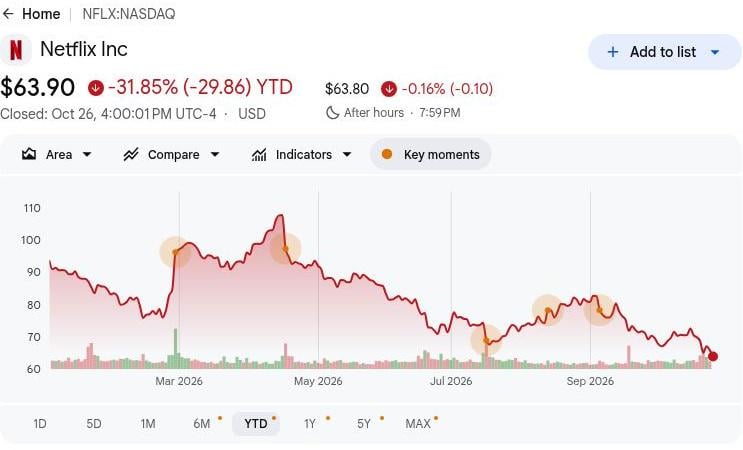
- NFLX closed at $63.90 on October 26, down 31.85% YTD: Shares remain below their $68.69 pre-earnings close, making the $85 bull scenario dependent on stronger earnings growth. Further upside will require sustained subscriber retention and advertising monetization rather than relying solely on share buybacks.
- Q3 revenue increased 12% to $12.874 billion. Sales rose from $11.510 billion a year earlier and $12.560 billion in Q2, supported by subscription growth. However, reduced advertising guidance highlights the need to convert growing viewer engagement into stronger ad revenue.
- Operating margin reached 34.6% as subscription profitability strengthened: Better-than-expected subscriber retention supported recurring revenue and earnings. Sustaining margins will depend on content spending, pricing power, and continued advertising expansion.
- TF1 and advertising partnerships expand Netflix's growth opportunities: The French broadcaster partnership launched during summer, while MercadoLibre and AdForm joined Netflix's advertising ecosystem in Q3. Broader advertiser adoption and stronger engagement could support additional revenue beyond subscriptions.
- Cash reserves of $8.2 billion support content investment and buybacks: Netflix repurchased $4.8 billion in shares during Q3 while carrying $15.3 billion in gross debt. Strong liquidity supports programming investment, although sustained cash generation and disciplined capital allocation remain essential to long-term shareholder returns.
What Is Netflix (NFLX)?

Netflix is a global entertainment company that streams television series, films, games and live events to paying members. Its subscription model combines professionally produced originals with licensed programming, distributed through an internet-based service across televisions and mobile devices. Ad-supported plans also connect advertisers with audiences watching the service, creating another source of monetization. The company generates revenue primarily through subscriptions and advertising, with Q3 sales of $12.874 billion illustrating the scale of its single streaming business.
Netflix's growth strategy focuses on differentiated programming, improved discovery, and stronger subscription and advertising monetization. In 2026, it launched a partnership with TF1 in France and secured a licensing deal with Disney, adding third-party content alongside its originals. The company is also expanding Netflix Ads Suite through Q3 partnerships with MercadoLibre in Latin America and AdForm in Europe, the Middle East and Africa. With its worldwide audience approaching one billion people, these initiatives aim to strengthen retention and advertiser demand, while returns depend on viewing engagement and successful ad-product delivery.
Netflix (NFLX) Q3 2026 Earnings Overview: 37% Operating Profit Growth Meets Weaker Advertising Outlook
Netflix reported Q3 2026 revenue of $12.874 billion, up 11.8% year over year, driven primarily by memberships and pricing. Operating income rose 37% to $4.459 billion and margin reached 34.6%, helped by expense timing, while full-year free cash flow guidance fell from $12.5 billion to $12 billion primarily because of an expected Q4 property transaction. With Q4 revenue guidance of $13.442 billion and advertising expectations reduced to $2.7 billion, future earnings depend on retention, ad-product delivery, and programming returns.
Read More: Netflix (NFLX) Q3 FY2026 Earnings Overview: Q4 Profit Miss and 1,000 Layoffs Drive 5.31% Selloff
|
Financial Metric |
Guidance / Consensus |
Reported / Actual |
Surprise |
|
Revenue |
$11.510B Q3 2025 |
$12.874B |
Improved. Up 11.8% YoY. |
|
Operating income |
$3.248B Q3 2025 |
$4.459B |
Higher. Up 37% YoY. |
|
Operating margin |
28.2% Q3 2025 |
34.60% |
Expanded. Up 6.4 percentage points. |
|
Diluted EPS |
$0.59 Q3 2025 |
$0.87 |
Higher. Up $0.28 YoY. |
|
Free cash flow |
$2.660B Q3 2025 |
$2.884B |
Improved. Up 8.4% YoY. |
|
FY2026 ad revenue |
~$3B prior forecast |
~$2.7B |
Reduced. About $300M below prior guide. |
|
FY2026 free cash flow |
~$12.5B prior forecast |
~$12B |
Reduced. About $500M below prior guide. |
|
Q4 revenue guidance |
$12.051B Q4 2025 |
$13.442B |
Outlook. Implies 11.5% YoY growth. |
- Q3 revenue increased 11.8% to $12.874 billion. Revenue increased 2.5% sequentially alongside annual growth, reflecting stronger subscription monetization and advertising contributions. Sustained member retention and successful price adjustments will be important to maintaining revenue momentum.
- UCAN revenue rose 11% to $5.628 billion. Membership growth and pricing supported performance in Netflix's largest regional market during the quarter. Continued retention and advertiser demand could support earnings, although programming costs influence profitability and cash returns.
- Operating income rose 37% to $4.459 billion. Prior-year profit included a $619 million Brazilian tax expense, while current expense timing also helped. Subscription growth supported profitability, but maintaining cost efficiency will be important as expenses normalize.
- Content investment expanded Netflix's programming capabilities. Q3 additions to content assets totaled $5.16 billion, supporting the production and licensing of streaming releases. The investments support retention, with returns depending on viewing engagement and subscription monetization.
- Q4 revenue guidance reached $13.442 billion. The outlook implies 11.5% annual growth, with delivery depending on memberships, pricing and advertising demand. Retaining subscribers, improving advertising capabilities, and controlling programming expenses will be important to future earnings growth.
Netflix (NFLX) 2026 Investment Outlook: $85 Bull Case vs. $55 Bear Case
Netflix's 2026 outlook depends on whether subscription growth can sustain earnings while advertising products catch up with expectations. Nine-month free cash flow of $9.5 billion supports the reduced $12 billion annual forecast, while advertising delays make recurring growth central to valuation. The following editorial scenarios reflect how retention, monetization and programming costs could shape performance through December 2026.
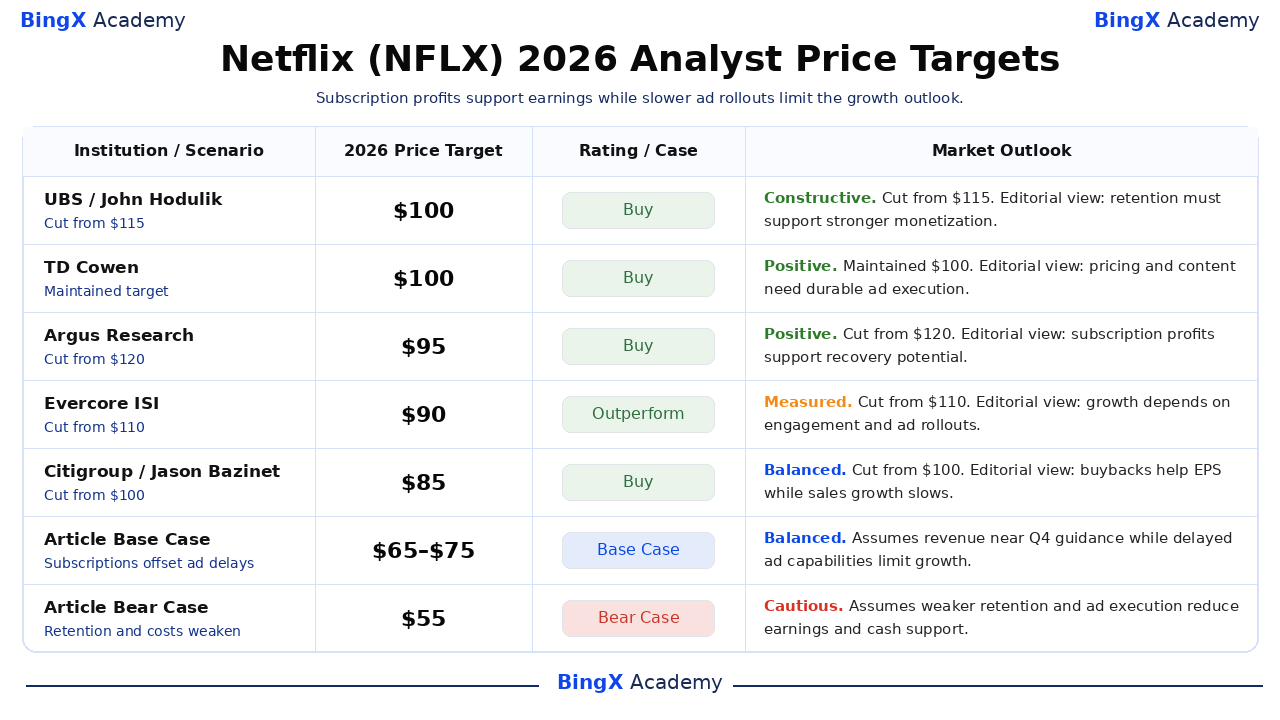
The Bull Case: Subscription Growth and Ad Recovery Push NFLX Toward $85
Improving advertising execution would give Netflix a direct route to stronger earnings alongside its profitable subscription base. Its full-year ad revenue forecast fell to approximately $2.7 billion from $3 billion, leaving room to recover delayed product capabilities. Better advertiser access would monetize existing viewing while retained members continue supporting subscription income.
The $85 scenario would gain support if advertising sales recover toward the prior $3 billion annual forecast and Q4 revenue exceeds $13.442 billion. Cash generation above the roughly $2.5 billion implied Q4 level, after property spending, would strengthen per-share return prospects.
The Base Case: Steady Subscriptions Keep NFLX Between $65 and $75
Continued subscription growth could keep Netflix's earnings moving forward even if advertising improves slowly. Q3 revenue increased 11.8%, helping offset the reduced ad outlook and upcoming organizational costs. The base case assumes those offsets persist, producing moderate earnings progress while leaving the pace of advertising monetization unresolved.
A $65 to $75 range would fit revenue near Q4 guidance, a 31.5% full-year operating margin and gradual advertising improvement. Better engagement would support the upper end, while weaker retention could absorb enough progress to limit share-price upside.
The Bear Case: Weaker Retention and Higher Costs Pull NFLX Toward $55
Slower subscription growth would expose Netflix more fully to advertising delays and programming costs. Subscription monetization supported Q3 revenue growth, while expense timing helped lift operating margin above the 26% expected for Q4. If cancellations rise or new programming fails to retain viewers, Netflix could lose that earnings cushion before advertising capabilities improve.
The $55 scenario would become more likely if Q4 revenue misses $13.442 billion alongside margin below 26% and further advertising weakness. New content would then need to contribute more simply to stabilize earnings, leaving less support for valuation.
NFLX Stock Price Forecasts for 2026 By Wall Street Analysts
These named, dated third-party targets refer to Nasdaq-listed Netflix shares and generally cover approximately 12 months, extending beyond December 2026. The $85 to $100 range reflects different judgments about subscription monetization and advertising recovery; business interpretations below are editorial. The final two rows are this article's separate 2026 scenarios.
|
Institution / Scenario |
2026 Price Target |
Rating / Case |
Market Outlook |
|
UBS |
$100 |
Buy |
Constructive. October 21, 2026: cut from $115 to $100; retained Buy. Editorial interpretation: subscription retention and improving monetization must rebuild growth after the reduced advertising outlook. |
|
TD Cowen |
$100 |
Buy |
Positive. October 21, 2026: maintained $100 and Buy. Editorial interpretation: content distribution and pricing can support earnings, but new advertising tools still need to deliver sales. |
|
Argus Research |
$95 |
Buy |
Positive. October 22, 2026: cut from $120 to $95; retained Buy. Editorial interpretation: a profitable subscription base supports recovery potential, although expense timing limits extrapolation from the third-quarter margin. |
|
Evercore ISI |
$90 |
Outperform |
Measured. October 21, 2026: cut from $110 to $90; retained Outperform. Editorial interpretation: international distribution and advertising expansion offer growth routes, subject to engagement and product rollout improvements. |
|
Citigroup |
$85 |
Buy |
Balanced. October 21, 2026: cut from $100 to $85; retained Buy. Editorial interpretation: retained subscribers and repurchases support per-share earnings, while slower sales growth limits the near-term valuation case. |
|
Article Base Case |
65–75 |
Base Case |
Balanced. Assumes subscriptions support revenue near Q4 guidance while delayed advertising capabilities limit growth through December 2026. |
|
Article Bear Case |
$55 |
Bear Case |
Cautious. Assumes weaker retention and advertising execution reduce earnings and cash support through December 2026. |
How to Buy Netflix (NFLX) Stock on BingX
Buy and hold Netflix shares through BingX Stocks Trading using USDT or USDC, subject to listing and account eligibility. Netflix offers exposure to global streaming subscriptions, advertising and entertainment programming. Eligible users can size holdings according to their investment goals without using leverage or paying perpetual funding fees.
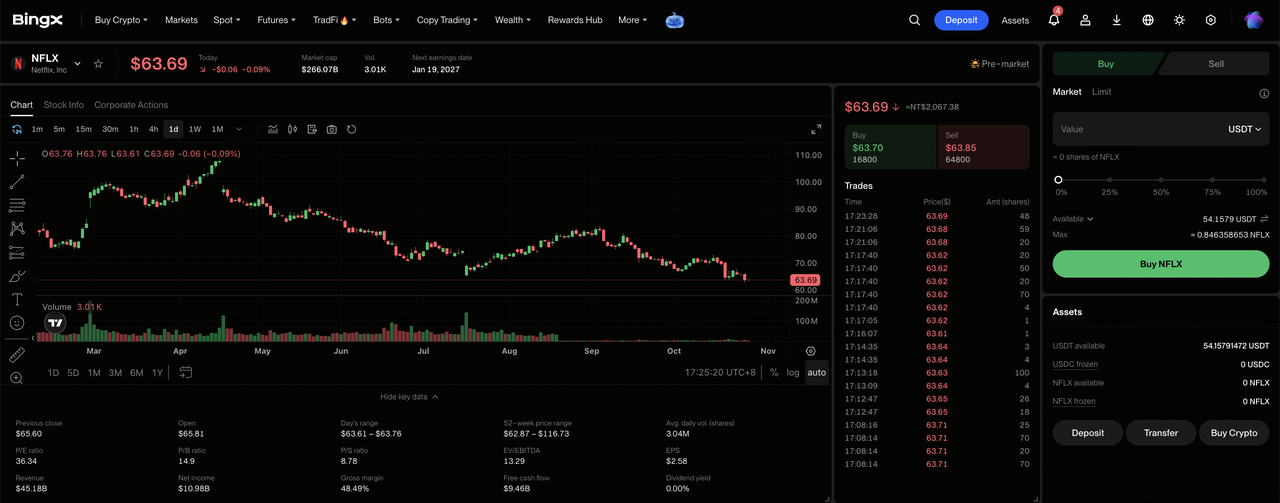
Step 1: Access BingX Stocks Trading. Sign up or log in to BingX, complete the required identity verification, and navigate to “TradFi > Stocks”. Accept the Stock Trading Risk Disclosure if accessing the product for the first time.
Step 2: Prepare USDT or USDC. Ensure your Spot Account has sufficient funds for the purchase. Transfer USDT or USDC from your Fund Account or Wealth Account if needed. Review the selected stock’s minimum order amount and fractional eligibility before choosing the investment size.
Step 3: Select Netflix (NFLX). Open the Stocks market, search for Netflix (NFLX), and confirm that the share is available to your account. Review the company identity, current share price, trading session and available order types.
Step 4: Buy Netflix Shares. Select “Buy”, enter an allowed investment amount or share quantity, and choose a supported market or limit order. Market orders use available prices during supported sessions, while limit orders require the specified price or better and sufficient liquidity to execute.
Step 5: Review and Manage Your Holdings. Open “Stocks > Positions” to monitor your NFLX shares and unrealized profit or loss. Use All Orders to review transactions or sell shares when needed. T+1 settlement generally affects when sale proceeds become withdrawable, rather than when purchased shares can be sold.
Top 5 Risks to Watch for Netflix Investors in 2026
Netflix's recurring subscriptions, global distribution, and substantial recurring cash generation support its earnings outlook. However, weaker retention, programming costs, advertising delays, and capital allocation could pressure profitability and shareholder returns.
- Weaker subscriber retention could pressure revenue: Q3 revenue reached $12.874 billion, supported primarily by memberships and pricing across the streaming service. Lower subscriber additions or renewal rates could reduce earnings and operating margins.
- Higher programming costs could constrain margins: Q4 margin guidance of 26% includes approximately 120 basis points of restructuring expense. Higher content and payroll costs could weaken profitability if subscription revenue and advertising sales grow more slowly.
- Advertising rollout delays could limit revenue growth: Full-year advertising guidance reached approximately $2.7 billion, but slower product capabilities reduced the prior forecast. Delayed advertiser tools, measurement features, or customer adoption could reduce future revenue visibility.
- Capital requirements could restrict shareholder returns: Netflix repurchased $4.8 billion in Q3 shares, while content production required substantial cash. Higher programming spending or additional property purchases could constrain future buybacks and per-share cash returns.
- Weaker monetization could pressure valuation: Netflix's Q3 operating margin reached 34.6%, supported partly by expense timing rather than recurring savings. Slower subscription growth, weaker advertising execution, or rising programming costs could reduce earnings and trigger share-price declines.
Final Thoughts: Should You Invest in Netflix in 2026?
Netflix's $4.459 billion in quarterly operating income and $2.884 billion in free cash flow demonstrate the earnings capacity of its subscription business. International programming and advertising partnerships support monetization opportunities, while repurchases can improve results per share. Sustaining that progress will depend on retaining members after price increases and generating returns from content and advertising investment.
The $85 bull case assumes advertising recovers toward $3 billion, revenue beats Q4 guidance, and cash generation outperforms. The $65 to $75 base case reflects steady subscriptions, while the $55 bear case accounts for weaker monetization and costs. With NFLX closing at $63.90 on October 26, investors should watch whether subscription growth translates into sustainable per-share earnings.
Risk Reminder: Netflix's global subscription business does not eliminate investment risk. Weaker retention, delayed advertising capabilities, or rising programming costs could reduce earnings and shareholder returns. Investors should assess valuation, cash generation, and their risk tolerance before buying NFLX shares.
Related Reading
- Walt Disney (DIS) Price Prediction 2026: Can Disney+ and Theme Parks Drive DIS Toward $145?
- AMC Entertainment (AMC) Price Prediction 2026: Can Box-Office Growth Push AMC Toward $4.50?
- Alphabet (GOOGL) Price Prediction 2026: Can 82% Cloud Growth and AI Push GOOGL Stock to $430?
- Reddit (RDDT) Price Prediction 2026: Can AI Data Opportunities Push RDDT Toward $300?
- GameStop (GME) Price Prediction 2026: Can Collectibles Growth Push GME Toward $30?
- Snap Inc. (SNAP) Price Prediction 2026: Can Advertising and Subscription Growth Push SNAP Toward $10?
