
Morgan Stanley (MS) provides investment banking, securities trading, wealth management and investment services to corporations, institutions and individual investors. Its wealth franchise supplies recurring asset-management fees, while the Integrated Firm strategy connects corporate financing with workplace and personal investing relationships. Client asset retention, trading activity and expense discipline determine whether that scale translates into stronger earnings and per-share returns.
The latest quarter showed record wealth revenue while fixed-income trading weakened. Morgan Stanley Q3 2026 revenue rose 12% to $20.34 billion, with equities revenue up 41%. Diluted EPS reached $3.03, while operating expenses increased about 12% to $13.71 billion. The next test is whether record asset inflows can generate recurring fees and sustain profitability as trading activity changes.
The MS stock forecast for 2026 now centers on two competing views:
- The recurring wealth growth case: Record asset inflows and advisory relationships could expand fee income if client assets remain invested and technology spending improves operating efficiency.
- The market and cost pressure case: Weaker trading and asset values could constrain earnings if compensation and technology expenses remain elevated across the firm.
This guide breaks down the MS stock forecast, 2026 price scenarios, key risks and analyst outlooks, drawing on Morgan Stanley’s October 14 Q3 earnings release, official financial presentation and market data through October 21, plus how to buy MS stock on BingX TradFi with USDT or USDC.
Top 5 Things for Morgan Stanley Investors to Know in October 2026
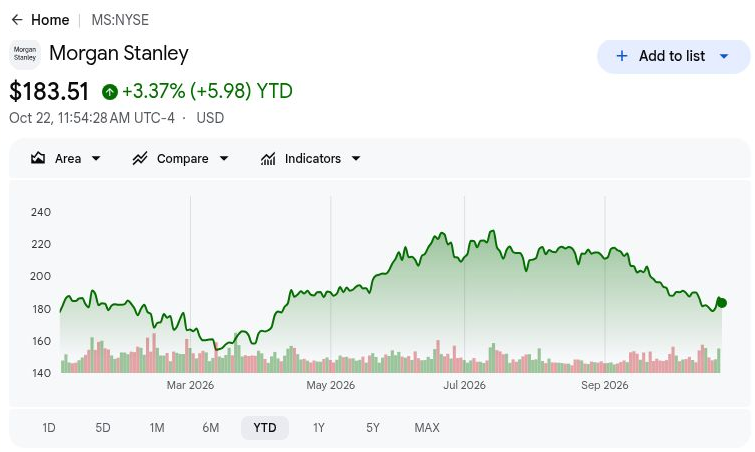
- MS closed at $187.01 on October 21, up 5.34% YTD: Shares remain below their July peak, making the $230 bull scenario dependent on stronger recurring earnings. A sustained recovery requires wealth flows to generate fee income rather than relying on another exceptionally strong equity-trading quarter.
- Q3 revenue increased to $20.34 billion from $18.22 billion a year earlier: Sales declined from $21.35 billion in Q2, showing sequential moderation. However, equities and wealth contributed to annual growth, making it important to distinguish recurring client fees from transaction-sensitive market activity.
- Fee-based wealth assets reached $3.155 trillion as client inflows expanded: The September 30 balance and $80.5 billion in quarterly fee-based flows provide evidence of customer demand. Asset retention, market performance, and servicing costs will determine how much of that scale translates into earnings.
- The Broadcom AI financing mandate provides an additional growth opportunity: Morgan Stanley served as lead advisor and a joint placement agent on an Apollo-led transaction announced in June. Future financing mandates and recognized fees will determine whether those relationships develop into sustained commercial growth.
- A 14.9% CET1 capital ratio supports investment and shareholder distributions: Morgan Stanley repurchased $1.54 billion of common shares and declared a $1.15 quarterly dividend. This provides support for per-share returns, although maintaining capital headroom and improving profitability will be essential to long-term shareholder value.
What Is Morgan Stanley (MS)?
Morgan Stanley is a global investment bank and financial services company serving corporations, governments, institutions and individual investors. Institutional Securities provides merger advisory, securities underwriting, trading and financing services, while Wealth Management serves clients through financial advisors, workplace programs and self-directed investing. Investment Management earns fees from overseeing institutional and individual client assets across investment strategies. Revenue depends on financial-market activity, client transactions, interest income and assets under management, making revenue diversification and capital efficiency important to profitability.
Morgan Stanley's growth strategy focuses on connecting institutional financing, workplace relationships, and wealth management through its Integrated Firm model. In June 2026, the firm worked with Apollo, Blackstone and leading banks on Broadcom's AI XPV platform, serving as lead advisor and a joint placement agent for the initial $35 billion financing transaction. The firm is also expanding client relationships through its advisor-led channel, including a new corporate retirement mandate within Q3 fee-based flows. With combined Wealth and Investment Management client assets reaching $10.5 trillion, these initiatives aim to strengthen recurring fees and improve shareholder returns.
Read More: Top Financial Services and Fintech Stocks to Buy in 2026 Amid Agentic AI, Stablecoin Rails Shift
Morgan Stanley (MS) Q3 2026 Earnings Overview: Equities Strength Lifts EPS Despite Higher Costs
Morgan Stanley reported Q3 2026 net revenues of $20.34 billion, up 12% year over year but down 5% sequentially, driven by equity trading and record wealth revenue. Operating expenses increased about 12% to $13.71 billion, while diluted EPS rose 8% to $3.03, reflecting stronger revenue alongside compensation and technology costs. With $232.4 billion in net new wealth assets and a 14.9% CET1 ratio, future earnings depend on recurring fee conversion, sustained client engagement and expense discipline.
|
Financial Metric |
Guidance / Consensus |
Reported / Actual |
Surprise |
|
Net revenues |
$18.224B Q3 2025 |
$20.338B |
Improved. Up 12% YoY. |
|
Diluted EPS |
$2.80 Q3 2025 |
$3.03 |
Improved. Up 8% YoY. |
|
Equity revenue |
$4.116B Q3 2025 |
$5.799B |
Expanded. Up 41% YoY. |
|
Fixed income revenue |
$2.169B Q3 2025 |
$2.011B |
Lower. Down 7% YoY. |
|
Wealth revenue |
$8.234B Q3 2025 |
$9.065B |
Expanded. Up 10% YoY. |
|
Wealth net new assets |
$81.0B Q3 2025 |
$232.4B |
Expanded. Nearly three times prior. |
|
Operating expenses |
$12.196B Q3 2025 |
$13.712B |
Higher. Up about 12% YoY. |
|
ROTCE |
23.5% Q3 2025 |
22.60% |
Lower. Down 0.9 percentage points. |
- Q3 net revenues increased 12% to $20.34 billion. Revenue declined 5% sequentially despite annual growth, reflecting moderating activity after the second quarter. Sustained client demand and wealth-management expansion will be important to maintaining earnings momentum.
- Equity revenue rose 41% to $5.80 billion. Broad client engagement and strength across international markets drove performance. Continued institutional activity and financing demand could support earnings, although market conditions and execution costs influence profitability.
- Diluted EPS rose 8% to $3.03 despite higher expenses. Operating costs increased 12% to $13.71 billion, while credit provisions reached $148 million. Stronger equities and wealth supported profitability, but expense discipline will be important as market activity normalizes.
- Fee-based wealth assets reached $3.155 trillion. Quarterly fee-based inflows totaled $80.5 billion, supporting $5.54 billion in asset-management revenue across the wealth franchise. Expanding fee-generating assets strengthens recurring revenue and reduces reliance on market-sensitive trading and advisory activity.
- Investment banking revenue rose 2% to $2.16 billion. Higher completed advisory activity supported quarterly results, although equity-underwriting revenue declined 19% year over year. Replenishing advisory mandates, completing financing transactions, and maintaining expense discipline will be important to future revenue growth.
Morgan Stanley (MS) 2026 Investment Outlook: $230 Bull Case vs. $165 Bear Case
Morgan Stanley's 2026 outlook depends on whether record wealth inflows can become durable fees while its equities franchise sustains client demand. Strong asset gathering shows progress, while weaker fixed-income trading and rising technology costs make operating leverage central to valuation. The following editorial scenarios reflect how asset retention, market activity and expenses could shape results through December 2026.
The Bull Case: Wealth Inflows and Equities Growth Push MS Toward $230
Converting new wealth assets into ongoing advisory fees would broaden earnings while resilient equity trading adds operating income. Q3 fee-based flows reached $80.5 billion and equities revenue increased 41%, demonstrating both sources of demand. If retained assets grow faster than servicing costs, Morgan Stanley could improve profitability without depending entirely on another surge in transactions.
The $230 scenario would gain support if quarterly fee-based inflows stay near or above $80.5 billion and wealth pre-tax margin expands beyond 30.4%. Revenue outgrowing expenses would strengthen this editorial test; these thresholds are not company guidance.
The Base Case: Steady Wealth Fees Keep MS Between $195 and $215
Recurring wealth fees could stabilize earnings while institutional trading normalizes from a strong first half. Q3 wealth revenue reached $9.07 billion and its pre-tax margin was 30.4%, providing a substantial contribution beyond securities trading. The base case assumes these relationships remain productive, allowing moderate profit growth while technology spending and uneven transaction activity limit operating leverage.
A $195 to $215 range would fit positive fee-based flows, stable wealth margins and resilient advisory demand. Stronger client retention would support the upper end, while weaker market levels could reduce fee-generating assets enough to limit further valuation gains.
The Bear Case: Weak Markets and Rising Costs Pull MS Toward $165
Falling asset values and weaker trading demand would reduce revenue while compensation and technology spending absorb more of the remaining income. Q3 fixed-income revenue declined 7% and Investment Management revenue fell 12%, showing uneven conditions beneath the headline growth. If equities activity also slows, recurring wealth fees may provide insufficient protection against the broader expense base.
The $165 scenario would become more likely if equity trading weakens alongside slower wealth flows or lower asset values. Elevated servicing and technology costs would then limit margin flexibility, leaving less earnings support for repurchases and a higher share-price valuation.
MS Stock Price Forecasts for 2026 By Wall Street Analysts
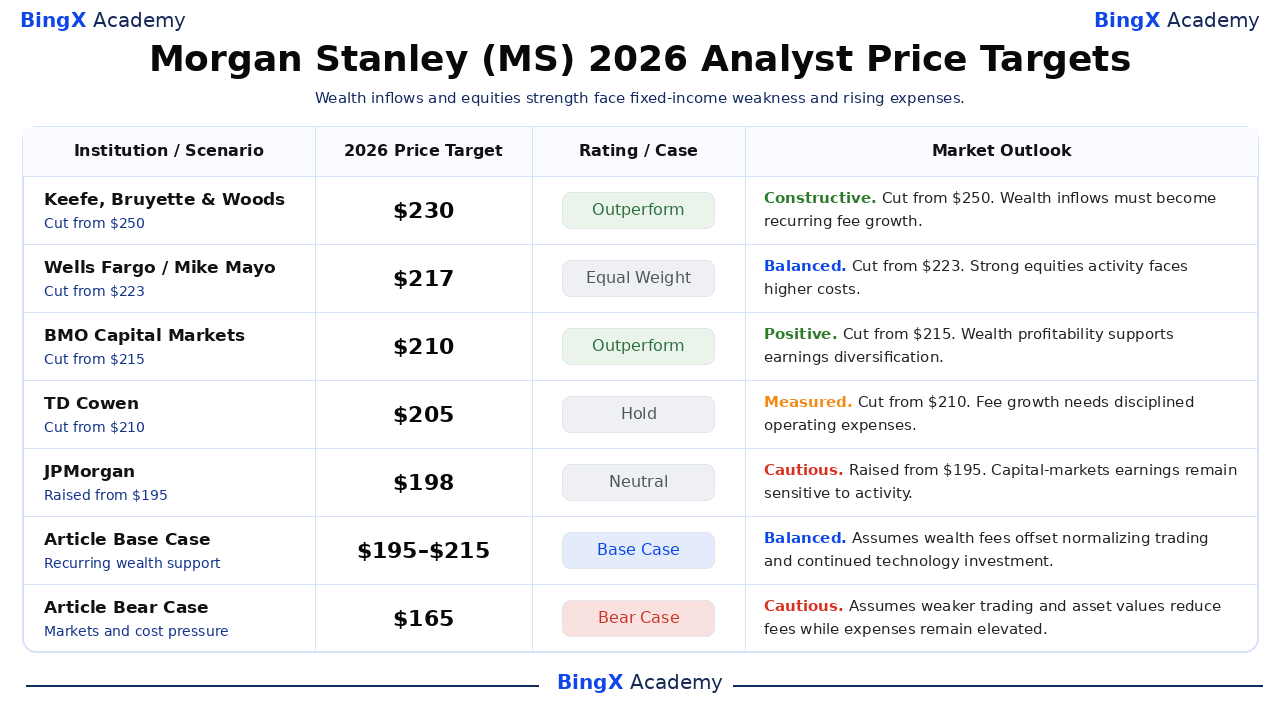
The following targets are dated third-party reference points for Morgan Stanley shares, generally using twelve-month horizons that extend beyond 2026. They are not guaranteed prices or identical to the December scenarios in this article. Recent target reductions show that constructive business views can coexist with more restrained earnings and valuation assumptions.
|
Institution / Scenario |
2026 Price Target |
Rating / Case |
Market Outlook |
|
Keefe, Bruyette & Woods |
$230 |
Outperform |
Constructive. October 15, 2026: Cut target from $250; maintained Outperform. Editorial view: Wealth inflows must become recurring fee growth. |
|
Wells Fargo |
$217 |
Equal Weight |
Balanced. October 15, 2026: Cut target from $223; maintained Equal Weight. Editorial view: Strong equities activity faces higher costs. |
|
BMO Capital Markets |
$210 |
Outperform |
Positive. October 19, 2026: Cut target from $215; maintained Outperform. Editorial view: Wealth profitability supports earnings diversification. |
|
TD Cowen |
$205 |
Hold |
Measured. October 15, 2026: Cut target from $210; maintained Hold. Editorial view: Fee growth needs disciplined operating expenses. |
|
JPMorgan |
$198 |
Neutral |
Cautious. October 16, 2026: Raised target from $195; maintained Neutral. Editorial view: Capital-markets earnings remain sensitive to activity. |
|
Article Base Case |
195–215 |
Base Case |
Balanced. Editorial December 2026 scenario. Assumes recurring wealth fees offset normalizing trading and expenses. |
|
Article Bear Case |
$165 |
Bear Case |
Cautious. Editorial December 2026 scenario. Assumes weaker markets and higher costs reduce earnings. |
How to Buy Morgan Stanley (MS) Stock on BingX
Buy and hold Morgan Stanley shares through BingX Stocks Trading using USDT or USDC, subject to listing and account eligibility. Morgan Stanley offers exposure to investment banking, institutional trading, wealth management and investment services. Eligible users can size holdings according to their investment goals without using leverage or paying perpetual funding fees.
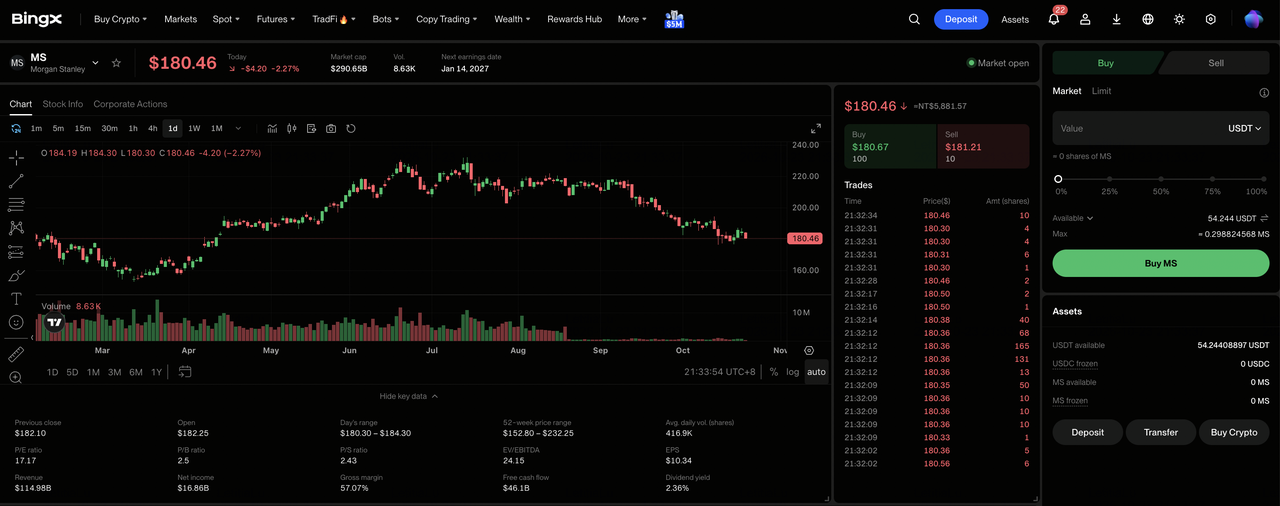
Step 1: Access BingX Stocks Trading. Sign up or log in to BingX, complete the required identity verification, and navigate to “TradFi > Stocks”. Accept the Stock Trading Risk Disclosure if accessing the product for the first time.
Step 2: Prepare USDT or USDC. Ensure your Spot Account has sufficient funds for the purchase. Transfer USDT or USDC from your Fund Account or Wealth Account if needed. Review the selected stock’s minimum order amount and fractional eligibility before choosing the investment size.
Step 3: Select Morgan Stanley (MS). Open the Stocks market, search for Morgan Stanley (MS), and confirm that the share is available to your account. Review the company identity, current share price, trading session and available order types.
Step 4: Buy Morgan Stanley Shares. Select “Buy”, enter an allowed investment amount or share quantity, and choose a supported market or limit order. Market orders use available prices during supported sessions, while limit orders require the specified price or better and sufficient liquidity to execute.
Step 5: Review and Manage Your Holdings. Open “Stocks > Positions” to monitor your MS shares and unrealized profit or loss. Use All Orders to review transactions or sell shares when needed. T+1 settlement generally affects when sale proceeds become withdrawable, rather than when purchased shares can be sold.
Top 5 Risks to Watch for Morgan Stanley Investors in 2026
Morgan Stanley's institutional relationships, expanding wealth franchise, and diversified client assets support its earnings outlook. However, trading volatility, operating expenses, investment banking activity, and asset-market declines could pressure profitability and shareholder returns.
- Weaker trading activity could pressure revenue: Q3 equities revenue reached $5.80 billion, supported by broad institutional client engagement. Lower trading volumes or financing balances could reduce earnings and returns on equity.
- Rising operating costs could constrain margins: Q3 operating expenses increased about 12% to $13.71 billion. Higher compensation and technology costs could weaken profitability if trading revenue and management fees grow more slowly.
- Investment banking delays could limit fee growth: Q3 banking revenue reached $2.16 billion, but equity underwriting declined 19%. Delayed mergers, underwriting activity, or transaction completions could reduce future revenue visibility.
- Capital requirements could restrict shareholder returns: Morgan Stanley repurchased $1.54 billion in shares during Q3, with CET1 at 14.9%. Higher credit provisions or regulatory capital needs could constrain future buybacks and per-share earnings growth.
- Weaker returns could pressure valuation: Morgan Stanley's Q3 return on tangible common equity reached 22.6%, supported by strong equities activity. Slower trading, weaker investment performance, or rising servicing costs could reduce returns and trigger share-price declines.
Final Thoughts: Should You Invest in Morgan Stanley in 2026?
Morgan Stanley's $9.07 billion in quarterly wealth revenue and $3.155 trillion in fee-based assets highlight the scale of its recurring earnings franchise. Strong equities trading and growing advisory relationships provide additional income, while share repurchases create opportunities to improve per-share returns. Sustaining that growth will depend on retaining client assets and controlling compensation and technology costs.
The $230 bull case assumes sustained wealth flows, resilient equity trading, and improving operating leverage. The $195 to $215 base case reflects steady fees, while the $165 bear case accounts for weaker markets and elevated expenses. With MS closing at $187.01 on October 21, investors should watch whether asset gathering translates into durable per-share earnings.
Risk Reminder: Morgan Stanley's wealth franchise does not eliminate investment risk. Weaker trading activity, falling client asset values, or rising operating costs could reduce earnings and shareholder returns. Investors should assess valuation, capital strength, and their risk tolerance before buying MS shares.
Related Reading
- Top Financial Services and Fintech Stocks to Buy in 2026 Amid Agentic AI, Stablecoin Rails Shift
- Broadcom (AVGO) Price Prediction 2026: Can AI Revenue Growth Push AVGO Toward $600?
- Goldman Sachs (GS) Price Prediction 2026: Can Record Equities Revenue Lift GS Toward $1,150?
- JPMorgan Chase (JPM) Price Prediction 2026: Can Rising Interest Income Drive JPM Toward $425?
- BlackRock (BLK) Price Prediction 2026: Can Strong ETF Demand Push BLK Toward $1,400?
- Wells Fargo (WFC) Price Prediction 2026: Can Rising Interest Income Push WFC Toward $105?
