



Johnson & Johnson (JNJ) develops prescription medicines and medical technologies for patients, hospitals, and healthcare professionals. Its established drug portfolio generates cash, while new oncology treatments, immunology launches, and OTTAVA surgical robotics create additional growth opportunities. Treatment adoption, replacement of patent-exposed sales, and returns on development spending determine whether that expansion translates into stronger per-share earnings.
The latest quarter showed pharmaceutical growth while strategic investment weighed on earnings. Johnson & Johnson Q3 2026 revenue rose 5.9% to $25.399 billion, with Innovative Medicine sales up 7.7%. Adjusted EPS fell to $2.59, while MedTech grew only 2.5%. The next test is whether new launches and improving devices can support the raised full-year outlook despite ongoing development costs.
The JNJ stock forecast for 2026 now centers on two competing views:
- The replacement-growth case: New oncology and immunology treatments offset lost patent-protected sales, while improved devices and cash conversion turn portfolio investment into stronger shareholder returns.
- The dilution-pressure case: Development costs, slower device demand, and continuing litigation absorb pharmaceutical gains before newer treatments deliver enough profitable revenue to support a higher valuation.
This guide breaks down the JNJ stock forecast, 2026 price scenarios, key risks and analyst outlooks, drawing on Johnson & Johnson’s October 13 earnings release, management remarks and market data through October 21, plus how to buy JNJ stock on BingX TradFi with USDT or USDC.
Top 5 Things for Johnson & Johnson Investors to Know in October 2026
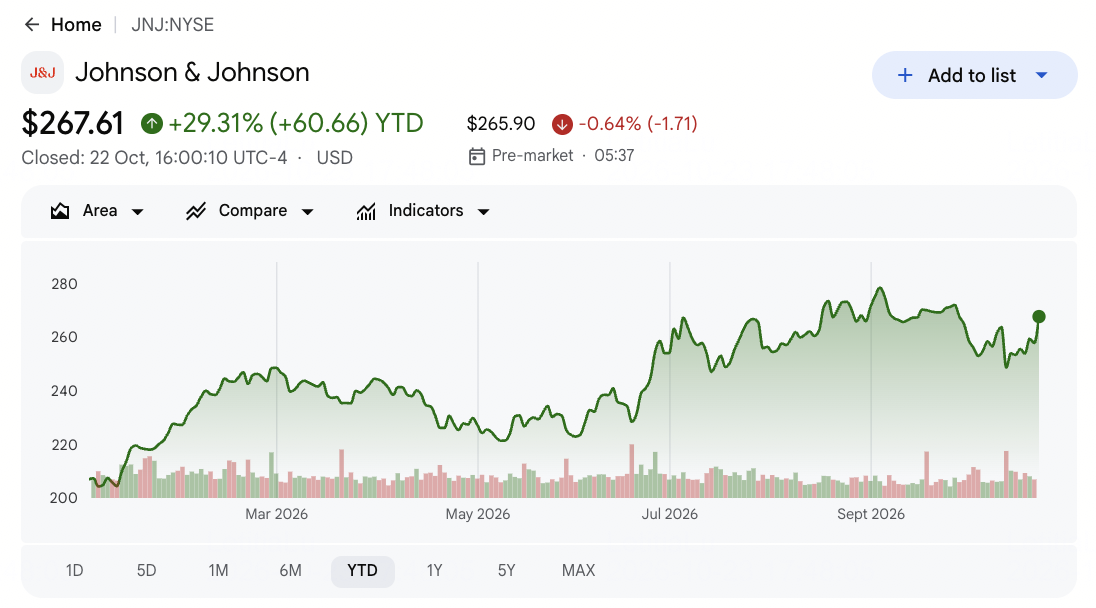
- JNJ closed at $267.61 on October 22, up 29.31% YTD: Shares remain above their opening-year level, making the $320 bull scenario dependent on stronger earnings conversion. Continued gains require new medicines to replace lost patent-protected sales, rather than relying on higher revenue expectations alone.
- Q3 revenue increased to $25.399 billion from $23.993 billion: Innovative Medicine contributed $16.757 billion, showing stronger demand for newer oncology and immunology treatments. However, MedTech grew more slowly, making it important to distinguish pharmaceutical momentum from a broad recovery across the company’s healthcare portfolio.
- Darzalex sales reached $4.239 billion as oncology demand expanded: The Q3 result and 7.9% operational Innovative Medicine growth provide evidence of continuing treatment adoption. Pricing, replacement-brand demand, and development spending will determine how much of that operating scale translates into sustainable per-share earnings growth.
- OTTAVA and Sail Biomedicines provide additional growth opportunities: OTTAVA received market authorization during Q3, while the July Sail collaboration targeted in vivo CAR-T therapies. Future hospital adoption and successful clinical development will determine whether these milestones develop into sustained commercial growth and attractive investment returns.
- Estimated $15.1 billion in YTD free cash flow supports investment: Johnson & Johnson generated cash while completing its $1 billion Firefly Bio acquisition during Q3. This provides support for pipeline expansion, although stronger earnings conversion and returns on research spending will be essential to long-term shareholder value.
What Is Johnson & Johnson (JNJ)?

Johnson & Johnson (JNJ) is a global healthcare company developing prescription medicines and medical technologies for patients, clinicians, and hospitals. Its Innovative Medicine business researches and commercializes therapies across oncology, immunology, neuroscience, and other treatment areas. MedTech supplies cardiovascular devices, surgical technologies, orthopaedic products, and vision care, combining equipment sales with procedure-related demand. Revenue depends on treatment adoption, product pricing, hospital activity, and protection from competition, with the two businesses providing distinct sources of healthcare sales and operating cash flow.
Johnson & Johnson’s growth strategy focuses on expanding oncology and immunology, advancing surgical technology, and improving its portfolio mix. In July 2026, the company announced a collaboration with Sail Biomedicines on in vivo CAR-T therapies, including initial payments of $785 million and an option to acquire Sail for $2.58 billion. The company also completed its $1 billion Firefly Bio acquisition during Q3 and is preparing the planned DePuy Synthes separation. With quarterly sales reaching $25.399 billion, these initiatives aim to replace aging drug revenue and improve long-term returns, although development costs precede commercial results.
Read More: Top Pharma Stocks to Buy in 2026: Cancer Drugs, Weight-Loss Drugs, mRNA, and New Medicines
Johnson & Johnson (JNJ) Q3 2026 Earnings Overview: Drug Growth Supports Sales Despite Earnings Pressure
Johnson & Johnson reported Q3 2026 revenue of $25.399 billion, up 5.9% year over year, supported by 7.7% Innovative Medicine growth and continued oncology demand. Adjusted EPS declined 7.5% to $2.59, while GAAP EPS fell to $0.09 as litigation and strategic transaction charges weighed on results. With MedTech growth of 2.5% and full-year adjusted EPS guidance of $11.05 to $11.15, future earnings depend on replacing patent-exposed sales, improving devices, and earning returns on pipeline investment.
|
Financial Metric |
Guidance / Consensus |
Reported / Actual |
Surprise |
|
Revenue |
$23.993B Q3 2025 |
$25.399B |
Improved. Up 5.9% YoY. |
|
Innovative Medicine |
$15.563B Q3 2025 |
$16.757B |
Expanded. Up 7.7% YoY. |
|
MedTech revenue |
$8.430B Q3 2025 |
$8.642B |
Improved. Up 2.5% YoY. |
|
Adjusted diluted EPS |
$2.80 Q3 2025 |
$2.59 |
Lower. Down 7.5% YoY. |
|
GAAP diluted EPS |
$2.12 Q3 2025 |
$0.09 |
Lower. Down 95.8% YoY. |
|
Stelara revenue |
$1.570B Q3 2025 |
$716M |
Declined. Down 54.4% YoY. |
|
Estimated YTD free cash flow |
$14.226B YTD 2025 |
~$15.1B |
Improved. Up about 6%. |
|
2026 adjusted EPS guide |
10.96–11.11 prior |
11.05–11.15 |
Raised. Midpoint increased $0.06. |
- Q3 revenue increased 5.9% to $25.399 billion. Innovative Medicine revenue reached $16.757 billion, reflecting stronger oncology and immunology demand across several established and newer treatments. Sustained medicine adoption and device recovery will be important to maintaining earnings momentum.
- Innovative Medicine revenue rose 7.7% to $16.757 billion. Darzalex sales of $4.239 billion and expanding oncology treatments drove performance. Continued treatment adoption and product launches could support earnings, although pricing and patent competition influence profitability.
- Adjusted EPS fell to $2.59 as transaction costs weighed. GAAP EPS declined to $0.09, while adjusted net earnings decreased 6.8%. Transaction charges reduced earnings, making stronger operating efficiency important as new medicines reach larger commercial markets.
- Firefly Bio expanded Johnson & Johnson’s oncology capabilities. Approximately $1 billion was spent on the completed acquisition during Q3. The investments support antibody engineering, with returns depending on successful clinical development and profitable future medicine launches.
- Full-year adjusted EPS guidance reached $11.05 to $11.15. The revised midpoint increased $0.06, with delivery depending on continued drug growth and steadier device performance. Expanding treatment adoption, improving device sales, and managing development spending will be important to future earnings growth.
Johnson & Johnson (JNJ) 2026 Investment Outlook: $320 Bull Case vs. $225 Bear Case
Johnson & Johnson’s 2026 outlook depends on whether newer medicines can replace patent-exposed revenue while preserving earnings after pipeline investment. Q3 drug sales expanded faster than devices, but adjusted EPS declined as strategic transactions added costs. The following editorial scenarios show how launch demand, MedTech recovery, and spending discipline could shape the stock through December 2026.
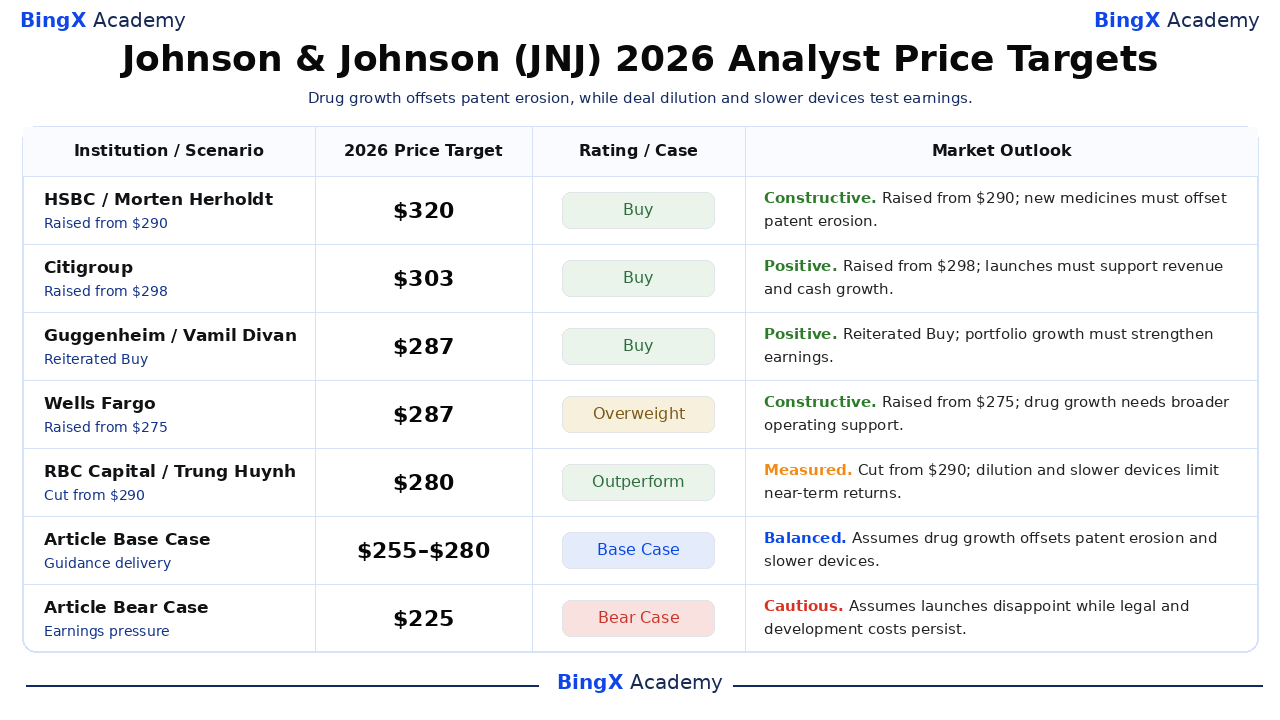
The Bull Case: New Medicines and Device Recovery Push JNJ Toward $320
Broader adoption of new medicines would lift earnings while recovering medical-device growth provides a second source of operating support. Innovative Medicine sales rose 7.7% to $16.757 billion, with Darzalex reaching $4.239 billion. Extending that momentum across immunology and oncology would help replace Stelara losses as better device sales absorb development and commercialization costs.
The $320 scenario would gain support if full-year adjusted EPS reaches the $11.15 guide ceiling and MedTech growth improves beyond Q3’s 2.5%. Stronger cash conversion would connect higher pharmaceutical sales with more sustainable shareholder returns.
The Base Case: Steady Drug Demand Keeps JNJ Between $255 and $280
Continued drug growth could maintain operating cash generation even if devices recover slowly and development spending limits adjusted earnings. Estimated year-to-date free cash flow reached $15.1 billion, while MedTech sales grew only 2.5%. Those offsets would support ongoing research and shareholder distributions without demonstrating that new initiatives can yet lift per-share profitability consistently.
A $255 to $280 range would fit delivery within the $11.05 to $11.15 adjusted EPS guide and continued pharmaceutical growth. Better devices would support the upper end, while patent erosion and transaction dilution could limit valuation expansion.
The Bear Case: Patent Erosion and Development Costs Pull JNJ Toward $225
Slower growth in replacement medicines would expose earnings more fully to patent losses and the cost of building future treatments. Stelara sales fell 54.4% to $716 million, while strategic transactions also reduced adjusted profitability. If new launches lose momentum before device growth improves, investment spending could absorb too much of the remaining pharmaceutical contribution.
The $225 scenario would become more likely if medicine growth slows alongside further device weakness and earnings fall short of the annual guide. Higher litigation costs or disappointing development progress would then weaken cash returns and reduce support for the valuation.
JNJ Stock Price Forecasts for 2026 By Wall Street Analysts
The selected Wall Street actions span $280 to $320 and reflect different views of new medicines, patent exposure, and device performance. These are published analyst reference points, generally using twelve-month horizons that extend beyond December 2026. The article’s bull, base, and bear prices are separate editorial scenarios, not additional broker forecasts.
|
Institution / Scenario |
2026 Price Target |
Rating / Case |
Market Outlook |
|
HSBC |
$320 |
Buy |
Constructive. September 10, 2026: Raised from $290; maintained Buy. Editorial view: New medicines must offset patent erosion and device weakness. |
|
Citigroup |
$303 |
Buy |
Positive. October 5, 2026: Raised from $298; maintained Buy. Editorial view: Commercial launches must support revenue and cash growth. |
|
Guggenheim |
$287 |
Buy |
Positive. October 7, 2026: Reiterated Buy with a $287 target. Editorial view: Portfolio growth must translate into stronger earnings. |
|
Wells Fargo |
$287 |
Overweight |
Constructive. October 16, 2026: Raised from $275; maintained Overweight. Editorial view: Strong drug sales need broader operating support. |
|
RBC Capital |
$280 |
Outperform |
Measured. October 14, 2026: Cut from $290; maintained Outperform. Editorial view: Acquisition dilution and slower devices limit near-term returns. |
|
Article Base Case |
255–280 |
Base Case |
Balanced. Editorial December 2026 scenario. Assumes guidance delivery offsets patent erosion and slower devices. |
|
Article Bear Case |
$225 |
Bear Case |
Cautious. Editorial December 2026 scenario. Assumes launches disappoint while legal and development costs persist. |
How to Buy Johnson & Johnson (JNJ) Stock on BingX
Buy and hold Johnson & Johnson shares through BingX Stocks Trading using USDT or USDC, subject to listing and account eligibility. Johnson & Johnson offers exposure to prescription medicines, medical devices and healthcare innovation across a global portfolio. Eligible users can size holdings according to their investment goals without using leverage or paying perpetual funding fees.
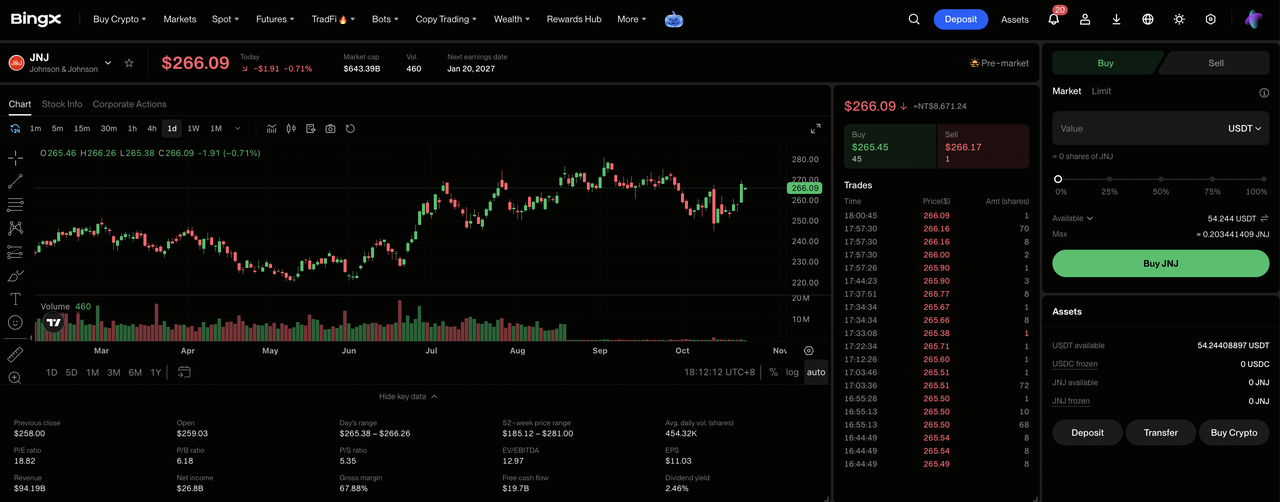
Step 1: Access BingX Stocks Trading. Sign up or log in to BingX, complete the required identity verification, and navigate to “TradFi > Stocks”. Accept the Stock Trading Risk Disclosure if accessing the product for the first time.
Step 2: Prepare USDT or USDC. Ensure your Spot Account has sufficient funds for the purchase. Transfer USDT or USDC from your Fund Account or Wealth Account if needed. Review the selected stock’s minimum order amount and fractional eligibility before choosing the investment size.
Step 3: Select Johnson & Johnson (JNJ). Open the Stocks market, search for Johnson & Johnson (JNJ), and confirm that the share is available to your account. Review the company identity, current share price, trading session and available order types.
Step 4: Buy Johnson & Johnson Shares. Select “Buy”, enter an allowed investment amount or share quantity, and choose a supported market or limit order. Market orders use available prices during supported sessions, while limit orders require the specified price or better and sufficient liquidity to execute.
Step 5: Review and Manage Your Holdings. Open “Stocks > Positions” to monitor your JNJ shares and unrealized profit or loss. Use All Orders to review transactions or sell shares when needed. T+1 settlement generally affects when sale proceeds become withdrawable, rather than when purchased shares can be sold.
Top 5 Risks to Watch for Johnson & Johnson Investors in 2026
Johnson & Johnson’s established medicines, broad healthcare portfolio, and reliable cash generation support its earnings outlook. However, patent erosion, device demand, development spending, and litigation could pressure profitability and shareholder returns.
- Weaker medicine demand could pressure revenue: Q3 Innovative Medicine sales reached $16.757 billion, supported by oncology and immunology treatments. Lower treatment volumes or replacement-brand demand could reduce earnings and operating margins as patent competition intensifies.
- Rising development costs could constrain margins: Q3 adjusted EPS declined 7.5% to $2.59, reflecting transaction-related dilution. Higher research and commercialization costs could weaken profitability if medicine sales and device revenue grow more slowly.
- Device adoption delays could limit revenue growth: Q3 MedTech revenue reached $8.642 billion, but growth remained only 2.5%. Delayed hospital purchases, robotic installations, or procedure recovery could reduce future revenue visibility.
- Pipeline investment could weaken shareholder returns: Approximately $1 billion was spent on Firefly Bio, supporting antibody-engineering capabilities. Clinical setbacks or additional development costs could limit future cash generation and reduce shareholder value before acquired programs reach commercialization.
- Weaker earnings could pressure valuation: Johnson & Johnson’s adjusted Q3 EPS reached $2.59, supported by a large pharmaceutical business. Slower launches, weaker device demand, or rising litigation costs could reduce earnings and trigger share-price declines.
Final Thoughts: Should You Invest in Johnson & Johnson in 2026?
Johnson & Johnson’s $25.399 billion in quarterly revenue and estimated $15.1 billion in year-to-date free cash flow show its capacity to fund healthcare innovation. Darzalex and newer medicines support sales, while Firefly Bio and Sail expand development opportunities. Sustaining that growth will depend on replacing patent-exposed revenue and converting device investment into profitable adoption.
The $320 bull case assumes broader new-medicine demand, recovering devices, and stronger conversion of revenue into earnings. The $255 to $280 base case reflects guidance delivery, while the $225 bear case accounts for patent erosion and persistent costs. With JNJ closing at $257.78 on October 21, investors should watch whether portfolio growth produces durable per-share returns.
Risk Reminder: Johnson & Johnson’s diversified healthcare portfolio does not eliminate investment risk. Patent losses, clinical setbacks, or higher litigation costs could reduce earnings and shareholder returns. Investors should assess valuation, cash generation, and their risk tolerance before buying JNJ shares.
Related Reading
- Top Pharma Stocks to Buy in 2026: Cancer Drugs, Weight-Loss Drugs, mRNA, and New Medicines
- Moderna (MRNA) Price Prediction 2026: Can Cancer Vaccine Momentum Push MRNA Stock Toward $180?
- Merck (MRK) Price Prediction 2026: Can Pipeline Momentum Push MRK Stock Toward $170?
- Eli Lilly (LLY) Price Prediction 2026: Can Weight-Loss Drug Demand Push LLY Toward $1,600?
- UnitedHealth (UNH) Stock Price Prediction 2026: AI-Driven Recovery or Regulatory Trap at $306?
