GitLab (GTLB) provides an intelligent orchestration platform for DevSecOps, combining source-code management, planning, continuous integration and delivery, application security, compliance and deployment in one system. Subscriptions to GitLab.com and self-managed editions drive most revenue, while Duo AI, Flex consumption and security add-ons are becoming more important to expansion. That platform breadth creates a large enterprise opportunity, but leaves GTLB sensitive to AI-native coding competition, customer consolidation and execution on monetization.
The latest quarter showed stronger demand with a less settled profitability picture. GitLab Q2 FY2027 revenue reached $286.3 million, up 21% and $13.2 million above consensus, while dollar-based net retention improved to 117% and current remaining performance obligations rose 20% to $744.7 million. Adjusted EPS of $0.24 beat the $0.18 estimate, though adjusted free cash flow fell to $9.8 million from $46.5 million a year earlier.
The GTLB stock forecast for 2026 now centers on two competing views:
- The agentic-platform and enterprise-expansion case: Duo Agent Platform, Flex and stronger large-customer adoption lift consumption, retention and bookings while GitLab converts its more than 50 million registered users into higher-value enterprise workloads.
- The AI-disruption and cash-conversion case: GitHub, Claude Code and other AI-native tools slow seat and usage expansion while rising development expense and stock compensation keep GAAP losses and free-cash-flow volatility elevated.
This guide breaks down the GTLB stock forecast, 2026 price scenarios, key risks and analyst outlooks, drawing on GitLab's September 1, 2026 Q2 FY2027 earnings release, quarterly filing and market data through September 23, plus how to trade GTLB stock futures on BingX TradFi with USDT collateral.
Top 5 Things for GitLab Investors to Know in September 2026
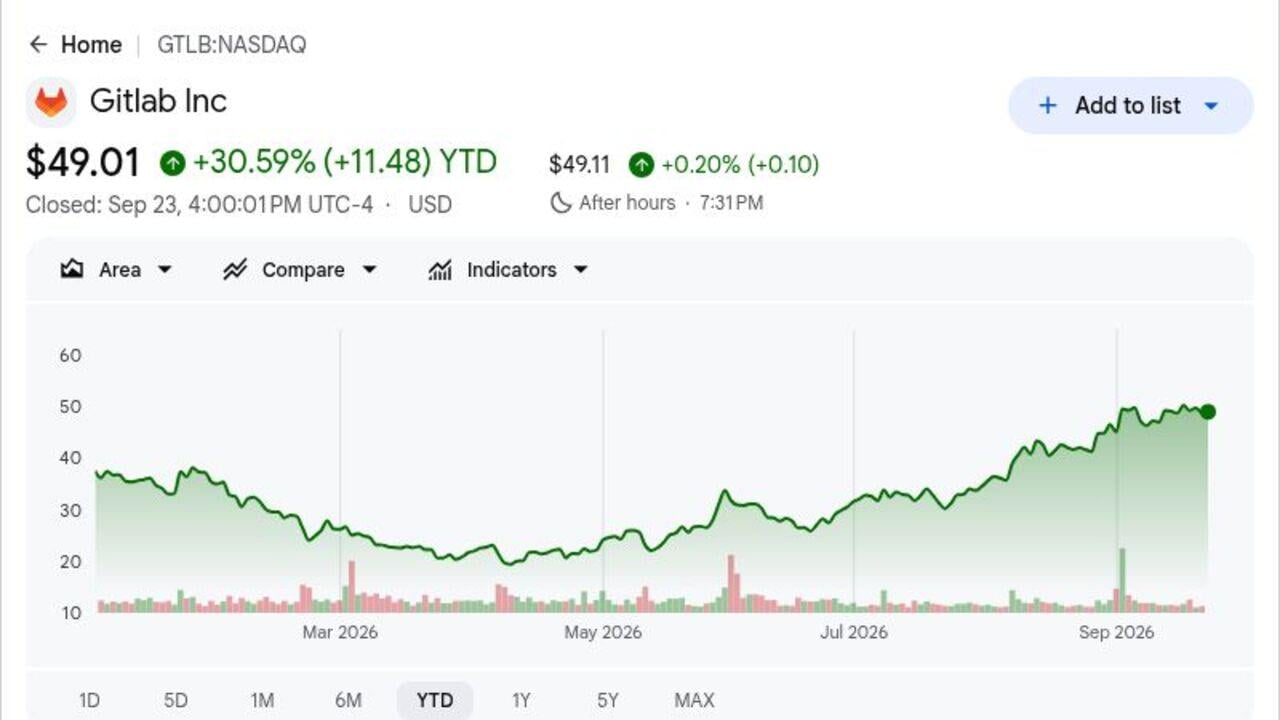
- GTLB closed at $49.01 and was up 30.59% in 2026: The September 23 close followed a 9.4% post-earnings gain but remained below Canaccord's $70 target. The rally shows investors rewarded the beat, though the $47 to $70 analyst range still reflects uncertainty around AI competition.
- Revenue reached $286.3 million and beat consensus by $13.2 million: Sales grew 21% year over year versus the $273.1 million FactSet estimate. The result also exceeded management's prior $272 million to $274 million guidance range.
- Net retention reached 117% as large customers grew 17%: Customers generating more than $100,000 of ARR increased to 1,571, while current RPO rose 20% to $744.7 million. The metrics show enterprise customers are expanding spending and contracted future revenue.
- Annual revenue guidance increased to $1.129 billion to $1.133 billion: The midpoint rose by $16 million from the prior range, while adjusted EPS guidance increased to $0.85 to $0.87 from $0.79 to $0.82. Higher revenue and earnings expectations strengthen the valuation base.
- Adjusted free cash flow fell by $36.7 million to $9.8 million: Operating cash flow was negative $3.1 million versus positive $49.4 million a year earlier. Cash conversion remains a key concern even as record gross bookings and more than 100% first-order growth support demand.
What Is GitLab (GTLB)?
GitLab is an all-remote software company built around a single application for the software-development lifecycle. Its platform connects planning, repositories, code review, CI/CD, testing, security scanning, compliance evidence and deployment so developers, security teams and operations groups work from one governed data layer. Customers buy term subscriptions for GitLab.com SaaS or self-managed deployments, with Premium and Ultimate tiers, services and usage-based credits supporting revenue. More than 50 million registered users and roughly half of the Fortune 100 use the platform.
GitLab's long-term direction is to orchestrate human developers and AI agents without separating AI from security and governance. Duo Agent Platform applies conversational assistance, specialized agents and workflow automation across planning, coding, testing and remediation, while Orbit connects code, pipelines, deployments and production signals into a context graph. GitLab Flex gives enterprises one annual commitment spanning seats and credits, and Secrets Manager extends the platform into credential governance. The company highlights NVIDIA, Lockheed Martin, Ericsson, Deutsche Telekom and Agoda among customers using its platform.
Read More: UiPath (PATH) Price Prediction 2026: Can Agentic AI Push PATH Toward $23?
GitLab (GTLB) Q2 FY2027 Earnings Overview: $286.3M Revenue Beat, 117% Retention and Higher Guidance
GitLab reported Q2 FY2027 revenue of $286.3 million versus $273.1 million expected, adjusted diluted EPS of $0.24 versus $0.18 consensus, and current RPO of $744.7 million, up 20%. Dollar-based net retention reached 117% and customers above $100,000 of ARR rose 17% to 1,571. Management raised FY2027 revenue to $1.129 billion to $1.133 billion and adjusted EPS to $0.85 to $0.87, though adjusted free cash flow declined to $9.8 million.
Read More: GitLab (GTLB) Q2 FY2027 Earnings Overview: 21% Revenue Growth and Raised Outlook Lift Shares 9.98%
|
Financial Metric |
Guidance / Consensus |
Reported / Actual |
Surprise |
|
Q2 FY2027 revenue |
$273.1M consensus |
$286.3M |
Beat. $13.2M above consensus; up 21% YoY. |
|
Q2 non-GAAP diluted EPS |
$0.18 consensus |
$0.24 |
Beat. $0.06 above consensus. |
|
Q2 GAAP diluted EPS |
-$0.06 a year earlier |
-$0.22 |
Worsened. Investment and stock compensation increased. |
|
Dollar-based net retention |
— |
117% |
Improved. Expansion strengthened sequentially. |
|
Customers above $100K ARR |
1,343 a year earlier |
1,571 |
Expanded. Increased 17% YoY. |
|
Current RPO |
— |
$744.7M |
Expanded. Increased 20% YoY. |
|
Q2 non-GAAP operating margin |
17% a year earlier |
15% |
Compressed. Down 2 percentage points. |
|
Q2 adjusted free cash flow |
$46.5M a year earlier |
$9.8M |
Declined. Lower by $36.7M. |
|
FY2027 revenue outlook |
$1.112B–$1.118B prior |
$1.129B–$1.133B |
Raised. Midpoint increased by $16M. |
|
FY2027 non-GAAP EPS outlook |
$0.79–$0.82 prior |
$0.85–$0.87 |
Raised. Midpoint increased by $0.055. |
- Revenue of $286.3 million grew 21% and beat consensus by $13.2 million: The result also exceeded the $273 million midpoint of prior guidance. Stronger-than-expected growth showed that enterprise expansion and new customer orders outweighed near-term concerns about AI coding competition.
- Adjusted EPS of $0.24 beat consensus by $0.06: Non-GAAP operating income reached $42.6 million with a 15% margin. The beat showed operating leverage, though the margin was two points below a year earlier as GitLab increased AI investment.
- Net retention reached 117% as large customers rose to 1,571: Customers generating more than $100,000 of ARR increased 17%, while first-order growth exceeded 100%. The combination points to healthy expansion from existing customers and stronger new-business demand.
- Current RPO increased 20% to $744.7 million: Total RPO reached $1.2 billion, up 16%, providing stronger visibility into future revenue. cRPO growth close to the revenue growth rate also suggests the quarterly beat was supported by underlying demand.
- Annual revenue guidance rose to a $1.131 billion midpoint: Management increased the midpoint by $16 million and raised adjusted operating-income guidance to $148 million to $152 million. The higher revenue and profit outlook strengthens the operating case, though quarterly adjusted free cash flow of $9.8 million remains a constraint.
Read More: Adobe (ADBE) Price Prediction 2026: Can AI Monetization Push ADBE Toward $350?
GitLab (GTLB) 2026 Investment Outlook: $70 Bull Case vs. $35 Bear Case
GitLab's 2026 outlook depends on whether stronger bookings, 117% retention and AI consumption become durable growth while the company restores cash conversion. The analyst actions below reflect that tension between better execution and unresolved competitive risk.
The Bull Case: AI Products Drive Faster Customer Spending and Push GTLB Toward $70
The Bull Case assumes Duo Agent Platform becomes a core workflow layer for enterprise software teams and Flex converts more AI usage into paid credits. Net ARR growth already exceeded 40% in Q2, first-order growth topped 100% and current RPO rose 20%, providing measurable demand signals.
A move toward $70 would require revenue growth to stay near or above 20%, net retention to remain at least 117% and annual revenue to exceed the $1.133 billion high end. Adjusted free cash flow recovering from $9.8 million would provide stronger evidence that AI investment is improving per-share economics.
The Base Case: Revenue Growth Near 20% Keeps GTLB Between $50 and $60
The Base Case assumes enterprise customers continue expanding across security, compliance and AI while smaller customers adopt Flex gradually. Revenue grows in the high teens and adjusted profitability improves, though competition from GitHub and AI-native tools limits valuation upside.
GTLB could trade mainly between $50 and $60 under this scenario. Revenue within the $1.129 billion to $1.133 billion range, retention around 115% to 117% and annual non-GAAP operating income near $150 million would support the range. Retention below 110% would weaken it.
The Bear Case: AI Coding Tools Slow GitLab Growth and Pull GTLB Toward $35
The Bear Case assumes developers shift more work to AI-native coding tools and cloud platforms, reducing demand for broader DevSecOps expansion. Slower seat and usage growth would weaken retention while R&D spending remains high, delaying cash-flow improvement.
A move toward $35 would become more likely if revenue growth falls below 15%, retention approaches 105% or annual guidance is reduced. Adjusted free cash flow remaining near the Q2 level of $9.8 million would make a lower valuation multiple harder to avoid.
GTLB Stock Price Forecasts for 2026 By Wall Street Analysts
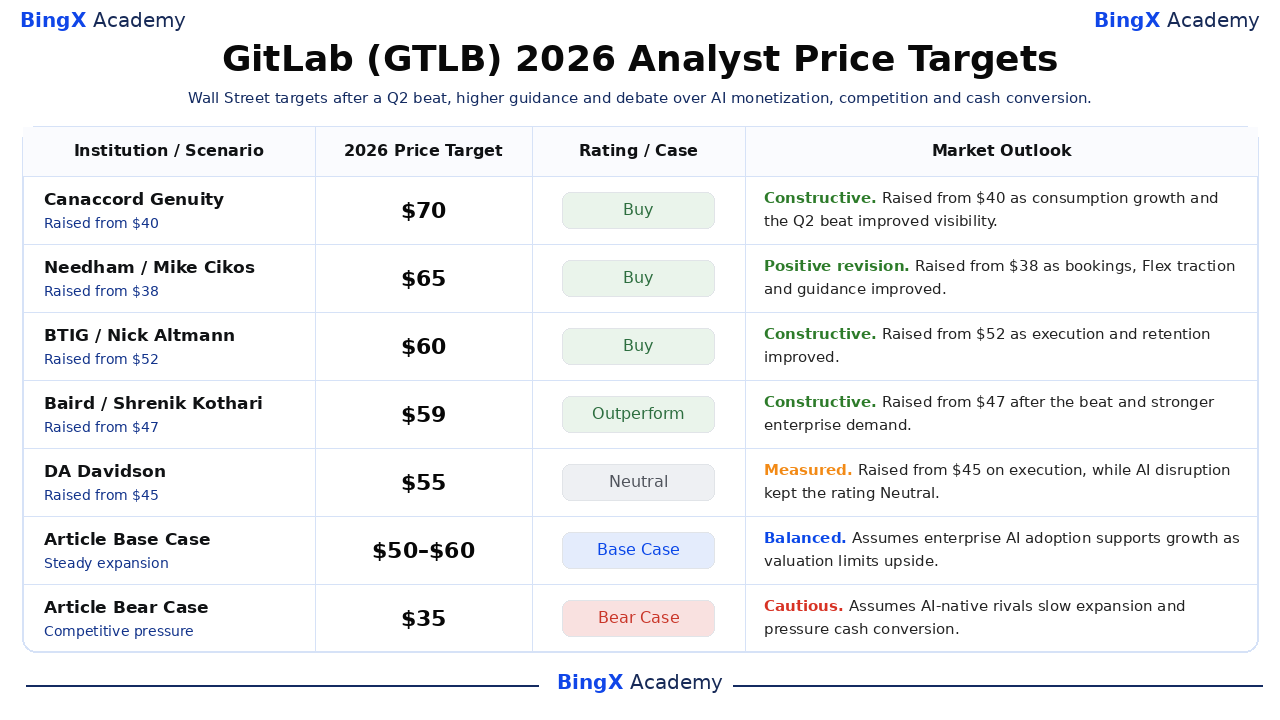
The six dated actions below followed GitLab's Q2 report and show a wide $47 to $70 range. They are third-party reference points rather than a single consensus forecast. The final Base and Bear rows are BingX Academy editorial scenarios and are labeled separately.
|
Institution / Scenario |
2026 Price Target |
Rating / Case |
Market Outlook |
|
Canaccord Genuity / Kingsley Crane |
$70 |
Buy |
Constructive. September 2: raised from $40 as consumption growth and the Q2 beat improved visibility. |
|
Needham / Mike Cikos |
$65 |
Buy |
Positive revision. September 2: raised from $38 as bookings, Flex traction and guidance improved. |
|
BTIG / Nick Altmann |
$60 |
Buy |
Constructive. September 2: raised from $52 as execution and retention improved. |
|
Baird / Shrenik Kothari |
$59 |
Outperform |
Constructive. September 2: raised from $47 after the beat and stronger enterprise demand. |
|
DA Davidson / Lucky Schreiner |
$55 |
Neutral |
Measured. September 2: raised from $45 on execution, while AI disruption kept the rating Neutral. |
|
Barclays / Raimo Lenschow |
$47 |
Underweight |
Cautious. September 2: raised from $25, but competitive concerns kept the rating Underweight. |
|
Article Base Case |
$50–$60 |
Base Case |
Balanced. Assumes enterprise AI adoption supports growth as valuation limits upside. |
|
Article Bear Case |
$35 |
Bear Case |
Cautious. Assumes AI-native rivals slow expansion and pressure cash conversion. |
How to Trade GitLab (GTLB) Stock on BingX
Trade GitLab's agentic-platform adoption, enterprise expansion and cash-conversion outlook using BingX TradFi and BingX AI tools. Because GTLB can react sharply to retention, bookings, guidance and competitive product launches, traders should define both the catalyst and risk limits before entering a position.
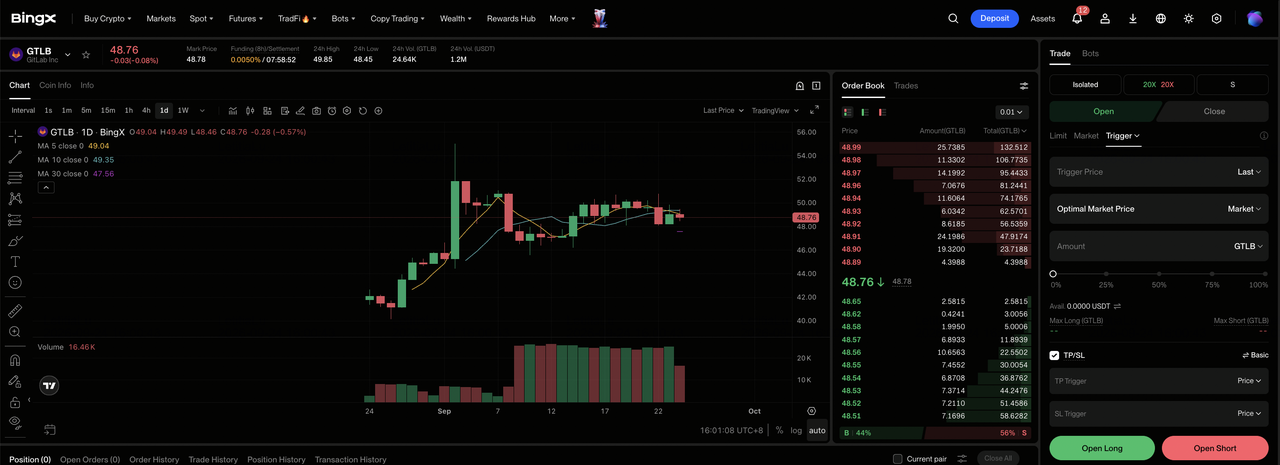
Step 1: Access BingX TradFi. Sign up and navigate to the specialized TradFi section on the BingX exchange dashboard.
Step 2: Select GitLab (GTLB). Search for and select the GTLB-USDT perpetual futures contract.
Step 3: Choose your direction. Select Open Long if Duo monetization lifts retention and bookings. Select Open Short if AI-native competition slows enterprise expansion or guidance weakens.
Step 4: Select leverage and margin mode. Choose Isolated or Cross-Margin based on your risk tolerance. The 9.4% post-earnings move shows why conservative leverage and clear position sizing are important.
Step 5: Execute strict risk protocols. Set Take-Profit and Stop-Loss (TP/SL) levels before or immediately after entering the trade. GTLB can react quickly to revenue, retention, RPO, Flex adoption, margins and free cash flow.
Top 5 Risks to Watch for GitLab Investors in 2026
GitLab's valuation depends on turning stronger enterprise demand into durable cash flow. Slower AI adoption, weak cash conversion, deal timing and dilution could all reduce growth or pressure the valuation.
- AI coding tools could reduce GitLab usage: GitHub, Claude Code and other AI-native products can absorb more developer workflow. Lower seat or credit consumption would pressure 117% retention and reduce expansion from existing customers.
- Cash flow may lag adjusted earnings: Adjusted free cash flow fell to $9.8 million from $46.5 million, while operating cash flow turned negative $3.1 million. Continued weakness would make non-GAAP earnings growth less valuable.
- Large enterprise deals can shift between quarters: Major customers often require security, procurement and architecture reviews. Delays can move bookings and RPO into later periods even when underlying demand remains healthy.
- Stock compensation can dilute shareholders: GAAP loss widened to $36.8 million and GAAP EPS fell to negative $0.22. Continued equity awards can increase the share count unless stronger cash flow or buybacks offset dilution.
- A higher valuation makes guidance misses more costly: GTLB's $49.01 reference price was already up 30.59% in 2026. Revenue below the $1.129 billion guidance floor or retention under 110% could quickly compress the valuation multiple.
Final Thoughts: Should You Invest in GitLab in 2026?
GitLab's Q2 produced stronger operating evidence: revenue beat consensus by $13.2 million, retention reached 117%, current RPO grew 20% and annual revenue guidance rose by $16 million at the midpoint. Those figures support the view that enterprises still value a governed DevSecOps platform even as AI changes how software is built.
The Bull Case requires Duo and Flex to sustain growth and restore cash conversion, supporting a path toward $70. The Bear Case reflects competition, dilution and weaker free cash flow that could pull GTLB toward $35. Conservative traders may monitor retention, first-order growth, cRPO, operating margin and adjusted free cash flow together before treating one strong quarter as a durable inflection.
Risk Reminder: Trading and investing in equities like GTLB involves a risk of capital loss. Company execution, competition, valuation changes and leveraged trading can produce rapid losses. Conduct independent research before allocating capital.
Related Reading
- Oracle (ORCL) Price Prediction 2026: Can AI Cloud Growth Push ORCL Toward $260?
- UiPath (PATH) Price Prediction 2026: Can Agentic AI Push PATH Toward $23?
- Adobe (ADBE) Price Prediction 2026: Can AI Monetization Push ADBE Toward $350?
- Figma (FIG) Price Prediction 2026: Can AI Monetization Push FIG Toward $45?
- CrowdStrike (CRWD) Price Prediction 2026: Can AI Security and Falcon Flex Push CRWD Toward $280?
