
Credo Technology (CRDO) is a fabless semiconductor company that designs high-speed copper and optical links for data centers. Active electrical cables (AECs), optical transceivers, DSPs, silicon-photonics components, retimers and software connect accelerators, servers and switches. Revenue depends on customers converting designs into deployments, linking growth to AI infrastructure spending, product qualification and hyperscaler schedules.
The latest quarter showed AI-connectivity growth alongside pressure from the optical ramp. Credo Q1 FY2027 revenue reached $479.0 million, up 114.7%, and non-GAAP gross margin was 68.0%, while GAAP gross margin fell to 64.5%. Cash and short-term investments totaled $764.3 million, giving Credo runway to pursue management’s more than $600 million FY2027 optical-revenue target even though shipment timing and customer concentration leave that ramp exposed.
The CRDO stock forecast for 2026 now centers on two competing views:
- The optical expansion case: Credo's more than $600 million FY2027 optical revenue target and 1.6T product roadmap add a second growth engine to AECs, giving the company more ways to participate as AI clusters scale.
- The execution and valuation case: a single end customer represented 43% of Q1 revenue, margin measures softened sequentially, and any delay in hyperscaler programs could challenge a valuation built on continued rapid growth.
This guide breaks down the CRDO stock forecast, 2026 price scenarios, key risks and analyst outlooks, drawing on Credo's September 1 Q1 FY2027 earnings release, its August 1 quarterly filing and market data through October 5, plus how to trade CRDO stock futures on BingX TradFi with USDT collateral.
Top 5 Things for Credo Technology Investors to Know in October 2026
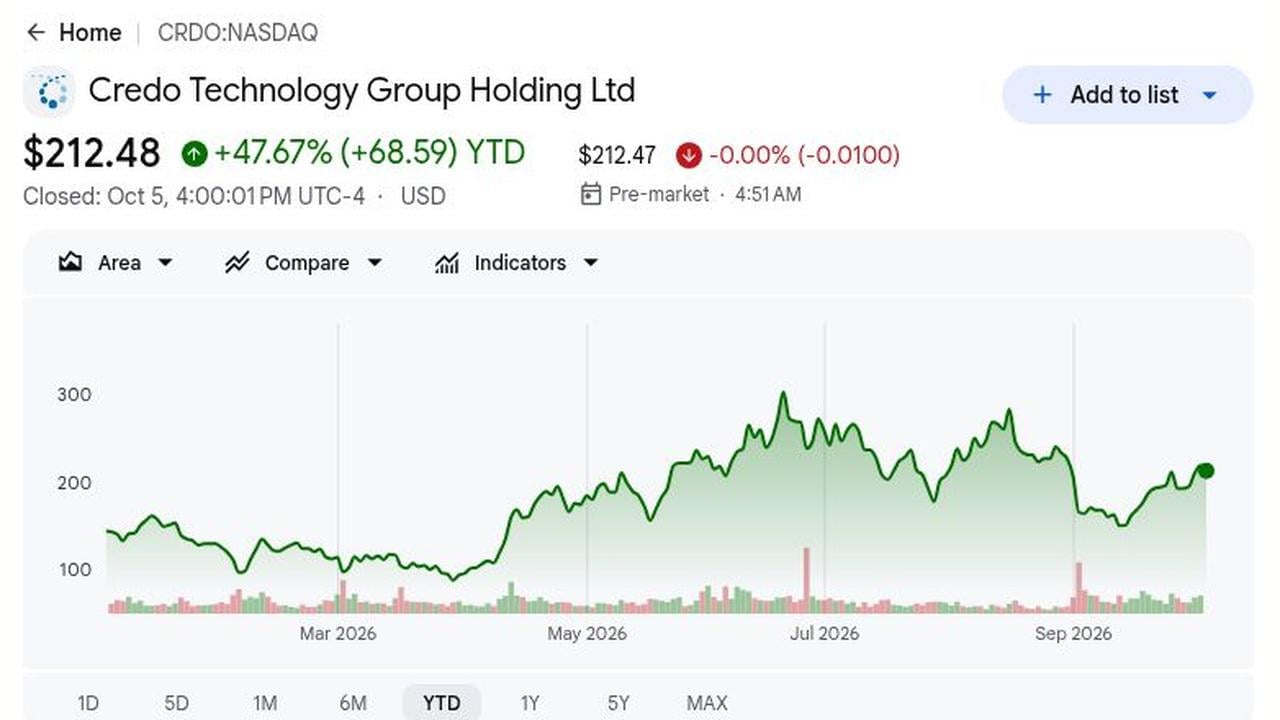
- CRDO closed at $212.48 on October 5, up 47.67% YTD: The stock was 31.2% below its $308.67 high, showing how investors reprice execution risk even as AI-connectivity revenue grows. This remains a volatile reference, not a forecast.
- Q1 FY2027 revenue rose 114.7% to $479.0 million: Revenue beat $471.71 million consensus by $7.29 million and grew 9.6% sequentially. This confirms demand, but leaves AEC durability uncertain as optics expands into more hyperscale network designs.
- Non-GAAP EPS reached $1.20, up from $0.52 a year earlier: GAAP EPS was $0.67 and net income doubled to $129.4 million from $63.4 million. Sales are reaching earnings, though mix and costs can still change quickly.
- Q2 revenue guidance implies another 10.6% sequential increase: Credo expects $525 million to $535 million, a $530 million midpoint versus Q1's $479.0 million and above the $514.7 million consensus, setting a higher bar for the next report.
- Optical revenue is targeted above $600 million in FY2027: Management expects ZeroFlap optics, PICs and DSPs each above $100 million, and showcased 1.6T connectivity at ECOC 2026. Qualification and customer deployments must convert these targets into reported sales to sustain the growth case and meaningful contributions at scale.
What Is Credo Technology (CRDO)?
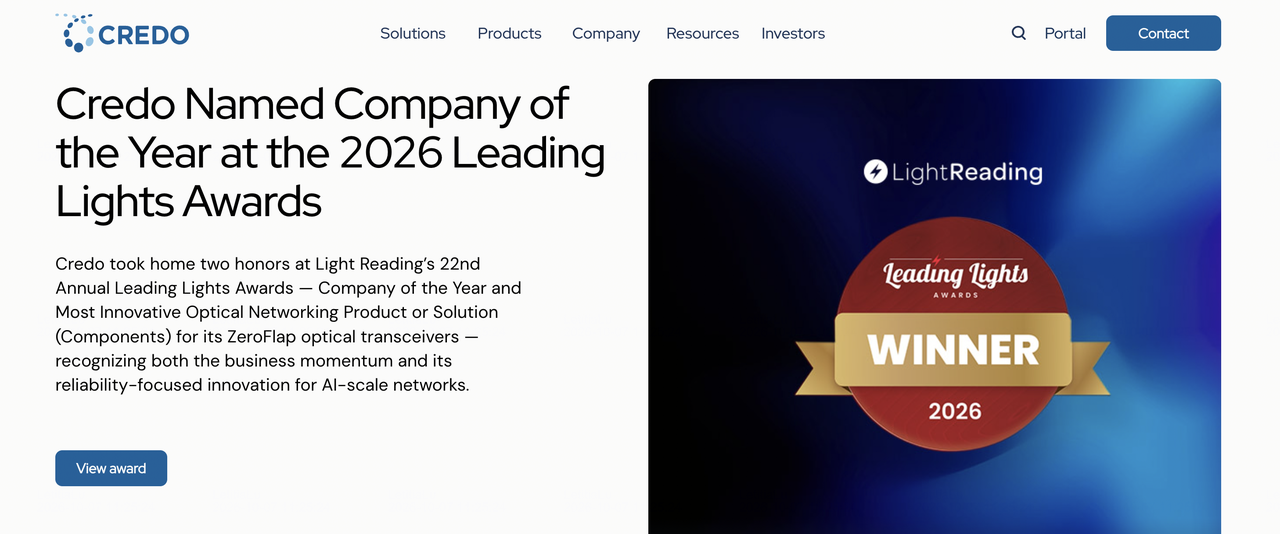
Credo Technology Group designs high-speed connectivity chips and systems that move data inside and between servers, AI accelerators, and network switches. Its portfolio includes active electrical cables (AECs), optical transceivers, digital signal processors, silicon-photonics components, retimers, and diagnostic software. AECs handle short-reach links where power efficiency and signal quality matter, while optical products support longer connections across larger data-center networks. Credo is fabless, so it designs the technology and relies on external manufacturing partners, with growth tied to design wins, customer qualification, and large-scale deployment.
Credo's long-term strategy is to expand from AECs into a broader electrical and optical connectivity platform for AI data centers. ZeroFlap AECs support short-reach links, while optical transceivers, DSPs, and silicon-photonics components address bandwidth growth from 800G toward 1.6T. The DustPhotonics acquisition added photonic integrated-circuit technology, giving Credo more control across signal processing and optical connectivity. Its products can serve both scale-up links inside AI systems and scale-out networks between servers and racks, with long-term growth depending on customer programs moving from qualification into repeat production.
Read More: Top AI Networking Stocks 2026: AI Fabric, Switches, Copper, Fiber, and Optics Connectivity
Credo Technology (CRDO) Q1 FY2027 Earnings Overview: Record Revenue and Strong Q2 Guidance Support Optical Growth
Credo reported record Q1 revenue of $479.0 million, up 114.7%, and $1.20 adjusted EPS versus $1.17 expected. Q2 guidance implies 10.6% sequential growth, while the FY2027 optical target tops $600 million. Yet 64.5% GAAP margin and the post-release selloff show investors still want profitable optical conversion.
|
Financial Metric |
Guidance / Consensus |
Reported / Actual |
Surprise |
|
Q1 FY2027 revenue |
$471.71M consensus |
$479.00M |
Beat. $7.29M above consensus; up 114.7% YoY. |
|
Q1 non-GAAP diluted EPS |
$1.17 consensus |
$1.20 |
Beat. Three cents above consensus and up from $0.52. |
|
Q1 GAAP diluted EPS |
$0.34 a year earlier |
$0.67 |
Improved. Nearly doubled as GAAP net income reached $129.4M. |
|
Q1 GAAP gross margin |
67.4% a year earlier |
64.50% |
Lower. Contracted 2.9 percentage points YoY. |
|
Q1 non-GAAP gross margin |
68.3% in Q4 FY2026 |
68.00% |
Stable. Down 0.3 points sequentially. |
|
Q1 operating cash flow |
$104.5M a year earlier |
$163.4M |
Higher. Cash generation expanded alongside rapid revenue growth. |
|
Cash and short-term investments |
$663.6M at May 2, 2026 |
$764.3M at August 1, 2026 |
Higher. Increased $100.7M during the quarter. |
|
Q2 FY2027 revenue outlook |
$514.7M consensus |
525M–535M |
Above. $530M midpoint implies 10.6% sequential growth. |
|
FY2027 optical revenue outlook |
FY2026 total revenue: $1.335B |
More than $600M |
Expanded. Three optical categories are each expected to exceed $100M. |
- Revenue of $479.0 million beat consensus by $7.29 million: Sales rose 114.7% year over year and 9.6% sequentially. The sequential increase is especially important because it shows the revenue base is still expanding after an already strong prior quarter.
- Non-GAAP diluted EPS of $1.20 beat consensus by $0.03: Adjusted EPS rose from $0.52 a year earlier, while GAAP EPS increased from $0.34 to $0.67. Stronger earnings show that rapid revenue growth is translating into profit, though stock-based compensation remains important to track.
- GAAP net income more than doubled to $129.4 million: Adjusted net income reached $236.3 million, up 140% year over year. The stronger profit base gives Credo more flexibility to fund optical expansion and new-product development.
- GAAP gross margin fell to 64.5% from 67.4%: Non-GAAP gross margin was more stable at 68.0%, only 0.3 percentage points below Q4 FY2026. The main risk is whether a growing optical mix can scale without causing further margin compression.
- Q2 revenue guidance midpoint of $530 million beat consensus by $15.3 million: The outlook implies another 10.6% sequential increase, while FY2027 optical revenue is expected to exceed $600 million. Delivering on those targets without sacrificing margin would strengthen the case that optical products are becoming a second major growth engine.
Credo Technology (CRDO) 2026 Investment Outlook: $325 Bull Case vs. $145 Bear Case
Credo's 2026 outlook depends on whether strong AI-network demand can keep AEC growth high while newer optical products scale without weakening margins. The upside comes from 800G and 1.6T adoption, while customer concentration, qualification delays, and margin pressure remain the main risks.
The Bull Case: Strong AI Networking Demand Pushes CRDO Toward $325
The Bull Case assumes AEC demand remains strong while 800G and 1.6T optical products expand Credo's role in AI data centers. Q1 revenue rose 114.7% to $479.0 million, Q2 guidance implies another 10.6% sequential increase, and management expects more than $600 million of FY2027 optical revenue.
A move toward $325 would require optical programs to convert into shipments, Q2 revenue near the $530 million midpoint, and adjusted gross margin around 68%. Stronger 1.6T production and further estimate upgrades would strengthen the case.
The Base Case: Steady AI Data-Center Growth Keeps CRDO Between $230 and $280
The Base Case assumes AI infrastructure spending remains healthy, AEC revenue continues growing, and optical products ramp gradually. Revenue and EPS remain strong, but customer concentration and a 2.9-point year-over-year decline in GAAP gross margin limit further valuation expansion.
CRDO could trade mainly between $230 and $280 if revenue stays above $525 million, adjusted gross margin remains near 67% to 69%, and several optical products contribute meaningfully.
The Bear Case: Slower Optical Ramps Pull CRDO Toward $145
The Bear Case assumes a major cloud customer slows deployment, AEC demand weakens, or 1.6T qualification takes longer than expected. With the largest end customer representing 43% of Q1 revenue, even one schedule change could materially affect growth.
A move toward $145 would become more likely if Q2 revenue falls below $525 million, adjusted gross margin drops under 67%, or optical guidance is cut. Those signals would pressure earnings estimates and the valuation multiple.
CRDO Stock Price Forecasts for 2026 By Wall Street Analysts
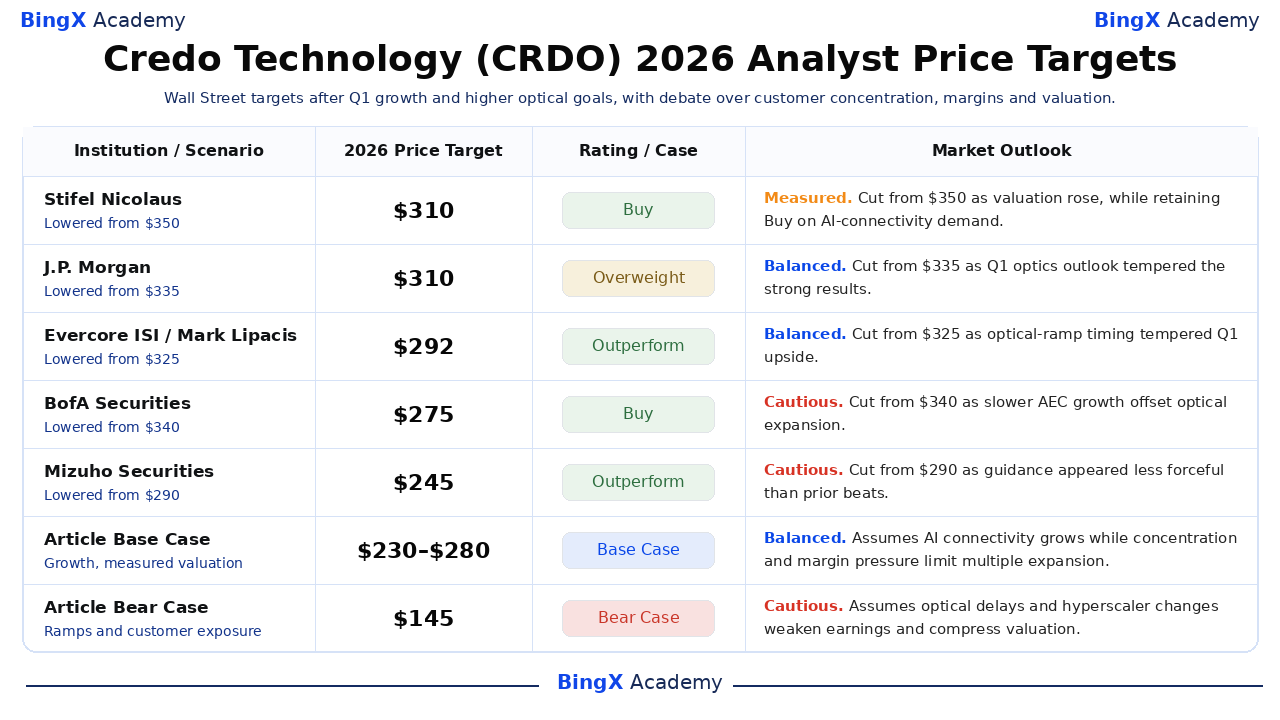
Recent 235–310 targets reflect views on optical timing, AEC durability and valuation. They are reference points, not a consensus; article scenarios are separate. Stifel cut its target October 5 after September reductions following mixed Q1 reactions from analysts currently.
|
Institution / Scenario |
2026 Price Target |
Rating / Case |
Market Outlook |
|
Stifel Nicolaus |
$310 |
Buy |
Measured. October 5: cut from $350 as valuation rose, while retaining Buy on AI-connectivity demand. |
|
J.P. Morgan |
$310 |
Overweight |
Balanced. September 2: cut from $335 as the Q1 optical outlook tempered the strong results. |
|
Evercore ISI |
$292 |
Outperform |
Balanced. September 2: lowered from $325 as optical-ramp timing tempered Q1 upside. |
|
BofA Securities |
$275 |
Buy |
Cautious. September 2: cut from $340 as slower AEC growth increased reliance on optical execution. |
|
Mizuho Securities |
$245 |
Outperform |
Cautious. September 21: cut from $290 as guidance appeared less forceful than prior beats. |
|
Rosenblatt Securities |
$235 |
Neutral |
Measured. September 2: raised from $215 after higher FY2027–FY2028 estimates, while awaiting proof optical products can scale. |
|
Article Base Case |
230–280 |
Base Case |
Balanced. Assumes AI connectivity grows while concentration and margin pressure limit multiple expansion. |
|
Article Bear Case |
$145 |
Bear Case |
Cautious. Assumes optical delays and hyperscaler changes weaken earnings and compress valuation. |
How to Trade Credo Technology (CRDO) Stock on BingX
Trade Credo's AEC, optical ramp and margin outlook using BingX TradFi and BingX AI. CRDO can react sharply to hyperscaler spending, guidance and product mix, so define the catalyst and risk limits before entering.
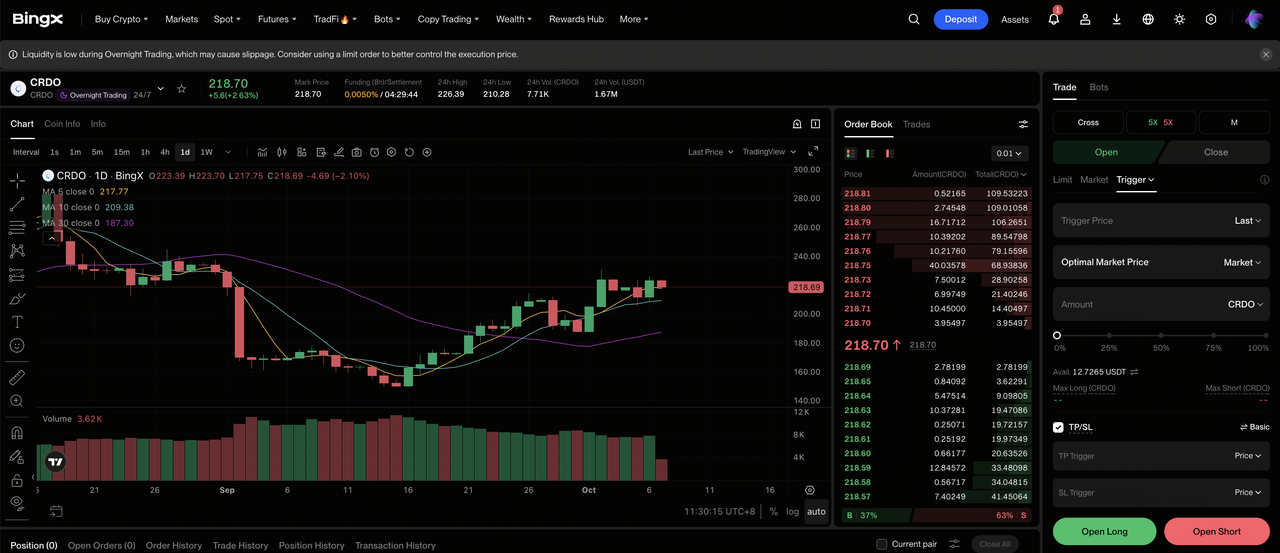
Step 1: Access BingX TradFi. Sign up and navigate to the specialized TradFi section on the BingX exchange dashboard.
Step 2: Select Credo Technology (CRDO). Search for and select the CRDO-USDT perpetual futures contract.
Step 3: Choose your direction. Select Open Long if AEC demand remains strong and optical revenue scales on schedule. Select Open Short if cable growth slows, product qualifications slip or guidance weakens.
Step 4: Select leverage and margin mode. Choose Isolated or Cross-Margin based on your risk tolerance. CRDO's decline from $308.67 to $212.48 shows why conservative leverage and position sizing matter.
Step 5: Execute strict risk protocols. Set Take-Profit and Stop-Loss (TP/SL) levels before or immediately after entering the trade. CRDO can react quickly to revenue, gross margin, hyperscaler programs, AEC volumes and optical-product updates.
Top 5 Risks to Watch for Credo Technology Investors in 2026
Credo's valuation depends on new product ramps converting into durable earnings. The risks below can reduce sales visibility, margins, cash conversion or the multiple investors pay for growth.
- Customer concentration can make growth lumpy: The largest end customer represented 43% of Q1 revenue. A purchasing shift could move quarterly results even if aggregate AI infrastructure spending stays healthy, making account-level demand a key forecast variable.
- The AEC-to-optics transition may not be synchronized: Management targets more than $600 million of FY2027 optical revenue, but ZeroFlap, PIC and DSP programs still need qualification. If AEC growth slows first, sales may undershoot the longer-term demand thesis.
- Gross-margin changes can dilute earnings growth: Q1 GAAP margin fell 2.9 points to 64.5%, and adjusted margin slipped 0.3 points sequentially to 68.0%. Weaker pricing or mix could reduce per-share value from sales growth.
- Valuation leaves little room for a guidance reset: Shares closed at $212.48 after a $308.67 high. Stifel cut its target from $350 to $310 on October 5; a guidance miss could drive further multiple compression.
- Product and supply execution can delay returns: 800G and 1.6T optics require demanding qualification and reliability checks. Yield or manufacturing delays could push programs past FY2027 while keeping R&D costs high, reducing expected earnings leverage.
Final Thoughts: Should You Invest in Credo Technology in 2026?
Credo's Q1 strengthens the 2026 growth case. Revenue rose 114.7% to $479.0 million, adjusted EPS reached $1.20, and Q2 guidance came in above consensus. The more important question is whether newer optical products can become a second major growth engine alongside AECs. Management's more than $600 million FY2027 optical target gives investors a measurable benchmark, though the 43% customer concentration and lower GAAP gross margin show that execution still matters.
The $325 Bull Case becomes more credible if 800G and 1.6T optical shipments scale without pushing adjusted gross margin below the high-60% range. The $230 to $280 Base Case fits a scenario where AI networking demand stays strong but concentration and valuation limit further upside, while the $145 Bear Case becomes more plausible if a major customer slows deployment or optical qualification slips. Q2 revenue, optical contribution, gross-margin stability, and customer concentration are the clearest metrics to watch next.
Risk Reminder: Trading and investing in equities like CRDO involves a high risk of capital loss. Customer concentration, semiconductor cycles, product qualification, valuation changes, and leveraged trading can cause rapid losses. Conduct independent research before allocating capital.
Related Reading
- Top AI Networking Stocks 2026: AI Fabric, Switches, Copper, Fiber, and Optics Connectivity
- Top AI Optical Stocks to Buy in 2026: Photonics, Optics, Fiber, and Data Center Interconnects
- Lumentum (LITE) Price Prediction 2026: Can AI Optics Push LITE Toward $1,300?
- Marvell (MRVL) 2026 Outlook: Can AI & Silicon Momentum Drive Stock to $150?
- Ciena (CIEN) Price Prediction 2026: Can AI Optical Networking Demand Push CIEN Stock Toward $600?
- Corning (GLW) Stock Forecast 2026: Can AI Optical Growth Push GLW Toward $220?
