

CleanSpark, Inc. (CLSK) is a Bitcoin miner that is increasingly repositioning itself as a broader data center and digital infrastructure company. It operates large-scale mining sites and power assets across the United States, with results still driven largely by Bitcoin prices, network difficulty, mining efficiency, and electricity costs. At the same time, CleanSpark is beginning to use that power footprint to pursue high-performance computing and AI data center opportunities, giving investors exposure to both Bitcoin mining and the wider infrastructure buildout.
The investment case now centers on whether CleanSpark can turn that existing power base into more predictable contracted revenue. In fiscal Q3 2026, revenue fell to $138.0 million from $198.6 million a year earlier, while the company posted a net loss of $239.8 million, partly reflecting Bitcoin-related accounting volatility. At the same time, CleanSpark signed a long-term data center lease that marked an important step toward recurring infrastructure revenue. For investors, the key question is whether that new business can scale fast enough to reduce dependence on volatile mining economics over time.
The CLSK stock forecast for 2026 now centers on two competing views:
- The data-center conversion case: Bulls expect the $6.6 billion Sandersville lease, strong liquidity, HPC colocation demand and a shift toward contracted revenue to build a more durable growth base beyond Bitcoin mining, with analyst targets ranging as high as $26.
- The mining-and-financing case: Bears see revenue down 30% year over year, large Bitcoin markdowns, negative adjusted EBITDA and substantial capital needs to fund the data-center build-out, pressuring near-term results.
This guide breaks down the CLSK stock forecast, 2026 price scenarios, key risks, and analyst views, drawing on the August 6 earnings release, plus how to trade CLSK stock futures on BingX TradFi with USDT collateral.
Top 5 Things for CleanSpark Investors to Know in August 2026
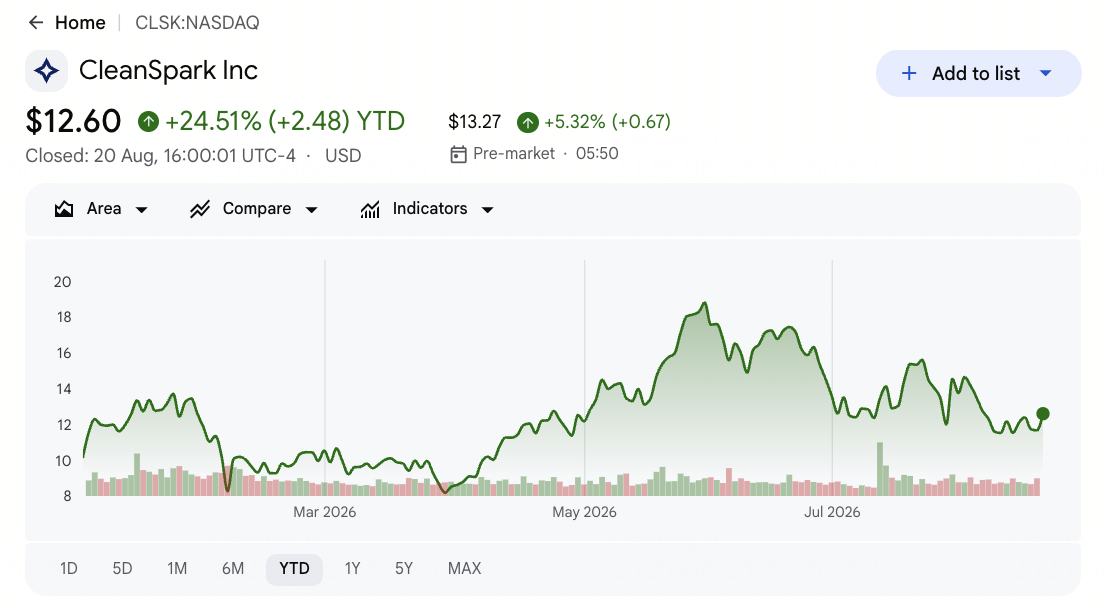
CLSK traded near $12 in mid-August 2026, with the stock remaining highly sensitive to Bitcoin prices, mining economics, and progress on its data center expansion.
- Fiscal Q3 revenue fell 30.5% to $138 million. Revenue declined from $198.6 million a year earlier and came in below the roughly $149 million consensus as weaker Bitcoin prices and higher network difficulty pressured mining economics. The miss increased the importance of CleanSpark’s move into data center infrastructure.
- A Bitcoin markdown contributed to a $239.8 million net loss. CleanSpark recorded a large non-cash fair-value loss on its Bitcoin holdings alongside higher depreciation and amortization. The company reported a net loss of $239.8 million, or $0.89 per share, highlighting how sharply reported earnings can move with Bitcoin prices.
- A 20-year, $6.6 billion data center lease changed the investment story. CleanSpark signed the long-term triple-net lease at its Sandersville site with a high investment-grade tenant and funded its expected equity contribution to the project. The agreement gives the company a clearer path toward recurring, contracted data center revenue.
- Liquidity remained strong at roughly $917 million. CleanSpark ended the quarter with about $200 million in cash and nearly 14,000 Bitcoin. Management also said normalized adjusted EBITDA was around positive $20 million after excluding the non-cash Bitcoin charge, providing additional support for its expansion plans.
- Analysts remained constructive despite weaker mining results. Published price targets have generally clustered in the low-to-mid $20s, with consensus near $23. The bullish view centers on HPC demand and the Sandersville lease, while mining losses, financing requirements, and execution on the data center buildout remain the main concerns.
Read More: CleanSpark (CLSK) Q3 2026 Earnings News: $138M Revenue Miss Triggers a 3.53% Price Selloff
What Is CleanSpark, Inc. (CLSK)?
CleanSpark, Inc. is a Bitcoin miner and data center developer that owns and operates large-scale power and computing sites across the United States. Its core business remains Bitcoin mining, where profitability depends on Bitcoin prices, network difficulty, mining efficiency, and electricity costs. The company has built a sizable power portfolio and data center footprint around that business, giving it infrastructure that can also support high-performance computing and AI workloads.
CleanSpark is now trying to turn more of that existing power capacity into long-term contracted data center revenue. Its Sandersville, Georgia campus has become an important part of this transition, supported by a major long-term lease and broader HPC colocation plans. The company therefore sits between a traditional Bitcoin miner and an emerging digital infrastructure provider, with future performance depending on how quickly data center revenue can scale, how efficiently new capacity is developed, and whether that growth can reduce its reliance on volatile Bitcoin mining economics.
Read More: Top Bitcoin Mining Stocks to Buy in 2026: BTC Hashrate Meets the AI Infrastructure Pivot
CleanSpark (CLSK) Fiscal Q3 2026 Earnings: What Drove the Revenue Decline and the Reported Loss
- Mining revenue fell as Bitcoin economics weakened. Fiscal Q3 revenue declined 30.5% year over year to $138 million as lower Bitcoin prices and higher network difficulty pressured mining results. Revenue improved only modestly from the prior quarter, keeping CleanSpark’s data center expansion central to the outlook.
- A non-cash Bitcoin markdown drove the reported loss. A large fair-value loss on Bitcoin, combined with higher depreciation, pushed CleanSpark to a net loss of $239.8 million, or $0.89 per share, compared with a profit a year earlier. The headline loss therefore reflected both weaker mining economics and accounting volatility tied to its Bitcoin holdings.
- The Sandersville lease became the key growth catalyst. CleanSpark signed a 20-year, $6.6 billion triple-net lease covering 175 MW of critical IT load, with potential contract value rising to $11.6 billion if extensions are exercised. The agreement gives the company a clearer path toward long-term contracted data center revenue.
- Liquidity remained strong enough to support the buildout. CleanSpark ended the quarter with roughly $917 million in liquidity, including about $200 million in cash and nearly 14,000 Bitcoin. The company had also fully funded its expected equity contribution to the Sandersville project.
- Underlying profitability remained positive after adjusting for Bitcoin swings. Management said normalized adjusted EBITDA was around positive $20 million after excluding the non-cash Bitcoin charge. That helps separate the operating performance of the business from the large accounting movements created by Bitcoin price changes.
CleanSpark Fiscal Q3 2026 Financial and Consensus Profile: Revenue, EPS and Data Centers
CleanSpark's fiscal Q3 results showed weaker mining economics and a large Bitcoin markdown alongside a landmark data-center lease and strong liquidity. The table separates the non-cash Bitcoin charge from the underlying operating and strategic developments.
|
Financial Metric |
Guidance / Consensus |
Reported / Actual |
Surprise |
|
Fiscal Q3 2026 Revenue |
~$149 million consensus |
$138.0 million |
Below Street. Down 30.5% year over year. |
|
Fiscal Q3 2026 EPS |
~$(0.32) expected |
$(0.89) |
Below. Non-cash Bitcoin markdown drove the loss. |
|
Bitcoin Fair-Value Loss |
- |
~$116 million |
Non-cash. Fair-value accounting on Bitcoin. |
|
Normalized Adjusted EBITDA |
- |
~$20 million positive |
Positive. Excludes the Bitcoin charge. |
|
Cash |
- |
~$202.6 million |
Strong. Supports the build-out. |
|
Bitcoin HODL Value |
- |
~$814.9 million |
Sizable. Roughly 12,000–14,000 BTC. |
|
Total Liquidity |
- |
~$917 million |
Strong. Funds contracted development. |
|
Sandersville Lease |
- |
$6.6 billion, 20-year |
Landmark. Points toward recurring revenue. |
For context, CleanSpark is using its power portfolio and development pipeline to pivot from Bitcoin mining toward contracted data-center revenue. The Sandersville lease and strong liquidity support the conversion thesis, while weaker mining economics and a large Bitcoin markdown pressured reported results. The key question is whether contracted revenue can scale fast enough to offset volatile mining economics.
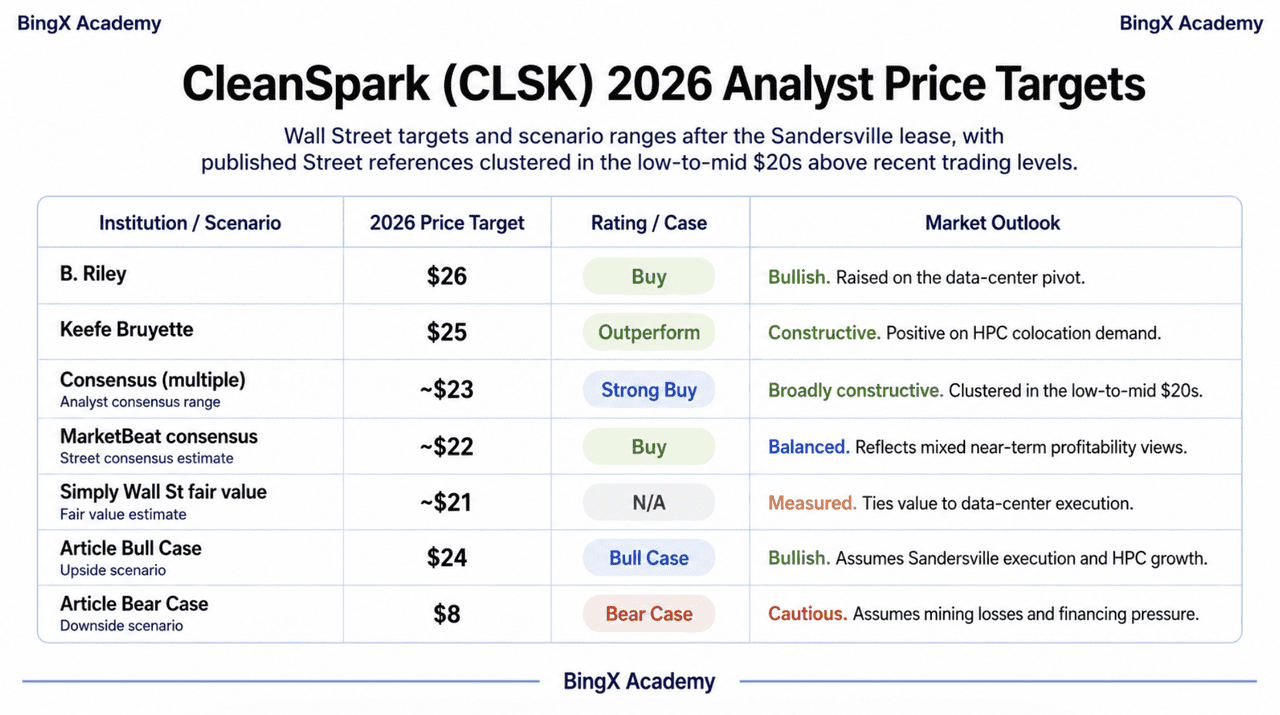
CleanSpark (CLSK) 2026 Investment Outlook: $24 Bull Case vs. $8 Bear Case
CleanSpark’s outlook for the rest of 2026 depends on one central question: whether the Sandersville data center project can create enough contracted revenue to support a re-rating, or whether weak Bitcoin mining economics and high capital needs keep pressure on the stock.
The Bull Case: Data Center Growth Pushes CLSK Toward $24
The bull case centers on CleanSpark’s $6.6 billion Sandersville lease and its broader move into HPC infrastructure. The agreement gives the company a long-term contracted revenue opportunity that is very different from the volatility of Bitcoin mining, while strong liquidity and a funded equity contribution reduce some of the near-term financing pressure around the project. If CleanSpark can use Sandersville as a foundation for additional HPC and AI hosting demand, the business could begin to look more like a diversified digital infrastructure operator.
A move toward $24 would require CleanSpark to meet Sandersville development milestones, begin converting the lease into recognized revenue, and secure additional HPC demand. The strongest confirmation would be evidence that data center cash flows are growing fast enough to offset weaker mining economics.
The Base Case: Mining and Early Data Center Progress Keep CLSK Between $12 and $20
The base case assumes Bitcoin mining remains the main source of revenue while CleanSpark makes steady progress on its data center strategy. Sandersville advances through development, liquidity remains sufficient to support the buildout, and early contracted infrastructure revenue begins to emerge, but not fast enough to completely change the company’s earnings profile. Under this setup, investors continue to value CLSK as a hybrid between a Bitcoin miner and an emerging data center operator.
Under this scenario, CLSK could trade mainly between $12 and $20 as investors wait for clearer evidence that the data center strategy can materially change the earnings mix. Key confirmation points would include construction progress, new HPC agreements, stable liquidity, and initial revenue contribution from Sandersville.
The Bear Case: Mining Pressure and Funding Needs Pull CLSK Toward $8
The bear case assumes Bitcoin mining remains weak while the infrastructure buildout continues to consume significant capital. Lower mining profitability, continued earnings volatility, and rising development costs could pressure cash flow before the data center business becomes large enough to offset those headwinds. The data center thesis could still remain intact, but the market may be unwilling to give CleanSpark a higher valuation until contracted revenue becomes more visible.
A move toward $8 would become more likely if Bitcoin prices fall, network difficulty rises further, development costs increase, or CleanSpark needs additional financing on unfavorable terms. In that scenario, the long-term data center opportunity could remain intact, but near-term funding and mining pressure would dominate the stock.
CLSK Stock Price Forecasts for 2026 By Wall Street Analysts
Published analyst targets on CleanSpark clustered in the low-to-mid $20s after the Sandersville lease, well above recent trading levels. The table shows the latest available Street reference points alongside article scenarios that reflect the stock's current valuation range.
|
Institution / Scenario |
2026 Price Target |
Rating / Case |
Market Outlook |
|
B. Riley |
$26 |
Buy |
Bullish. Raised on the data-center pivot. |
|
Keefe Bruyette |
$25 |
Outperform |
Constructive. Positive on HPC colocation demand. |
|
Consensus (multiple) |
~$23 |
Strong Buy |
Broadly constructive. Clustered in the low-to-mid $20s. |
|
MarketBeat consensus |
~$22 |
Buy |
Balanced. Reflects mixed near-term profitability views. |
|
Simply Wall St fair value |
~$21 |
- |
Measured. Ties value to data-center execution. |
|
Article Bull Case |
$24 |
Bull Case |
Bullish. Assumes Sandersville execution and HPC growth. |
|
Article Bear Case |
$8 |
Bear Case |
Cautious. Assumes mining losses and financing pressure. |
How to Trade CleanSpark, Inc. (CLSK) Stock on BingX
Navigate the volatility of CleanSpark's mining and data-center cycle using BingX TradFi and BingX AI tools. By leveraging AI-driven predictive analytics, you can better anticipate market sentiment shifts and price action around Bitcoin prices, data-center milestones and analyst revisions.
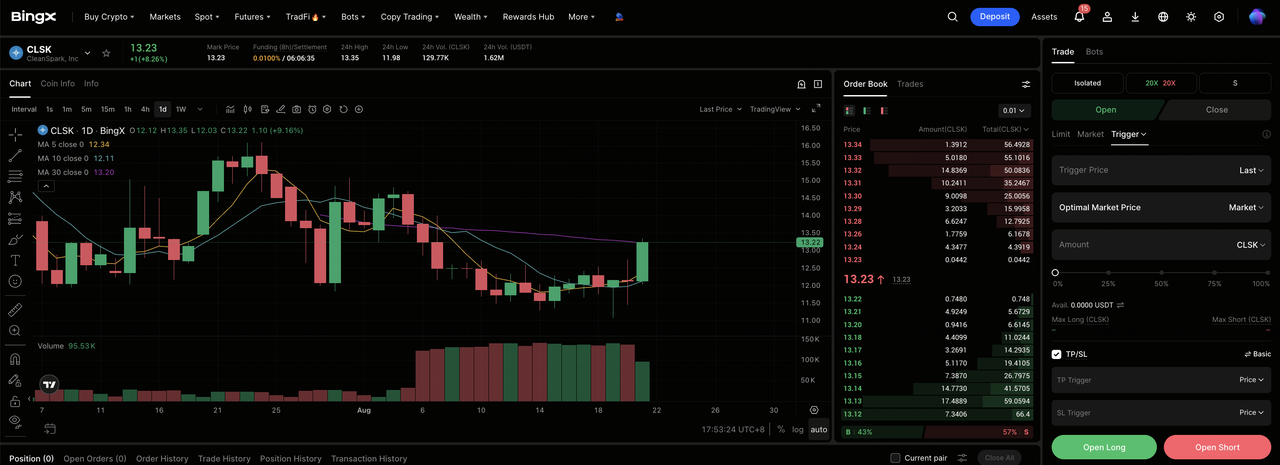
Step 1: Access BingX TradFi. Sign up and navigate to the specialized TradFi section. Complete KYC if required in your region and enable two-factor authentication before funding an account.
Step 2: Select CleanSpark, Inc. (CLSK). Deposit USDT, then search for and select the CLSK-USDT perpetual futures contract.
Step 3: Choose your direction. Select Open Long if you expect the data-center pivot to scale, the Sandersville lease to convert into revenue, and liquidity to fund the build-out. Select Open Short if you expect Bitcoin mining losses to persist, financing needs to grow, or execution to slip.
Step 4: Select leverage and margin mode. Choose Isolated or Cross-Margin based on your risk tolerance. Because CLSK can move sharply on Bitcoin prices and data-center news, conservative leverage and clear position sizing are important.
Step 5: Execute strict risk protocols. Set Take-Profit and Stop-Loss (TP/SL) levels before or immediately after entering the trade. CLSK can react quickly to Bitcoin's price, network difficulty, data-center announcements and financing news.
Top 5 Risks to Watch for CLSK Investors in 2026
CleanSpark’s data center pivot supports the upside case, but five risks could determine whether contracted revenue can grow fast enough to offset volatile Bitcoin mining economics.
- Bitcoin prices and network difficulty still drive mining results. Lower Bitcoin prices reduce the value of mined BTC, while higher network difficulty makes production more expensive. Both can pressure mining revenue and margins even as the data center business expands.
- The data center buildout requires substantial capital. Turning the Sandersville lease into operating revenue requires major spending on construction, power infrastructure, cooling, and computing capacity. Additional funding could increase debt or lead to shareholder dilution.
- Execution on HPC and AI data centers is still unproven at scale. CleanSpark has deep experience in Bitcoin mining, but delivering large contracted data center capacity on schedule requires different infrastructure, customers, and operating capabilities. Delays or cost overruns could weaken the re-rating case.
- Reported earnings can remain highly volatile. Fair-value changes in CleanSpark’s Bitcoin holdings can create large swings in GAAP earnings even when underlying operations are relatively stable. That can make quarterly results harder to interpret and increase stock volatility.
- Competition for AI infrastructure is increasing. Other Bitcoin miners, data center developers, and dedicated AI infrastructure providers are competing for power, customers, equipment, and financing. Greater competition could make new contracts harder to win or reduce expected returns on future projects.
Final Thoughts: Should You Invest in CleanSpark in 2026?
CleanSpark enters the rest of 2026 as a Bitcoin miner trying to build a second business around data center infrastructure. Fiscal Q3 revenue fell to $138 million and the company posted a $239.8 million net loss, largely affected by a Bitcoin markdown, but the $6.6 billion, 20-year Sandersville lease gives the company a clearer path toward long-term contracted revenue. With roughly $917 million in liquidity, the key question is whether CleanSpark can execute on that buildout without putting too much pressure on its balance sheet.
The bull case is that Sandersville, additional HPC demand, and strong liquidity help CleanSpark create a more stable revenue base beyond Bitcoin mining. The bear case is that mining economics remain weak, Bitcoin-related accounting swings keep earnings volatile, and the data center expansion requires more capital than expected. The main confirmation points to watch are Sandersville development milestones, new data center contracts, liquidity, and evidence that contracted revenue is becoming meaningful enough to reduce dependence on mining.
Risk Reminder: Investing in CLSK carries a high risk of capital loss. CleanSpark remains exposed to Bitcoin prices, mining difficulty, data center execution, financing needs, and shareholder dilution. Investors should conduct independent research and assess their own risk tolerance before trading.
Related Reading
- Top Bitcoin Mining Stocks to Buy in 2026: BTC Hashrate Meets the AI Infrastructure Pivot
- Top AI Data Center Stocks to Buy in 2026: Cloud, Servers, and AI Compute Infrastructure
- Top AI Compute and GPU Stocks to Buy in 2026: The Shift to Inference and Custom Silicon
- IREN Limited (IREN) Stock Outlook 2026: Can Bitcoin Mining and AI Cloud Expansion Drive IREN Higher?
- Cipher (CIFR) Stock Forecast 2026: Can New Data Center Revenue Push CIFR Toward $43.50?
