

Alphabet (GOOGL) reported second-quarter results on July 22 that beat on almost every line and sent the stock lower anyway. Consolidated revenue rose 24% to $119.8 billion against a consensus near $116.9 billion, the twelfth consecutive quarter of double-digit growth. Operating income rose 30% to $40.77 billion and operating margin expanded two percentage points to 34%. Shares slipped after hours and then fell roughly 6% on July 23 to close at $319.24, as management raised 2026 capital expenditure guidance to $195 billion to $205 billion and signalled a significant further increase in 2027.
The standout was Google Cloud, where revenue accelerated to 82% growth reaching $24.8 billion, a sharp step up from 63% in Q1 and 48% in Q4 2025. Cloud operating income more than tripled to $8.8 billion from $2.8 billion. What the market focused on instead was the funding. Free cash flow sank to negative $5.9 billion from almost $25 billion a year earlier, Alphabet raised $49.6 billion by issuing stock in June and $20.3 billion from senior unsecured notes in the quarter, and Search revenue of $63.3 billion came in slightly below estimates.
The GOOGL stock forecast for 2026 now centers on two competing views:
- The AI monetization case: Bulls expect Cloud at 82% growth, Gemini processing 22 billion API tokens per minute with 950 million monthly active users, and nearly 90% of the Fortune 100 using Gemini Enterprise to prove the AI investment is converting into revenue faster than any peer.
- The capex case: Bears see 2026 capital expenditure guidance raised to $195 billion to $205 billion, free cash flow at negative $5.9 billion, equity and debt issuance to fund it, and a Search line growing slower than expected while the bills arrive.
This guide breaks down the GOOGL stock forecast, 2026 price scenarios, key risks, and the July 22 earnings release and investor call, plus how to trade GOOGL stock futures on BingX TradFi with USDT collateral.
Top 5 Things for Alphabet Investors to Know in July 2026
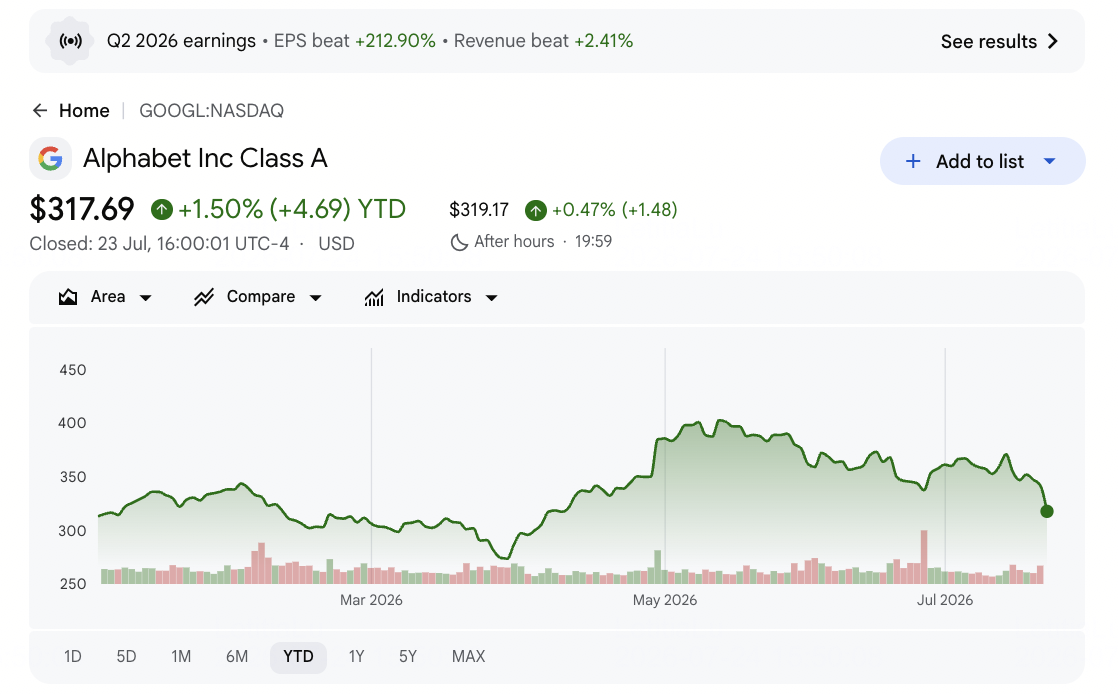
- Q2 revenue of $119.8 billion grew 24% and beat consensus: The figure topped estimates near $116.9 billion and marked the twelfth consecutive quarter of double-digit revenue growth, with 23% growth in constant currency.
- Google Cloud accelerated to 82% growth: Cloud revenue reached $24.8 billion, up from 63% growth in Q1 and 48% in Q4 2025, with operating income tripling to $8.8 billion from $2.8 billion a year earlier on enterprise AI infrastructure and solutions demand.
- Operating margin expanded to 34%: Consolidated operating income rose 30% to $40.77 billion, with margin up two percentage points, demonstrating that the AI build-out has not yet compressed profitability at the operating line.
- Free cash flow turned deeply negative at $5.9 billion: Down from almost $25 billion a year earlier. Alphabet raised $49.6 billion through a June stock issuance and $20.3 billion from senior unsecured notes to fund AI infrastructure expansion.
- Reported EPS was distorted by a $99 billion equity gain: Diluted EPS of $9.11 against a $2.88 consensus included a net gain on equity securities that added $77.1 billion to net income and $6.26 to EPS, so the headline beat overstates operating performance considerably.
What Is Alphabet (GOOGL)?
Alphabet is the parent company of Google and one of the largest advertising, cloud computing and artificial intelligence businesses in the world. It reports through three segments: Google Services, Google Cloud and Other Bets.
Google Services generated $94.5 billion in the quarter, up 15%, and remains the profit engine. Within it, Google Search and other grew 17% to $63.3 billion, YouTube advertising grew 13% to $11.1 billion, and subscriptions, platforms and devices grew 15% to $12.9 billion. Google Cloud has become the growth story, reaching $24.8 billion at 82% growth with operating income of $8.8 billion. Other Bets remains small and loss-making at $382 million of revenue against a $1.8 billion loss. The AI layer now runs across everything: Gemini models process 22 billion API tokens per minute, the Gemini app has 950 million monthly active users, nearly 90% of the Fortune 100 use Gemini Enterprise, and the Antigravity AI coding tool reports 2.4 million weekly active users on subscriptions ranging from $19.99 to $99.99 per month. The board declared a quarterly dividend of $0.22 per share payable September 14.
Alphabet (GOOGL) Q2 2026 Earnings: What Drove 82% Cloud Growth and the Stock Decline
- Cloud growth accelerated three quarters running. From 48% in Q4 2025 to 63% in Q1 to 82% in Q2, driven by enterprise AI infrastructure and AI solutions demand across Google Cloud Platform alongside core services.
- Cloud profitability improved faster than revenue. Operating income tripled to $8.8 billion from $2.8 billion, meaning the segment is scaling margin as it scales volume rather than buying growth.
- Search came in slightly light. Google Search and other grew 17% to $63.3 billion but landed marginally below analyst estimates, raising the question of whether the core business can fund the AI programme.
- Free cash flow went sharply negative. At negative $5.9 billion against almost $25 billion a year earlier, for a company long valued on the durability of its advertising cash generation.
- Alphabet financed the build-out externally. A $49.6 billion June equity issuance plus $20.3 billion of senior unsecured notes in the quarter marked a departure for a company that historically funded itself from operations.
Alphabet Q2 2026 Financial and Consensus Profile: Revenue, Segments and Margins
Alphabet's Q2 print showed acceleration in the segment that matters most for the AI narrative alongside a cash flow profile that no longer looks like a mature advertising business.
|
Financial Metric |
Consensus Estimate |
Reported / Actual |
Surprise |
|
Q2 2026 Revenue |
~$116.9 billion |
$119.8 billion |
Beat; up 24%, or 23% in constant currency |
|
Q2 2026 Google Cloud |
— |
$24.8 billion |
Up 82%, accelerating from 63% in Q1 |
|
Q2 2026 Cloud Operating Income |
— |
$8.8 billion |
Up from $2.8 billion a year earlier |
|
Q2 2026 Google Services |
— |
$94.5 billion |
Up 15%; Search up 17%, YouTube ads up 13% |
|
Q2 2026 Search & Other |
— |
$63.3 billion |
Up 17% but slightly below analyst estimates |
|
Q2 2026 Operating Income |
— |
$40.77 billion |
Up 30%; margin expanded 2 points to 34% |
|
Q2 2026 Net Income |
— |
$112.1 billion |
Includes a $99.0 billion gain on equity securities |
|
Q2 2026 Diluted EPS |
~$2.88 |
$9.11 |
Distorted; the equity gain contributed $6.26 of it |
|
Q2 2026 Free Cash Flow |
— |
Negative $5.9 billion |
From almost $25 billion a year earlier |
For context, Q1 2026 delivered $109.9 billion of revenue, up 22%, with operating income up 30% to $39.7 billion at a record 36.1% margin and Cloud growing 63% to $20.0 billion with backlog nearly doubling sequentially, since grown to roughly $514 billion. Alphabet has beaten consensus EPS in each of the past seven quarters. Management raised 2026 capital expenditure guidance to $195 billion to $205 billion from $180 billion to $190 billion and said spending will increase significantly again in 2027. Capex rose 100% in Q2 to $45 billion, and free cash flow had already fallen 47% year over year in Q1 before turning negative for the first time in Alphabet's public history. Other Bets generated $382 million of revenue against a $1.8 billion operating loss.
Alphabet (GOOGL) 2026 Investment Outlook: $515 Bull Case vs. $310 Bear Case
Alphabet's outlook for the rest of 2026 depends on one central question: whether 82% Cloud growth is proof the AI investment is working or simply the revenue side of a bill that has not finished arriving.
The Bull Case: Cloud and AI Growth Push GOOGL Toward $430
The bull case rests on Alphabet’s accelerating operating momentum. Google Cloud growth climbed from 48% to 63% to 82% across three quarters while operating income tripled, showing that the business is scaling with stronger profitability. Consolidated operating margin also expanded to 34%, suggesting the main pressure comes from capital spending rather than weaker core operations.
This scenario requires Alphabet’s AI products to keep converting engagement into revenue. Gemini now processes 22 billion API tokens per minute, the Gemini app has 950 million monthly active users, nearly 90% of the Fortune 100 use Gemini Enterprise, and Cloud backlog has reached roughly $514 billion. If Cloud continues gaining share while AI features support Search growth, the current capex cycle may strengthen Alphabet’s long-term position. BofA maintained a $430 target, while Citizens holds the Street high at $515. Against a consensus near $421 and a stock around $319, the upside case remains substantial.
Read More: Top AI Hyperscaler Stocks to Watch in 2026: The $700 Billion Cloud Infrastructure Race
The Base Case: Strong Growth and Heavy Spending Keep GOOGL Between $319 and $400
In the base case, Alphabet continues delivering strong growth but the market remains cautious about spending. Cloud compounds rapidly, Search grows in the mid-teens, operating margin stays near 34%, and the stock trades sideways while investors wait for free cash flow to recover.
The main issue is financing. Alphabet raised $49.6 billion through equity and $20.3 billion through notes in one quarter, changing a capital structure that had historically relied far less on external funding. That shift may take time for investors to absorb. Support sits near the low $300s, while the $376 to $400 area represents the first meaningful resistance zone. Mixed analyst revisions, including cuts from Cantor Fitzgerald, Raymond James, and Piper Sandler alongside selective increases elsewhere, reinforce the case for consolidation rather than an immediate re-rating.
The Bear Case: Search Weakness and Capex Pressure Pull GOOGL Toward $310
The bear case does not require Cloud growth to slow. It requires Search to stop generating enough cash to fund the rest of Alphabet’s AI expansion. Search revenue grew 17% to $63.3 billion but came in slightly below expectations, while annual capex is projected at $195 billion to $205 billion and may rise again in 2027.
The main trigger would be another quarter of negative free cash flow combined with softer Search growth. Competition from Meta, Microsoft Azure, and OpenAI ChatGPT means Alphabet cannot easily reduce spending, while greater use of equity and debt introduces dilution and leverage. If AI monetization falls short while capex remains elevated, investors could compress the valuation and push GOOGL toward DA Davidson’s $310 target.
Read More: What Is OpenAI Pre-IPO and How to Trade It on BingX?
Alphabet (GOOGL) Stock Price Forecasts for 2026 By Wall Street Analysts
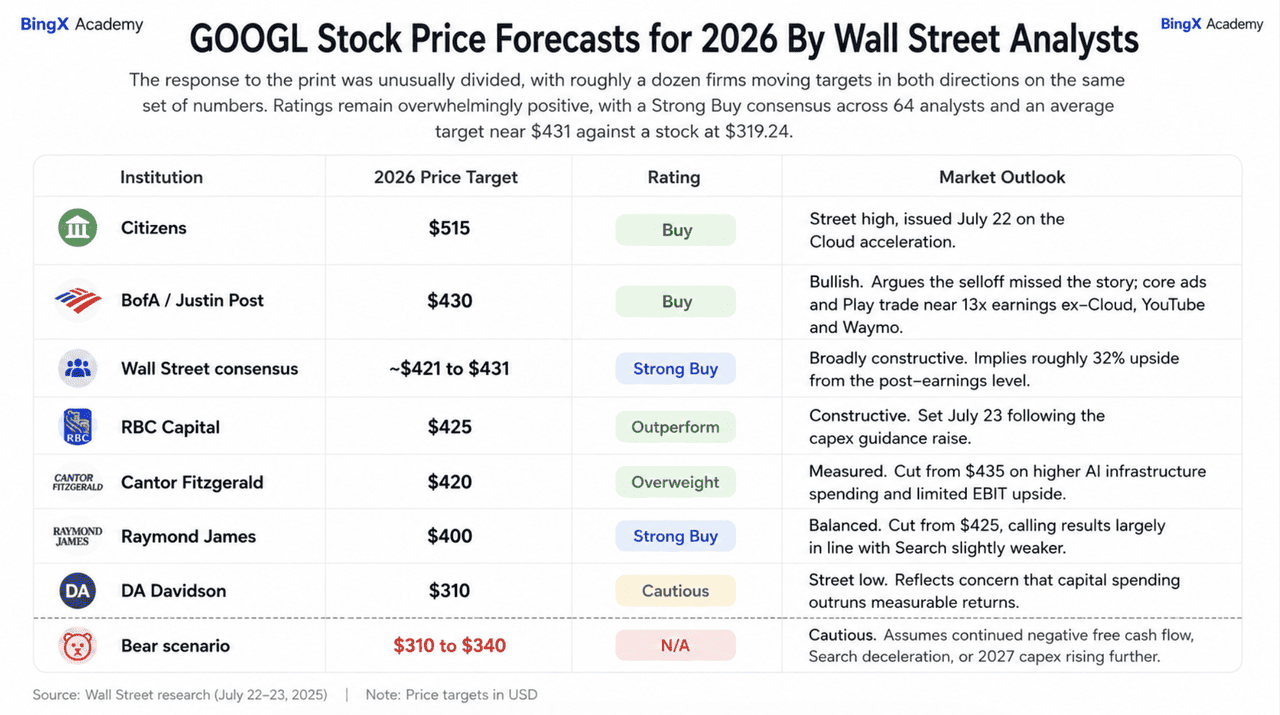
The response to the print was unusually divided, with roughly a dozen firms moving targets in both directions on the same set of numbers. Ratings remain overwhelmingly positive, with a Strong Buy consensus across 64 analysts and an average target near $431 against a stock at $319.24.
|
Institution |
2026 Price Target |
Rating |
Market Outlook |
|
Citizens |
$515 |
Buy |
Street high, issued July 22 on the Cloud acceleration. |
|
BofA / Justin Post |
$430 |
Buy |
Bullish. Argues the selloff missed the story; core ads and Play trade near 13x earnings ex-Cloud, YouTube and Waymo. |
|
Wall Street consensus |
~$421 to $431 |
Strong Buy |
Broadly constructive. Implies roughly 32% upside from the post-earnings level. |
|
RBC Capital |
$425 |
Outperform |
Constructive. Set July 23 following the capex guidance raise. |
|
Cantor Fitzgerald |
$420 |
Overweight |
Measured. Cut from $435 on higher AI infrastructure spending and limited EBIT upside. |
|
Raymond James |
$400 |
Strong Buy |
Balanced. Cut from $425, calling results largely in line with Search slightly weaker. |
|
DA Davidson |
$310 |
Cautious |
Street low. Reflects concern that capital spending outruns measurable returns. |
|
Bear scenario |
$310 to $340 |
N/A |
Cautious. Assumes continued negative free cash flow, Search deceleration, or 2027 capex rising further. |
How to Trade Alphabet (GOOGL) Stock on BingX
Navigate the volatility of Alphabet's earnings cycle using BingX TradFi and BingX AI tools. By leveraging AI-driven predictive analytics, you can better anticipate market sentiment shifts and price action around quarterly releases. BingX offers two routes to GOOGL exposure: tokenized stock for direct spot ownership, and perpetual futures for leveraged long or short positions.
Spot Trading: Buy and Own GOOGL Tokenized Stocks Directly
Spot trading is the most straightforward way to gain Alphabet exposure on BingX. When users buy tokenized GOOGL on the spot market, they hold the asset directly in their BingX spot account, with no leverage, no funding costs and no liquidation risk.
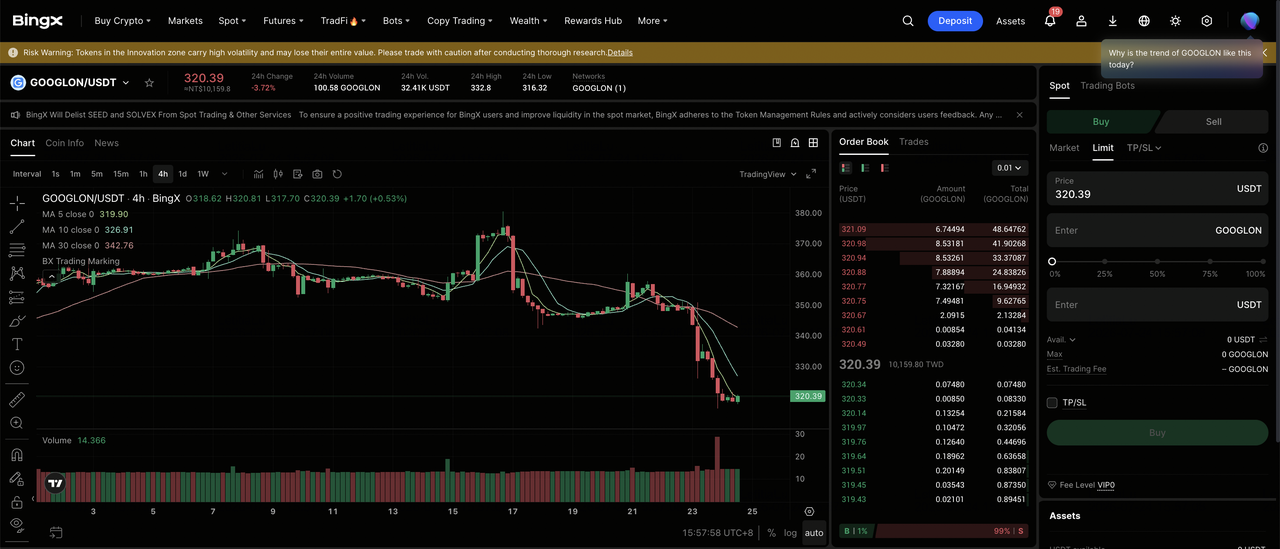
Step 1: Account setup and security. Sign up and log into your BingX account, complete the identity verification (KYC) required in your region, and enable two-factor authentication.
Step 2: Fund your spot account. Deposit USDT or another supported asset into your BingX spot account. Where available, users can also use supported fiat on-ramp options.
Step 3: Navigate to the spot market. Search for the GOOGLON/USDT trading pair.
Step 4: Place your order. Choose a market order to buy tokenized GOOGL immediately at the current price, or use a limit order to set the price you want to pay. Because Alphabet fell roughly 6% on the capex guidance despite beating on revenue, a limit order lets you define your entry rather than chase a post-earnings move.
Step 5: Manage your position. Once filled, your tokenized GOOGL appears in your spot account, where it tracks the underlying share price. Spot positions carry no liquidation risk, which makes them suitable for holding through an earnings release.
Futures Trading: Long or Short GOOGL on BingX TradFi
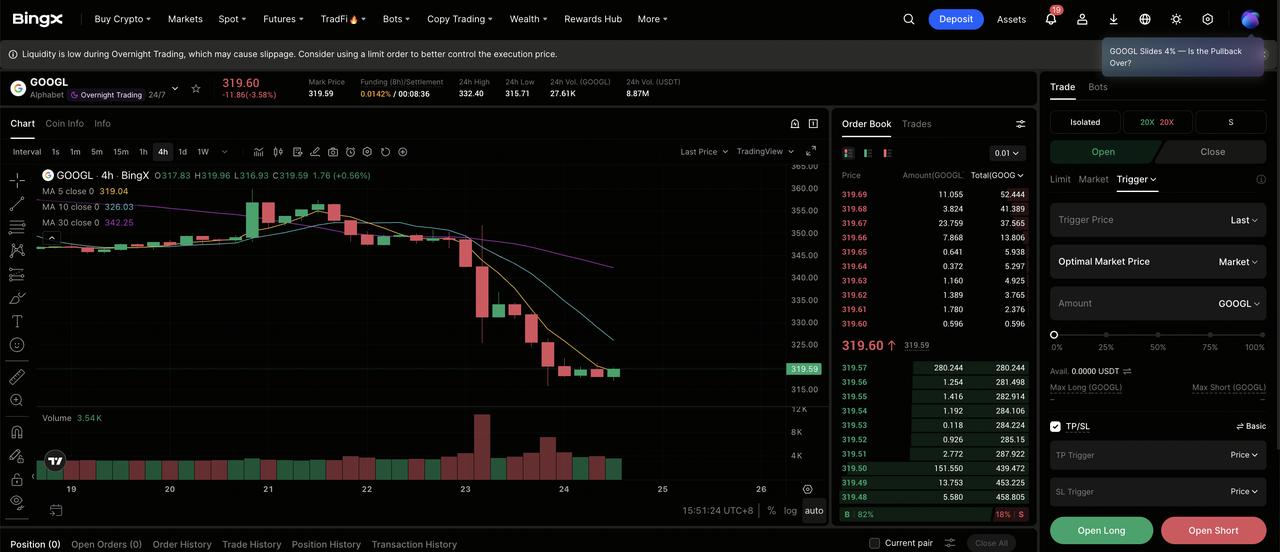
Step 1: Access BingX TradFi. Sign up and navigate to the specialized TradFi section on the main BingX exchange dashboard.
Step 2: Select Alphabet (GOOGL). Search for and select the GOOGL-USDT perpetual futures contract.
Step 3: Choose your direction. Select Open Long if you expect Cloud to sustain accelerating growth, Gemini adoption to convert into paid revenue, and free cash flow to normalize as the capex wave crests. Select Open Short if you expect Search to keep coming in light, free cash flow to stay negative, or 2027 capital expenditure guidance to rise further.
Step 4: Select leverage and margin mode. Choose Isolated or Cross-Margin based on your risk tolerance. Because the stock fell roughly 6% despite beating on revenue and Cloud accelerating to 82%, conservative leverage and clear position sizing are important.
Step 5: Execute strict risk protocols. Set Take-Profit and Stop-Loss (TP/SL) levels before or immediately after entering the trade. GOOGL can react quickly to quarterly earnings, Cloud growth and backlog disclosures, capital expenditure guidance, Gemini and TPU announcements, antitrust and regulatory rulings, and broader AI sentiment.
Top 5 Risks to Watch for Alphabet Investors in 2026
To navigate the second half of 2026, investors must weigh Alphabet's AI momentum against these five structural and financial headwinds.
- Free cash flow has turned negative: At negative $5.9 billion against almost $25 billion a year earlier, for a company whose valuation has long rested on advertising cash generation. Q1 free cash flow had already fallen 47% before the swing.
- Capital spending guidance was raised to $195 billion to $205 billion: Up from $180 billion to $190 billion, with management signalling a significant further increase in 2027. Capex doubled in Q2 alone to $45 billion, and the commitment continues regardless of whether AI revenue arrives on schedule.
- Alphabet is now funding growth externally: A $49.6 billion equity issuance in June plus $20.3 billion of senior notes in the quarter dilutes and levers a balance sheet that historically needed neither.
- Search came in below expectations: Search and other grew 17% to $63.3 billion but missed estimates. Search funds everything else, so softness there matters far more than the same softness elsewhere.
- Reported earnings are distorted by investment gains: A $99 billion gain on equity securities added $77.1 billion to net income and $6.26 to diluted EPS, meaning headline figures overstate operating performance and will complicate comparisons.
Final Thoughts: Should You Invest in Alphabet in 2026?
Following its July 22 report, Alphabet combines some of the strongest AI revenue growth among large technology companies with the heaviest spending cycle in its history. Revenue rose 24% to $119.8 billion, Google Cloud accelerated to 82% growth, Cloud operating income tripled to $8.8 billion, operating margin expanded to 34%, backlog approached $514 billion, and Gemini reached 950 million monthly active users. The debate is whether that growth justifies equity issuance, new debt, and negative free cash flow.
The bull case is that Cloud’s acceleration from 48% to 63% to 82%, alongside sharply higher profitability, shows Alphabet is converting AI investment into revenue faster than peers. The bear case is that Search slightly missed expectations while capital spending remains near $175 billion, and issuing $49.6 billion in stock changes the ownership and dilution profile. Investors confident that scale will determine the AI winners may see the post-earnings decline as an entry point. More cautious traders may wait for free cash flow to turn positive, using roughly $358 as support and $376 as the main recovery test.
Risk Reminder: Trading and investing in equities like GOOGL involves a high risk of capital loss. Alphabet is exposed to advertising cycles, antitrust and regulatory action, AI competition and a capital spending programme that will pressure cash flow for several quarters, any of which can move the stock independently of its earnings. Conduct independent research before allocating capital.
Related Reading
- Top AI Hyperscaler Stocks to Watch in 2026: The $700 Billion Cloud Infrastructure Race
- Top AI Data Center Stocks to Buy in 2026: Cloud, Servers, and AI Compute Infrastructure
- Apple (AAPL) Stock Outlook for 2026: MacBook Neo Growth or AI Valuation Trap?
- Amazon (AMZN) Stock Price Prediction 2026: Can AWS AI Re-acceleration Offset a $200B CapEx Gamble?
- Microsoft (MSFT) Stock Outlook for 2026: Can Azure AI and Copilot Growth Drive MSFT Stock to $550+?
- Meta (META) Stock Price Prediction 2026: Can AI Efficiency and Custom Silicon Drive META to $900?
