
The financial landscape of early 2026 marks a definitive epoch in the institutionalization of digital assets. No longer defined by speculative exuberance alone, the market has transitioned toward a rigorous, equity-based valuation of its primary architects. Central to this narrative is Cameron Winklevoss, whose personal fortune and corporate strategy have undergone a profound evolution following the landmark listing of Gemini Space Station (ticker: GEMI) on the Nasdaq in late 2025.
As of the first quarter of 2026, the wealth of Cameron Winklevoss serves as a primary case study in the intersection of crypto-native liquid assets and the volatile scrutiny of public markets. While the global financial community navigates the complexities of a mid-decade crypto winter and the geopolitical shocks of the Iran-Israel conflict, Winklevoss remains a structural titan of the industry, pivoting from a private exchange founder to the leader of a publicly traded financial powerhouse.
Who Is Cameron Winklevoss?

Source: X
Cameron Winklevoss is a tech entrepreneur, Olympic rower, and venture capitalist who, alongside his twin brother Tyler, became one of the first publicized Bitcoin Billionaires. After a high-profile $65 million legal settlement with Facebook’s Mark Zuckerberg in 2008, the twins executed one of the most successful early-stage capital allocations in history by purchasing 1% of the entire Bitcoin supply in 2013.
In 2014, they founded Gemini, a cryptocurrency exchange and custodian built on the ethos of "Ask for permission, not forgiveness." By 2026, Cameron has transitioned into a Public Era executive, managing the complexities of a Nasdaq-listed entity while maintaining his status as one of the world's largest individual holders of Bitcoin.
How Did Cameron Winklevoss Build His Wealth?
The architecture of the Winklevoss fortune is built on three foundational pillars that distinguish him from overnight crypto success stories:

1. The 2013 Bitcoin Accumulation
The bedrock of Cameron's wealth is the estimated 110,000 to 120,000 Bitcoins the brothers acquired when the asset was priced below $10. By maintaining a HODL conviction through multiple 80% drawdowns, they transformed a $11 million investment into a multi-billion dollar treasury. In 2026, this unencumbered stash provides a level of infinite profit margin that protects them from operational setbacks in their corporate ventures.
2. The Gemini Ecosystem (Nasdaq: GEMI)
Founded as a private trust company in New York, Gemini evolved into a global gateway for institutional crypto adoption. In September 2025, the firm went public on the Nasdaq, raising $425 million. Although the stock has faced a reality discount in 2026 due to market contractions, the equity remains a core institutional asset, valuing the twins' stake in the hundreds of millions.
3. Winklevoss Capital (VC)
Through their venture arm, the twins have seeded the next generation of the decentralized internet. With over 27 portfolio companies ranging from Nifty Gateway (NFTs) to Stoke Space (reusable rockets), this portfolio provides a diversified layer of technological sovereignty wealth that tracks the broader tech sector's growth.
Cameron Winklevoss, Gemini Co-founder, Net Worth in 2026: Key Estimates
| Metric | Q1 2026 Status | Qualitative Influence |
| High-End Estimate | $4.1 Billion | Includes potential appreciation of private VC exits |
| Conservative Estimate | $3.7 Billion | Verifiable on-chain BTC + Nasdaq GEMI equity |
| Primary Asset | Bitcoin (35k BTC) | $2.48B - $2.51B (Personal liquid share) |
| Exchange Value | GEMI Equity | $950M (Based on $6.60 - $7.50 share price) |
| Venture Capital | Winklevoss Capital | $220M (Estimated NAV of 27+ startups) |
| Altcoin Holdings | ETH, SOL, etc. | $45M (Liquid diversification) |
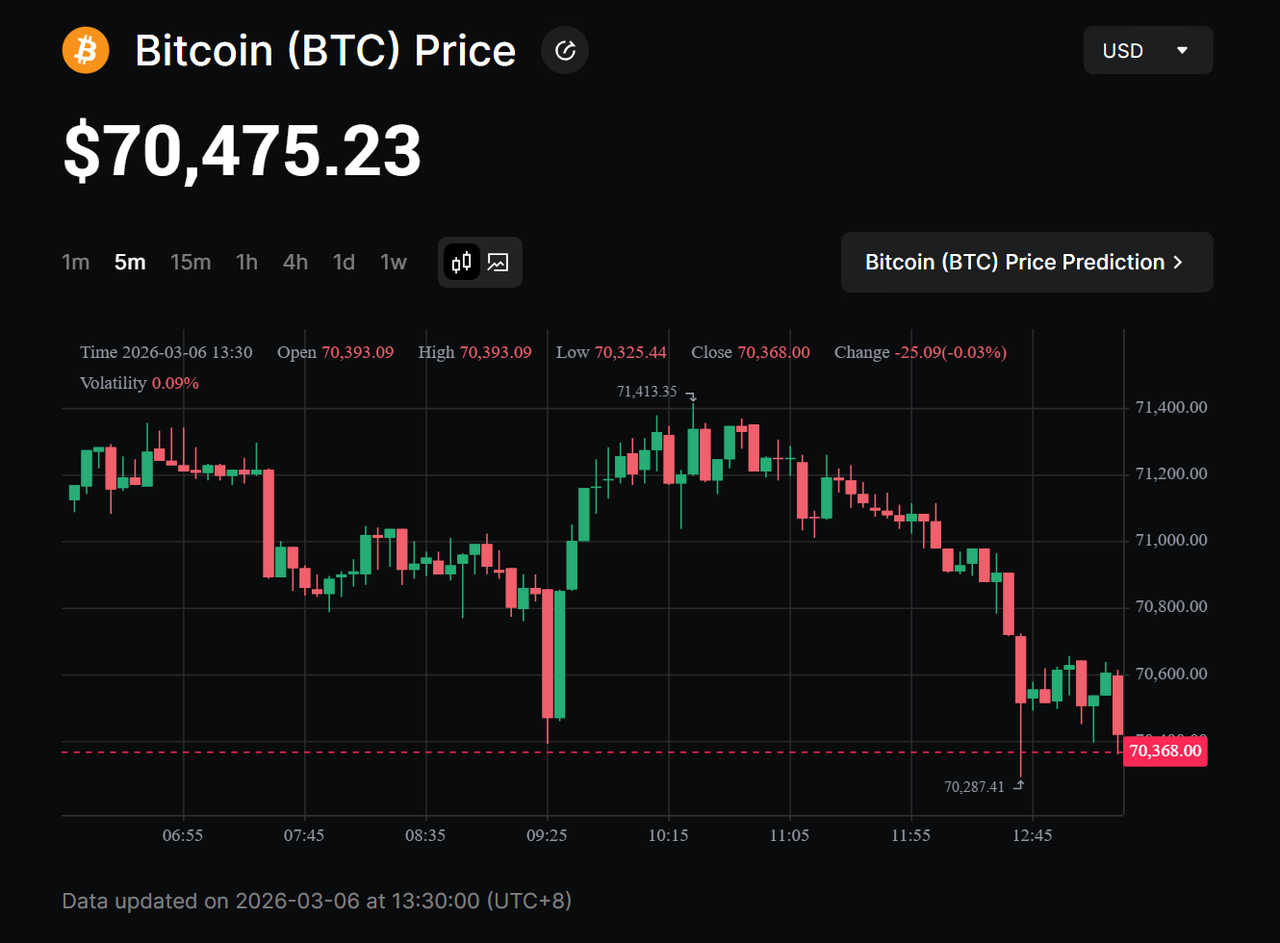
The variance in these figures is driven by the extreme sensitivity of his portfolio to the Spot Bitcoin price. With a personal stash of roughly 35,000 BTC, every $10,000 move in Bitcoin’s price shifts Cameron’s net worth by approximately $350 million.
Source: Bitcoin (BTC) Price | BingX
A Breakdown of Cameron Winklevoss's Portfolio: BTC vs. Public Equity
The composition of Cameron's wealth in 2026 is bifurcated, creating a unique risk profile:
1. The Bitcoin Treasury: 67.2% of Portfolio
While many founders use their coins as collateral, the Winklevoss strategy centers on an unencumbered Bitcoin treasury. By March 2026, with the BTC price hovering at $71,000, his 35,000 BTC Bitcoin treasury constitutes the core of his $3.7 billion net worth. This fortified Bitcoin treasury acts as a strategic fortress balance sheet, allowing him to weather crypto winter drawdowns and exchange-side volatility with unique financial resilience.
2. The GEMI Reality Discount: 25.7% of Portfolio
The transition of Gemini to a publicly traded entity has introduced traditional market scrutiny. After peaking at $45.89 in late 2025, GEMI shares hit an all-time low of $6.66 in February 2026. This collapse was driven by a 25% workforce reduction and a strategic retreat from the EU and UK markets. For analysts, this equity now represents a bet on US regulatory clarity rather than global retail dominance.
How Has Cameron Winklevoss’s Net Worth Changed Over Time?
• 2013–2017: The Accumulation Phase. Wealth was largely illiquid and speculative, tied to the initial $11 million Bitcoin bet.
• 2021–2022: The Bull Market Peak. Gemini reached a $7.1 billion private valuation, and the twins' combined wealth was estimated at $6 billion.
• 2023–2024: The Regulatory Winter. The SEC lawsuit over the Gemini Earn program and the Genesis bankruptcy put significant pressure on the twins' reputation and liquid capital.
• Late 2025: The IPO Euphoria. As Bitcoin touched $126,000 in October 2025, their combined net worth briefly exceeded $13 billion.
• Early 2026: The Consolidation. A 50% drawdown in Bitcoin from its peak and the repricing of GEMI stock have brought Cameron's individual net worth to the current $3.7 billion mark.
What Drives Cameron Winklevoss’s Net Worth? 5 Key Factors
1. Bitcoin Price Milestones and the Iran War Stress Test
In March 2026, following geopolitical strikes in the Middle East, Bitcoin fell to $63,000 before staging a dramatic safe haven recovery to $71,890. This volatility is the primary driver of Cameron’s liquid net worth. The resilience of institutional Bitcoin ETF inflows during this crisis has solidified the floor for his Bitcoin-based wealth.
2. The US Digital Asset Market Clarity Act (CLARITY Act)
The 2026 wealth trajectory of the Winklevoss twins is inextricably linked to US legislation. The expected passage of the CLARITY Act would narrow the SEC’s jurisdiction and define digital assets as commodities. For a US-centric exchange like Gemini, this regulatory breakthrough is viewed as a coiled spring for equity valuation.
3. The SEC Dismissal: A Reputation Recovery
On January 23, 2026, the SEC’s long-standing lawsuit regarding the Gemini Earn program was dismissed with prejudice. By returning 100% of customer assets in-kind, Gemini successfully argued there was no investor harm. This legal vindication removed a massive litigation discount from Cameron’s net worth and allowed the IPO to proceed with a clean slate.
4. Strategic Corporate Restructuring
In February 2026, Gemini announced a 25% reduction in global staff, approx. 200 employees, and an exit from the European Union. While this caused a short-term stock dip, it pivoted the company toward an AI-driven, lean model. By focusing purely on the US and Singapore, Cameron is betting on higher profit margins over raw global market share.
5. Gemini Predictions and Revenue Diversification
With spot trading volumes muted in 2026, the twins launched Gemini Predictions, a regulated event-trading market. By competing with Polymarket and Kalshi, Gemini is tapping into high-margin revenue from political and cultural wagering, a sector less dependent on Bitcoin price action and more on global event volatility.
How Does Cameron Winklevoss's Wealth Compare to Other Crypto Titans?
To understand his position in 2026, we must look at him alongside the Infrastructure Class, the Industrial AI leaders, and the Leveraged Maximalists. The 2026 landscape has created a wider wealth gap than ever before, separating those with diversified ecosystems from those with singular bets.
| Leader | Entity | Est. Net Worth (March 2026) | Primary Strategy |
| Elon Musk | SpaceX / xAI / Tesla | $841.4 Billion | Industrial AI & Space Infrastructure |
| Changpeng Zhao (CZ) | Binance | $78.8 Billion | Global Exchange Dominance (BNB Stake) |
| Pavel Durov | Telegram | $17.1 Billion | Social App Integration / TON Ecosystem |
| Brian Armstrong | Coinbase | $14.2 Billion | Public Equity / US Custody Dominance |
| Justin Sun | TRON / HTX | $10.1 Billion (Avg) | Stablecoin Utility / Ecosystem Ownership |
| Michael Saylor | MicroStrategy | $8.6 Billion | Leveraged BTC Treasury (MSTR) |
| Cameron Winklevoss | Gemini | $3.7 Billion | Unencumbered BTC / Regulated Public Equity |
| Jesse Powell | Kraken | $1.2 Billion | Private Exchange Equity / Security Focus |
| Vitalik Buterin | Ethereum | $1.1 Billion | Protocol Development / Staked ETH |
| Arthur Hayes | BitMEX / Maelstrom | $350 Million | Derivatives Innovation / VC Yield |
The Sovereign Class: Musk and Durov
In 2026, the definition of a crypto titan has expanded. Elon Musk sits in a category of his own with a staggering $841.4 billion, driven by the SpaceX-xAI merger. While not a crypto-native, his influence over the Muskonomy (Dogecoin and PolitiFi tokens) exerts more gravity on the market than most exchanges. Similarly, Pavel Durov ($17.1 billion) has leveraged Telegram’s 1 billion users to turn the TON blockchain into a massive wealth engine, surpassing traditional exchange founders like Armstrong.
The Strategic Diversifiers: Sun and Armstrong
Justin Sun ($10.1 billion) and Brian Armstrong ($14.2 billion) represent the institutional middle-ground. Sun’s wealth is a decentralized conglomerate of Layer-1 gas assets and stablecoin yields, whereas Armstrong’s is tied to the transparency and volatility of Nasdaq-listed equity. Both maintain significantly higher valuations than the Winklevoss twins due to their larger capture of global trading volumes and stablecoin settlement, specifically TRON’s USDT dominance.
The Pure Beta Resilience: Winklevoss vs. Saylor
Cameron occupies a unique Conservative Growth niche. Unlike Michael Saylor, whose $8.6 billion fortune is tied to a company with massive debt used to acquire Bitcoin, Cameron’s Bitcoin treasury is largely personal and debt-free. In the face of the March 2026 Iran War shock, this provides Cameron with superior psychological resilience; he is not at risk of a margin call or corporate liquidation.
Furthermore, while he lacks the $78 billion scale of CZ or the $1.2 billion niche dominance of Jesse Powell, Cameron’s focus on the CLARITY Act and US-regulated infrastructure positions him as a primary beneficiary of the 2026 shift toward domestic compliance. While Arthur Hayes ($350 million) continues to lead in derivatives innovation via his Maelstrom fund, his wealth remains more sensitive to active trading performance compared to the buy-and-hold fortress of the Winklevoss Bitcoin treasury.
What Are the Top Risks Affecting Cameron Winklevoss’s Net Worth in 2026?
• The GEMI Stock Floor: If Gemini Space Station fails to hit its Q2 2026 earnings targets, the stock could face further penny stock risks, eroding the equity portion of his wealth.
• The SEC-CFTC Turf War: While the CLARITY Act is promising, any delay in its implementation could leave Gemini in a regulatory limbo compared to offshore competitors.
• Geopolitical Volatility: As seen in the March 2026 Iran shocks, extreme black swan events can cause temporary liquidations in Bitcoin, leading to multi-hundred-million dollar swings in his daily net worth.
Conclusion
Cameron Winklevoss’s net worth in 2026 is a testament to strategic patience. At an estimated $3.7 billion, he has successfully transitioned from a crypto pioneer to a public market executive. While he may not be the wealthiest individual in the space, the quality of his wealth, anchored by an unencumbered 35,000 BTC treasury and a lean, regulated exchange, makes him one of the most resilient figures in the industry.
If Bitcoin continues its trajectory toward the $150,000 Institutional Super-Cycle predicted for 2027, Cameron Winklevoss could realistically see his personal fortune double, solidifying his role as the preeminent proxy for the institutionalization of the decentralized future.
Related Reading
1 .What Is Changpeng Zhao (CZ)’s Net Worth in 2026?
2. Who Are the Top 10 Crypto Billionaires in 2026? Net Worth and Portfolios Revealed
3. Vitalik Buterin’s Net Worth in 2026: How Much Does the Ethereum Co-Founder Own?
4. What Is Michael Saylor’s Net Worth in 2026?
5. What Is Arthur Hayes' Net Worth in 2026?
FAQs on Cameron Winklevoss’s Net Worth
1. How much is Cameron Winklevoss worth in 2026?
As of Q1 2026, his net worth is estimated at approximately $3.7 billion, primarily driven by his Bitcoin holdings and equity in Gemini (GEMI).
2. How many Bitcoins does Cameron Winklevoss own?
Personal estimates suggest he holds roughly 35,000 BTC, representing half of the 70,000 BTC treasury he shares with his brother Tyler.
3. Is Gemini a public company in 2026?
Yes, Gemini listed on the Nasdaq in September 2025 under the ticker GEMI.
4. Did the SEC lawsuit against Gemini end?
Yes, the SEC's Gemini Earn lawsuit was dismissed with prejudice on January 23, 2026, after users received 100% of their crypto back.
5. What is Winklevoss Capital?
It is the private venture capital firm owned by the twins, which has invested in over 27 companies across the fintech, AI, and space exploration sectors.