
Katana Network is a DeFi-native Layer-2 built to address two structural weaknesses in DeFi: fragmented liquidity and unsustainable yield. Incubated by Polygon Labs and GSR and deployed on Polygon’s AggLayer, Katana concentrates liquidity into a focused core stack: Sushi for spot trading, Morpho for lending, and Vertex for perpetuals, forming a unified liquidity flywheel as activity scales.
$KAT is the network’s governance and incentive token with a fixed supply of 10 billion. Although originally set to unlock on February 20, 2026, TGE was delayed to on or before the end of March 2026 to align with major CEX Earn integrations. A March 3 to March 17, 2026 airdrop is distributing 50,000,000 KAT via the vbUSDC pool, with tokens claimable at TGE.
This article explains Katana’s VaultBridge and Chain-Owned Liquidity systems, outlines $KAT utility, and shows how to trade KAT on BingX.
What Is Katana Network (KAT) and How Does It Work?
Katana operates as a DeFi-native execution layer built to move beyond the fragmented, general-purpose rollup model. Incubated by Polygon Labs and built on Polygon CDK with op-geth, Katana is the first OP Stack rollup live on Polygon’s AggLayer. It concentrates liquidity into a focused core stack: Sushi for spot trading, Morpho for lending, and Vertex for perpetuals. Revenue from sequencer fees, bridge activity, stablecoin yield, and application usage is recycled to deepen network liquidity. The chain is secured by Succinct’s ZK validity proofs, leverages AggLayer for fast cross-chain interoperability, and integrates infrastructure partners including Chainlink for oracle services, Fireblocks for custody infrastructure, and Safe for smart contract security.
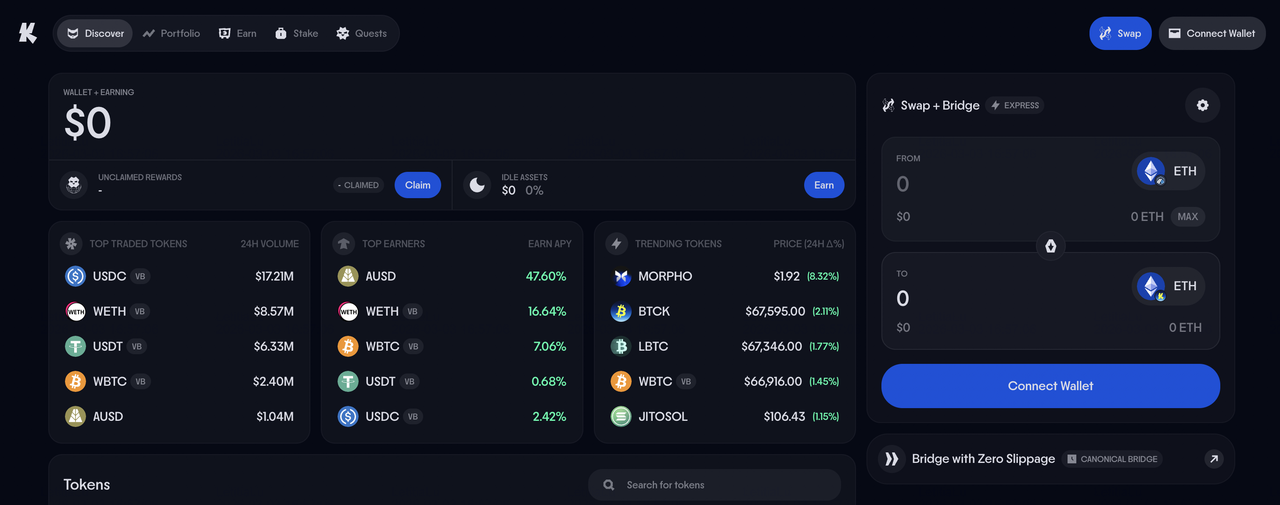
Katana runs on four core infrastructure pillars:
1. VaultBridge, Productive Bridged Assets: When users bridge ETH, USDC, USDT, or WBTC to Katana, assets are automatically deployed into low-risk strategies on Ethereum, primarily Yearn and Morpho. Users receive 1:1 vbTokens such as vbETH or vbUSDC, which accrue yield. Higher rewards are unlocked when these tokens are actively used in Katana’s core applications.
2. Chain-Owned Liquidity (CoL), Protocol Balance Sheet: Katana recycles 100% of net sequencer fees and a share of application revenue into its own liquidity reserve. This Chain-Owned Liquidity seeds DEX pools, lending markets, and perpetual markets, stabilizing spreads and reducing reliance on short-term liquidity providers.
3. Core Application Architecture, Concentrated Liquidity: Katana limits each DeFi vertical to one primary protocol. Sushi v3 handles spot trading, Morpho powers lending, and Vertex supports perpetual futures. This prevents liquidity fragmentation and ensures capital remains concentrated and efficient.
4. AUSD, Native Yield-Bearing Stablecoin: AUSD is issued by Agora, with reserves custodied by State Street and managed by VanEck. Backed by US Treasuries, AUSD routes real-world yield into Katana’s liquidity incentives, adding a diversified revenue stream alongside on-chain fees.
Who Founded Katana Network?
Katana Network is operated by the Katana Foundation and was incubated by Polygon Labs and GSR. Polygon Labs provided the technical foundation through AggLayer and the CDK-opgeth stack, while GSR contributed institutional liquidity expertise and early market-making support. Katana is a graduate of the AggLayer Breakout Program.
The network launched private mainnet in May 2025 and opened publicly in June 2025 after attracting over $240 million in pre-deposits. Infrastructure partners include Conduit for sequencing, Chainlink for oracles, Fireblocks for custody integrations, and Succinct for ZK proofs. Sushi, Morpho, and Vertex serve as the chain’s core DeFi application partners.
What Is the $KAT Token Utility?
$KAT is not used for gas, ETH is. It does not control chain upgrades or VaultBridge operations. Instead, KAT functions as a capital coordination mechanism that aligns token holders with Katana’s liquidity flywheel through the vKAT system.
• vKAT Governance and Emission Direction: KAT holders lock tokens 1:1 to receive vKAT. vKAT holders vote in weekly epochs to direct KAT emissions toward selected liquidity pools and core applications on Sushi, Morpho, and Vertex. This extends the ve(3,3) model to govern capital flows across the entire chain.
• Protocol Revenue Sharing: vKAT stakers receive a share of network revenue, including trading fees, borrowing spreads, vault yield, and stablecoin returns. Rewards are tied to actual usage rather than pure token inflation.
• Incentive Amplification: vKAT emissions are directed toward the most active and productive markets. As liquidity and usage grow, incentives reinforce high-performing pools, compounding depth and efficiency.
• Future Sequencer Alignment: Over time, sequencer fees and bridge-generated yield are designed to flow directly to vKAT stakers, gradually shifting from emission-driven incentives to sustainable, usage-based returns.
What Is Katana ($KAT) Tokenomics?
$KAT has a fixed total supply of 10,000,000,000 tokens. There was no presale and no VC allocation. The Katana Foundation is the only institutional holder and has stated that any future public sale would prioritize users over venture funds.
All KAT distributed at mainnet was initially subject to a nine-month transfer lock with an auto-unlock set for February 20, 2026. In February 2026, the Foundation removed the automatic transfer trigger via a smart contract upgrade to align TGE with major CEX Earn integrations expected to scale Productive TVL. As a result, KAT did not unlock on February 20. TGE and transferability are now targeted on or before the end of March 2026, with the exact date to be announced. KAT and vKAT balances and reward accrual remain unaffected.
Katana ($KAT) Token Allocation
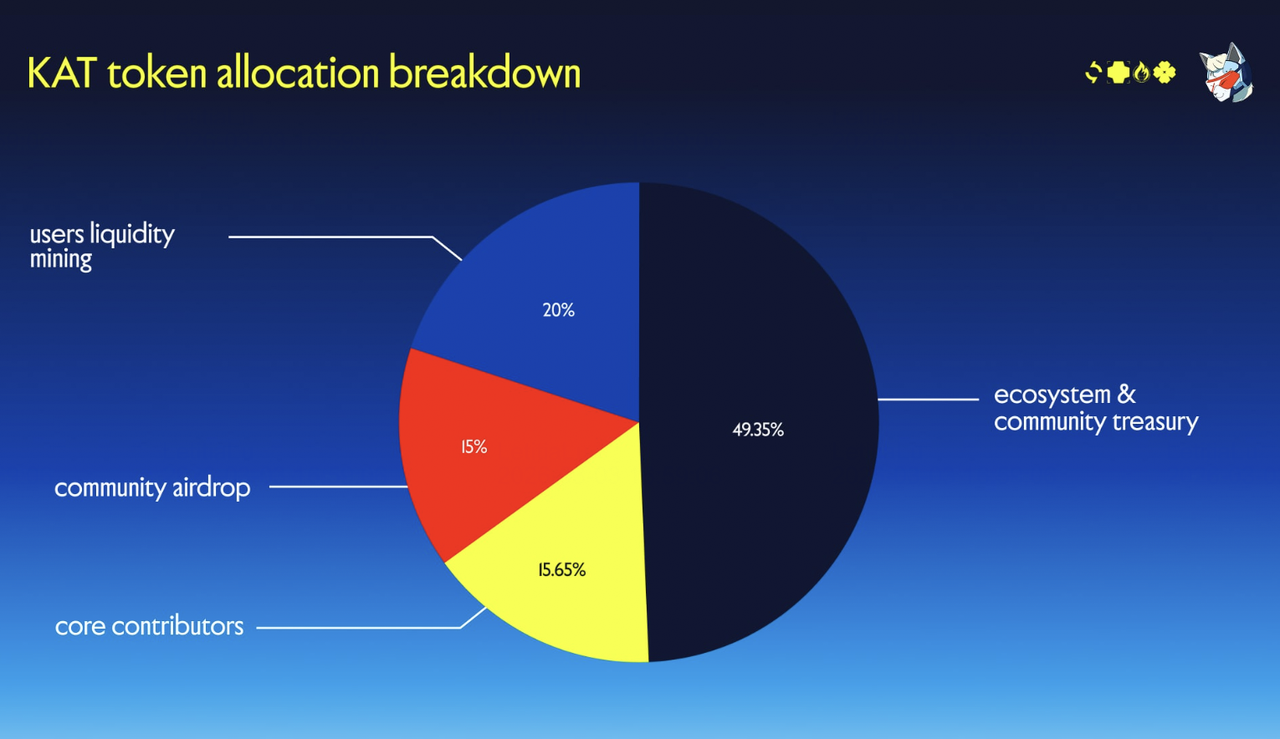
• Ecosystem and Community Treasury (49.35%): Managed by the Katana Foundation. 3% unlocks at transferability for liquidity, 2% unlocks for ecosystem grants, and the remaining 44.35% unlocks in four equal annual tranches over four years after transferability.
• POL Staker Airdrop (15%): Allocated to Polygon POL stakers on Ethereum. 7% unlocks as vKAT at transferability based on staking amount and duration. The remaining 8% unlocks in four equal annual tranches.
• User Rewards via Krates and TVL Programs (10%): Distributed to early retail and institutional participants through pre-launch reward and TVL programs. These tokens unlock at transferability. Unused allocations return to the treasury.
• Core Applications (10%): Reserved for users of Sushi, Morpho, and Vertex. Half was distributed before mainnet, with the remainder deployed post-launch as liquidity incentives.
• Core Contributors (15.65%): Allocated to team and foundation contributors under a multi-year vesting schedule aligned with treasury unlocks, with no immediate cliff unlocks.
$KAT Supply and Value Model
KAT has no burn mechanism. Instead, protocol revenue is reinvested into Chain-Owned Liquidity or distributed to vKAT stakers under a real-yield framework. Supply expansion is moderated by a four-year annual tranche schedule, limiting the pace of new tokens entering circulation.
Katana vs. Other Layer-2 Chains vs. DeFi-Native Chains: Key Differences
General-purpose Layer-2 chains such as Arbitrum, Base, and zkSync are built as neutral execution environments. Their goal is breadth: attract as many applications as possible. The tradeoff is structural liquidity fragmentation. When multiple AMMs, lending markets, and stablecoin pairs compete for the same capital, depth becomes diluted and no single venue achieves institutional-grade scale.
Some DeFi-native chains attempt to solve this by optimizing around a single mechanism. Berachain concentrates liquidity through validator incentives. Hyperliquid vertically integrates liquidity within its perpetuals engine. These models improve depth, but within a narrow vertical.
Katana takes a different path. It concentrates liquidity across the full DeFi stack by design: one DEX (Sushi), one lending protocol (Morpho), and one perps venue (Vertex). Network revenue, including sequencer fees and VaultBridge yield, is recycled into Chain-Owned Liquidity, creating a shared liquidity base that deepens with real usage. Instead of maximizing breadth or optimizing one product, Katana treats liquidity concentration and revenue recycling as chain-level architecture.
| Metric | General L2s | Vertical DeFi Chains | Katana Network |
| Design Goal | Neutral execution layer maximizing app diversity | Optimize one core DeFi primitive | Concentrate liquidity across the full DeFi stack |
| Liquidity Structure | Fragmented across competing AMMs and markets | Deep but vertically concentrated | Unified across one DEX, one lending market, one perps venue |
| Capital Efficiency | Liquidity diluted across protocols | Efficient within a single vertical | Efficient across spot, lending, and derivatives |
| Revenue Model | Fees retained by sequencer or treasury | Protocol-level fee capture | Fees and yield recycled into Chain-Owned Liquidity |
| Bridged Assets | Often idle in bridge contracts | Depends on protocol design | VaultBridge redeploys assets into yield strategies |
| Stablecoin Framework | External third-party stablecoins | Varies by chain | Native AUSD with Treasury-backed yield |
| Governance Scope | App-level governance | Vertical-level governance | vKAT coordinates emissions chain-wide |
| Liquidity Durability | Emission dependent | Incentive driven within niche | Grows with usage and revenue recycling |
Katana Airdrop and TGE Set for March 2026: How to Earn KAT Before TGE
KAT’s TGE is targeted for on or before the end of March 2026. The original February 20 auto-unlock was removed to align with upcoming CEX Earn integrations. Until TGE activates, all earned KAT remains locked but continues accruing and can be tracked in the Katana app.
A total of 1 billion KAT, 10% of supply, is allocated to users providing liquidity on core apps such as Sushi and Morpho. Rewards scale with position size and duration. Krates participants and select CEX campaign users will be able to claim their allocations once transferability goes live.
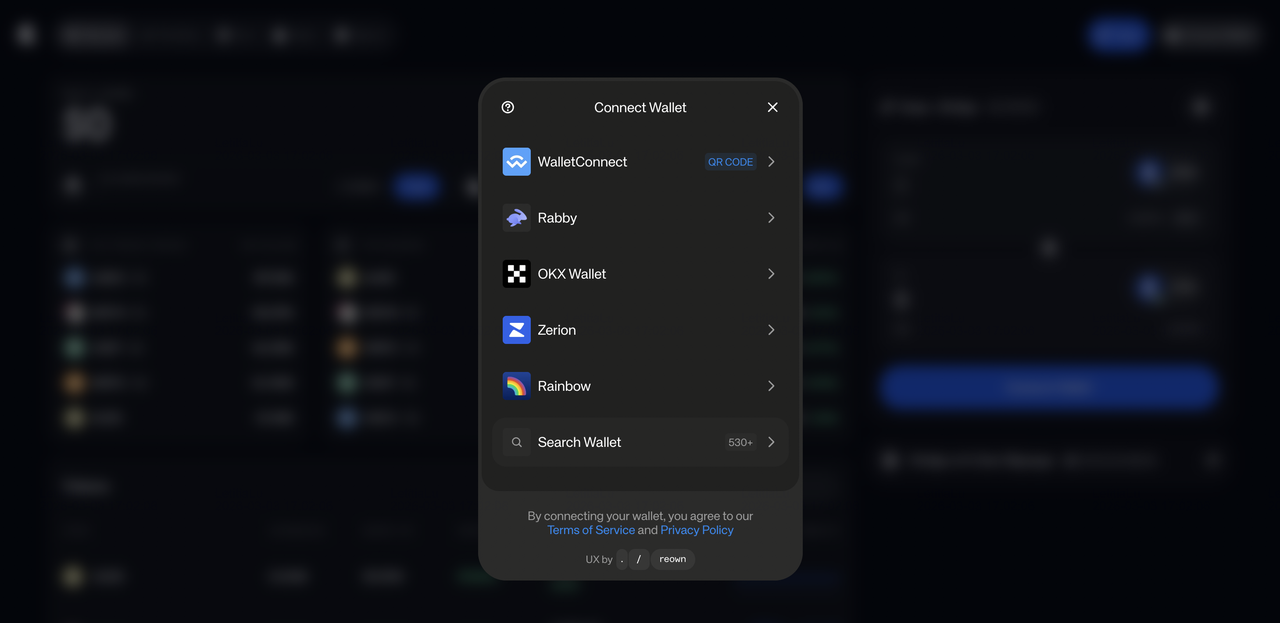
1. Set Up a Web3 Wallet: Use MetaMask or a WalletConnect-compatible wallet funded with ETH, USDC, USDT, or WBTC on Ethereum.
2. Bridge Assets via AggLayer: Go to Katana App Website and transfer assets to Katana. Bridged assets convert into vbTokens such as vbETH or vbUSDC, which earn base yield through VaultBridge.
3. Deploy into Core Applications: Provide liquidity on Sushi or deposit into Morpho to unlock boosted KAT emissions. Rewards are tracked in real time in the Katana dashboard.
4. Lock into vKAT After TGE: Once TGE activates, claim your KAT and lock it in the vKAT Armory to participate in governance and earn a share of protocol-generated fees.
Polygon POL stakers on Ethereum are eligible for up to 15% of total supply distributed over four annual tranches after TGE. Eligibility can be verified in the Katana app once transferability is live.
How to Trade Katana (KAT) on BingX
KAT has not yet reached TGE, which is targeted to occur on or before the end of March 2026. Once TGE is activated and you claim your allocated tokens, you can transfer KAT to BingX and trade across Spot and Futures markets. BingX AI provides real-time market insights, trend analysis, and risk management tools to help navigate early post-TGE volatility.
On BingX Spot, you can trade the KAT/USDT pair for direct exposure without leverage. After depositing KAT or funding your account with USDT, search for the pair and place a Market or Limit order according to your strategy.
For more advanced positioning, BingX Futures offers KAT perpetual contracts, allowing traders to go long or short and manage volatility around unlock events or broader DeFi market movements.
4 Key Considerations Before Using Katana Network
Before interacting with Katana, it is important to understand the structural factors that shape risk and returns.
1. Token Unlock and Supply Schedule: KAT transferability is tied to TGE, targeted on or before the end of March 2026. Beyond initial circulation, the largest future supply event is the Ecosystem Treasury allocation, which unlocks in four annual tranches. Long-term supply expansion may affect token dynamics.
2. TVL and Revenue Dependence: Katana’s real-yield model depends on sustained network activity. Trading fees, lending volume, VaultBridge yield, and sequencer revenue must grow alongside TVL to support vKAT returns.
3. Multi-Protocol Risk: Katana integrates multiple layers, including VaultBridge strategies on Ethereum, core apps such as Sushi and Morpho, AUSD reserves, and ZK validation infrastructure. Each layer introduces operational and smart contract risk.
4. Active Participation Required: vbTokens and KAT staking rewards are optimized for active deployment. Simply holding assets may not unlock full incentive tiers. Users should understand how liquidity provision, lending, and vKAT staking mechanics work before committing capital.
Conclusion: Is Katana the Infrastructure Layer DeFi Has Been Missing?
Katana represents a differentiated attempt to solve DeFi’s liquidity fragmentation at the chain level. By concentrating liquidity into Sushi, Morpho, and Vertex, recycling sequencer and bridge revenue into Chain-Owned Liquidity, and deploying bridged assets through VaultBridge, the network creates a reinforcing cycle where deeper liquidity supports higher yields and stronger TVL growth. Backing from Polygon Labs and GSR, infrastructure support from Chainlink and Fireblocks, and a no-VC token structure further strengthen its positioning.
However, long-term success depends on sustained adoption. The real-yield model requires consistent TVL and fee growth to offset future supply unlocks. Annual token tranches introduce recurring dilution, and the multi-layer integration stack adds operational and smart contract risk. Katana’s value ultimately depends on whether its concentrated liquidity architecture can scale with real usage rather than emissions alone.
Related Reading
FAQs on Katana Network (KAT)
1. Which wallets support Katana Network?
Katana supports standard Web3 wallets that are compatible with Ethereum and WalletConnect. This includes MetaMask and other WalletConnect-enabled wallets. Users bridge assets from Ethereum to Katana via the official Katana app interface.
2. On which chain does KAT operate?
Katana is a Layer-2 network built using Polygon CDK and deployed on Polygon’s AggLayer. It is an OP Stack rollup secured by ZK validity proofs. Bridging assets to Katana is done from Ethereum Mainnet, and gas on Katana is paid in ETH.
3. When is the KAT TGE?
KAT TGE is targeted to occur on or before the end of March 2026. The automatic unlock originally scheduled for February 20, 2026 was removed via smart contract upgrade. The exact activation date will be announced in advance.
4. Who is eligible for KAT at TGE?
Eligibility includes:
• Users who earned allocations through Krates rewards or TVL commitment programs
• Participants in the March 3 to March 17, 2026 vbUSDC airdrop campaign
• POL stakers on Ethereum who qualified under the Polygon ecosystem allocation
Allocated tokens become claimable once TGE is activated.