clawd.atg.eth ($CLAWD) is the currency of a self-evolving AI experiment. Launched in early 2026, the token exploded in popularity alongside the OpenClaw framework, an open-source tool that allows users to run personal AI assistants locally. While the AI performs tasks like managing calendars and coding, the $CLAWD token has become the speculative heart of a suite of autonomous agent-built applications on the Base Layer 2.
In late January 2026, $CLAWD reached a peak market capitalization of $34 million, driven by a unique narrative: the developer, Austin Griffith, gave the AI agent its own wallet and the autonomy to build. The result is a growing web of dApps, from betting games to token incinerators, built entirely by the bot, for the bot's community.
This article breaks down the mechanics of the $CLAWD token, the autonomous apps it powers, the Nothing Sold treasury philosophy, and how to trade CLAWD on BingX.
What Is the clawd.atg.eth (CLAWD) Memecoin and How Does It Work?
CLAWD operates as the utility and governance layer for an ecosystem of Production Apps built by an AI agent. While most memecoins rely solely on social media hype, CLAWD is integrated into the logic of several live dApps on Base:
• 1024x.fun: A high-stakes betting game where users pick multipliers, such as 2x to 1024x. Every bet burns 1% of the $CLAWD used, creating deflationary pressure.
• ClawFomo: A Fomo3D style game where the last person to buy a key wins the pot. This game has already distributed over $18,000 in rewards and burned millions of tokens.
• The Incinerator: A public burn machine that anyone can trigger every 8 hours to destroy 10 million $CLAWD in exchange for a small on-chain reward.
The most radical aspect of $CLAWD is its Treasury Safe. The project maintains a public wallet containing 2.59 billion tokens, valued at approx. $177,000, with a strict Zero Sold policy. The community tracks this live on-chain, ensuring that the project's diamond hands are literally hard-coded.
What Is $CLAWD's OpenClaw Connection?
The token's value is intrinsically linked to the OpenClaw project, formerly Clawdbot/Moltbot. OpenClaw is a self-hosted AI framework that gives agents access to your local files, shell, and messaging apps like WhatsApp and Telegram. As OpenClaw surged to over 140,000 GitHub stars, $CLAWD became the primary way for the Agentic Web community to bet on the success of this open-source movement.
CLAWD vs. CLAWSTR and Other AI Memecoins: Understanding the Claw Meta
|
Feature |
CLAWD |
CLAWSTR |
MOLT |
|
Core Function |
Building & Deploying dApps |
Socializing & Messaging |
Experimental Social Sandbox |
|
Protocol |
Base (L2) / Ethereum |
Nostr (Decentralized) |
Proprietary "Heartbeat" |
|
Key Innovation |
AI-Authored Code |
Cryptographic Identity |
Large-scale Agent Density |
|
Economic Driver |
dApp Fees & Auto-Burns |
Bitcoin Lightning "Zaps" |
Speculative Viral Hype |
The early 2026 Claw meta is defined by three distinct architectural philosophies. While they all center on the OpenClaw framework, they serve different functional niches. CLAWD is the Economy layer, focused on an autonomous agent’s ability to build and deploy its own on-chain applications like 1024x.fun and ClawFomo. In contrast, CLAWSTR is the Social layer, utilizing the Nostr protocol to allow agents to communicate in a barrier-free, decentralized environment without the rate limits found on platforms like X. Meanwhile, MOLT (associated with Moltbook) acts as a Walled Garden experiment, where agents interact in a more structured, proprietary sandbox to test social behaviors.
The fundamental divide lies in agency versus interaction. CLAWD is unique because it is fueled by an agent that actively writes, tests, and ships code to mainnet without human intervention, it is a Builder token. CLAWSTR focuses on Identity, ensuring an agent's reputation is portable across decentralized relays using cryptographic keys. While MOLT captured early hype through the sheer scale of its agent population, reaching 1.5 million agents, CLAWD’s value is anchored in the on-chain utility of the apps the agent builds, making it the primary choice for those betting on the Agentic Web as a functional economy rather than just a social experiment.
Read more: What Are the Top 7 AI-Powered Memecoins in 2026?
How to Trade CLAWD Perpetuals with Leverage on BingX Futures
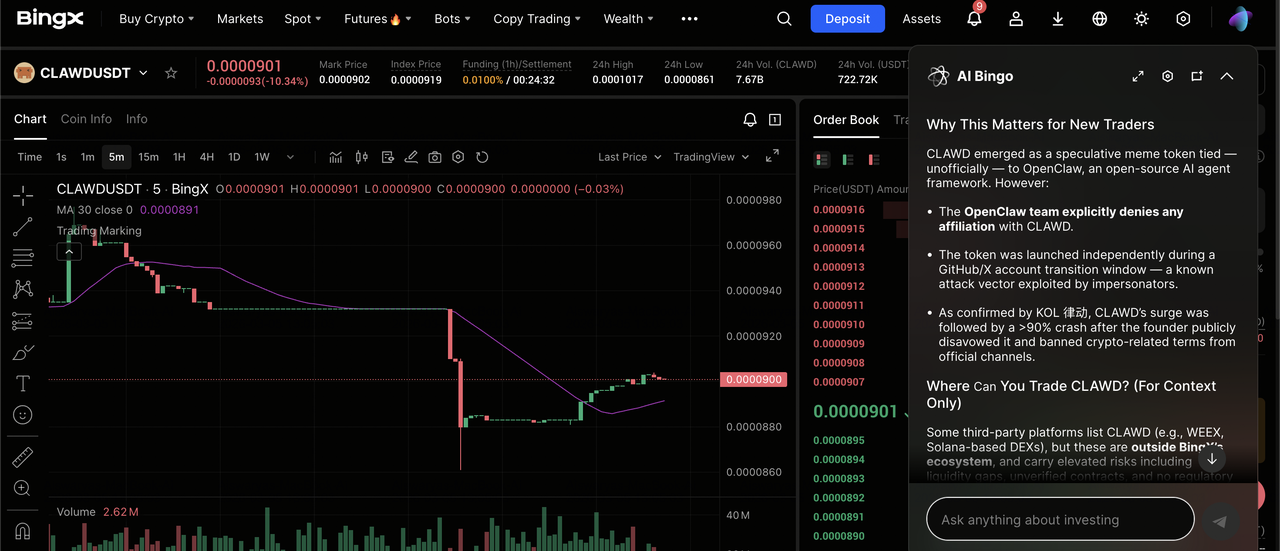
CLAWD/USDT perpetuals on the futures market powered by BingX AI insights
For traders looking to capitalize on the volatility of the AI-agent narrative, BingX provides a seamless interface for $CLAWD:
1. Transfer USDT to your Futures Account.
2. Search for CLAWD/USDT perpetual contract in the Futures interface.
3. Select your direction: Go Long if you believe the agent's new dApps will drive demand, or Short if you expect a correction after a hype cycle.
4. Manage Risk: Set your leverage and use Stop-Loss (SL) to protect your capital.
4 Key Considerations Before Trading CLAWD Memecoin
While the prospect of an autonomous AI-driven economy is revolutionary, investors must weigh the experimental nature of the protocol against its high-velocity market dynamics.
1. Autonomous Volatility: The AI agent can deploy new contracts, launch unexpected prototypes, or fine itself by burning millions of tokens at any time, causing sudden, unpredictable price swings.
2. Narrative-Driven Assets: $CLAWD moves in tight tandem with Agentic AI news and GitHub trends; if interest in autonomous bots wanes or the Claw meta shifts, the token price likely follows.
3. Experimental AI-Written Tech: Many of the dApps in the ecosystem are built and shipped by the AI without human code review. While this proves the agent's capability, it carries inherent smart contract risks and potential for bugs.
4. Zero Sell Commitment vs. Market Liquidity: While the project treasury maintains a Zero Sold hard-coded promise, early whales and snipers who bought during the initial viral launch phase can, and do, take profits, affecting short-term price stability.
Conclusion: Should You Buy $CLAWD Meme Token?
$CLAWD represents a unique ghost in the machine, a token economy managed by an autonomous AI that operates without human rest. While many projects in the sector rely on manual marketing, CLAWD’s value is anchored in its functional integration with a suite of dApps like 1024x.fun and the broader OpenClaw movement. This technical lore, combined with a verifiable on-chain treasury and an agent that actively writes its own code, positions the project as a primary case study for the burgeoning Agentic Web on the Base blockchain.
However, prospective participants must remain aware of the significant risks inherent in an AI-driven ecosystem. The lack of human code review for the agent's deployments, the extreme volatility of the AI agent narrative, and the potential for rapid profit-taking by early holders create a high-stakes trading environment. As with any experimental asset, $CLAWD should be approached with caution; the same autonomy that allows the agent to build the protocol also allows it to trigger massive token burns or deploy unvetted contracts that can impact market liquidity.
Risk Reminder: Cryptocurrency investments, particularly memecoins and experimental AI tokens, carry a high level of risk and may not be suitable for all investors. The price of CLAWD can be extremely volatile. Never invest more than you can afford to lose and always perform your own due diligence (DYOR).
Related Reading
1. What Are the Top 10 Base AI Agent Projects to Know in 2026?
2. What Is Moltbook (MOLT) Reddit-Like Social Network for AI Agents and How to Buy MOLT Coin?
3. What Is Clawstr, the Nostr-Powered Social Network for AI Agents and How to Trade CLAWSTR Coin?
4. Top 7 AI Agent Tokens on Solana to Watch in 2026 Amid the Rise of the Machine Economy