

Bitway (BTW) is a sovereign Layer 1 blockchain and Internet Capital Gateway built to unify fragmented on-chain liquidity. By merging the transparency of Decentralized Finance (DeFi) with the risk-management standards of Traditional Finance (TradFi), a model it calls DeTraFi, Bitway enables digital assets to flow into institutional-grade yield strategies.
In early March 2026, Bitway marked a major milestone with its Token Generation Event (TGE), transitioning from a points-based rewards system to a fully tokenized ecosystem. As $BTW gained traction across top exchanges like BingX, the protocol has seen a surge in interest from Bitcoin holders looking for non-custodial ways to put their digital gold to work.
This article examines how Bitway’s unique architecture unlocks the trillion-dollar Bitcoin economy, the drivers behind its recent 2026 market momentum, what investors should consider before engaging with the $BTW token, and how to trade Bitway (BTW) on BingX spot and futures markets.
What Is Bitway (BTW)?
Bitway (BTW) is a purpose-built blockchain optimized to connect decentralized capital with global financial markets. While most Bitcoin L2s require users to wrap their BTC into centralized tokens like WBTC, Bitway allows users to interact with its ecosystem using their native Bitcoin addresses and wallets.
The protocol operates as the missing layer between idle liquidity and productive yield. It provides a suite of modular financial tools, including Bitway Earn, Native BTC Financing, and Gas-free Payments, all secured by a Proof-of-Stake (PoS) consensus engine that is fully compatible with Bitcoin's UTXO model.
Bitway’s mission is to solve the isolated island problem of Bitcoin. By using the Bitway Ledger, BTC holders can access smart contracts, earn stablecoin yields, and take out loans without ever surrendering custody of their private keys to a centralized intermediary.
How Does the Bitway Ecosystem Work?
At its core, Bitway is an infrastructure layer delivered through a sovereign blockchain. Its functionality is built upon four foundational pillars:
1. Bitway Ledger: The Infrastructure
The Ledger is a high-performance L1 built on the Cosmos-SDK. It is uniquely Bitcoin-compatible, supporting Taproot and Native SegWit addresses. This allows users to sign transactions directly with hardware wallets like Ledger or browser wallets like Unisat, bypassing the need for EVM-style 0x addresses.
2. DeTraFi amd Bitway Earn
Bitway Earn is a wealth management platform that brings institutional strategies on-chain. Its flagship product is a Market Neutral Strategy executed on top-tier exchanges. Users deposit stablecoins like USDT and USDC into audited vaults and receive yield-bearing bwTokens, combining off-chain trading efficiency with on-chain transparency.
3. Native BTC Financing: Lending
This is Bitway’s killer app. Using Discreet Log Contracts (DLCs), users can lock native BTC as collateral to borrow stablecoins. Because it uses Bitcoin’s native scripting, the collateral remains in a non-custodial 2-of-2 multisig vault on the Bitcoin mainnet.
4. Gas-free Bitcoin Payments
Bitway implements a built-in fee sponsorship mechanism. Through its native bridge token, ɃTCT, users can send Bitcoin-pegged assets for payments or subscriptions without needing to hold a separate gas token. This delivers a seamless, Web2-like experience for everyday commerce.
Why Did BTW Momentum Surge in March 2026?
Following its listing on BingX and other major platforms on March 2, 2026, $BTW saw a significant uptick in volume. Several key drivers fueled this growth:
1. Successful TGE and Points Conversion: Bitway converted millions of BW Points from early testnet participants into $BTW at a 1:200 ratio, creating a large, liquid community of holders from day one.
2. Institutional Backing: The project recently secured $4.444 million in seed funding led by TRON DAO Ventures and HTX Ventures, signaling strong institutional confidence in Bitway's Bitcoin-native approach.
3. High-Yield Booster Campaigns: To celebrate the launch, Bitway introduced yield campaigns offering up to 18% APR on stablecoin deposits, attracting over $10 million in fresh liquidity within weeks.
4. Exchange Visibility: The simultaneous listing on BingX and other platforms provided the necessary market depth for price discovery, as traders rotated capital into the emerging Bitcoin Finance (BTCFi) sector.
What Is the BTW Token Used For?
The $BTW token is the utility and governance heart of the ecosystem. Its primary functions include:
• Network Gas: Required for all transactions and smart contract executions on the Bitway Ledger.
• Staking & Security: Users stake BTW to validators to secure the PoS network and earn a portion of transaction fees.
• Governance: Holders can vote on protocol upgrades, reward emissions, and the onboarding of new DeTraFi strategies.
• Tiered Access: Staking BTW grants Exclusive Access to capped-capacity yield vaults and provides Fee Benefits or discounts on BTC loans.
What Is Bitway (BTW) Tokenomics?
The $BTW token has a hard-capped total supply of 10,000,000,000 (10 billion) tokens, designed to balance long-term ecosystem sustainability with immediate community incentives.
• Community Rewards and Emissions (37.2%): The largest share, dedicated to staking rewards, seasonal airdrops, and incentivizing network growth.
• Ecosystem Fund (28.0%): Reserved for strategic partnerships, grant programs, and the long-term expansion of the Bitway Ledger.
• Early Investors (16.15%): Allocated to seed and private round partners, typically subject to a 12-month cliff and 18–36 month linear vesting.
• Team & Advisors (13.65%): Vested over 48 months to ensure the core contributors remain aligned with the project’s multi-year roadmap.
• Liquidity (5.0%): Specifically set aside to maintain deep order books and minimize slippage across decentralized and centralized exchanges like BingX.
How to Trade Bitway (BTW) on BingX
Whether you're looking to capitalize on the BTCFi trend or hold for long-term utility, BingX provides the tools to trade $BTW efficiently, supported by BingX AI insights that help analyze market trends, identify opportunities, and optimize trading decisions.
Buy, Sell, or Hold $BTW Tokens on the Spot Market
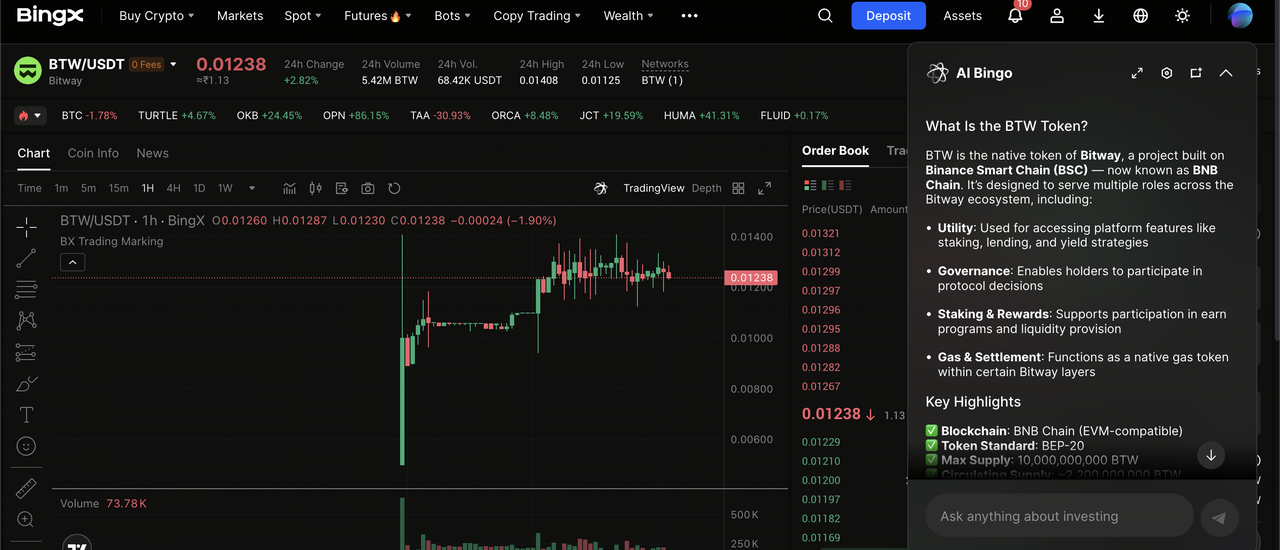
BTW/USDT trading pair on the spot market powered by BingX AI insights
Ideal for long-term investors.
1. Search for the BTW/USDT pair on the BingX Spot Market.
2. Analyze the chart using BingX AI to find optimal entry points near support levels.
3. Execute a limit or market order to add $BTW to your wallet.
Long or Short BTW Perps on the Futures Market
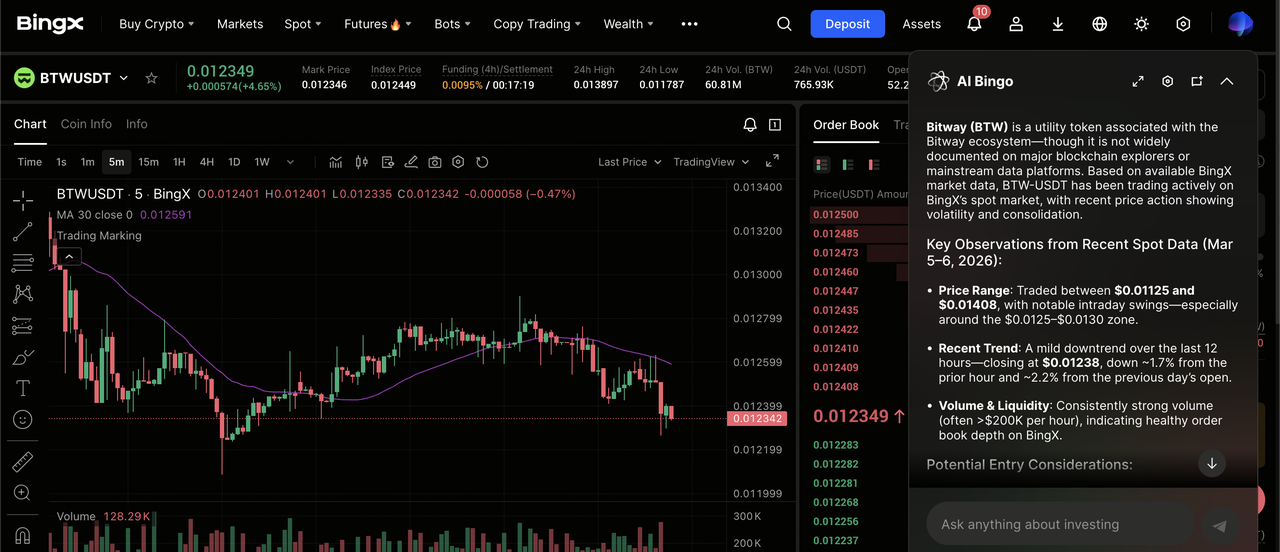
BTW/USDT perpetual contract on the futures market featuring BingX AI analysis
For traders looking to hedge or profit from short-term volatility.
1. Select BTW/USDT Perpetual in the Futures section.
2. Set your leverage, e.g., 2x - 10x, and manage risk with stop-loss orders.
3. Use BingX AI to monitor trend strength and potential reversals.
5 Key Considerations Before Investing in Bitway ($BTW)
Before engaging with the $BTW token, investors should evaluate the specific structural and market risks unique to Bitway’s DeTraFi and Bitcoin-native model.
1. Vesting Overhang and Dilution: With only approximately 22% of the total supply in circulation as of early 2026, investors must monitor the 18-to-36-month linear vesting schedules for early backers (16.15%) to anticipate potential sell-side pressure.
2. BTCFi Adoption Dependency: Bitway’s utility as a Capital Gateway relies heavily on the continued growth of the Bitcoin-native finance (BTCFi) sector; if users prefer custodial wrapped assets over Bitway’s DLC-based lending, protocol revenue may stall.
3. DeTraFi Strategy Execution: While Bitway Earn employs delta-neutral hedging to minimize market directionality, these strategies still face black swan risks, such as exchange-side liquidity failures or extreme decoupling of stablecoins.
4. Validator and DCM Security: As a relatively new Layer 1, the network’s security depends on the decentralization of its 21 TSS signers and the Distributed Collateral Manager (DCM); any quorum compromise could theoretically impact the integrity of the BTC vaults.
5. Burn Rate vs. Emissions: The token's long-term value is tied to its deflationary mechanism; investors should verify if on-chain transaction volume is high enough to offset the 37.2% community emission rate through the protocol's fee-burning model.
Final Thoughts: Assessing Bitway’s Role in the BTCFi Evolution
As of early 2026, Bitway has positioned itself as a structural pillar within the emerging BTCFi (Bitcoin Finance) sector by solving the long-standing friction between Bitcoin’s security and DeFi’s utility. By moving away from centralized wrapped assets and toward DLC-based cryptographic enforcement, the protocol provides a scalable gateway for institutional and retail capital to enter the on-chain economy. Its success as an investment depends largely on its ability to maintain high TVL in its DeTraFi vaults and the broader adoption of its native-address user experience over traditional EVM-compatible alternatives.
However, investors must approach $BTW with a clear understanding of the nascent nature of Bitcoin Layer 1 appchains. While the protocol’s architecture minimizes custodial trust, it remains subject to the systemic risks of smart contract vulnerabilities, oracle accuracy, and the significant token dilution expected from upcoming vesting unlocks.
Risk Reminder: Cryptocurrency investments, particularly in new infrastructure layers like Bitway, carry high volatility; never invest more than you can afford to lose and ensure you conduct thorough due diligence on protocol audit reports before committing capital to self-custodial vaults.
Related Reading
1. What Are the Top Bitcoin Layer-2 Networks of 2026?
2. What Are the Top BTCFi (Bitcoin DeFi) Projects in 2026?
3. What is Babylon Protocol? A Complete Guide to Bitcoin Staking and the BABY Token Airdrop
4. What Is Lombard (BARD) the Bitcoin DeFi Protocol and How Does it Work?