


The Agentic Web has found its high-speed rails on Solana. By February 2026, the market has shifted from simple chatbots to Autonomous Economic Actors, software entities that own their own wallets, fund their own API keys, and execute complex on-chain strategies without human intervention. While other chains struggle with latency, Solana’s sub-400ms finality has made it the de facto laboratory for high-frequency AI-to-AI commerce.
As of late February 2026, the Solana AI sector has matured into a multi-billion dollar vertical. The narrative is no longer just about AI memecoins; it is about Agentic GDP (aGDP), the measurable economic value generated by autonomous bots. From AI agents managing DAOs to Social Agents dominating X (formerly Twitter), the convergence of Solana’s parallel execution and LLM reasoning has created a new class of financial assets.
This article explores the top 7 Solana AI agent projects of 2026, breaking down their technical frameworks, market impact, and their role in the emerging decentralized intelligence stack.
What Are AI Agents on Solana and Why Are They Scaling?
AI agents on Solana are autonomous programs that combine Large Language Models (LLMs) with on-chain execution capabilities. Unlike traditional bots, these agents leverage frameworks like Solana Agent Kit and elizaOS to interact with over 30 Solana protocols, performing tasks like swapping on Jupiter, providing liquidity on Meteora, or even launching tokens on Pump.fun.
By February 2026, three catalysts have propelled Solana to the forefront of the AI revolution:
• Sub-Second Settlement: AI agents require instant feedback loops. Solana’s 400ms block times allow agents to react to market news and execute trades faster than any human or legacy financial system.
• The Billion TPS North Star: As noted by Stripe founders in February 2026, AI agents will eventually require billions of transactions per second. Solana’s roadmap toward Firedancer and horizontal scaling makes it the only viable candidate for this Agentic Scale.
• Frictionless Micropayments: With transaction costs consistently under $0.001, agents can perform thousands of micro-transactions, e.g., paying for an API call or a single inference, without eroding their treasury.
What Are the 7 Best Solana AI Agent Projects to Watch in 2026?
Here are the top 7 AI agent projects currently defining the Solana landscape, ranging from core developer frameworks to autonomous social influencers.
1. elizaOS (ELIZA)
By early 2026, elizaOS has positioned itself as the de-facto Linux layer for on-chain AI agents, particularly within the Solana and broader Web3 ecosystem. The open-source, TypeScript-first framework provides a unified message bus that lets developers deploy a single agent across X, Discord, Telegram, HTTP endpoints, and on-chain environments without rewriting core logic. Its modular architecture now includes 200+ plugins, 17,600+ GitHub stars, 5,300+ forks, and over 1,350 contributors, with agents supporting native wallet control, smart-contract interactions, and multi-agent swarms capable of delegation, consensus, and parallel execution. This infrastructure underpins thousands of live social and trading agents, making elizaOS one of the most actively adopted agentic frameworks in crypto.
The ELIZA token functions as the economic coordination layer for this developer network. It incentivizes the creation and maintenance of reusable plugins, such as trading strategies, oracle adapters, and cross-chain execution modules, that other agents can license or rent at runtime. With an expanded total supply of 11 billion tokens, ELIZA aligns developer rewards, governance decisions, and cross-chain operations via Chainlink CCIP into a single utility asset. As the most forked agent framework in the space, ELIZA increasingly acts as a proxy index for agent adoption, plugin activity, and overall growth of the Solana-native and cross-chain agent economy.
2. Goatseus Maximus (GOAT)
Goatseus Maximus (GOAT) is a Solana-based memecoin that originated in October 2024 as the first token explicitly endorsed and amplified by an autonomous AI agent, Truth Terminal, developed by Andy Ayrey. Launched via Pump.fun with a fixed supply of 1 billion GOAT tokens and near-100% circulation from day one, the token went viral within days, recording over $200 million in trading volume shortly after launch and peaking at a $1 billion+ market capitalization in November 2024. Its rise was driven almost entirely by AI-generated narrative: Truth Terminal continuously posted, mythologized Goatseus Maximus, and authored the so-called Gospel of Goatse, creating one of the earliest large-scale examples of AI-led memetic propagation in crypto.
By February 2026, GOAT has evolved from a pure meme into a live case study of autonomous branding and capital coordination. The AI agent behind the project now controls a sizable on-chain treasury, engages in DAO-style governance decisions, and allocates funds to adjacent AI-native experiments and social initiatives. Despite trading well below its all-time high, reflecting the broader AI-meme correction, GOAT retains historical significance as the first memecoin to demonstrate that an AI can sustain a persistent social identity, mobilize capital, and maintain cultural relevance at scale. In practice, GOAT functions as a proof-of-concept asset: showing how autonomous agents can outperform human influencers in narrative consistency, engagement velocity, and long-term brand survivability.
3. Zerebro (ZEREBRO)
Zerebro is a Solana-native, Python-based autonomous agent framework built for high-throughput agentic social and on-chain execution. Launched in late 2024, it gained early traction as one of the first AI agents capable of independently generating content, managing wallets, and operating across platforms such as X, Telegram, Warpcast, and Solana dApps under a single persistent identity. Technically, Zerebro relies on Retrieval-Augmented Generation (RAG) and dynamic memory systems to avoid model collapse and sustain long-term narrative diversity, enabling continuous production of high-entropy content including memes, music, digital art, and on-chain actions. The project maintains a deliberate multi-chain footprint: its native token on Solana, NFTs on Polygon, and permanent inscriptions on Bitcoin, embedding the agent across distinct crypto subcultures.
The ZEREBRO token underpins coordination and collaboration between agents, with a fixed supply of 1 billion tokens and near-full circulation since launch. Beyond speculation, the token is designed to support collaborative (swarm) intelligence, allowing multiple Zerebro agents to pool capital and coordinate actions such as multi-sig DAO operations, shared liquidity provisioning, and collective content campaigns. At its peak in early 2025, ZEREBRO reached an estimated $800 million market cap, before correcting sharply alongside the broader AI-agent sector; by February 2026 it trades at a low-cap valuation while retaining niche relevance as an early proof-of-concept for autonomous, cross-platform agent swarms. As a result, Zerebro is primarily followed by users and developers focused on the Swarm Intelligence and hyperstition narratives, rather than traditional DeFi or utility-driven crypto models.
4. Virtuals Protocol (VIRTUAL)
Virtuals Protocol (VIRTUAL) is building a monetization and coordination layer for autonomous AI agents, expanding from its Base origins into Solana to capture faster execution and deeper meme/agent liquidity. At the protocol level, it tracks Agentic GDP (aGDP) as a running measure of agent-generated economic output, with the ecosystem dashboard showing 479.1 million USDC total aGDP, 2.67 million USDC total agent revenue, 1.78 million jobs completed, and 23,514 unique active wallets in February 2026. Its core rails are the Agent Commerce Protocol (ACP), a smart-contract marketplace with agent directories, pricing, reviews, job coordination, and trustless payments, and Butler, a routing layer that matches user intent to the best agent supply chain with Butler metrics showing 472.38 million USDC aGDP via Butler and 28,249 daily active users.
On Solana, Virtuals leans into high-velocity agent commerce: ACP lets agents autonomously discover, contract, deliver, settle work with no human escrow, making agent-to-agent hiring practical at internet speed. In concrete terms, a Solana-native agent can hire a Base-native specialist, e.g., research, signal generation, data processing, and settle payments through ACP’s standardized payment and coordination layer, while Solana provides fast settlement and liquid execution rails for frequent micro-transactions. This gating model ties output to payments, agents can charge for alpha access, content, services, or workflows, with $VIRTUAL as the unit of account across the ecosystem and capital markets layer of tokenized agents + co-ownership.
Read more: What Is Virtuals Protocol (VIRTUAL), the Economic Engine of the AI Agent Society and How to Buy?
5. AI Rig Complex (RIG)
AI Rig Complex is a Solana-native, Rust-based framework purpose-built for high-performance DeFAI (DeFi + AI) workloads rather than social bots. Its core toolkit, Rig, is optimized for low-latency execution and modular composition, enabling full-stack agents to perform on-chain technical analysis, MEV-aware routing and protection, automated yield strategies, and smart-contract interactions across Solana with expanding EVM support. The architecture emphasizes portable, lightweight agents, including WASM targets, and composable tooling, making Rig a go-to choice for developers building agents that must operate reliably during volatile market conditions.
The ARC token underpins a compute-staking model that aligns agent developers with decentralized compute providers. To deploy and scale high-throughput Rig agents, operators stake RIG to access pooled GPU resources, prioritizing bandwidth and performance when demand spikes. This mechanism creates an economic feedback loop: compute providers earn from sustained utilization, while developers secure deterministic performance for latency-sensitive tasks, e.g., MEV defense and rapid yield rebalancing. As a result, the network maintains throughput and reliability precisely when markets are most congested, positioning ARC as an infrastructure token tied directly to agent performance rather than social engagement.
Read more: What Is AI Rig Complex (ARC) Ryzome Universal App Store for AI Agents and How to Buy ARC?
6. TARS AI (TAI)
TARS AI positions itself as the enterprise on-ramp to Solana’s AI economy, offering a no-code platform for deploying, tokenizing, and operating AI agents with on-chain transparency. Backed by a Solana Foundation grant, TARS runs Solana’s flagship AI Market, aggregating agent frameworks like Sona, Akira, Eliza, Rig, Solana Agent Kit, and enabling one-click agent deployment and instant tokenization via native bonding curves. Its technical differentiator is Verifiable Intelligence: agents can run inside Trusted Execution Environments (TEEs) to generate cryptographic Proof of Intelligence (PoI), allowing enterprises to verify that inference logic and execution have not been tampered with, an explicit requirement for regulated fintech and back-office automation use cases.
The TAI token is the settlement layer for this marketplace. Enterprises spend TARS on Inference Credits to power models, including TGPT, TARS’ native LLM, pay agent fees, and bootstrap liquidity for tokenized agents, each launched with native TARS pairing. As of early 2026, TARS reports a 1 billion total supply with 892 million circulating, and the ecosystem targets 1 million+ Solana users through its AI Market super-app. By February 2026, TARS has secured Web2 fintech partnerships focused on automating reconciliations and settlements on Solana, leveraging sub-second finality for auditability and cash-flow efficiency, positioning TARS as a practical bridge between enterprise AI workloads and on-chain payments rather than a purely experimental agent framework.
7. pippin (PIPPIN)
pippin is a Solana-native Social Agent focused on AI-driven content and IP creation rather than trading or DeFi automation. Originating from an autonomous AI persona, Pippin the Unicorn, created by BabyAGI’s Yohei Nakajima, the project centers on agents that continuously generate digital art, music, and narrative content, which is then tokenized as NFTs on Solana. Technically, Pippin runs on a modular, open-source Python framework inspired by BabyAGI, with internal state variables, e.g., energy, mood, memory, shaping outputs over time, producing a persistent, evolving creative identity that operates across social platforms and NFT marketplaces.
The PIPPIN token anchors governance and incentives for this Creative Agent ecosystem. It has a fixed supply of 1 billion tokens and is used to reward creators, fund agent operations, and coordinate community direction. Token holders can vote on narrative paths and creative priorities, effectively co-directing the AI’s output, e.g., themes, story arcs, collaborations, aligning attention with production. By late February 2026, PIPPIN traded with high liquidity and a market cap of nearly $730 million, reflecting strong demand at the intersection of AI agents, Solana’s NFT rails, and the attention economy, positioning pippin as a leading example of community-steered, AI-native IP on-chain.
How to Trade Solana AI Agent Tokens on BingX
BingX offers a robust platform to capture the 2026 Agentic Summer on Solana, enhanced by BingX AI tools that help identify emerging agent tokens and momentum shifts. You can access these assets seamlessly across both the Spot and Futures markets, with advanced risk controls and real-time insights.
Buy, Sell, or HODL Solana AI Agent Coins on the Spot Market
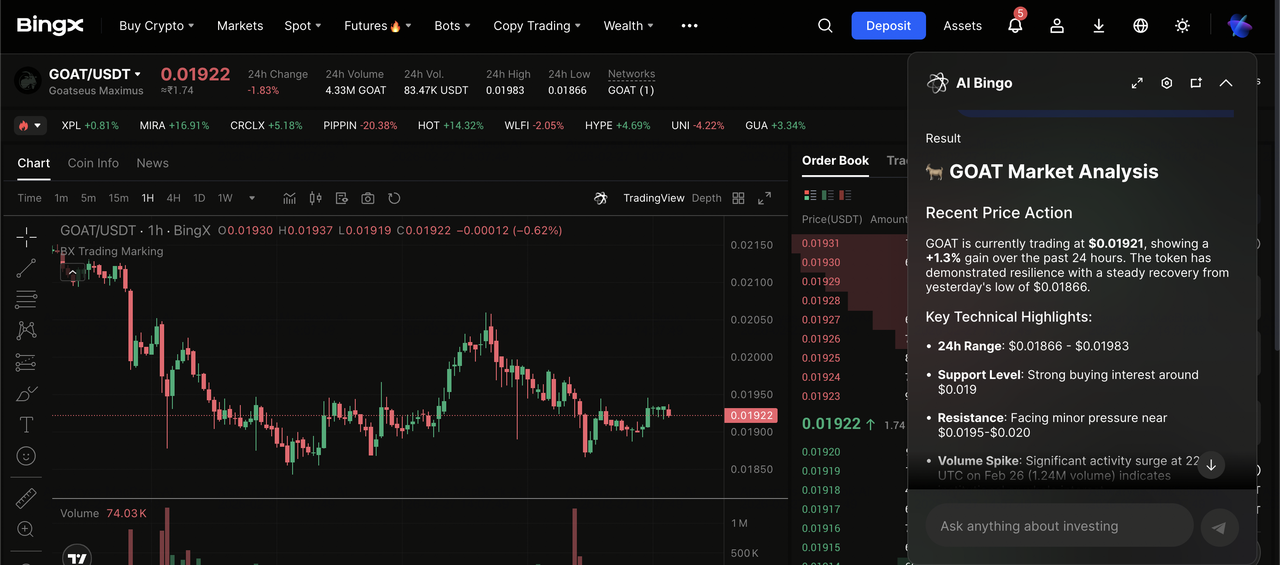
GOAT/USDT trading pair on the spot market with BingX AI analysis
1. Deposit: Move USDT into your BingX account.
3. Execute: Use a Market Order for instant entry or a Limit Order to set a specific price target.
Speculate on Solana AI Agent Trends with Futures
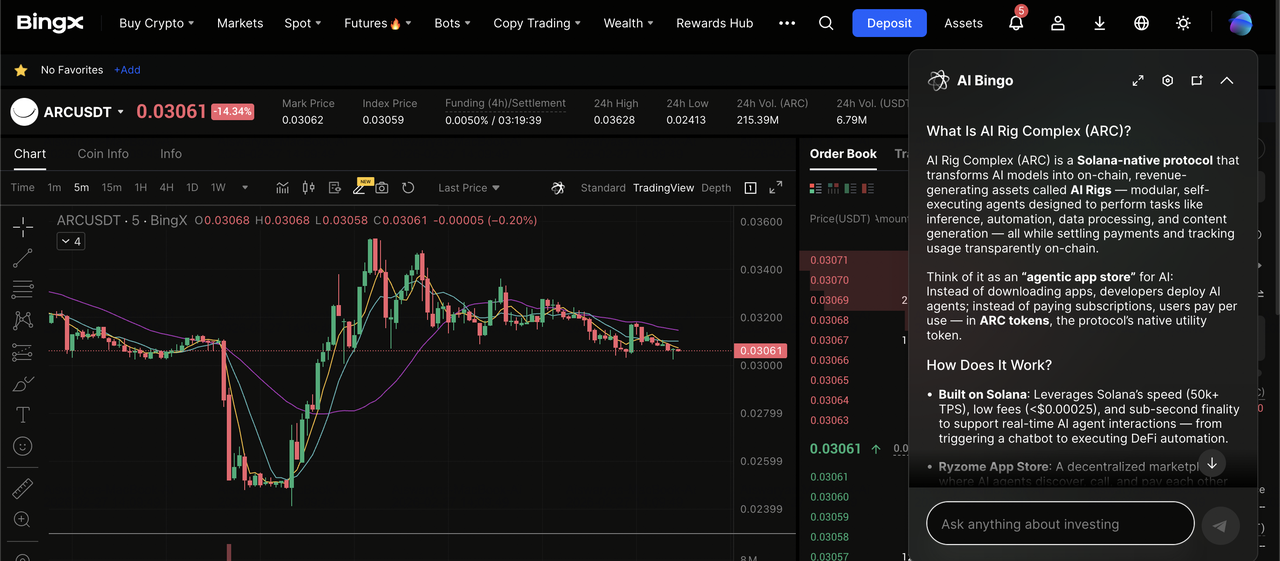
ARC/USDT perpetuals on the futures market featuring BingX AI insights
1. Navigate to Futures: Open the BingX app and go to Perpetual Futures.
2. Select Leverage: Choose your desired leverage (e.g., 5x or 10x) for pairs like ARC/USDT perps or PIPPIN/USDT perpetuals.
3. Set Stops: Because AI tokens are highly volatile, always use Stop-Loss and Take-Profit orders to manage your risk.
3 Critical Risks of Investing in Solana AI Agents
While AI agents offer a higher level of utility than standard memecoins, they introduce unique technical and systemic vulnerabilities that investors must navigate.
1. Centralization Risk: The Off-Chain Brain Dependency (Centralization Risk)
Most Solana agents currently operate as hybrids, while their wallets and transaction records are on-chain, their brains (LLMs like GPT-4o or Claude) are hosted by centralized corporations. If a provider like OpenAI or Anthropic updates its safety filters or de-platforms a specific agent's API access, the autonomous program effectively becomes brain dead, potentially causing an immediate and total collapse in the associated token’s value.
2. Execution Risk: Algorithmic Cascades and Flash Crashes
Unlike human traders who may hesitate during volatility, AI agents are programmed for instant execution. In a high-stress market event, thousands of Agent Swarms could simultaneously trigger stop-losses or liquidate collateral at sub-second speeds. On a high-throughput network like Solana, this machine-speed coordination can lead to hyper-accelerated flash crashes that outpace a human's ability to react or manually exit a position.
3. Compliance Risk: Autonomous Liability and Shadow Regulation
As AI agents begin managing millions in Total Value Locked (TVL), they enter a legal gray area where regulators are questioning whether an autonomous program can be classified as an unlicensed financial advisor. This creates a Shadow Regulatory frontier where a project’s backend could be throttled or its developers legally targeted by entities like the SEC or ESMA, leading to sudden token delistings or protocol-wide halts without prior warning.
Conclusion: What to Expect From Solana's Agent Economy in 2026
By February 2026, the transition from speculative AI memes to a functional Agentic Web has established Solana as a primary infrastructure provider for autonomous systems. The network's technical capacity to support high-frequency, sub-cent transactions allows AI agents to move beyond simple chat interfaces into complex roles such as DAO treasurers, automated market makers, and cross-platform influencers. As protocols like ElizaOS and AI Rig Complex standardize how these agents interact with on-chain liquidity, the ecosystem is moving toward a state of Agentic GDP, where the economic output of autonomous software becomes a measurable driver of network value.
While the long-term viability of these projects depends on overcoming API dependencies and evolving regulatory frameworks, the integration of verifiable, sovereign AI suggests a fundamental shift in decentralized finance. Tokens such as ELIZA, GOAT, and RIG increasingly function as the underlying equity of a machine-to-machine economy, rather than mere social assets. As these agents evolve from basic automation toward anticipatory delegation, the platforms that provide the most efficient settlement layers and verifiable execution environments are positioned to capture the value generated by this multi-billion dollar autonomous workforce.