
XRP is one of the oldest and most widely held cryptocurrencies, but it is often misunderstood because XRP, the XRP Ledger, and Ripple are frequently treated as the same thing. In simple terms, XRP is a digital asset designed for fast, low-cost cross-border value transfer. Unlike Bitcoin, which is often framed as digital gold, or Ethereum, which functions as a programmable smart contract platform, XRP was built for payments, liquidity, and settlement. Its core purpose is to act as a bridge asset that can help move value between different currencies in seconds.
It is important to separate the three names clearly. The XRP Ledger (XRPL) is the blockchain network that records transactions. XRP is the native digital asset used on that network. Ripple is a private company that builds payment and financial infrastructure products using XRP Ledger technology and holds a significant amount of XRP, but Ripple is not the same as XRP or the XRPL. In recent years, the XRP Ledger has also expanded beyond payments into tokenized real-world assets, including U.S. Treasuries, regulated stablecoins, and tokenized bonds. This guide explains what XRP is, how the XRP Ledger works, how XRP is used, how its supply model functions, and how to trade XRP on BingX.
What Is XRP?
XRP (XRP) is the native digital asset of the XRP Ledger (XRPL), an open-source blockchain launched in 2012. It was created by David Schwartz, Jed McCaleb, and Arthur Britto as a faster and more energy-efficient alternative to Bitcoin for payments. Shortly after, the company now known as Ripple was founded to build commercial payment products using the XRP Ledger. From the beginning, XRP’s core purpose has been settlement: helping value move across borders and between currencies faster than the traditional correspondent banking system.
The easiest way to understand XRP is to compare it with Bitcoin and Ethereum:
- Bitcoin: Bitcoin is often described as “digital gold.” It is designed to be a scarce, secure store of value, with transactions secured by Proof of Work mining.
- Ethereum: Ethereum is a programmable blockchain for smart contracts and decentralized applications (dApps). Its main strength is flexibility and application development.
- XRP: XRP is a payments-focused digital asset. It is designed to settle transactions in seconds at very low cost, making it useful for high-volume cross-border value transfer.
This narrow focus is XRP’s identity. It is not trying to be the broadest smart contract platform or the most decentralized store of value. It was built to do one thing efficiently: move money.
XRP Coin vs. XRP Ledger vs. Ripple: What Are the Differences?
- XRP the coin: XRP is the native cryptocurrency of the XRP Ledger. It is used to pay transaction fees, serve as a settlement and liquidity asset, and act as a bridge currency between different fiat currencies.
- The XRP Ledger (XRPL): XRPL is the open-source blockchain that records XRP transactions. It also supports issued tokens, a built-in decentralized exchange, and native NFTs.
- Ripple: Ripple is a private company that builds payment and financial infrastructure products using XRP Ledger technology. Ripple holds a large amount of XRP, but it is not the same as XRP or the XRP Ledger.
Read More: How to Invest in XRP Ledger (XRPL), a Beginner’s Guide to Buying XRP
How Does the XRP Ledger Work?
The XRP Ledger is a decentralized blockchain optimized for speed, low cost, and energy efficiency. It can process roughly 1,500 transactions per second, settle transactions in three to five seconds, and keep fees at a tiny fraction of a cent. Four concepts explain how it works:
- XRP Ledger Consensus Protocol: Unlike Bitcoin’s mining or Ethereum’s staking, the XRP Ledger uses its own consensus protocol. Independent validators propose and agree on which transactions should be added to the ledger. Validators do not earn block rewards or transaction fees; their role is to help maintain ledger accuracy.
- Unique Node Lists (UNLs): Each validator follows a list of trusted validators called a Unique Node List. When a supermajority of trusted validators agrees on a set of transactions, the ledger closes and those transactions become final. This process repeats every few seconds.
- Fast finality: XRP transactions do not require multiple block confirmations. Once consensus is reached, the transaction is final, which is why the XRP Ledger can offer three-to-five-second settlement and very low energy usage.
- Built-in ledger features: The XRP Ledger supports more than payments. It includes a native decentralized exchange, issued tokens, and native NFTs through the XLS-20 amendment. While it was not originally designed for Ethereum-style smart contracts, the network has gradually added more programmability.
This design also creates a decentralization debate. Anyone can run a validator, and Ripple operates only a small share of validators, but many nodes still rely on default UNLs curated by Ripple or the XRP Ledger Foundation. Critics argue this gives those organizations influence over validator trust lists, while supporters argue the validator set has become more diverse and that no single party can unilaterally control the ledger.
Major XRP Developments: From Launch to SEC Resolution and ETFs
XRP’s history is shaped by three major themes: its early launch, its close relationship with Ripple, and the multi-year SEC lawsuit that defined market perception for years. The table below gives a quick overview, followed by a shorter walkthrough of each milestone.
|
Milestone |
Date |
Main Purpose |
|
XRP Ledger Launch |
2012 |
The ledger went live; 100 billion XRP created at inception |
|
Ripple Founded |
2012 |
Company formed to build payment products on the ledger |
|
Escrow Lockup |
2017 |
Ripple locked 55 billion XRP in escrow for predictable supply |
|
SEC Lawsuit Filed |
December 2020 |
SEC alleged XRP was sold as an unregistered security |
|
Torres Ruling |
July 2023 |
Court ruled programmatic sales were not securities |
|
Spot XRP ETFs |
November 2025 |
First U.S. spot XRP ETFs launched following legal clarity |
|
SEC Case Resolved |
March 2026 |
Litigation concluded with regulatory clarity for XRP |
- XRP Ledger Launch (2012). The XRP Ledger went live with the full supply of 100 billion XRP created at inception. Unlike Bitcoin, there was no mining, which made XRP one of the earliest fixed-supply, pre-mined cryptocurrencies.
- Ripple Founded (2012). The company later known as Ripple was created to build cross-border payment software using the XRP Ledger. A large portion of the XRP supply was allocated to the company, which became a long-running point of debate around supply control.
- Escrow Lockup (2017). To make XRP supply more predictable, Ripple placed 55 billion XRP into on-chain escrow. This limited how much XRP could be released each month and helped reduce concerns about sudden large-scale selling.
- SEC Lawsuit Filed (December 2020). The SEC sued Ripple, alleging that XRP sales amounted to unregistered securities offerings. The lawsuit created years of uncertainty and led many U.S. exchanges to delist or restrict XRP trading.
- Torres Ruling (July 2023). Judge Analisa Torres ruled that programmatic XRP sales on public exchanges did not constitute investment contracts. This became a major turning point, allowing XRP to regain exchange listings and market confidence.
- Spot XRP ETFs (November 2025). After greater legal clarity, spot XRP ETFs launched in U.S. markets and opened a regulated path for institutional and traditional investors to gain XRP exposure.
- SEC Case Resolved (March 2026). The long-running case was resolved, removing the largest legal overhang on XRP. The resolution helped reinforce XRP’s position in public markets and improved institutional confidence.
XRP Ecosystem and Adoption: Cross-Border Payments, Tokenization, and ETFs
XRP’s adoption story is no longer limited to cross-border payments. Its core use case remains settlement and liquidity, but the XRP Ledger has also expanded into tokenized real-world assets, regulated stablecoins, and institutional financial infrastructure. After the SEC case resolution and the launch of spot XRP ETFs, XRP has regained attention as both a bridge asset for global value transfer and a settlement layer for tokenized assets.
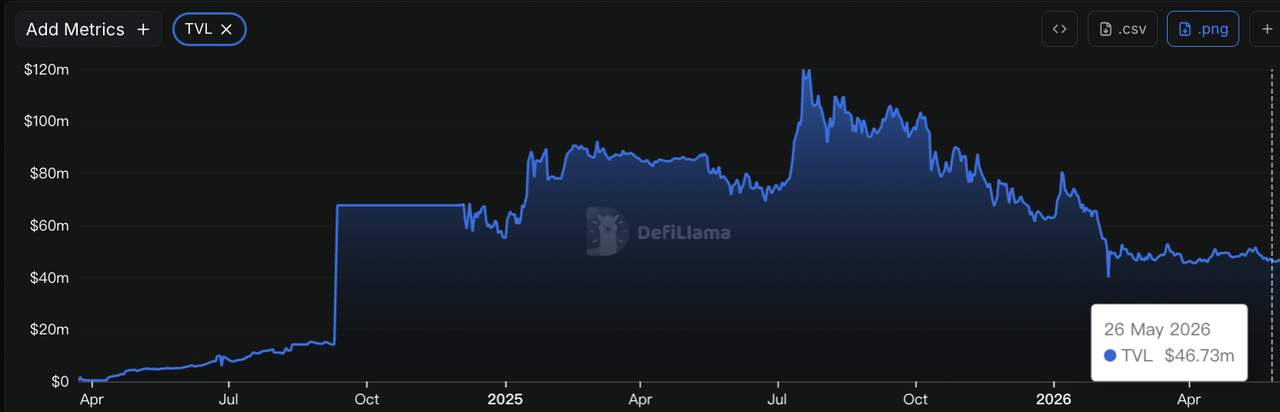
Source: DefiLlama
XRP’s ecosystem is narrower than Ethereum’s, but more focused. Banks, payment providers, asset managers, and stablecoin issuers use XRP or the XRP Ledger for settlement workflows, token issuance, custody, or liquidity infrastructure. The key question is whether this growing institutional activity creates direct demand for XRP itself, or whether some flows can bypass XRP through fiat settlement or Ripple’s RLUSD stablecoin.
1. Cross-Border Payments and RippleNet
XRP was designed to act as a bridge currency for international payments. In the traditional system, cross-border transfers often depend on correspondent banks, pre-funded accounts, and multi-day settlement. XRP offers a different model: convert one currency into XRP, move it across the ledger in seconds, and convert it into the destination currency.
This is the idea behind Ripple’s On-Demand Liquidity (ODL) service, which sits within the broader RippleNet payment infrastructure. The appeal is capital efficiency. Payment providers can reduce the need for idle funds in foreign accounts while using the XRP Ledger for faster settlement.
2. Real-World Asset Tokenization on the XRP Ledger
Tokenization has become one of the fastest-growing areas of XRP Ledger adoption. The XRPL supports issued tokens, on-chain compliance features, escrow, and a built-in decentralized exchange, making it well suited for regulated financial assets.
As of late April 2026, the XRP Ledger hosts around $3 billion in tokenized real-world assets (RWAs), up sharply from roughly $24.7 million at the start of 2025 and about $568 million at the end of 2025. Major contributors include:
- Tokenized U.S. Treasuries: Products such as Ondo Finance’s OUSG, along with similar offerings from Guggenheim and OpenEden, have brought tokenized Treasury exposure onto the XRP Ledger.
- Institutional issuers: Archax has committed to bringing $1 billion in additional tokenized assets to XRPL, while Justoken’s JMWH product is one of the largest single tokenized assets on the network.
- Tokenized bonds and stablecoins: SBI Holdings issued a $65 million tokenized bond in Japan on XRPL, and Société Générale launched its MiCA-compliant euro stablecoin on the ledger.
- Cross-institution settlement: In May 2026, Ondo Finance, JPMorgan, Mastercard, and Ripple completed a cross-border redemption of a tokenized U.S. Treasury fund in under five seconds.
The growth is significant, but the market is still early. XRPL’s RWA base remains smaller than Ethereum’s, and the active user base is still narrow. Tokenization should be viewed as an emerging institutional thesis rather than a fully mature adoption story.
Read More: What Is XRP Ledger Tokenization and Why Is It Growing in 2026?
3. ETFs, RLUSD, and Institutional Adoption
XRP’s institutional footprint expanded in 2025 and 2026 through ETFs, regulated stablecoins, custody infrastructure, and banking partnerships.
- Spot XRP ETFs: U.S. spot XRP ETFs launched after greater legal clarity, giving traditional investors a regulated way to gain XRP exposure.
- RLUSD stablecoin: Ripple’s regulated stablecoin crossed $1 billion in market capitalization, adding a settlement counterpart for tokenized assets on XRPL.
- National trust bank charter: Ripple received conditional approval to operate as a national trust bank, strengthening its digital asset custody position.
- Institutional partnerships: Ripple expanded tokenized Treasury pilots, custody solutions, and banking integrations across multiple regions.
Read More: Spot XRP ETFs to Launch on November 13: What Is a Spot XRP ETF?
The important nuance is that Ripple’s business growth does not always equal XRP demand. Some institutional payment flows may use fiat or RLUSD instead of XRP as the bridge asset. The bull case is that more tokenization and settlement activity increases XRP’s role in liquidity, reserves, and fees. The bear case is that the XRPL ecosystem can grow while XRP captures only part of that value.
Read More: What Is RLUSD? A Beginner's Guide to Ripple's USD-backed Stablecoin
XRP Tokenomics Explained: XRP Supply, Burn, Escrow, and Cloud Mining
XRP’s tokenomics work differently from both Bitcoin and Ethereum. Bitcoin has a fixed cap of 21 million coins, while Ethereum has a dynamic supply shaped by issuance and fee burns. XRP sits in a different category: all 100 billion XRP were created when the XRP Ledger launched in 2012. There is no mining, no staking issuance, and no new XRP created over time. Instead, XRP supply gradually decreases through small transaction burns, making it a fixed-from-inception asset with mild deflationary pressure.
XRP supply is shaped by three main mechanisms:
- Pre-mined fixed supply: All 100 billion XRP were created at launch. There are no block rewards, mining rewards, or staking rewards that create new tokens. A portion of XRP is circulating in the market, while a large share remains held in escrow.
- Escrow releases: Ripple holds a significant amount of XRP in on-chain escrow. A set amount can be released each month under pre-programmed rules, and unused XRP is typically returned to escrow. This makes the release schedule more predictable, though Ripple’s large holdings remain a source of supply concentration.
- Transaction burn: Every XRP Ledger transaction destroys a tiny amount of XRP. This burn is mainly designed to prevent spam, but it also slowly reduces total supply over time.
A common point of confusion is XRP cloud mining. XRP itself cannot be mined because the XRP Ledger does not use Proof of Work and does not create new XRP through mining rewards. Some “XRP cloud mining” platforms may mine other cryptocurrencies and pay users in XRP, or use the term as marketing for a third-party yield product. These services are not part of XRP tokenomics and do not create new XRP.
The key point is that XRP is not a mineable or yield-bearing asset like Proof-of-Work or Proof-of-Stake tokens. Holding XRP does not generate native staking rewards, and validators do not earn block rewards or transaction fees. Its economics are closer to a fixed-supply settlement asset, with long-term value tied to liquidity demand, network usage, and how Ripple’s escrow supply is managed.
How to Trade XRP (XRP) on BingX
BingX offers three practical ways to gain exposure to XRP, depending on whether the goal is direct ownership, short-term trading, or steady accumulation over time. Spot trading is better suited for users who want to buy and hold XRP directly. Futures trading is designed for active traders who want long or short exposure to XRP price movements. Dollar-cost averaging (DCA) is useful for users who want to build an XRP position gradually without trying to time every market move.
Spot Trading: Buy and Own XRP Directly
Spot trading is the most straightforward way to buy XRP on BingX. When users buy XRP on the spot market, they own the asset directly and can hold it in the BingX spot account, transfer it, or withdraw it to a self-custody wallet.
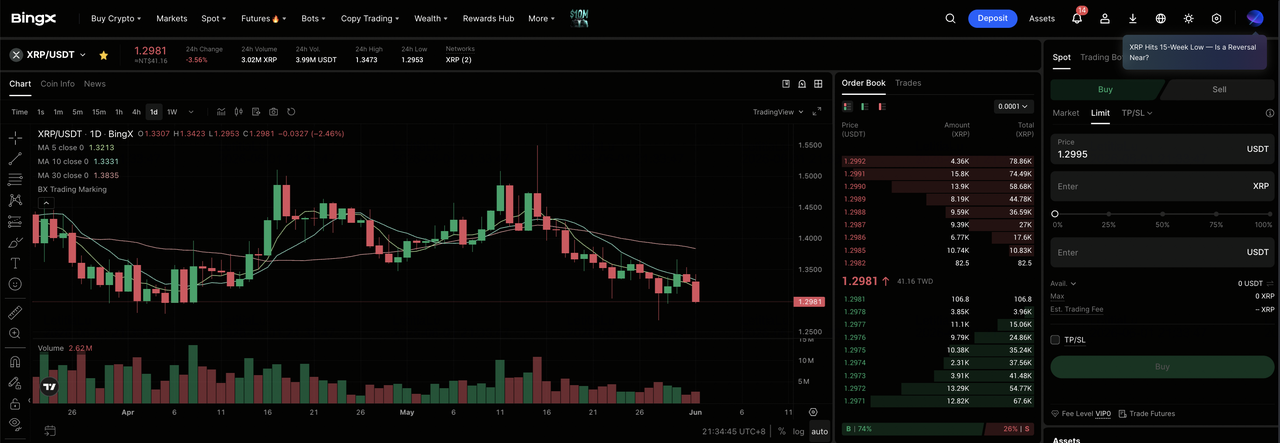
Step 1: Account setup and security. Sign up and log into your BingX account, complete the identity verification (KYC) required in your region, and enable two-factor authentication.
Step 2: Fund your spot account. Deposit USDT or another supported asset into your BingX spot account. Where available, users can also use supported fiat on-ramp options.
Step 3: Navigate to the spot market. Search for the XRP/USDT trading pair.
Step 4: Place your order. Choose a market order to buy XRP immediately at the current price, or use a limit order to set the price you want to pay.
Step 5: Manage your XRP. Once filled, your XRP appears in your spot account. You can keep it on BingX for convenience or withdraw it to a personal wallet for self-custody.
Futures Trading: Trade XRP Price Movements
For active traders, BingX offers USDT-margined XRP perpetual futures. Futures allow users to trade XRP price movements without holding the underlying asset, with the flexibility to open long positions if they expect XRP to rise or short positions if they expect XRP to fall.
Because futures involve leverage, they can amplify both gains and losses. This approach is more suitable for traders who already have a clear risk plan and understand liquidation risk.
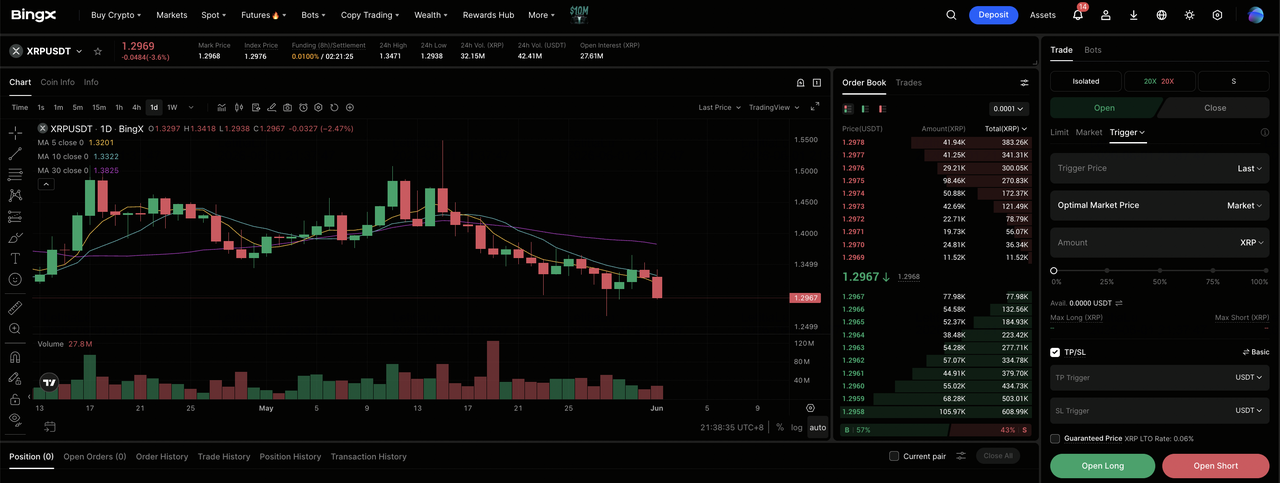
Step 1: Transfer collateral. Move USDT from your spot account into your futures account, where it will serve as margin.
Step 2: Select the contract. Search for the XRP-USDT perpetual contract.
Step 3: Set direction and leverage. Open long if you expect XRP to rise, or open short if you expect XRP to decline. Choose leverage based on your risk tolerance and position size.
Step 4: Execute the trade. Enter the order amount and choose a market or limit order depending on your trading plan.
Step 5: Manage risk. Set stop-loss and take-profit orders before or immediately after entering the position. Profit and loss settle dynamically in USDT.
Dollar-Cost Averaging (DCA): Build an XRP Position Over Time
Dollar-cost averaging (DCA) means buying a fixed amount of XRP at regular intervals, regardless of short-term price movement. Instead of trying to find the perfect entry, users can gradually build exposure over time. This approach is often used by long-term investors who want XRP exposure but prefer to reduce emotional decision-making during volatile markets.
BingX’s recurring-buy feature can help automate this process by purchasing a set amount of XRP on a schedule chosen by the user, such as weekly, biweekly, or monthly.
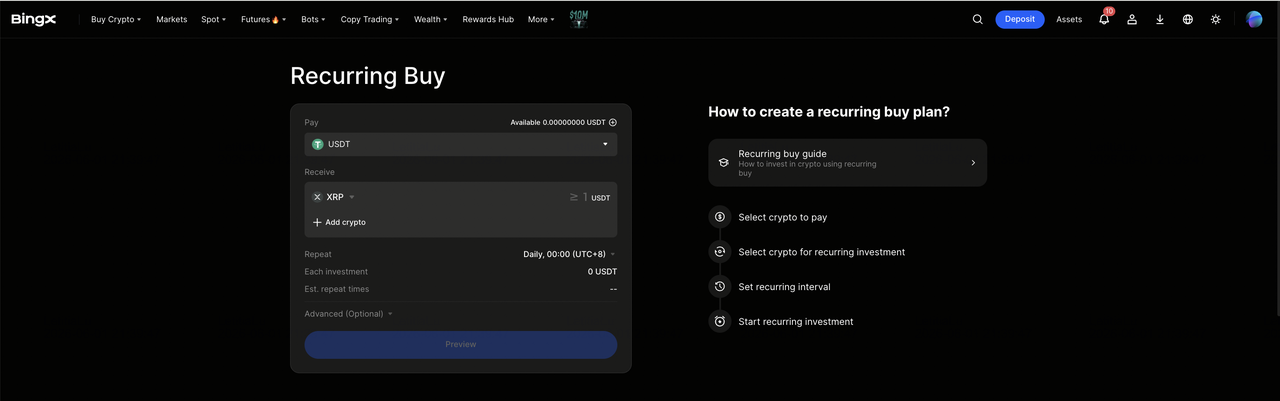
Step 1: Select XRP as the target asset. Open the recurring buy or DCA feature on BingX and choose XRP as the cryptocurrency to accumulate.
Step 2: Set amount and frequency. Enter the fixed amount to invest each time and choose the purchase schedule, such as weekly or monthly.
Step 3: Confirm the funding source. Make sure your selected wallet or payment source has enough balance to support the recurring purchases.
Step 4: Review and activate the plan. Check the asset, amount, frequency, and execution details, then confirm the DCA plan.
Step 5: Monitor and adjust when needed. Review the plan periodically and adjust the amount or frequency based on your budget, market outlook, or investment goals.
Final Thoughts: Should You Invest in XRP in 2026?
XRP has evolved from a fast cross-border settlement asset into one of the most institutionally recognized cryptocurrencies. With U.S. regulatory clarity, spot ETFs, Ripple’s RLUSD stablecoin strategy, and growing tokenization activity on the XRP Ledger, XRP now sits at the intersection of payments, liquidity, and institutional blockchain infrastructure.
For anyone evaluating XRP in 2026, the key is to understand both the opportunity and the trade-off. XRP is used for transaction fees, settlement, and liquidity on the XRP Ledger, but it also faces questions around validator decentralization, Ripple’s escrow holdings, and whether Ripple’s business growth always creates direct XRP demand. Whether users buy XRP through spot, build a position with DCA, or trade futures, understanding the network behind the asset is essential.
Related Reading
- What Is XRP Ledger Tokenization and Why Is It Growing in 2026?
- What Are the Top 10 XRP Wallets to Store Ripple (XRP) in 2026?
- What Is XRP Cloud Mining and How to Earn Rewards? (2026)
- How to Invest in XRP Ledger (XRPL), a Beginner’s Guide to Buying XRP
- Spot XRP ETFs to Launch on November 13: What Is a Spot XRP ETF?
- Who Owns the Most XRP in 2026? Top 10 XRP Rich List Revealed
