

The global technology landscape in 2026 is undergoing a profound structural realignment. The speculative, high-flying phase of early generative artificial intelligence deployment has given way to an era of strict capital discipline, infrastructure optimization, and aggressive platform monetization. In this macroeconomic climate, corporate value is no longer measured solely by raw frontier model capabilities, but by the efficiency of cloud ecosystems, localized data center scaling, and institutional platform control. At the absolute apex of this institutional enterprise transition stands Satya Nadella, the Chairman and Chief Executive Officer of Microsoft Corporation.
Nadella’s personal wealth accumulation presents a compelling and highly distinct case study within the technology sector. Unlike foundational tech entrepreneurs whose multi-billion-dollar fortunes stem from massive, concentrated founder equity stakes, Nadella’s financial architecture represents the absolute pinnacle of the elite professional manager model. By steering a legacy technology giant through successive mobile, cloud, and machine intelligence transformations, Nadella has secured immense personal liquidity and institutional leverage. As Microsoft navigates the complex capital demands of the 2026 AI compute loop, evaluating Nadella's net worth offers critical insights into modern corporate governance, executive compensation frameworks, and the financial mechanics driving global enterprise software.
Who Is Satya Nadella?
Satya Nadella is an Indian-American engineer and corporate executive who has completely redefined Microsoft’s strategic trajectory over the past decade. Born in Hyderabad, India, Nadella earned a bachelor's degree in electrical engineering from the Manipal Institute of Technology before relocating to the United States to complete a master's degree in computer science at the University of Wisconsin–Milwaukee and a Master of Business Administration (MBA) at the University of Chicago Booth School of Business.
Joining Microsoft in 1992, Nadella spent more than two decades navigating the company’s enterprise and server divisions. He gained critical corporate prominence as the Executive Vice President of Microsoft’s Cloud and Enterprise group, where he masterminded the infrastructure transition of traditional server products into the Azure cloud ecosystem.
In February 2014, Nadella was selected as only the third Chief Executive Officer in Microsoft’s history, succeeding Steve Ballmer. Upon taking the helm, he initiated a dramatic cultural and operational pivot, moving away from the company’s historically rigid, Windows-centric monopoly model toward an open, cloud-first framework. His subsequent leadership saw the execution of highly impactful corporate acquisitions, including LinkedIn, GitHub, and Activision Blizzard, alongside an early, market-defining $13 billion partnership with OpenAI. By anchoring Microsoft at the center of global cloud computing and enterprise AI infrastructure, Nadella engineered a 1,000% appreciation in the company’s common stock over his tenure, establishing himself as one of the most successful corporate executives in industrial history.
How Did Satya Nadella Build His Wealth?
\
While technology founders accumulate wealth linearly through the appreciation of their initial equity pools, Satya Nadella’s financial estate has been systematically constructed over a multi-decade corporate career. His billion-dollar financial status is anchored on four primary macroeconomic pillars:
- High-Scale Executive Compensation Architecture: Nadella’s wealth is built on highly structured, performance-linked compensation packages. Microsoft’s board tied key milestones to total shareholder return (TSR) and commercial cloud revenue growth, allowing his annual pay to scale into the top tier of global corporate executives through large cash and equity awards.
- Disciplined Historical Portfolio Liquidation: Nadella has followed a structured long-term stock divestment strategy instead of holding a static, illiquid share position. Through automated trading frameworks, he has converted major blocks of paper equity into realized gains, diversified cash reserves and private asset holdings.
- Performance-Stock Unit (PSU) Maximization: A large share of Nadella’s accumulated wealth comes from performance-stock units. Microsoft’s strong peer-group performance and cloud execution allowed many of these grants to vest at maximum levels, expanding his share ownership before tax-related liquidations.
- Strategic Cloud Moat Capitalization: Nadella’s shift of Microsoft from a legacy licensing company into a global cloud infrastructure leader tied his personal fortune to one of the stickiest areas of enterprise spending. Azure’s growth and Microsoft’s cloud moat helped protect his equity-linked wealth from broader tech-market volatility.
Satya Nadella’s Net Worth in 2026: Key Estimates
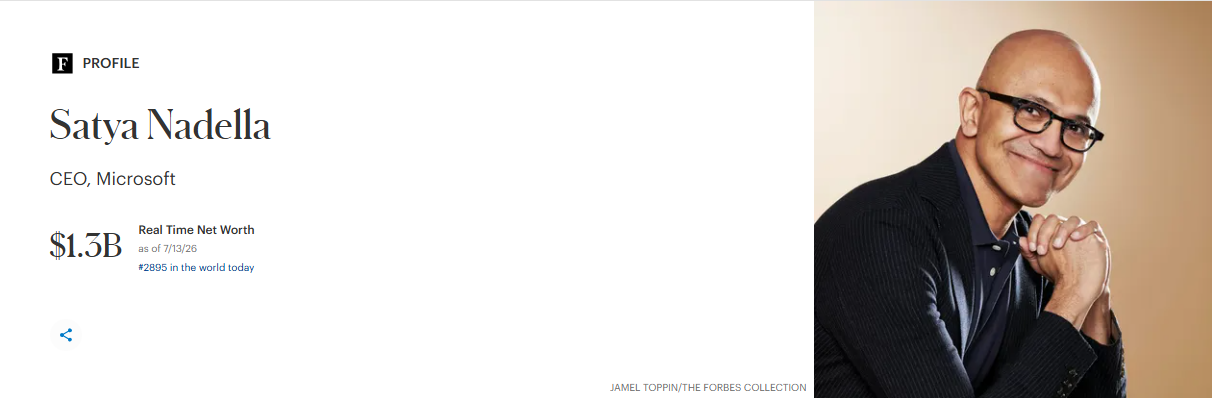
The baseline metrics of Satya Nadella's personal wealth in 2026 establish him firmly within the ranks of the world's elite professional billionaires. Because his net worth is fundamentally driven by a combination of public market equity valuations, structural insider sales, and private asset diversifications, top-tier global wealth trackers evaluate his financial standing through a combination of public SEC disclosures and real-time equity tracking.
Satya Nadella Financial Status Registry (2026)
|
Holding Metric |
Value / Share Count |
Reporting Date / Context |
|
Forbes Verified Net Worth |
$1.3 Billion – $1.56 Billion |
Mid-2026 Registry Index |
|
Global Billionaire Ranking |
Position #2858 – #2918 |
Consolidated Global Wealth Registry |
|
Direct Microsoft Shares Owned |
790,852.378 shares |
Post-September 2025 Form 4 Filings |
|
Indirect Microsoft Shares Owned |
109,720.000 shares |
Family Trust and GST Accounts |
|
Implied Value of Direct Holding |
$304.5 Million |
Calculated at $385.10 share price |
|
Cumulative Share Sales |
Over $700 Million |
Tenure-to-Date Insider Liquidations |
|
Portfolio Fractional Ownership |
≈ 0.01% of outstanding equity |
Microsoft Outstanding Common Stock |
A review of SEC filings shows that Nadella’s wealth comes from direct Microsoft equity, indirect trust holdings and cash reserves built through structured stock sales. Since becoming CEO in February 2014, he has received more than $1 billion in total compensation, supported by Microsoft’s roughly 1,000% stock appreciation during his tenure.
He has also sold more than $700 million in Microsoft shares for financial planning and diversification. This includes a major August 2018 sale of 328,000 shares for $35.9 million. Since 2021, insider records indicate that Nadella has sold about 1.2 million shares, generating an estimated $430 million in liquidity.
By mid-2026, insider tracking data placed his direct Microsoft holdings at roughly 786,875 to 790,852 shares. He also has indirect holdings, including 109,720 shares held through family LLCs and generation-skipping trusts for his children. A June 5, 2024 Form 4 filing showed he gifted interests in a family LLC to two generation-skipping trusts, each holding 7,199 shares.
These transactions are managed through pre-scheduled Rule 10b5-1 trading plans. His largest recent transaction came on September 3, 2025, when he exercised options for 308,870 shares, sold 122,362 shares at $506.69 to cover taxes, and sold another 149,205 shares on the open market for about $75.3 million. Overall, his Microsoft holdings represent roughly 0.01% of the company’s outstanding equity.
How Microsoft’s Stock Price Drives Nadella’s Wealth
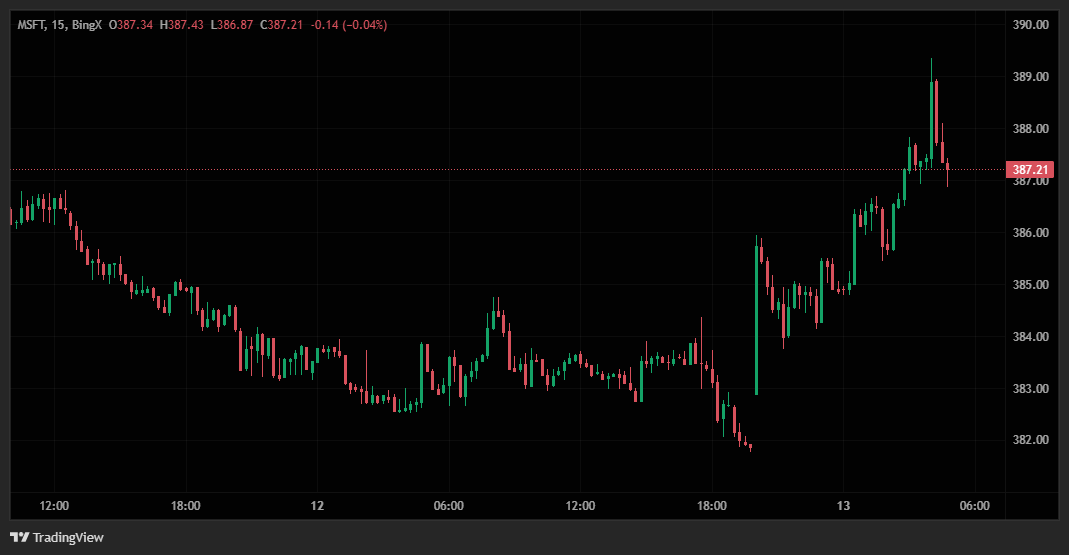
Because the vast majority of Satya Nadella’s net worth is tied up in Microsoft shares, his personal wealth changes rapidly based on how the stock market performs on any given day.
To put it simply, Nadella owns a combined total of approximately 900,572 shares (counting both his direct holdings and indirect family trusts). We can calculate exactly how much his paper wealth shifts when Microsoft’s stock price moves using a straightforward formula:
Change in Wealth = Total Shares Owned multiplied by Change in Stock Price
The Real-World Impact: For every $10.00 shift in Microsoft’s share price, Satya Nadella’s personal paper wealth increases or decreases by over $9 million ($9,005,720). This deep connection to the company's stock performance is fully intentional. It is how the Microsoft board structures his annual pay. According to Microsoft’s official proxy statement for the fiscal year ending June 30, 2025, Nadella took home a total compensation package of $96,496,790. This marked a 22% increase over his 2024 earnings of $79,106,183.
Microsoft Stock Valuation: Strong Fundamentals, Lower AI Multiple
As of mid-2026, Microsoft traded around $385.10 per share, implying a market capitalization near $2.86 trillion based on roughly 7.43 billion shares outstanding. The stock had fallen about 22.9% from its July 31, 2025 peak of $555.45, when Microsoft’s market value reached about $4.13 trillion.
The pullback reflects investor caution around AI infrastructure spending, even as Microsoft’s operating metrics remain strong. On a trailing twelve-month basis, Microsoft delivered 17.9% revenue growth, a 47% operating margin and about $93.7 billion in free cash flow. Its P/E ratio compressed to 22.8x, below Apple’s 37.9x despite Microsoft’s stronger growth and margins.
Two-stage free cash flow to equity (FCFE) models estimate Microsoft’s intrinsic value near $562 per share. Compared with the $385.10 trading price, that implies a market discount of about 31.5%. The gap suggests investors are pricing in higher data center spending, rising capital intensity and possible near-term margin pressure from generative AI infrastructure buildout.
Microsoft’s AI Strategy: Cost Control, Copilot and Platform Ownership
Under Nadella, Microsoft built a dominant AI position through its $13 billion OpenAI investment. By the first half of 2026, the focus had shifted from broad frontier-model deployment to cost control, model efficiency and platform ownership.
That shift became clear when Microsoft canceled internal Claude Code licenses inside its Experiences + Devices division, the unit behind Windows, Microsoft 365, Teams, Outlook and Surface hardware. Effective June 30, 2026, thousands of engineers were moved to GitHub Copilot CLI after token-metered AI usage burned through Microsoft’s internal AI budget ahead of schedule.
Nadella framed this as an enterprise AI efficiency problem. He warned that unchecked frontier-model use is too expensive for broad deployment and urged developers to match tasks with the right model scale. Microsoft applies that logic through Copilot’s “Auto Mode,” while Copilot CLI gives the company tighter control across repositories, CI/CD pipelines and internal security systems.
In his June 2026 essay, A Frontier Without an Ecosystem is Not Stable, Nadella argued that enterprises need their own AI learning loops rather than total dependence on a few frontier-model providers. His framework separates corporate AI assets into human capital, meaning employee judgment and proprietary insight, and token capital, meaning custom AI systems, weights and orchestration layers. The goal is to let companies switch between foundation models without losing internal intelligence or platform sovereignty.
How Does Satya Nadella's Wealth Compare to Other Tech Leaders?
Comparing Satya Nadella's wealth and corporate governance standing in 2026 with his prominent technology peers highlights the vast structural difference between professional executive management fortunes and founder-controlled ownership paradigms. While Nadella is a billionaire with a comfortable net worth of $1.3 billion to $1.56 billion, his personal fortune is several orders of magnitude smaller than that of prominent founders whose wealth is tied directly to concentrated equity stakes.
Elon Musk represents the absolute apex of founder-centric wealth accumulation, with a net worth scaling between $839 billion and $1.053 trillion in mid-2026. This massive valuation was significantly enhanced after SpaceX went public on the Nasdaq, which added an estimated $218 billion to his personal wealth in a single month, placing him on the definitive path to becoming the world's first multi-trillionaire. Musk retains intense operational control over his ventures through a 20% stake in Tesla and a 42% stake in private SpaceX common equity.
Mark Zuckerberg ($194B – $222B) and Jensen Huang ($154B – $173B) also maintain highly concentrated founder-equity models. Zuckerberg controls Meta Platforms through high-leverage dual-class voting structures that grant him absolute operational authority despite holding only a 13% direct economic stake. Huang’s fortune is driven by a 3.0% to 3.6% direct and trust-held stake in Nvidia, which briefly became the first company valued at $5 trillion in late 2025 due to its total dominance in AI silicon infrastructure.
In sharp contrast, private venture-backed AI founders like Dario Amodei and Sam Altman exhibit high paper valuations tied to private venture capital rounds rather than liquid public markets. Amodei’s net worth rose from a $7.0 billion baseline to $15.5 billion in mid-2026 following Anthropic’s massive $965 billion Series H funding round. Amodei controls his company through Class B "golden" voting shares despite holding only a 1.8% fully diluted economic stake.
Sam Altman’s net worth is estimated between $2.0 billion and $5.5 billion. Uniquely, Altman holds 0% direct equity in OpenAI; his wealth is held through independent venture vehicles and a 33.3% stake in the nuclear fusion startup Helion, which reached a $15.5 billion valuation in June 2026.
Sir Demis Hassabis, who runs Google DeepMind as a salaried corporate executive, sits at a net worth of $500 million to $1.0 billion. Hassabis’s wealth is composed of cumulative payouts from the historic 2014 DeepMind acquisition and appreciated Alphabet stock units, reflecting a professional wealth profile that aligns closely with Nadella's corporate executive structure.
Tech Leader Wealth and Governance Matrix (2026)
|
Tech Leader |
Primary Organization |
Estimated 2026 Net Worth |
Equity Control Mechanism |
Core AI Operational Role |
|
Elon Musk |
Tesla / SpaceX / xAI |
$839B – $1.053T |
20% Tesla; 42% SpaceX |
Sovereign compute clusters & data infrastructure |
|
Mark Zuckerberg |
Meta Platforms |
$194B – $222B |
≈ 13% direct; dual-class votes |
Open-source foundational LLaMA models |
|
Jensen Huang |
Nvidia |
$154B – $173B |
3.0% - 3.6% direct & family trusts |
Primary hardware silicon supply & GPU logistics |
|
D Dario Amodei |
Anthropic |
$7.0B – $15.5B |
1.8% economic; Class B shares |
Enterprise-focused safety frontier models |
|
Sam Altman |
OpenAI |
$2.0B – $5.5B |
0% OpenAI; independent VC & Helion |
Consumer app ecosystems & sovereign fund structures |
|
Satya Nadella |
Microsoft |
$1.3B – $1.56B |
≈ 0.01% direct; performance grants |
Cloud integration & multi-model partner ecosystems |
|
Sir Demis Hassabis |
Google DeepMind |
$500M – $1.0B |
M&A payouts; Alphabet GSUs |
Multi-modal science-first fundamental modeling |
Strategic Outlook
The strategic direction established by Satya Nadella through mid-2026 indicates a permanent transition from rapid capital deployment to cost-optimization and platform control. By shifting internal workflows to GitHub Copilot CLI and aggressively managing consumption-based token costs, Nadella has prioritized near-term margin protection. This strict financial discipline directly influences the valuation of Microsoft stock, which in turn acts as the primary driver of his personal wealth.
As the enterprise AI sector continues to mature, Microsoft’s balance sheet remains structured to support capital-intensive physical data center infrastructure rather than highly volatile digital assets. Nadella's framework of human and token capital serves as a strategic roadmap designed to preserve corporate IP and maintain high margin levels, positioning Microsoft to capture sustained enterprise value across the global software ecosystem.
Related Reading
- Top AI Data Center Stocks to Buy in 2026: Cloud, Servers, and AI Compute Infrastructure
- Top AI Hyperscaler Stocks to Watch in 2026: The $700 Billion Cloud Infrastructure Race
- Top AI Cloud Infrastructure Stocks to Buy in 2026 Amid Hyperscaler Capex and the Neocloud Boom
- Top AI Tokenized Stocks to Watch in 2026
- Microsoft (MSFT) Stock Outlook for 2026: Can Azure AI and Copilot Growth Drive MSFT Stock to $550+?
- What Is Ondo's Microsoft Tokenized Stock (MSFTON) and How to Buy It?
FAQs on Satya Nadella’s Net Worth
1. How much is Satya Nadella worth in 2026?
As of mid-2026, Satya Nadella’s personal net worth is estimated to be between $1.3 billion and $1.56 billion. This wealth places him around position #2858 or #2918 on the global billionaires index. His fortune is built primarily on performance-linked executive stock awards and compensation grants accumulated during his tenure as Microsoft CEO.
2. What percentage of Microsoft does Satya Nadella own?
Satya Nadella directly and indirectly controls approximately 0.01% of Microsoft’s outstanding common stock. This exposure comprises between 786,875 and 790,852 directly owned shares, supplemented by 109,720 shares held through family LLCs and generation-skipping trusts established for his children.
3. What is a Rule 10b5-1 trading plan, and how does Satya Nadella use it?
A Rule 10b5-1 plan is a pre-scheduled trading framework established under SEC rules that automatically executes stock sales based on predefined criteria, such as specific dates, price thresholds, or volume metrics. Nadella uses these automated plans to systematically liquidate fractions of his vested Microsoft shares—such as his major transaction on September 3, 2025, at $506.69 per share—to fulfill tax obligations and manage personal portfolio diversification without triggering insider trading concerns.
4. Why did Satya Nadella’s compensation increase significantly in fiscal year 2025?
Satya Nadella’s total compensation package rose by 22% to $96,496,790 in fiscal year 2025. This increase was driven by an expansion in performance-linked stock awards ($84.2 million) and an increased cash bonus of $9,555,000. The board justified this payout by citing strong corporate financial results at 117% of target, high operational assessments at 151.67% of target, and the successful expansion of Microsoft’s cloud and artificial intelligence infrastructure.
5. Does Microsoft hold Bitcoin or other cryptocurrencies in its corporate treasury?
No. Under Satya Nadella’s direction, Microsoft’s Global Treasury and Investment Services team maintains a highly conservative capital allocation strategy focused on stable, liquid assets to fund operational data center infrastructure. A shareholder proposal in December 2024 to add Bitcoin to the corporate treasury reserves was overwhelmingly rejected, receiving only 0.55% of the vote.
6. What does Satya Nadella mean by "tokenmaxxing" and "token capital"?
In the context of Nadella's 2026 strategic publications, "tokens" refer strictly to linguistic computational units utilized by large language models, completely independent of cryptocurrency tokens. "Tokenmaxxing" describes the habit of over-consuming frontier model compute, while "token capital" represents the proprietary AI systems, weights, and software orchestration layers a corporation builds and owns on top of foundational models.
