

Nesa (NES) is a privacy-preserving, verifiable Layer-1 blockchain network purpose-built for executing trustless, decentralized AI inference. Discover how Nesa leverages advanced cryptographic architectures like Equivariant Encryption (EE), Homomorphic Secret Sharing (HSS-EE), and meta-learned inference scheduling to execute heavy machine learning models across commodity hardware, guaranteeing strict data privacy and cryptographic verifiability without relying on centralized tech providers.
As artificial intelligence advances into an omnipresent digital fabric, the critical infrastructure powering it remains dangerously centralized. Traditional machine learning deployment mirrors a black-box monopoly: a handful of mega-corporations control the primary compute pipelines, exposing users to zero privacy guarantees, opaque alterations in output quality, systemic single points of failure, and the unauthorized harvesting of proprietary prompt data.
While generalized blockchain infrastructure has attempted to fill this gap, standard Web3 smart contract protocols are structurally incapable of processing heavy artificial intelligence workloads directly on-chain due to intense latency penalties and prohibitive execution fees. Nesa delivers a specialized solution to these systemic constraints. Built as a native, lightweight Layer-1 blockchain network, Nesa acts as a decentralized execution layer that secures user queries, shreds model bottlenecks, and verifies machine learning computation trustlessly across an interconnected global swarm of commodity devices.
What Is Nesa (NES)?
Nesa is an interactive, privacy-centric decentralized network engineered to host, secure, and run advanced artificial intelligence inference, such as large language models (LLMs), machine learning text classification, and diffusion-based image generation, completely on-chain. Conceived by a technical team of cryptographers and AI researchers from institutions like Harvard, Caltech, and MIT, Nesa targets three fundamental operational flaws within contemporary machine learning ecosystems:
- The Exposure of Sensitive Prompts: Legacy AI models process data in clear, readable plaintext on centralized servers, making standard platforms unusable for compliance-critical sectors like healthcare, law, and finance. Nesa utilizes continuous domain encryption so that raw inputs, weights, and model parameters are never revealed to infrastructure operators.
- The Verification Dilemma: Confirming that an off-chain server accurately ran a specific model with correct weights has historically required duplicating the entire calculation, completely defeating the efficiency of delegating tasks. Nesa solves this via zero-knowledge decentralized proof structures and statistical consensus tracking.
- Prohibitive GPU Gatekeeping: Running production-grade foundational models requires enterprise data centers equipped with ten-thousand-dollar A100 or H100 cards. Nesa democratizes this economy, enabling humble, edge-level hardware, such as standard consumer laptops with as little as 2 GB of RAM, to participate globally via model sharding.
How Does Nesa Work?
The Nesa protocol bypasses the typical black-box cloud model by introducing an end-to-end, horizontally scalable transaction and routing loop. When a decentralized application (dApp) or end-user submits an AI request, it traverses a structured, cryptographic workflow across the network.
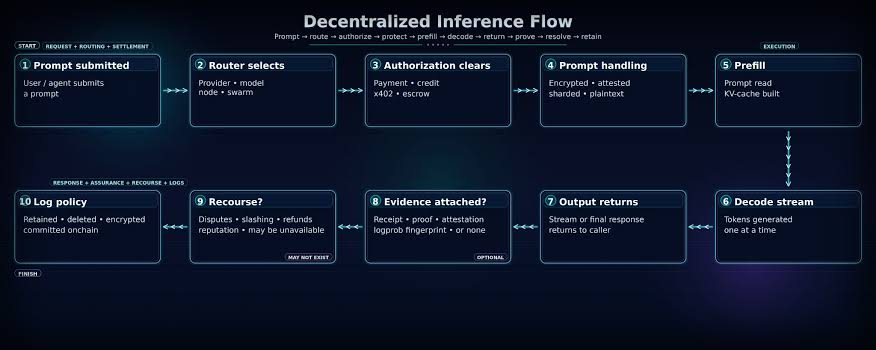
1. Query Submission and Local Embedding
An inference session begins when the user prepares an incoming prompt inside the Nesa Model Playground or an integrated dApp API. The client-side interface encrypts the raw input vector using specialized public keys assigned to decentralized node networks. At this stage, the request is published via a PayForQuery transaction to Nesa's gas-price prioritized mempool.
2. VRF Committee and Shard Selection
Once the transaction clears the queue, Nesa invokes its native Verifiable Random Function (VRF) module. The VRF outputs an unbiased, cryptographic lottery score to dynamically select a random cluster of validation and execution nodes, known as an Inference Committee. This ensures fair task distribution and prevents malicious actors from guessing which nodes will process their tasks to execute collusion attacks.
3. Secure Multi-Party Decryption inside TEEs
For hardware-fortified deployments, committee selection targets Enhanced Nodes equipped with specialized hardware enclaves like Intel TDX, AMD SEV-SNP, or NVIDIA Hopper H100 architectures. The chosen committee executes a threshold cryptosystem process. A secret key is split into n separate evaluations over a randomized polynomial:
p(x) = s + Σ(r_i * x^i) from i=1 to t
Where s represents the shared secret key, and ri are randomly chosen coefficients. No individual machine holds the full key; instead, a threshold of nodes (∣S∣>t) must collaborate via distributed Lagrange interpolation inside secure memory enclaves to decrypt the query ciphertext, isolating the processing data from outside operating systems.
4. The Commit-Reveal Anti-Cheat Protocol
To prevent a critical decentralized exploit known as Free-Riding, where an idle node waits for an honest peer to compute an answer, then lazily duplicates it to collect rewards without expending processing power; Nesa splits execution into distinct sub-phases:
- The Commit Phase: Each node computes its assigned task independently and submits a secure one-way cryptographic hash combining the result with a private random nonce H(m || r). This locks the node's answer in stone while hiding its contents.
- The Reveal Phase: Once all commitments are locked before a strict slot timeout, nodes publish their raw data and nonces. The network cross-checks the unmasked values against the historical commits to enforce independent computation.
Nesa vs. Other DeAI Projects: Core Architectural Innovations
Nesa differentiates itself from earlier decentralized AI networks by embedding math-heavy cryptographic primitives directly into its execution stack.
Equivariant Encryption (EE) and HSS-EE
Rather than choking throughput via heavy Fully Homomorphic Encryption (FHE) operations, Nesa builds on Equivariant Encryption (EE). This unique scheme applies high-dimensional algebraic transformations directly to neural net layers, allowing operations like ReLU, GeLU, or LayerNorm transitions to execute directly on encrypted vectors without data loss or significant latency overhead.
For maximum compliance-grade security, Nesa couples this with Homomorphic Secret Sharing over Encrypted Embeddings (HSS-EE). HSS-EE splits input data into additive secret shares (x=x1+x2) sent to isolated parallel nodes. The nodes process the shards simultaneously, achieving information-theoretic security where individual machines read nothing but random-looking noise.
MetaInf Meta-Learned Scheduling
No single optimization method (such as continuous batching or prefix caching) consistently delivers the best results across a fragmented, heterogeneous network of nodes. Nesa implements MetaInf, a two-stage meta-learning framework accepted to the main conference of COLM 2025. MetaInf reads real-time semantic data, hardware capacity, and model structures to dynamically predict the highest-performing acceleration strategy on the fly, outperforming traditional machine learning schedulers with an average 1.55× acceleration ratio.
Blockchain-based Sequential Neural Sharding (BSNS)
To accommodate heavy architectures that exceed the fast-memory limits (SRAM) of single devices, Nesa applies BSNS. This protocol maps complex directed acyclic graphs (DAGs) into distinct block partitions, such as a 32-layer LLM cut into discrete layer segments. Nodes form an orchestrated execution swarm where individual machines process a localized block shard and stream intermediate activations down the network. If an edge node fails mid-inference, a dynamic rebalancing algorithm instantly restructures the topology to prevent throughput bottlenecks.
Nesa vs. Alternative Data and AI Infrastructure: Key Differences
|
Feature |
Nesa (NES) |
Bittensor (TAO) |
SingularityNET (AGIX) |
Centralized APIs (OpenAI) |
|
Execution Layer |
On-Chain Privacy Native |
Off-Chain Open Market |
Off-Chain Wrappers |
Centralized Black-Box |
|
Privacy Mode |
Cryptographic (EE/HSS-EE) |
Plaintext Output |
Plaintext / Node Trust |
Opaque Data Mining |
|
Hardware Barrier |
Low (Democratized Laptop) |
High (GPU Mining Rigs) |
Variable |
Proprietary Data Centers |
|
Verification |
zkDPS & Commit-Reveal |
Peer-to-Peer Ranking |
Reputation Tracking |
No Auditing Available |
|
Core Infrastructure |
Lightweight Cosmos + WASM |
Custom Blockchain |
Multi-Chain Framework |
Monopolized Cloud |
What Can You Build on Nesa?
Nesa’s infrastructure decouples decentralized artificial intelligence execution from standard deployment limitations, opening a broad ecosystem for sovereign AI applications:
Decentralized AI Applications (DAIs)
A DAI acts and functions exactly like a mainstream software platform but runs natively on Nesa's decentralized inference protocol. Developers can launch DAIs without managing underlying web servers or scaling hardware, while users gain transparency via staking-based credibility scores.
The DNA X Ecosystem
As Nesa's inaugural first-party application showcase, DNA X allows creators to mint autonomous digital personality agents as unique, 1-of-1 NFTs. Each digital being functions via a dedicated AI Kernel on Nesa. Unlike static chatbots, a DNA possesses long-term memory streams that alter its perspective, conversational style, and knowledge base in real-time by fine-tuning models via task-specific adapter parameters as conversations evolve.
What Is Nesa (NES) Tokenomics?
The economic cycle of the network relies on the native utility asset, NES, which anchors the decentralized query marketplace.
NES Token Utility Profiles
- Network Gas and Query Fees: Users pay for incoming inference tasks using stablecoins or raw NES tokens via PayForQuery calls. A portion of the fee covers flat transaction validation, while the remainder compensates the execution nodes.
- Miner Staking Requirements: Miners must stake a bonded pool of NES tokens to secure a spot in the active inference rotation. This ensures they maintain a distinct skin-in-the-game incentive; if a node outputs intentionally corrupted tensors or fails the Commit-Reveal timeframe, its stake is automatically slashed.
- Model Monetization: AI developers who upload proprietary or open-source weights to Nesa's global repository receive automated protocol-level compensation in NES every time their model kernel is queried.
Supply and Emissions Framework
Nesa deployed its official public Mainnet on May 9, 2026, generating a maximum fixed cap of 1,000,000,000 (1 Billion) $NES tokens at genesis. The asset architecture leverages a decaying inflation protocol, starting higher (8%) to fuel early node adoption and gradually tapering down to a long-term stability floor of 1.8% annually. Approximately 40% of the genesis allocations are strictly cordoned off for community ecosystem expansion, liquidity initiatives, and incentivized mainnet testing cycles.
NES Token Distribution
- Ecosystem and Community Allocation (39.83%): The largest structural share, designated to incentivize long-term network growth, developer grants, strategic partnerships, and decentralized community rewards.
- Genesis Allocation (25.55%): Reserved to fuel early launch and trading infrastructure, distributed across exchange listings (4.85%), localized market liquidity (4.8%), user airdrops (4.05%), a public sale (1%), and future protocol activations (10.85%).
- Investors Allocation (14.62%): Distributed to pre-seed, seed, and Series A backers who financed Nesa's multi-year deep-tech research and early development phases.
- Core Team Allocation (10.00%): Locked under strict vesting conditions to support ongoing blockchain optimization and ensure long-term alignment for the engineering team.
- Initial Core Contributors Allocation (10.00%): Dedicated to rewarding the project's original founders and early cryptographic architects.
How to Trade Nesa (NES) on BingX
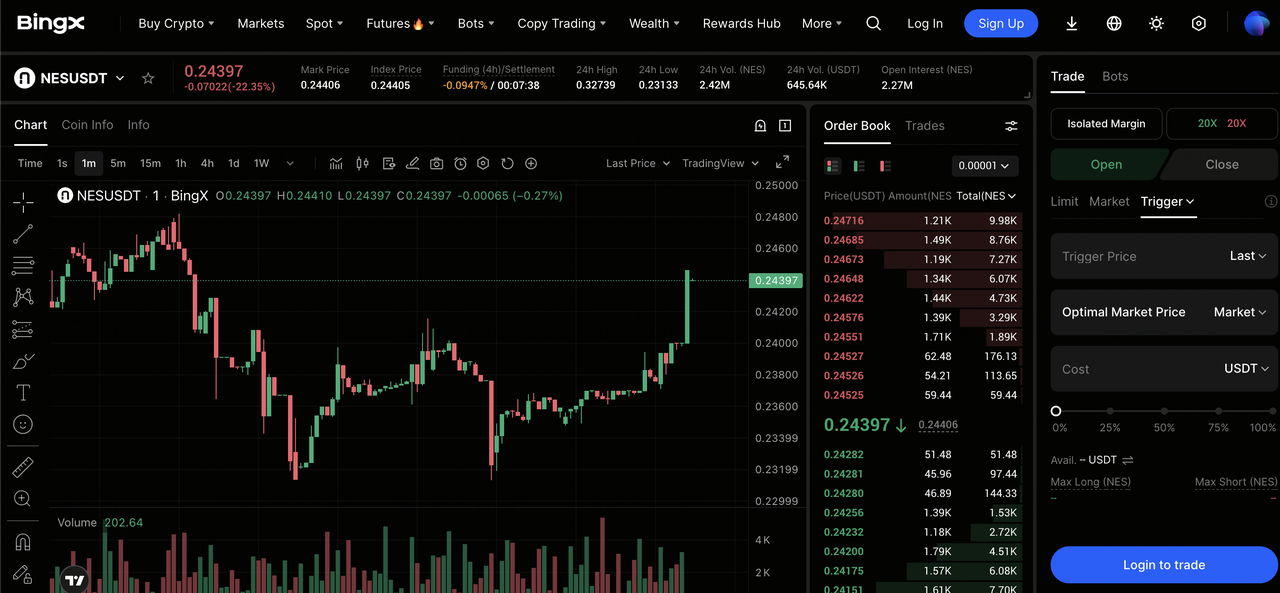
NES/USDT perpetuals on BingX futures market
Leveraging the sophisticated BingX AI-driven derivatives ecosystem, you can optimize capital efficiency by trading native Nesa liquidity distributions with institutional-grade tools. Follow this concise step-by-step guide to trade the NES/USDT Perpetual Futures contract with flexible leverage:
- Access the Futures Derivative Suite: Log into your verified BingX account, hover over the Futures navigation header, click Perpetual Futures, and input NES into the upper-left contract search bar to synchronize your interface with the active market layout.
- Capitalization and Collateral Routing: Ensure your Futures Account holds an adequate margin allocation of Tether (USDT). If your liquidity is positioned in separate ledgers, perform an instantaneous, zero-fee internal transfer to move funds from your Fund or Spot account directly into your Perpetual Futures wallet.
- Configure Leverage and Margin Mechanics: Select your cross-network risk preference by toggling between Isolated Margin, confining risk strictly to the individual trade, and Cross Margin, utilizing your entire account equity to prevent liquidations. Adjust your desired leverage multiplier using the slider tool, ensuring your configuration aligns with proper risk parameters.
- Define Position Parameters and Execute: Navigate to the transaction setup module on the right-hand panel to structure your entry using a Limit Order for a precise manual price target, or a Market Order to fill your position immediately at the best available order-book depth. Specify your total margin allocation, set your hardcoded Take-Profit (TP) and Stop-Loss (SL) risk guards, and select Buy/Long to speculate on upward price momentum, or Sell/Short to capture downward market trends.
5 Critical Considerations Before Investing in Nesa (NES)
Before allocating capital to $NES or setting up a local node machine, weigh these operational risk parameters carefully:
- Evaluation and Status Updates: Key components of Nesa’s advanced cryptographic stack (such as the specific parameters for dynamic BSNS sharding over arbitrary graphs) are under active development and iterative evaluation. Early mainnet phases may feature code adjustments as the environment matures.
- Network Uptime Commitments: While hardware requirements are intentionally low to encourage home laptop hosting, node operators must maintain stable internet connectivity. Frequent disconnections drop the node's Reputation Score (R∈[0.1,10]), actively reducing future task assignment tiers.
- The Complexity of the Inflation Decay: The tapering token issuance model relies heavily on consistent, organic query volume. If enterprise query adoption lags behind early network expansion, the circulating token supply could experience short-term sell-side pressure.
- The Single-Server Fallback Assumption: While advanced multi-party HSS-EE protocols split trust across independent servers, vanilla Equivariant Encryption assumes a single-server deployment. Users must configure their advanced query parameters carefully to match their specific confidentiality needs.
- Early Market Volatility: As a young, specialized Layer-1 emerging onto major secondary markets in mid-2026, NES is subject to intense liquidity shifts and speculative volatility. Capital allocations should fit within an appropriate risk-management strategy.
Final Thoughts: Is Nesa a Good Investment?
Nesa represents a foundational architectural evolution, separating itself from legacy, blockchain-adjacent projects by redesigning artificial intelligence execution from the ground up. By combining Equivariant Encryption, threshold cryptography, and automated MetaInf scheduling, the protocol proves that secure, blind, and verifiable machine learning inference can run practically across distributed commodity devices without sacrificing execution speed.
Ultimately, Nesa's long-term enterprise viability hinges on developer traction within its Model Playground, the commercial scaling of native dApps like DNA X, and its ongoing interoperability across established Web3 data layers.
Risk Reminder: Engaging with early-stage Layer-1 protocols, decentralized artificial intelligence networks, and distributed cryptographic utility tokens involves high operational, technological, and market risks. Always protect your private credentials and perform meticulous due diligence before deploying funds or hosting infrastructure. BingX bears no responsibility for external architectural choices or financial trading outcomes.
Related Reading
- What Are the Top 10 AI Crypto Projects to Watch in 2026?
- What Is Autonomi (ANT)? The Decentralized Data Layer for the Agentic Era
- What Is Gensyn (AI)? Discover Decentralised Protocol for AI and How To Trade It On BingX
- What Is Allora (ALLO), the Decentralized AI Network Powering Collective Intelligence?
- What Is Dolphin (POD) Decentralized AI Inference and How to Buy on BingX?
