
The tokenization of real world assets (RWAs) represents one of the most promising intersections of traditional finance and blockchain technology. Projections from the World Economic Forum indicate that the tokenization of RWAs could exceed US$10 trillion and account for 10% of global GDP by 2027. MANTRA Chain emerges as a pioneering platform in this space, positioning itself as the world's first dedicated RWA Layer 1 blockchain.
A Layer-1 (L1) blockchain is the base network that records and finalizes transactions on its own chain. Think Bitcoin, Ethereum, Solana, BNB Chain, or TRON. Every transfer, swap, or smart-contract call is written into blocks on this mainnet, and you pay fees on the chain's native coin, such as BTC, ETH, SOL, BNB, or TRX. With a strong emphasis on regulatory compliance, multi-virtual machine (MultiVM) support, and institutional-grade infrastructure, MANTRA enables the secure and compliant digitization of assets such as real estate, commodities, private credit, and tokenized funds. This article explores the core aspects of MANTRA Chain, its native token, and practical steps for acquiring the MANTRA token.
Read more: What Are the Top Layer-1 (L1) Blockchains to Know in 2026?
What Is MANTRA (MANTRA)?
Source: MANTRA
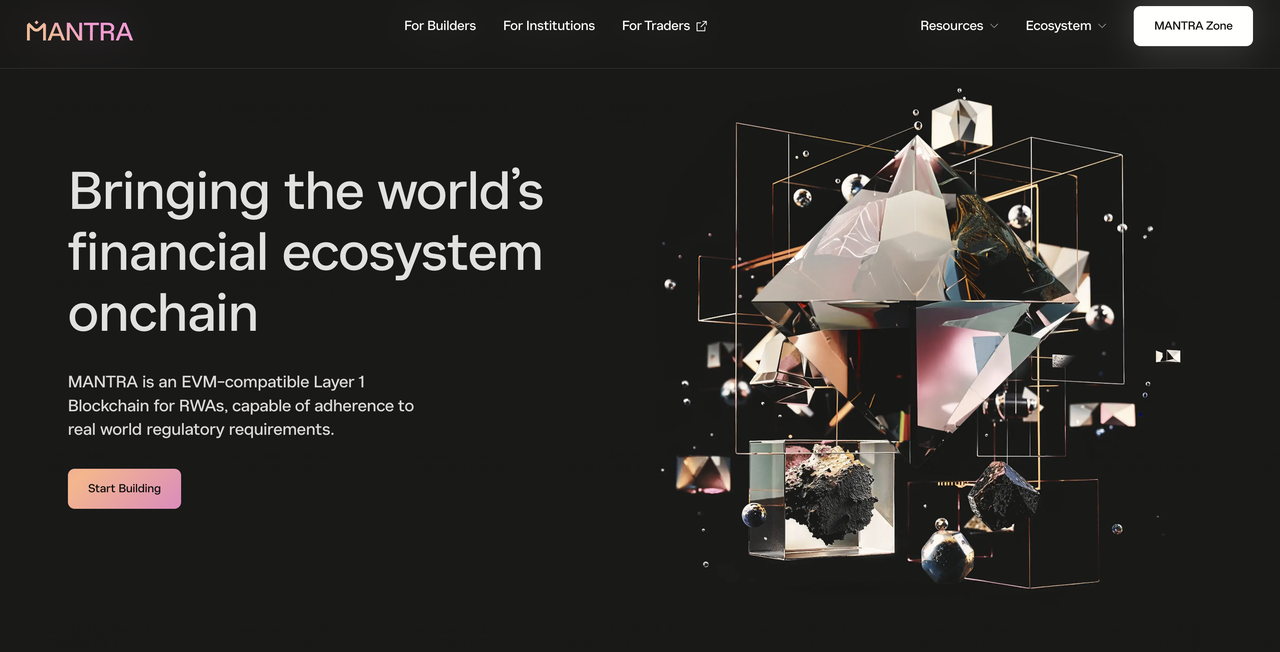
MANTRA Chain is a modular Layer 1 blockchain specifically engineered for decentralized finance (DeFi) and RWA tokenization, featuring full compatibility with the Ethereum Virtual Machine (EVM) alongside native CosmWasm support, making it a true MultiVM platform. It functions as a permissionless blockchain that supports permissioned applications, allowing developers and institutions to embed compliance directly at the chain or smart contract level. MANTRA Chain hosts MANTRA Finance, the only onchain portal holding a DeFi license from Dubai's Virtual Assets Regulatory Authority (VARA), which operates as a regulated virtual asset exchange. The platform provides regulatory pathways through additional licenses for broker-dealer and VA management services.
Launched on mainnet in October 2024, MANTRA Chain pioneered the first RWA-focused Layer 1 testnet in November 2023 and has since evolved to support a growing ecosystem of permissionless DeFi protocols, including NFTs, vaults, decentralized exchanges, and other onchain solutions. Its vision centers on becoming the ledger of record for RWAs by offering an end-to-end ecosystem for the full lifecycle of tokenized assets.
Read more: Top 10 Blockchains for Real‑World Asset (RWA) Tokenization Projects in 2025
What Are the Key Features of MANTRA Chain?
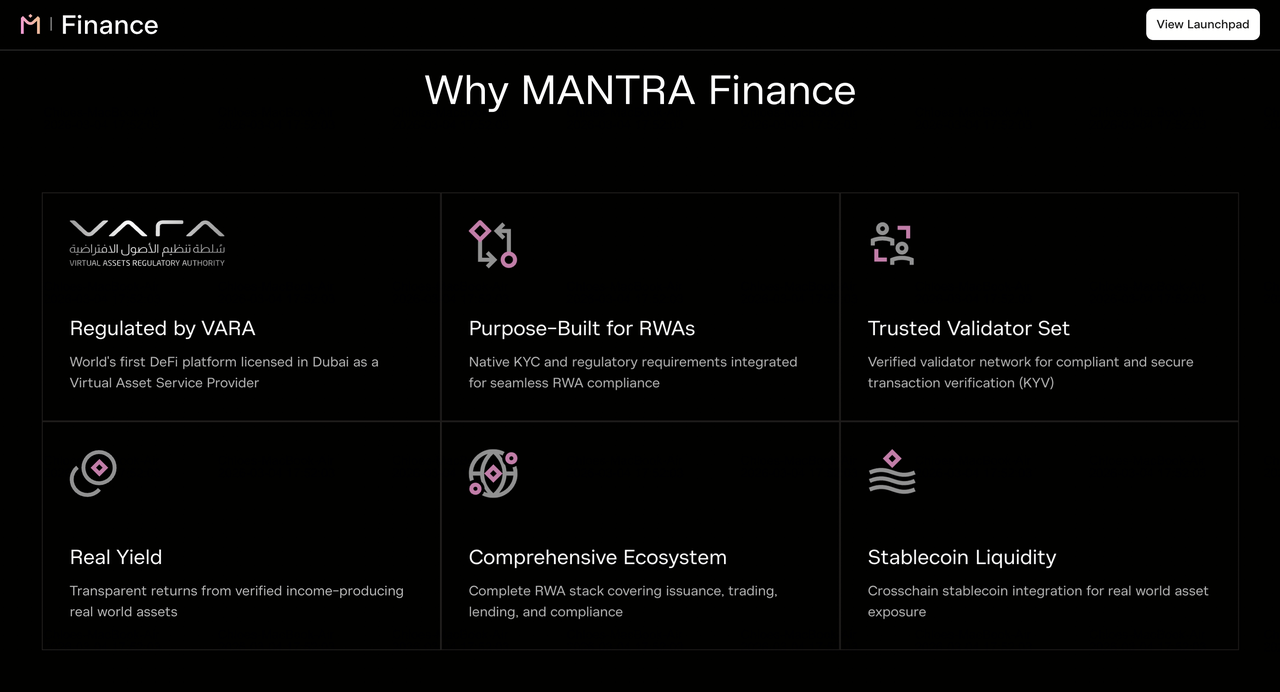
MANTRA Chain stands out through several institutional-focused features designed to bridge traditional finance with blockchain. Onchain compliance enables adherence to real-world regulatory requirements, including KYC, AML, and securities laws, supported by a decentralized identity system (DID) for secure, reusable user verification. Plug-and-play tokenization provides streamlined solutions that meet traditional finance standards, simplifying RWA deployment.
Counterparty risk mitigation ensures tokenized assets transfer only to verified participants via integrated DIDs. Interoperability is achieved through native IBC protocols and cross-chain bridges, facilitating multi-chain asset movement in a MultiVM environment. Security relies on a validator cohort that includes banks, custodians, and established providers, offering institutional custody and staking options.
High throughput combined with low transaction fees enhances accessibility for both retail and institutional users, while custodial integrations with regulated digital asset providers streamline regulatory reporting. These attributes make MANTRA particularly appealing for compliant RWA tokenization across jurisdictions.
Who Created MANTRA Blockchain?
MANTRA originated in 2020 as a DeFi project with the launch of its ERC-20 token OM in August of that year. Initially focused on asset tokenization and regulatory compliance, the project evolved significantly through close collaboration with regulators and financial institutions. By September 2022, the team shifted toward building a purpose-built RWA Layer 1 blockchain.
A community-led proposal in February 2024 unified the original OM token as the native staking coin for MANTRA Chain, leading to the deprecation of the ERC-20 supply in January 2026 and full migration to mainnet. The mainnet launched on October 10, 2024, with public announcement on October 23, 2024. The project has since undergone upgrades, including the addition of native EVM support in the v5.0.0 Abunnati Upgrade and a transition to MultiVM capabilities, solidifying its position as a leader in compliant RWA infrastructure.
What Is the MANTRA Token and What are Its Tokenomics?
The MANTRA token (formerly OM) serves as the native staking coin of MANTRA Chain, facilitating network security, governance, and ecosystem participation. Originally launched with a hard cap of 888.89M OM as an ERC-20 token, it evolved through community governance. Mainnet launched with a total supply of 1.78 billion OM at genesis in October 2024, mirroring the legacy supply and allocating portions for ecosystem incentives, contributors, investors, and more.
Community-approved tokenomics in October 2024 reduced inflation to 3% and extended vesting periods. A significant upgrade occurred around March 2, 2026, with a 1:4 non-dilutive token split and ticker change from OM to MANTRA, expanding the maximum hard cap to 10B MANTRA tokens proportionally.
Genesis allocations included 67.5% for OM upgrade (with mirrors and incentives), 12.8% for the MANTRA Chain Association, 16.9% for core contributors (with 5-year vesting), and smaller portions for ecosystem, pre-seed, seed, and airdrops. As of early March 2026, the circulating supply stands at approximately 4.76 billion MANTRA tokens, with market data showing a live price around $0.023 and a market capitalization exceeding $110 million, reflecting strong post-upgrade momentum.
How to Trade MANTRA (MANTRA) on BingX Spot: Step-by-Step Guide
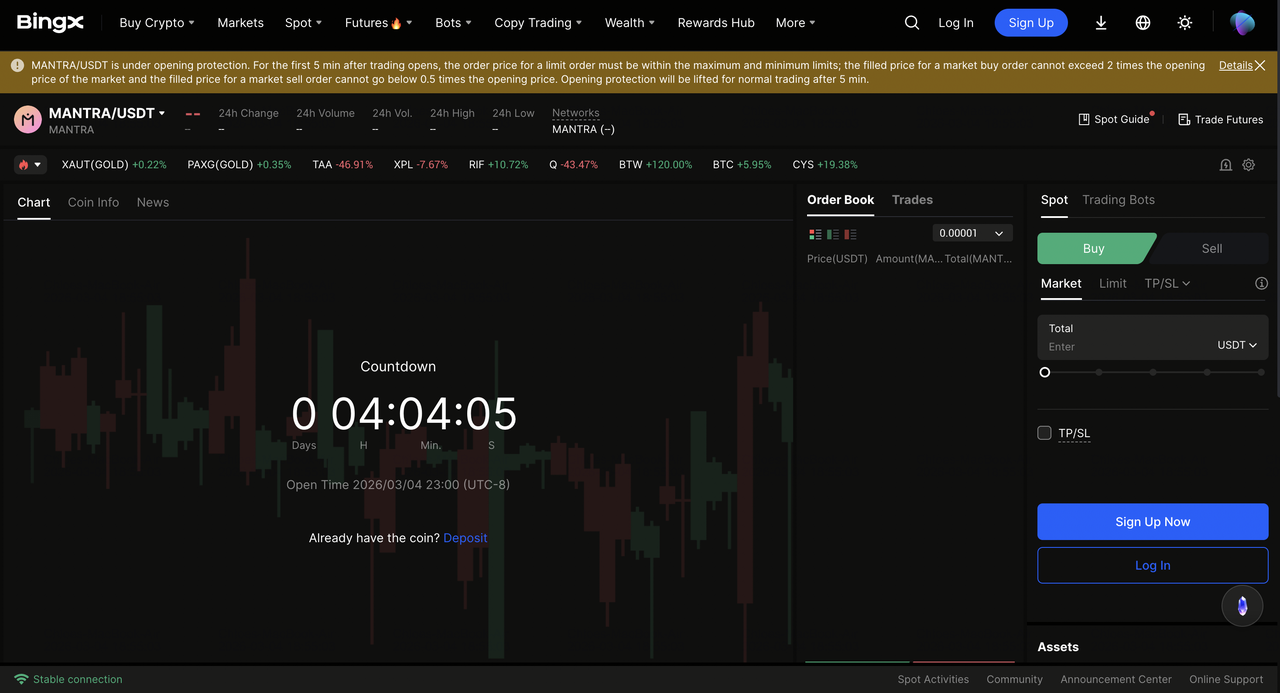
MANTRA/USDT Trading Pair on the BingX Spot Market
For traders seeking direct exposure to MANTRA's narrative-driven price movements, the BingX Spot market provides a transparent, order-book-based entry point:
1. Fund Your Account: Ensure your Spot Account is funded with USDT
2. Find the Pair: Search for MANTRA/USDT in the Spot market
3. Execute: Use a Limit Order to target key support levels during sentiment-driven pullbacks or a Market Order to capture momentum
How to Long or Short MANTRA Perps on BingX Futures: Step-by-Step Guide
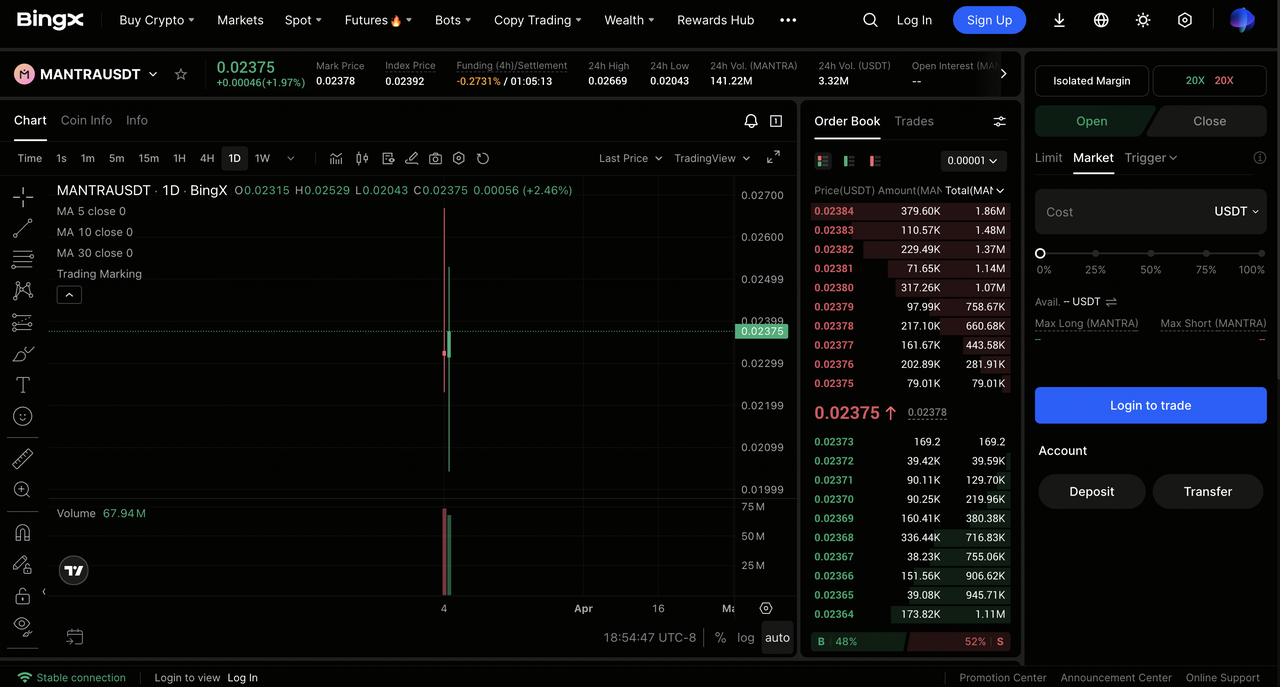
MANTRAUSDT on BingX Futures
BingX provides access to MANTRA through its perpetual futures market (specifically the MANTRAUSDT linear perpetual contract), allowing traders to open long or short positions with leverage to speculate on price movements.
1. Register or log in to your BingX account on the official website or mobile app. If you are a new user, complete the registration process using your email or phone number.
2. Complete any required identity verification (KYC) and security setups, such as enabling Google 2FA, to unlock full futures trading access.
3. Fund your account by depositing USDT via blockchain transfer, fiat purchase, or quick buy options. Navigate to Assets > Deposit or Buy Crypto to add funds to your main Funding account.
4. Transfer funds from your Funding account to your USD-Margined Perpetual Futures account (USDⓢ-M). Go to Assets > Futures Account > Perpetual Futures, then select Transfer and move USDT to the futures wallet for trading.
5. Navigate to the Futures section on the BingX platform. Hover over or tap Derivatives or directly select Perpetual Futures/USDⓢ-M, then search for and select the MANTRA/USDT perpetual contract.
6. Configure your trading settings on the order panel: Choose margin mode (Isolated or Cross), position mode if applicable, and set your desired leverage, up to 25x available for MANTRAUSDT in pre-launch phases; adjust carefully based on risk.
7. Decide on your position direction. Select Long to buy, expecting price increase) or Short to sell, expecting price decrease. Choose an order type such as Market for instant execution at current price or Limit to set specific entry price.
8. Enter the order details, including amount (by quantity, cost, or notional value), optional Take Profit (TP) and Stop Loss (SL) levels for risk management, then confirm and place the order to open your position.
9. Monitor your open positions, unrealized PnL, and margin levels in the Positions tab. Adjust or close positions as needed by selecting Close Long/Short or using market/limit orders.
10. Manage risk throughout by using stop-loss orders, avoid over-leveraging, and stay aware of funding rates (settled every 8 hours for perpetual contracts) and market volatility. Always trade responsibly, as futures involve high risk of loss.
5 Key Considerations Before Trading MANTRA
Before investing in or trading MANTRA, it is essential to evaluate its unique position as a regulatory-first blockchain and the specific mechanics of its recently updated tokenomics.
1. Regulatory Compliance and Licensing: MANTRA distinguishes itself by being purpose-built for regulated Decentralized Finance. It holds a DeFi license from Dubai’s VARA, making it a primary choice for institutional users who require KYC/AML compliance and decentralized identity (DID) verification to trade RWAs.
2. Recent Token Migration and Split: Investors should be aware of the significant protocol upgrade that occurred around March 2, 2026. This involved a 1:4 non-dilutive token split and a ticker change from OM to MANTRA, which increased the maximum supply cap to 10 billion tokens; ensure you are looking at the most current contract and pricing data.
3. RWA Market Growth Projections: The value proposition of MANTRA is heavily tied to the broader adoption of RWA tokenization. With projections suggesting the RWA sector could account for 10% of global GDP by 2027, MANTRA's success depends on whether it can capture a significant share of this multi-trillion-dollar market compared to other Layer 1 competitors.
4. Staking and Inflation Mechanics: Following the mainnet launch and subsequent governance votes, MANTRA transitioned to a low-inflation model of approximately 3%. The token serves as the native staking coin for network security, meaning long-term holders should consider staking to offset inflation and participate in governance.
5. Multi-Virtual Machine (MultiVM) Compatibility: MANTRA is engineered for high interoperability, supporting both the Ethereum Virtual Machine (EVM) and CosmWasm. This dual compatibility allows it to attract developers from both the Ethereum and Cosmos ecosystems, which is a critical factor for the network's liquidity and application growth.
Read more: Risk Management in Crypto Trading: 7 Rules Every Trader Must Know
Conclusion: Should You Trade MANTRA (MANTRA) Token?
MANTRA Chain represents a forward-thinking approach to RWA tokenization by combining regulatory compliance, MultiVM flexibility, and institutional-grade tools within a high-performance Layer 1 blockchain. Its evolution from a DeFi project to a specialized RWA ecosystem, bolstered by key milestones like mainnet launch, MultiVM upgrades, and the recent token rebrand, positions it as a frontrunner in bridging traditional and onchain finance. The MANTRA token underpins this network, offering utility in staking, governance, and ecosystem growth. As the RWA sector continues to expand rapidly, MANTRA provides a compliant and accessible pathway for institutions, developers, and users alike.
Related Reading
1. What Are the Top Layer-1 (L1) Blockchains to Know in 2026?
2. Top 10 Blockchains for Real‑World Asset (RWA) Tokenization Projects in 2025
