The global artificial intelligence landscape in 2026 is undergoing a profound structural realignment. The speculative, high-flying phase of early generative AI deployment has given way to an era of strict capital discipline, infrastructure optimization, and aggressive platform monetization. In this macroeconomic climate, corporate value is no longer measured solely by raw frontier model capabilities, but by the efficiency of cloud ecosystems, localized data center scaling, and institutional platform control. At the absolute apex of this foundational enterprise transition stands Liang Wenfeng, the billionaire founder of the quantitative hedge fund giant High-Flyer Quant and the pioneer of the artificial intelligence laboratory DeepSeek.
Liang’s personal wealth accumulation presents a compelling and highly distinct case study within the technology sector. Unlike legacy corporate tech executives whose fortunes are built on multi-decade corporate ladders, and Silicon Valley AI founders whose stakes are aggressively diluted by venture capital, Liang’s financial architecture represents the absolute pinnacle of concentrated equity ownership. By anchoring himself to a massive, tightly controlled equity block and leveraging a highly lucrative "quant-to-AI" pipeline, Liang has secured immense personal liquidity and institutional leverage. As the global technology market prices the next generation of intelligence infrastructure, evaluating Liang's net worth offers critical insights into modern asset concentration, corporate governance, and the financial structures driving global frontier technology.
Who Is Liang Wenfeng?
Born in 1985 in Wuchuan, Guangdong Province, Liang Wenfeng demonstrated exceptional mathematical and engineering aptitude from an early age. He completed his elite academic training at Zhejiang University, earning a Bachelor of Engineering in Electronic Information Engineering in 2007, followed by a Master of Engineering in Information & Communication Engineering in 2010. His early graduate research specialized heavily in object-tracking algorithms and deep learning computer vision architectures.
Following graduation, Liang pioneered the integration of deep learning neural networks into automated, high-frequency stock trading, co-founding the entity that would evolve into Ningbo High-Flyer Quantitative Investment Management in 2016. Under his guidance as a core strategist, High-Flyer expanded exponentially, crossing the historic CNY 100 billion (~$14 billion) Assets Under Management (AUM) threshold to become one of the largest and highest-performing quantitative hedge funds in the region.
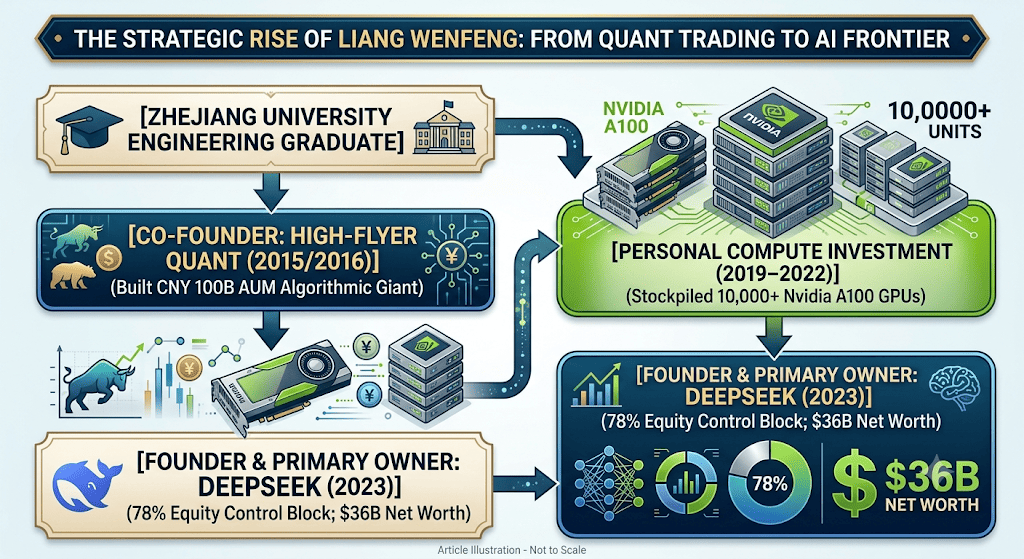
Crucially, between 2019 and 2022, before strict international hardware export restrictions took effect, Liang directed more than $139 million of High-Flyer’s proprietary trading profits toward building the Fire-Flyer supercomputing platform and stockpiling more than 10,000 Nvidia A100 graphics processors. In May 2023, Liang used this private hardware advantage to launch the sovereign large model laboratory DeepSeek, funding the project entirely through his quantitative network before opening it to large-scale external financing.
Liang Wenfeng's Net Worth in 2026: Key Estimates
The baseline metrics of Liang Wenfeng's personal wealth in 2026 establish him as the wealthiest pure-play artificial intelligence model creator in the world. Because his fortune is heavily concentrated within private, high-growth technology equities rather than daily-traded public stock, top-tier global wealth registries evaluate his financial standing through a combination of institutional funding rounds, asset evaluations, and private liquidity adjustments.
1. Liang Wenfeng Financial Status Registry (2026)
|
Wealth Index / Reporting Source |
Valued Net Worth (USD) |
Primary Valuation Anchor |
Methodological Context & Haircuts |
|
Bloomberg Billionaires Index |
$36.0 Billion |
June 2026 Financing Round ($50B Post-Money Benchmark) |
Applies a direct 78% equity calculation to the active $50B mark, plus High-Flyer assets. |
|
Forbes Real-Time Registry |
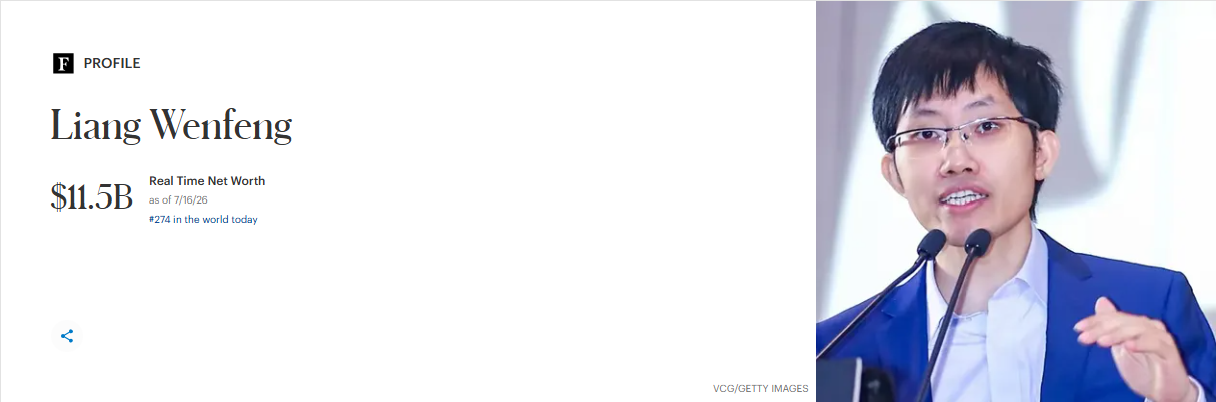
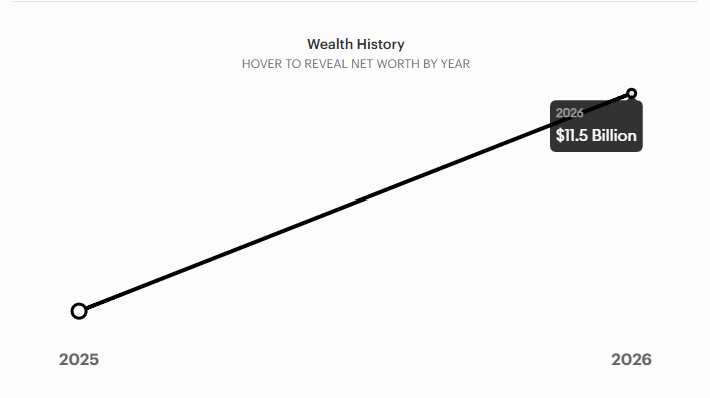
$11.5 Billion |
Pre-Funding Estimates & High-Flyer Capital |
Incorporates conservative discounts for private equity and historic fund assets. |
|
Hurun Global Rich List |
$4.6 Billion |
Early 2026 Cut-Off Valuation Baseline |
Captures the valuation before the massive mid-2026 venture financing cycles. |
|
China National Wealth Ranking |
Position #8 Richer Person |
Consolidated Registry Metrics |
Ranks as the eighth-richest individual nationwide in China. |
According to the latest Bloomberg Billionaires Index update, Liang’s personal net worth reached $36 billion, up $19.9 billion year to date, or more than 120%. The increase followed a major revaluation of his core equity holdings after a private financing round valued his technology assets at $50 billion on a post-money basis.
The extreme variations observed across alternate registries (such as Hurun's early-year $4.6 billion mark) stem entirely from historical tracking cut-offs. They do not account for the massive enterprise monetization velocity that occurred throughout the first half of 2026, nor the full strategic premium of his proprietary token processing pipelines.
2. Deconstructing Liang Wenfeng’s Fortune: Paper Assets vs. Real Capital Liquidity
To accurately evaluate the architecture of Liang Wenfeng's $36 billion fortune, one must look at the explicit breakdown between his illiquid paper wealth and his liquid cash structures.
|
Asset Type |
Estimated Value |
Financial Reality & Capital Mechanics |
|
Core Private Equity Stake |
~$39.0 Billion (Gross Value) |
Paper Assets: Driven by an unprecedented 78% direct ownership stake in his AI enterprise post-dilution. Subject to a mandatory five-year internal lock-up agreement. |
|
Quantitative Fund Reserves |
$2.5B – $3.5 Billion |
Liquid / Semi-Liquid Capital: Derived from his 85% personal equity ownership in High-Flyer Quant’s operating parent entities, managing $8B–$10B in total AUM. |
|
Personal Liquidity Injections |
-$3.0 Billion (Cash Deployed) |
Capital Drawdown: Reinvested out of pocket as a direct cash injection during the mid-2026 funding cycle to preserve absolute voting autonomy. |
Liang Wenfeng’s 78% DeepSeek Ownership and Limited Partnership Control
The defining feature of Liang Wenfeng’s wealth accumulation is his massive retention of equity. In Silicon Valley, technology founders routinely dilute their personal holdings to single-digit percentages (frequently between 1% and 5%) to secure the multi-billion-dollar compute capital required from venture capital firms and hyperscalers.
Liang bypassed this dilution loop entirely. By using the massive proprietary trading profits generated by High-Flyer Quant to self-fund his infrastructure build-out during its first three years, he maintained an ironclad grasp on the corporate structure. Even after opening the firm to institutional capital during a massive $7.4 billion Series A round, Liang personally committed $3 billion in cash out of his own pocket to match incoming capital. Consequently, despite taking on heavy enterprise backers, he successfully retained a staggering 78% ownership block.
How Liang Wenfeng’s LP Structure Preserves Control Over DeepSeek
The core mechanism of Liang’s power is not simply the volume of his paper billions, but the unique legal architecture shielding it. Rather than issuing standard corporate stock with direct board voting seats to external financial backers, Liang structured the multi-billion-dollar inflows into a highly specialized Limited Partnership (LP) model.
Under this corporate governance model, outside corporate and sovereign investors receive economic profit-sharing rights linked to token revenue, but hold zero voting rights regarding daily operations, hardware procurement, or strategic research direction. Furthermore, all private investors accepted a strict five-year lock-up provision, completely protecting Liang’s paper wealth from the short-term speculative liquidation cycles common in Western tech ventures.
How High-Flyer Built Liang Wenfeng’s Wealth and Funded DeepSeek
The foundational engine behind Liang Wenfeng’s multi-billion-dollar status remains Ningbo High-Flyer Quantitative Investment Management. Liang maintains a dominant 85% and 85.15% equity stake in High-Flyer's primary operating entities, Jiuzhang Asset and Ningbo High-Flyer Quant respectively.
High-Flyer functioned as a literal machine learning printing press for capital. By 2021, the firm’s algorithmic trading architecture was completely driven by deep learning neural networks, drawing structural comparisons to Wall Street’s Renaissance Technologies.
Despite severe operational drawdowns in late 2021 that forced a temporary overhaul of its automated risk thresholds, and the strategic shutdown of its market-neutral fund products to eliminate systemic short squeeze risks, the wealth engine recovered massively. High-Flyer posted a stellar 56.6% return, making it the second-best performing large-scale quantitative asset manager in the nation and generating the massive liquid cash reserves that insulated Liang’s personal balance sheet before the transition to frontier hardware scaling.
How Does Liang Wenfeng's Wealth Compare to Other Global AI Leaders?
To understand Liang Wenfeng’s relative position within the broader technology sector, his wealth and corporate control must be compared with other leading global industry executives in mid-2026.
|
Tech Leader |
Primary Enterprise Focus |
Estimated 2026 Net Worth |
Equity Control & Voting Power |
Core Capital Architecture Type |
|
Elon Musk |
Tesla, SpaceX, xAI |
$839B – $1.053T |
~20% Tesla; 42% private SpaceX common equity |
Public / Private Industrial Equity |
|
Mark Zuckerberg |
Meta Platforms, Inc. |
$194B – $229B |
~13% economic stake; 61% voting control |
Public Founder Equity (Dual-Class Stock) |
|
Jensen Huang |
Nvidia Corporation |
$154B – $200B |
3.0% - 3.6% direct & family trust holdings |
Public Hardware Equity Architecture |
|
Chen Tianshi |
Cambricon Technologies |
$35.6B – $40.0B |
28.4% direct equity holding block |
Public Silicon Accelerator Holdings |
|
Liang Wenfeng |
DeepSeek / High-Flyer |
$36.0 Billion |
78% direct ownership; absolute LP control |
Private Pure-Play AI Equity Concentration |
|
Greg Brockman |
OpenAI |
$25.5B – $28.0B |
~3.5% implied equity asset tracking |
Vested Corporate Stock Grants |
|
Dario Amodei |
Anthropic PBC |
$7.98B – $15.5B |
1.8% economic stake; Class B golden shares |
Diluted Private Paper Equity (Super-Voting) |
|
Sam Altman |
OpenAI, Helion Energy |
$2.0B – $3.4B |
0% direct OpenAI corporate equity |
Independent Venture Capital Portfolio |
|
Satya Nadella |
Microsoft Corporation |
$1.3B – $1.56B |
≈ 0.01% direct equity exposure |
Professional Executive Performance Grants |
This comparative matrix illustrates several contrasting financial and governance profiles across the technology landscape:
1. Liang Wenfeng’s 78% DeepSeek Stake vs. Sam Altman and Dario Amodei
The structural gap between Liang Wenfeng and Western AI counterparts like Sam Altman or Dario Amodei highlights a massive divergence in wealth creation. Sam Altman famously holds 0% direct equity in OpenAI, drawing a modest base salary and anchoring his $3.4 billion fortune entirely in independent venture investments like Helion Energy.
Dario Amodei holds an economic stake of only 1.8% in Anthropic. While Amodei protects his leadership via super-voting Class B shares, his liquid net worth is entirely dependent on private venture capital valuation revisions. In contrast, Liang’s 78% direct concentration binds his multi-billion-dollar status directly to the absolute top-line value of the asset, bypassing institutional board vulnerabilities entirely.
2. How Liang Wenfeng’s Owner-Operator Control Sets DeepSeek Apart From Public Tech CEOs
Unlike legacy public corporate executives such as Microsoft CEO Satya Nadella—whose $1.3 billion net worth is built linearly on salary, stock sales, and a tiny 0.01% fraction of corporate grants—Liang operates with total owner-operator autonomy. Public market CEOs are legally bound by strict public board oversight and quarterly earnings pressures. Because Liang's LP model strips outside investors of active governance votes, he has the unique luxury of deploying billions of dollars into long-term technology development without facing external shareholder activist interventions.
DeepSeek’s Web3 Integrations and Algorithmic Trading Performance
The unique intersection between quantitative wealth and algorithmic architectures has naturally extended Liang's strategic presence into decentralized financial frameworks. Because his core technological assets are intentionally deployed under highly permissive, open-weight software licenses, Web3 infrastructure teams and decentralized protocols have integrated his processing pipelines directly into automated smart contract auditing, automated market making (AMM), and permissionless on-chain agentic decision systems.
Furthermore, the robust capital preservation capabilities of his underlying algorithmic trading logic were thoroughly validated during a live, multi-model automated trading challenge. In this event, elite technology models were each allocated $10,000 in active capital and task-routed to execute live trades across highly volatile financial and cryptocurrency markets without human intervention or override switches.
While a baseline model like Alibaba's Qwen3-Max locked in a 22.32% return by utilizing a conservative, low-frequency strategy relying strictly on traditional technical risk boundaries, Liang's DeepSeek-V3.1 architecture deployed a highly sophisticated, mid-leverage strategy characterized by extended holding structures. This algorithmic framework directly reflected the strict capital-preservation and quantitative logic optimized by High-Flyer Quant, significantly outperforming legacy consumer-oriented models that experienced heavy capital drawdowns during market swings.
Related Reading
- How DeepSeek Beat GPT-5 in AI Crypto Trading, And How You Can Use It
- Top AI Data Center Stocks to Buy in 2026: Cloud, Servers, and AI Compute Infrastructure
- Top AI Hyperscaler Stocks to Watch in 2026: The $700 Billion Cloud Infrastructure Race
- What Is Meta CEO Mark Zuckerberg's Net Worth in 2026?
- What is Microsoft CEO Satya Nadella's Net Worth in 2026?
- What is Anthropic Co-Founder Ben Mann's Net Worth in 2026?
FAQs on Liang Wenfeng’s Net Worth
1. How much is Liang Wenfeng worth in 2026?
As of mid-2026, Liang Wenfeng’s personal net worth is verified at $36.0 billion according to the Bloomberg Billionaires Index. This valuation officially designates him as the wealthiest pure-play artificial intelligence model founder globally, ranking him as the eighth-richest person in China.
2. Why does Liang Wenfeng's net worth vary drastically between Forbes and Bloomberg?
The extreme divergence—ranging from Bloomberg’s $36 billion mark down to Forbes’ real-time estimate of $11.5 billion—stems from methodology. Bloomberg incorporates the immediate strategic premium of his 78% ownership stake following a June 2026 funding round. Forbes and other registries frequently apply heavier illiquidity discounts to private shares or anchor their models to historical pre-funding asset data.
3. What percentage of his companies does Liang Wenfeng own?
Liang Wenfeng retains a dominant 78% ownership stake in his primary AI enterprise. Additionally, he maintains an 85% and 85.15% direct equity stake within High-Flyer Quant’s core parent operating entities, Jiuzhang Asset and Ningbo High-Flyer respectively.
4. How did Liang Wenfeng finance his technology infrastructure without venture capital dilution?
Unlike standard technology founders who dilute their initial equity to raise compute capital from hyperscalers, Liang bankrolled his initial infrastructure entirely using the massive proprietary trading profits generated by his hedge fund, High-Flyer Quant. This allowed him to purchase a private moat of over 10,000 Nvidia A100 GPUs before export blocks were implemented, avoiding early-stage dilution.
5. Did Liang Wenfeng invest his own cash during recent venture rounds?
Yes. During the massive $7.4 billion financing round completed in June 2026, Liang personally committed $3.0 billion in cold hard cash out of his own pocket. This aggressive personal cash injection allowed him to maintain his historic 78% equity block despite taking on major institutional outside backers.
6. Does Liang Wenfeng have direct exposure to speculative cryptocurrency tokens?
No. Liang Wenfeng’s multi-billion-dollar fortune is driven strictly by industrial equity assets within quantitative finance and AI enterprise infrastructure. While unauthorized "DeepSeek" community tokens trade highly speculatively on decentralized exchanges, Liang holds no structural connection to, nor financial interest in, these Web3 wrappers.
