
Bitcoin is often described as "digital gold," and the phrase captures its core idea. While later networks like Ethereum were built to be programmable, Bitcoin was designed for one purpose: to move and store value without depending on any bank, company, or government. It is a decentralized network that lets people send money directly to one another, secured by a global network of computers rather than a central authority. This focus on being scarce, secure, and hard to change is why Bitcoin became the foundation of the entire digital asset economy and the asset most investors think of first.
It is also important to separate Bitcoin from BTC. Bitcoin is the decentralized network and payment system, while BTC is the native asset that moves across it, used to transfer value, settle transactions, and serve as a long-term store of value. As of August 2026, BTC trades around $72,000 with a market capitalization near $1.33 trillion, making it the largest cryptocurrency by a wide margin and the benchmark for the whole market. This guide explains what Bitcoin is, how it works, how the halving shapes its supply, how it compares with other blockchains, how BTC's supply economics function, and how to trade BTC on BingX.
What Is Bitcoin?
Bitcoin (BTC) is a decentralized, open-source digital currency and payment network. It was introduced in a 2008 whitepaper by the pseudonymous Satoshi Nakamoto and launched in January 2009, when the first block, known as the genesis block, was mined. The idea was to build a form of money that works over the internet without needing a bank or intermediary to approve, process, or reverse a payment. Instead, a shared public ledger and a global network of participants keep the system honest.
The easiest way to understand Bitcoin is to compare it with Ethereum:
-
Bitcoin: Bitcoin is designed to be a scarce, secure store of value and a way to transfer money without intermediaries. Its scripting capabilities are intentionally limited to keep the network simple, stable, and secure. This narrow focus is a feature, not a limitation.
-
Ethereum: Often described as a "world computer," Ethereum is a general-purpose blockchain platform that can run programmable applications through smart contracts, which is why it became the foundation for DeFi, NFTs, and Layer 2 networks. It trades flexibility for a larger technical surface area.
The trade-off is deliberate. Because Bitcoin does less than a general-purpose blockchain, it has a smaller technical surface area, changes slowly, and prioritizes security and predictability above all else. This conservatism is exactly why many investors treat it as the most reliable digital store of value.
Bitcoin the Network vs. BTC the Coin
-
Bitcoin the network: Bitcoin is the blockchain and payment system where transactions are broadcast, verified, and permanently recorded. It is the infrastructure layer, secured by mining, that lets value move globally without a central operator.
-
BTC the coin: BTC, the native asset of the network, is used to send and receive value, pay transaction fees to miners, and serve as a core store-of-value asset across the crypto market.
How Does Bitcoin Work?
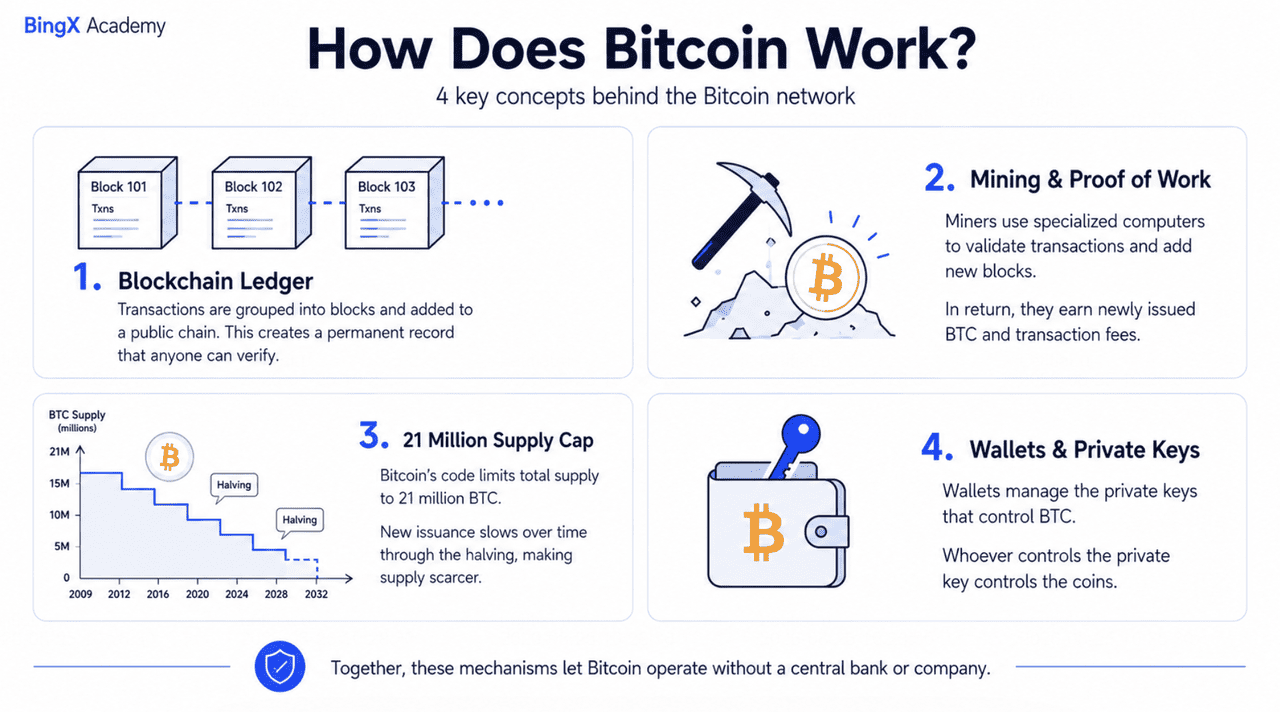
At its core, Bitcoin is a shared global ledger maintained by thousands of computers around the world. It records transactions, tracks ownership, and prevents the same BTC from being spent twice, all without relying on a bank or central server. Four parts explain how the system works:
-
The blockchain records every transaction. Bitcoin transactions are grouped into blocks and added to a public chain of previous blocks. Anyone can verify this history, and once enough new blocks are added, changing an earlier transaction becomes extremely difficult.
-
Mining and Proof of Work secure the network. Miners use specialized computers to compete for the right to add the next block. The successful miner receives newly issued BTC and transaction fees, while the process helps keep the network secure and transactions valid.
-
Bitcoin has a fixed 21 million supply. Bitcoin’s code limits the total supply to 21 million BTC. New coins enter circulation through mining, and the amount issued falls roughly every four years through the halving, making new supply increasingly scarce over time.
-
Wallets and private keys control BTC. Bitcoin wallets do not physically store coins. Instead, they manage the private keys that prove ownership and allow BTC to be transferred. Whoever controls the private key can control the associated Bitcoin, which makes key security essential for self-custody.
Together, these mechanisms allow Bitcoin to operate as a decentralized monetary network without a central company, bank, or government controlling transactions or supply.
What Is Bitcoin Proof of Work?
Bitcoin is secured by Proof of Work (PoW), the consensus mechanism it has used since launch. Under Proof of Work, miners compete with specialized hardware to solve a mathematical puzzle. The first to solve it earns the right to add the next block and collect the block reward plus fees. This competition is what makes the network secure: rewriting history would require an attacker to out-compute the entire honest network, which is prohibitively expensive.
To keep block times steady at roughly ten minutes, the network automatically adjusts mining difficulty every 2,016 blocks, about every two weeks. If more miners join and blocks come faster, difficulty rises; if miners leave, difficulty falls. This self-correcting mechanism keeps Bitcoin's issuance schedule on track regardless of how much computing power is aimed at the network.
Proof of Work shapes Bitcoin in three major ways:
-
Strong security: The enormous amount of computing power securing Bitcoin makes the network extremely resistant to attack, which is central to its reputation as a reliable store of value.
-
Predictable issuance: Difficulty adjustments keep new BTC entering circulation on schedule, reinforcing Bitcoin's fixed and transparent monetary policy.
-
Energy debate: Proof of Work consumes significant energy, which has drawn criticism. Supporters argue this cost is what makes Bitcoin secure and note growing use of renewable and stranded energy in mining.
The main trade-off is that Proof of Work is energy-intensive compared with newer consensus models, and mining has become highly concentrated among large, specialized operations. Supporters view the energy cost as the price of unmatched security and neutrality.
What Is Bitcoin Halving and How Is New BTC Created?
Bitcoin has a fixed supply system built directly into its code. New BTC enters circulation through mining, where miners receive a block reward for adding new blocks to the blockchain. Roughly every four years, or every 210,000 blocks, that reward is cut in half in an event known as the Bitcoin halving. Each halving slows the rate at which new BTC is created until the maximum supply of 21 million is eventually reached.
The halving is important because it controls Bitcoin’s monetary supply without relying on a central bank or company. Instead of changing based on policy decisions, new BTC follows a predictable schedule that becomes more restrictive over time. This decreasing issuance is a key part of Bitcoin’s scarcity and one of the main reasons it is often compared with scarce assets such as gold.
Read More: Bitcoin Post-Halving Cycle: Will BTC Enter a Bull Market or Face a Bear Market Reset in 2026?
| Event | Date | Block Reward | Main Effect |
| Genesis block | January 2009 | 50 BTC | Bitcoin network launches; first BTC issued |
| 1st halving | November 2012 | 50 to 25 BTC | New supply rate cut in half for the first time |
| 2nd halving | July 2016 | 25 to 12.5 BTC | Issuance slows further as adoption grows |
| 3rd halving | May 2020 | 12.5 to 6.25 BTC | Supply tightens ahead of institutional interest |
| 4th halving | April 2024 | 6.25 to 3.125 BTC | Most recent halving; daily issuance roughly halved |
| 5th halving | Expected April 2028 | 3.125 to 1.5625 BTC | Next reduction; daily issuance drops to roughly 225 BTC |
| Final issuance | Around 2140 | Approaches 0 BTC | Last new BTC mined; miners earn fees only |
-
The genesis block (January 2009). Satoshi Nakamoto mined the first block, embedding a newspaper headline about bank bailouts in it, a nod to Bitcoin's purpose as an alternative to the traditional financial system. The block reward started at 50 BTC.
-
The first halving (November 2012). The block reward dropped from 50 to 25 BTC. This was the first live demonstration that Bitcoin's supply schedule would tighten automatically, exactly as programmed.
-
The second halving (July 2016). The reward fell to 12.5 BTC. By this point, Bitcoin had gained wider recognition, and the halving cycle began attracting attention as a recurring market event.
-
The third halving (May 2020). The reward dropped to 6.25 BTC, shortly before a wave of institutional interest and corporate treasury adoption brought Bitcoin further into mainstream finance.
-
The fourth halving (April 2024). The reward fell to 3.125 BTC, cutting daily issuance to roughly 450 BTC. This halving coincided with the growth of US spot Bitcoin ETFs, which reshaped how institutions access BTC.
-
The fifth halving (expected April 2028). The reward is scheduled to drop to 1.5625 BTC, reducing daily issuance to roughly 225 BTC. With more than 95% of all BTC already mined, each future halving affects a smaller and smaller share of remaining supply.
-
Final issuance (around 2140). The last new BTC is expected to be mined around the year 2140, after which miners will be paid entirely through transaction fees rather than block rewards.
How Is Bitcoin Used in 2026? ETFs, Payments, and Institutional Adoption
Bitcoin’s role has expanded well beyond crypto trading. In 2026, it is widely held through regulated investment products, corporate treasuries, and direct ownership, while payment networks such as Lightning make BTC more practical for transfers. Three areas explain how Bitcoin is being used today.
1. Spot Bitcoin ETFs and Institutional Adoption
U.S. spot Bitcoin ETFs, launched in January 2024, gave investors a regulated way to gain BTC exposure without holding Bitcoin directly. By 2026, these funds hold well over $100 billion in assets, while public companies and institutional investors also hold substantial amounts of BTC on their balance sheets.
2. Payments and the Lightning Network
Bitcoin’s base layer prioritizes security and decentralization over transaction speed. For smaller payments, the Lightning Network provides a Layer 2 system that allows users to send BTC quickly and at relatively low cost, while ultimately relying on Bitcoin for settlement.
3. Store of Value and Benchmark Asset
For many investors, Bitcoin’s main role is as a long-term store of value. Its fixed 21 million supply, deep global liquidity, and long operating history support its “digital gold” narrative. BTC also remains the benchmark asset for the broader crypto market, with market sentiment often measured against Bitcoin’s performance.
Together, these uses show why Bitcoin remains central to the digital asset market. It functions as an investment asset, payment and settlement network, corporate treasury holding, and benchmark for the wider crypto economy.
Bitcoin Supply and Tokenomics: 21 Million BTC, Halving, and Scarcity
Bitcoin has one of the simplest and most predictable supply models in crypto. Its total supply is capped at 21 million BTC, and new coins enter circulation only through mining. By 2026, more than 95% of the total supply has already been mined, leaving the remaining BTC to be released gradually over more than a century. This fixed schedule is a major reason Bitcoin is often compared with scarce assets such as gold. BTC supply is shaped by three main mechanisms:
-
Fixed 21 million supply: Bitcoin’s protocol limits the total number of coins that can ever exist. Unlike fiat currencies, new supply cannot simply be created in response to economic conditions or policy decisions.
-
Halving-based issuance: Miners receive newly created BTC as block rewards, but that reward is cut in half roughly every four years. Each halving reduces the amount of new Bitcoin entering the market and makes issuance progressively slower over time.
-
Lost BTC reduces available supply: Some Bitcoin is permanently inaccessible because private keys have been lost, wallets have been abandoned, or early holders can no longer access their coins. This means the amount of BTC actually available to trade may be lower than the total circulating supply.
The key idea is predictability. Bitcoin’s maximum supply and issuance schedule are known in advance, giving the network a transparent monetary policy that does not depend on a central bank or company. For many investors, this combination of fixed supply, declining issuance, and potentially lower effective circulation is one of Bitcoin’s defining long-term characteristics.
How to Trade Bitcoin (BTC) on BingX
BingX offers three practical ways to gain exposure to Bitcoin, depending on whether the goal is direct ownership, short-term trading, or steady accumulation over time. Spot trading is better suited for users who want to buy and hold BTC directly. Futures trading is designed for active traders who want long or short exposure to BTC price movements. Dollar-cost averaging (DCA) is useful for users who want to build a BTC position gradually without trying to time every market move.
Spot Trading: Buy and Own BTC Directly
Spot trading is the most straightforward way to buy Bitcoin on BingX. When users buy BTC on the spot market, they own the asset directly and can hold it in the BingX spot account, transfer it, or withdraw it to a self-custody wallet.
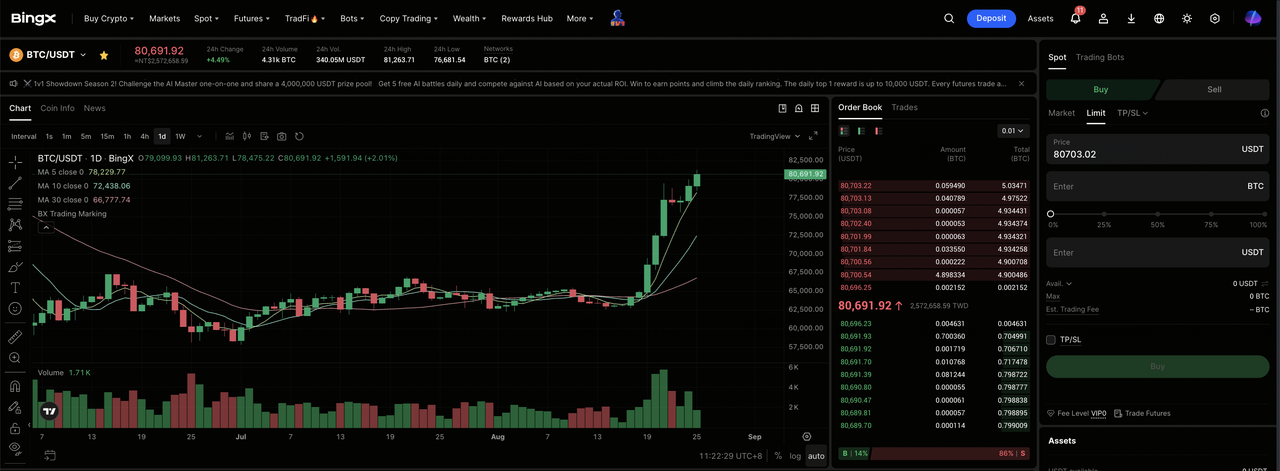
Step 1: Account setup and security. Sign up and log into your BingX account, complete the identity verification (KYC) required in your region, and enable two-factor authentication.
Step 2: Fund your spot account. Deposit USDT or another supported asset into your BingX spot account. Where available, users can also use supported fiat on-ramp options.
Step 3: Navigate to the spot market. Search for the BTC/USDT trading pair.
Step 4: Place your order. Choose a market order to buy BTC immediately at the current price, or use a limit order to set the price you want to pay.
Step 5: Manage your BTC. Once filled, your BTC appears in your spot account. You can keep it on BingX for convenience or withdraw it to a personal wallet for self-custody.
Futures Trading: Trade BTC Price Movements
For active traders, BingX offers USDT-margined BTC perpetual futures. Futures allow users to trade BTC price movements without holding the underlying asset, with the flexibility to open long positions if they expect BTC to rise or short positions if they expect BTC to fall.
Because futures involve leverage, they can amplify both gains and losses. This approach is more suitable for traders who already have a clear risk plan and understand liquidation risk.
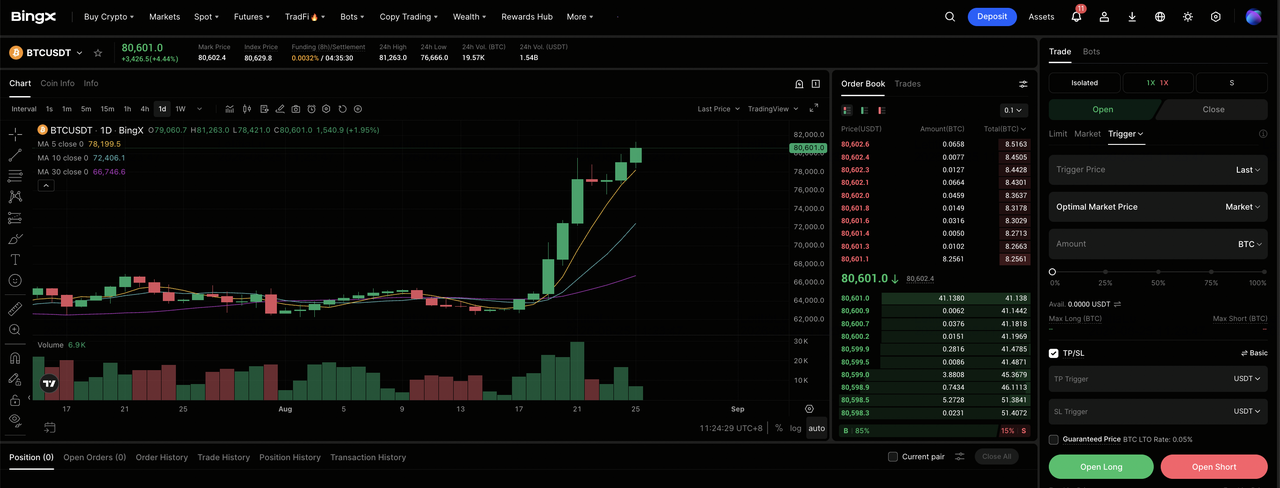
Step 1: Transfer collateral. Move USDT from your spot account into your futures account, where it will serve as margin.
Step 2: Select the contract. Search for the BTC-USDT perpetual contract.
Step 3: Set direction and leverage. Open long if you expect BTC to rise, or open short if you expect BTC to decline. Choose leverage based on your risk tolerance and position size.
Step 4: Execute the trade. Enter the order amount and choose a market or limit order depending on your trading plan.
Step 5: Manage risk. Set stop-loss and take-profit orders before or immediately after entering the position. Profit and loss settle dynamically in USDT.
Dollar-Cost Averaging (DCA): Build a BTC Position Over Time
Dollar-cost averaging (DCA) means buying a fixed amount of BTC at regular intervals, regardless of short-term price movement. Instead of trying to find the perfect entry, users can gradually build exposure over time. This approach is often used by long-term investors who want BTC exposure but prefer to reduce emotional decision-making during volatile markets.
BingX’s recurring-buy feature can help automate this process by purchasing a set amount of BTC on a schedule chosen by the user, such as weekly, biweekly, or monthly.
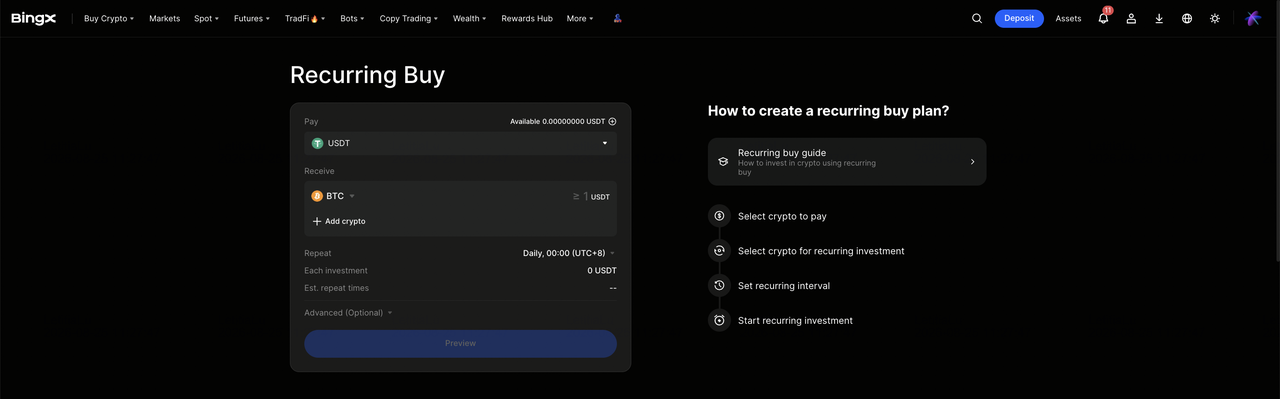
Step 1: Select BTC as the target asset. Open the recurring buy or DCA feature on BingX and choose BTC as the cryptocurrency to accumulate.
Step 2: Set amount and frequency. Enter the fixed amount to invest each time and choose the purchase schedule, such as weekly or monthly.
Step 3: Confirm the funding source. Make sure your selected wallet or payment source has enough balance to support the recurring purchases.
Step 4: Review and activate the plan. Check the asset, amount, frequency, and execution details, then confirm the DCA plan.
Step 5: Monitor and adjust when needed. Review the plan periodically and adjust the amount or frequency based on your budget, market outlook, or investment goals.
Final Thoughts: Should You Invest in Bitcoin in 2026?
Bitcoin has grown from a 2009 experiment in peer-to-peer digital cash into the largest and most widely held cryptocurrency in the world. Its core idea, a decentralized money supply that no government or company can inflate, has remained durable across multiple market cycles, while the halving, Proof of Work, and its fixed 21 million cap continue to define how BTC functions economically.
For anyone evaluating BTC in 2026, the key is to understand it as more than a tradable token. Bitcoin functions as a store of value, a settlement network, and the benchmark asset for the entire crypto market, and it is increasingly held through ETFs and corporate treasuries. Bitcoin still faces volatility, regulatory questions, and debate over its energy use, so whether users buy BTC through spot, build a position with DCA, or trade futures, understanding the network behind the asset is essential.
