Audiera (BEAT) is a Web3 music and dance game that reimagines one of the most recognized rhythm game franchises of the last two decades for a blockchain era. The project positions itself as the Web3 evolution of Audition, a dance game franchise with roughly twenty years of history and a reported 600 million registered users across its lifetime. Rather than starting from zero, Audiera aims to migrate an established Web2 community into a tokenized ecosystem built on BNB Chain.
What separates Audiera from a standard play-to-earn title is its combination of physical hardware, AI creativity tools, and an agent-native economy. Users can dance using smart fitness mats, create music with AI assistance, interact with AI virtual idols, and earn BEAT tokens for participation. The ecosystem has several key parts: BEAT is the utility token at the center of the economy, a mobile game and Telegram mini-game handle user onboarding, a Creative Studio supports music and content creation, and AI agents participate alongside human users. This guide explains what Audiera is, how the platform works, how BEAT tokenomics functions, the main risks to consider, and how to trade BEAT on BingX.
What Is Audiera (BEAT)?
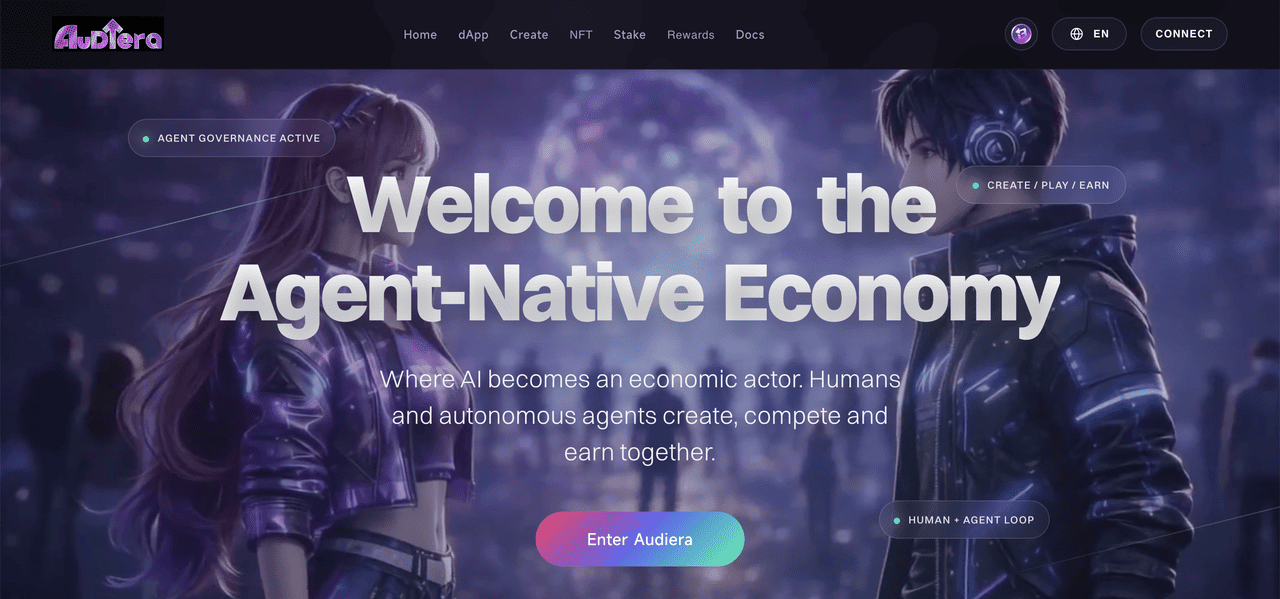
Audiera (BEAT) is a blockchain-native entertainment platform built on BNB Chain that combines rhythm gaming, AI music creation, digital collectibles, and a token economy. The core product includes a mobile dance game, creator tools through a Creative Studio, NFT minting systems, and mini-applications that bridge AI and physical gaming. Users produce songs, interact with AI idols, and participate in dance gameplay, earning and trading BEAT along the way.
The project's principal asset is its intellectual property lineage. Audiera builds on the legacy of Audition, a globally recognized music and dance game that once dominated the casual dance genre. According to the project, BEAT is intended as a medium of reward within the ecosystem rather than financial security, and its function is to power the platform's Dance and Earn model. The specific founders and developers behind Audiera are not prominently publicized, so the project's credibility rests on the brand recognition of the original franchise rather than on named individuals or venture firms.
The core idea behind Audiera is simple: take a game people already loved, add tokenized rewards and AI creation tools, and let an existing community bring itself on-chain. BEAT is the unit that ties gameplay, creation, and participation together.
Key components of the Audiera ecosystem include:
- BEAT token: The core utility token used for gameplay rewards, platform activity, AI-assisted music creation, voting, feature access, and future governance.
- Mobile dance game: A full-scale native game integrating core dance gameplay with customizable digital assets and virtual spaces.
- Telegram mini-game: A lightweight application designed to leverage traffic loops within the Telegram and TON ecosystems for rapid user onboarding.
- Smart dance mats: Physical hardware support that lets users dance on fitness mats rather than tapping a screen, bridging gaming and movement.
- AI virtual idols: AI-driven characters, including the idols Kira and Ray, used for engagement, content creation, and marketing.
Read More: What Are the Top 10 AI Crypto Projects to Watch in 2026?
How Does Audiera Work?
Audiera works as a BNB Chain-based entertainment platform whose gameplay, creation tools, and incentives are coordinated by the BEAT token and a dual-platform onboarding strategy.
- Dance and Earn drives the participation loop: Users play rhythm-based dance gameplay and earn BEAT for participation, turning gameplay activity into token rewards rather than purely cosmetic progression.
- Dual platforms capture different audiences: A full mobile application serves standard mobile gamers, while a lightweight Telegram mini-game targets casual crypto users and viral onboarding through Telegram and TON traffic.
- Physical hardware extends the experience: Support for smart dance mats allows real physical movement to drive gameplay, which the community has highlighted as a genuinely differentiating feature relative to other GameFi projects.
- AI tools power creation: The Creative Studio and AI-assisted music creation let users generate content, while AI virtual idols provide characters for engagement and community-driven content.
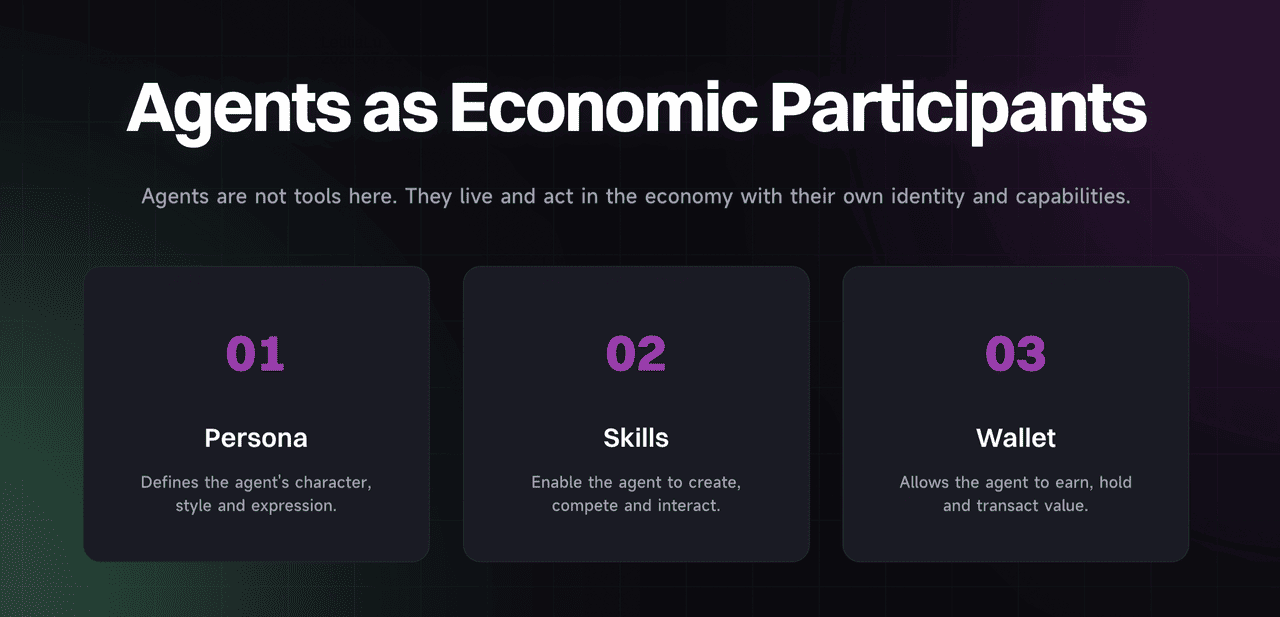
- An agent-native economy includes AI participants: Audiera frames itself around an economy where humans and autonomous AI agents act as participants in the same environment, with structured roles defined for agents.
How to Play Audiera Game and Earn Rewards
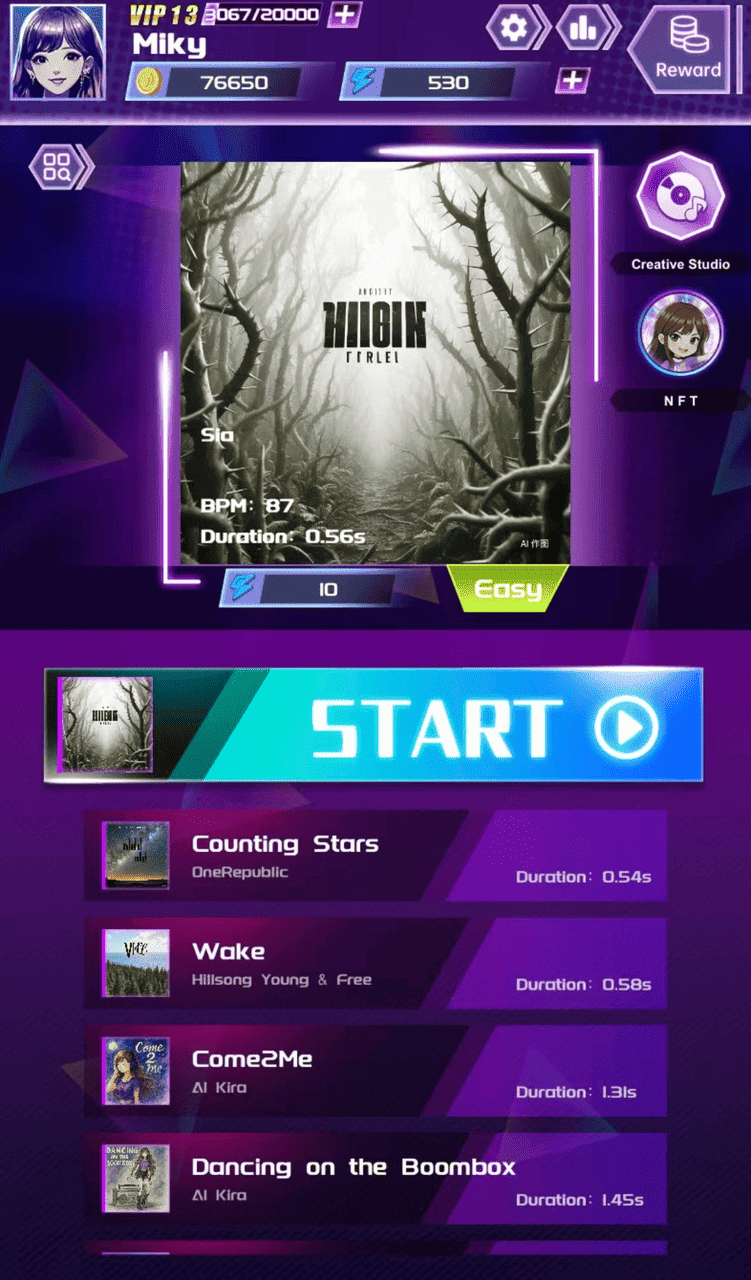
Audiera offers multiple paths for users to earn $BEAT tokens, ranging from high-skill gameplay to passive ecosystem participation.
- Dance and Earn (Active Gameplay) Players earn points by hitting bubbles or directional notes in sync with the music. Higher difficulty levels (Hard/Normal) yield more points but consume more Stamina.
- Weekly Rankings: The top 30 players on the leaderboard receive direct $BEAT airdrops every week.
- Alpha Clash: Exclusive to Beat Amplifier NFT holders, this quarterly competition offers the largest share of the reward pool.
- AI Music Voting (Curation) Users can stake $BEAT to receive veBEAT, which is used to vote in the Beatvote system.
- Voter Rewards: All voters share a weekly pool of up to 5,000 BEAT.
- Creator Rewards: If your AI-generated song reaches the Top 10, you earn BEAT tokens and have your track featured in the game.
- NFT Amplification The Beat Amplifier NFT acts as a multiplier for all in-game earnings. A Level 30 NFT can provide a 1000% point bonus and a 50% increase in prize-winning odds, significantly shortening the ROI period for active players.
Audiera vs. Traditional GameFi: Key Differences
Audiera is often compared with traditional play-to-earn projects because both reward users with tokens for gameplay. The main difference is their starting point. Most GameFi projects must build a new game, brand, and player base from scratch, while Audiera draws on an existing dance-game franchise with an established historical audience.
Audiera also combines dance and fitness gameplay with physical dance mats and AI creation tools, setting it apart from screen-based strategy, combat, or tap-to-earn games. Its strategy is to bring an existing Web2 community into a Web3 economy, while traditional GameFi projects usually build token and NFT mechanics into a crypto-native product from launch.
Read More: Top Web3 Games in the GameFi Sector to Watch in 2026
|
Feature |
Audiera |
Traditional GameFi |
|
Starting point |
Builds on an established Web2 dance-game franchise |
Usually launches as a new crypto-native game |
|
Audience strategy |
Seeks to convert existing fans while attracting Web3 users |
Often builds its player base from scratch |
|
Gameplay |
Dance, fitness, physical mats, and AI creation tools |
Commonly strategy, combat, simulation, or tap-to-earn gameplay |
|
Web3 model |
Adds tokens and digital ownership to an existing franchise |
Designs the game economy around crypto from launch |
|
Main advantage |
Brand recognition and differentiated physical gameplay |
Deeper native integration of tokens, NFTs, and on-chain assets |
|
Main risk |
Legacy users may not adopt the Web3 version, and limited team disclosure reduces transparency |
Player retention may depend heavily on token rewards and market prices |
|
Best suited for |
Users interested in dance, fitness, AI creativity, and familiar IP |
Users seeking a crypto-native gaming economy |
For users, the choice depends on the type of experience they prefer. Traditional GameFi may appeal more to players looking for a fully crypto-native economy, while Audiera may suit those interested in a familiar entertainment franchise combined with dance, fitness, AI creativity, and digital rewards. However, an established brand does not guarantee successful Web3 adoption, and the lack of a widely disclosed team may make the project harder to evaluate.
What Are the Audiera (BEAT) Tokenomics?
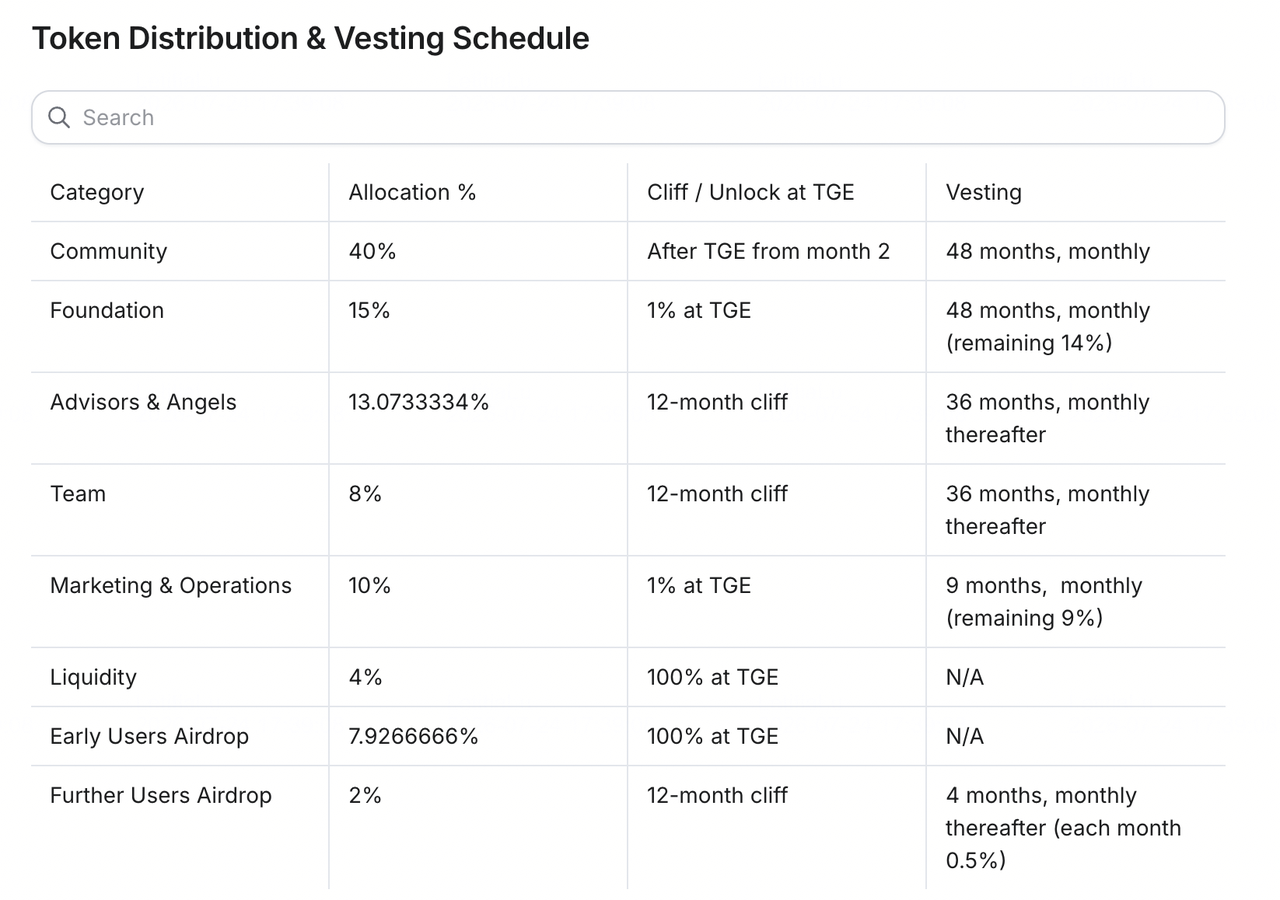
BEAT has a fixed total and maximum supply of 1 billion tokens, distributed across community incentives, the foundation, advisors and angel investors, the team, marketing and operations, liquidity, and an early-user airdrop. Much of the supply follows monthly vesting schedules lasting up to four years, making token unlocks an important consideration for traders. Audiera also states that its smart contract has been audited by blockchain security firm Beosin.
BEAT Token Utility and Supply Mechanisms
BEAT is the native utility token of the Audiera ecosystem. Its main functions include:
- Gameplay rewards: BEAT rewards gameplay and platform participation through Audiera’s Dance and Earn model.
- Content creation: The token supports AI-assisted music creation and rewards contributions to the Creative Studio.
- Feature access: Users can spend BEAT to unlock services and premium platform features.
- Voting: Users can stake BEAT to receive veBEAT, which is used to vote for songs and participate in community curation.
- Future governance: Audiera plans to expand BEAT’s role in platform-level community governance.
- Agent participation: BEAT coordinates rewards and value exchange between human users and autonomous agents within Audiera’s agent-native economy.
BEAT Token Allocation
Audiera allocates the largest share of BEAT to the community, while team, advisor, foundation, and operational allocations unlock over several years. Liquidity and early-user airdrop allocations were fully unlocked at the token generation event.
Source: Audiera Docs
How to Trade Audiera (BEAT) on BingX
BingX offers two practical ways to gain exposure to Audiera, depending on whether the goal is direct ownership or short-term trading. Spot trading is better suited for users who want to buy and hold BEAT directly, while futures trading is designed for active traders who want long or short exposure to BEAT price movements.
Spot Trading: Buy and Own BEAT Directly
Spot trading is the most straightforward way to buy Audiera on BingX. When users buy BEAT on the spot market, they own the asset directly and can hold it in the BingX spot account, transfer it, or withdraw it to a BNB Chain-compatible self-custody wallet.
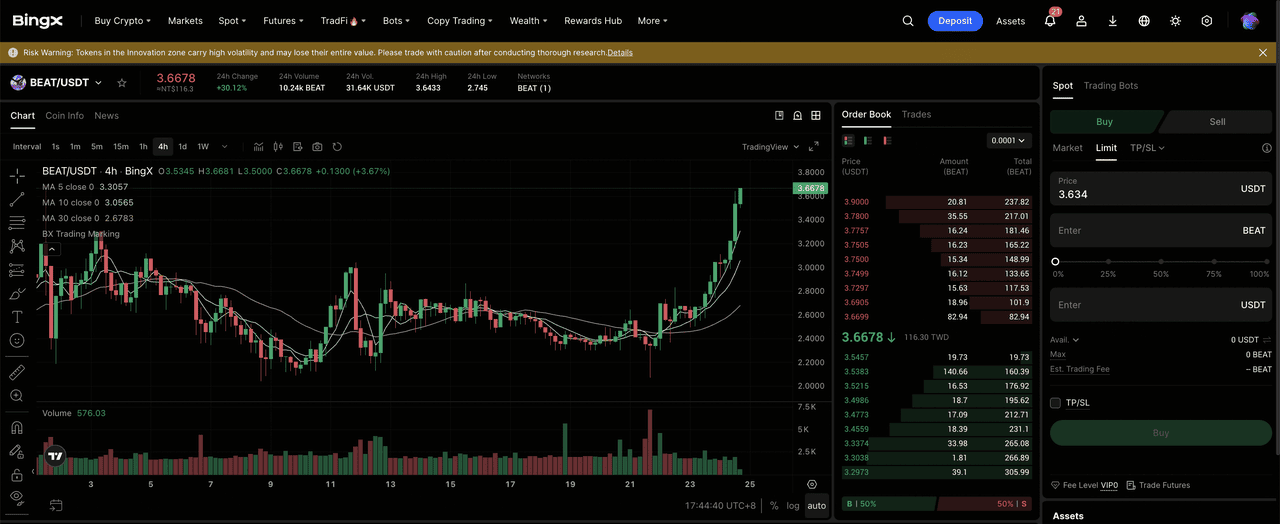
Step 1: Account setup and security. Sign up and log into your BingX account, complete the identity verification (KYC) required in your region, and enable two-factor authentication.
Step 2: Fund your spot account. Deposit USDT or another supported asset into your BingX spot account. Where available, users can also use supported fiat on-ramp options.
Step 3: Navigate to the spot market. Search for the BEAT/USDT trading pair.
Step 4: Place your order. Choose a market order to buy BEAT immediately at the current price, or use a limit order to set the price you want to pay.
Step 5: Manage your BEAT. Once filled, your BEAT appears in your spot account. You can keep it on BingX for convenience or withdraw it to a BNB Chain-compatible self-custody wallet for in-game or ecosystem participation.
Futures Trading: Trade BEAT Price Movements
For active traders, BingX offers USDT-margined BEAT perpetual futures. Futures allow users to trade BEAT price movements without holding the underlying asset, with the flexibility to open long positions if they expect BEAT to rise or short positions if they expect BEAT to fall.
Because futures involve leverage, they can amplify both gains and losses. This approach is more suitable for traders who already have a clear risk plan and understand liquidation risk, particularly for an asset like BEAT that has shown violent price swings, rapid open interest expansion, and heavy derivatives activity during narrative-driven rallies.
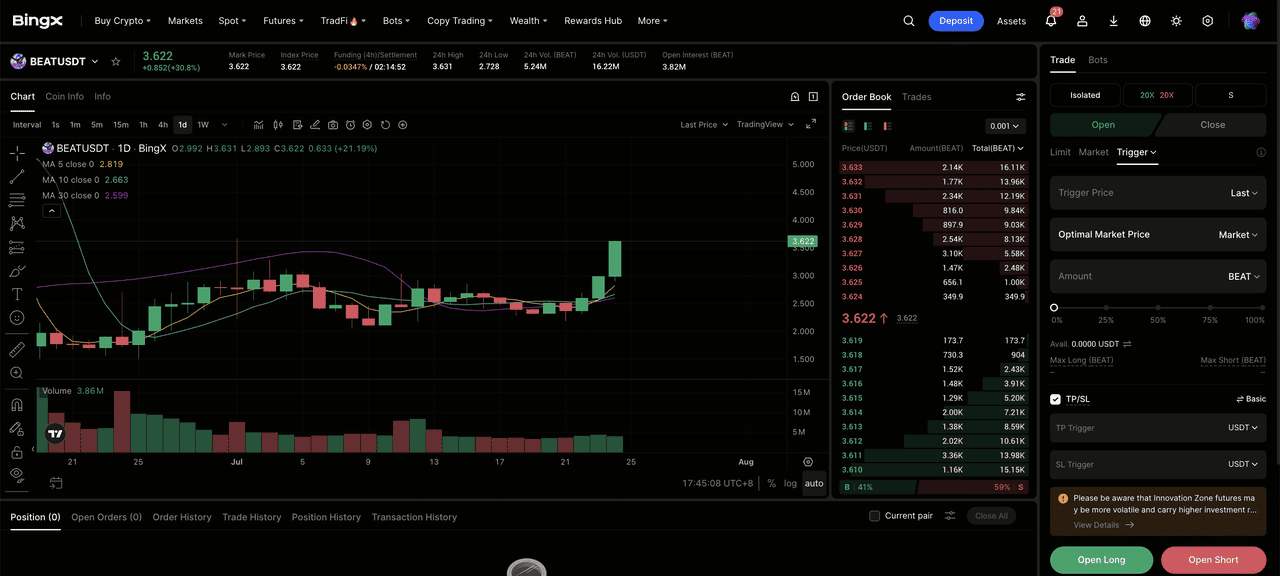
Step 1: Transfer collateral. Move USDT from your spot account into your futures account, where it will serve as margin.
Step 2: Select the contract. Search for the BEAT-USDT perpetual contract.
Step 3: Set direction and leverage. Open long if you expect BEAT to rise, or open short if you expect BEAT to decline. Choose leverage based on your risk tolerance and position size.
Step 4: Execute the trade. Enter the order amount and choose a market or limit order depending on your trading plan.
Step 5: Manage risk. Set stop-loss and take-profit orders before or immediately after entering the position. Profit and loss settle dynamically in USDT.
Risks and Considerations Before Investing in Audiera (BEAT)
Audiera has a recognizable IP lineage, a differentiated product with physical hardware, and an audited contract. However, BEAT still carries risks tied to tokenomics, team transparency, volatility, and adoption.
- Extreme volatility: BEAT has experienced violent swings, including rallies of several hundred percent within a week followed by sharp corrections, with on-chain observers flagging overextended market structure during those moves.
- Inflationary earn mechanics: Community discussions have repeatedly raised concerns about long-term sustainability, noting that Dance and Earn rewards create ongoing sell pressure unless effective token sinks absorb them.
- Vesting and unlock pressure: With a fixed one billion supply and only a fraction circulating, a long vesting schedule means future unlocks can add meaningful supply to the market.
- Limited team transparency: The specific founders and developers are not prominently publicized, so investors cannot vet leadership the way they can for projects with named teams and disclosed backers.
- Adoption is unproven: A large historical user base for the original franchise does not guarantee those users will convert to a Web3 product, and the value of BEAT depends on sustained gameplay and creation activity.
Final Thoughts: Should You Invest in Audiera (BEAT) in 2026?
Audiera is one of the more distinctive Web3 entertainment projects, combining a recognized dance game legacy with AI music creation, virtual idols, physical dance mats, and an agent-native economy. Its 2026 story is anchored by expanding AI features, partnership-driven marketing moments, and heavy derivatives-fueled price action.
The key question for 2026 is whether Audiera can convert nostalgia and narrative attention into durable gameplay activity and token demand. Its hardware integration and creation tools set it apart from tap-to-earn projects, but BEAT remains a supply-sensitive, highly volatile token with an unpublicized team and open questions about whether its earn mechanics are sustainable. For investors and traders, the most important metrics to watch are active user counts, gameplay and creation activity, token sink effectiveness, unlock schedules, and derivatives positioning.
Related Reading
- What Are the Top 10 AI Crypto Projects to Watch in 2026?
- What Are the Top 10 AI Agent Crypto Projects of 2026?
- What Are the Top 7 AI-Powered Memecoins in 2026?
- Top Web3 Games in the GameFi Sector to Watch in 2026
- What Is AKEDO (AKE)? A Beginner's Guide to the AI Game Creation Token in 2026
- Top Gaming Blockchain Networks in 2026: List and Stats to Know
FAQs About Audiera (BEAT)
1. What makes Audiera different from other GameFi projects?
Audiera builds on the Audition dance game franchise, which reported roughly 600 million registered users over about twenty years, so it starts with an existing community rather than from zero. It also supports physical smart dance mats, AI-assisted music creation, and AI virtual idols, which distinguish it from screen-only play-to-earn titles.
2. What blockchain is BEAT on?
BEAT operates primarily on BNB Chain. Users should confirm they are using the correct network before transferring the token to avoid loss of funds.
3. What is BEAT used for?
BEAT is the core utility token of the Audiera ecosystem, used for gameplay and platform activity rewards, AI-assisted music creation, community voting, feature access, and future governance participation. The project describes it as a medium of reward rather than a financial security.
4. What is Dance and Earn?
Dance and Earn is Audiera's participation model, where users earn BEAT tokens by playing the rhythm-based dance game and engaging with the platform. It can be played on mobile or with supported physical dance mats.
5. Which wallets support BEAT?
BEAT can be stored in BNB Chain-compatible wallets that support the BEP-20 standard, including MetaMask and other compatible wallets. Users should always confirm they are using the correct network before transferring BEAT.
