
According to Hashdex, the "AI Crypto" market is projected to reach $47 billion by 2034, driven by the need for a financial settlement layer tailored for autonomous systems. At the same time, AI-powered trading bots already account for roughly 40% of daily crypto trading volume. These figures are no coincidence: AI agents have evolved from a technical novelty into a core structural component of how the crypto market operates today.
Quick Take: Crypto AI agents are autonomous programs that analyze market data, execute decisions, and perform actions (such as trading or managing asset movements) without requiring constant human intervention. Leveraging machine learning and their own native digital wallets, these agents can monitor real-time prices, execute trading strategies, automate portfolio management, and seamlessly interact with DeFi protocols.
What is an AI Agent in Practice?
Look at it this way: an AI chatbot is like a store assistant who only responds when prompted. An AI agent is more like a store manager you hire, hand an objective to (e.g., "increase sales by 10%"), and leave to work autonomously—making decisions throughout the day without consulting you at every step.
In the crypto ecosystem, this distinction is even more pronounced. A crypto AI agent is autonomous software that fuses machine learning with blockchain infrastructure. The critical feature enabling this is that these agents hold their own crypto wallets. This means they can pay their own gas fees, hold assets, and settle transactions without a human needing to click "approve" for every single operation.
These systems generally operate across three tiers of autonomy:
- Assistive Agents: Recommend actions, but require manual user approval for final execution.
- Semi-Autonomous Agents: Execute predefined tasks within user-configured parameters (such as a standard grid trading bot).
- Fully Autonomous Agents: Operate with broad discretion to pursue a specific goal, dynamically adjusting their strategy as market conditions change.
AI Agents vs. Traditional Trading Bots: What’s the Difference?
This is one of the most common points of confusion for investors and traders entering the space. A traditional trading bot follows rigid, hard-coded rules: "buy if the price drops X%, sell if it rises Y%." It doesn't learn, adapt, or interpret context.
An AI agent, by contrast, simultaneously processes alternative data from multiple sources (price action, volume, social media sentiment, macroeconomic news, and on-chain activity) and continuously optimizes its strategy. The table below breaks down the key differences:
|
Feature |
Traditional Bot |
AI Agent |
|
Decision Logic |
Fixed, pre-programmed rules |
Adaptive machine learning |
|
Data Sources |
Typically single-source (price) |
Multi-source (on-chain activity, sentiment, news) |
|
Learning Capacity |
No |
Yes, optimizes performance over time |
|
Financial Autonomy |
Relies on manual setup and API key execution |
Can manage and operate its own native wallet |
|
Practical Example |
Grid bot with a fixed price range |
An agent that automatically reallocates a portfolio ahead of a Bitcoin market drawdown |
How a Crypto AI Agent Works: Step-by-Step
The operational cycle of a crypto AI agent follows a logical, continuous loop that is straightforward in concept but highly sophisticated behind the scenes:
- Data Aggregation. The agent ingests broad streams of on-chain data (wallet movements, liquidity depth, price feeds) and off-chain data (breaking news, social media sentiment, macroeconomic indicators).
- Processing and Analysis. Leveraging advanced machine learning models, the agent uncovers hidden patterns and anomalies that would be impossible for human analysts to detect manually in real time.
- Decision Making. Based on its quantitative analysis, the agent determines the optimal course of action: buy, sell, rebalance, provision liquidity, or sit in cash/stablecoins.
- Execution. The trade or capital allocation is executed directly on-chain via smart contracts or programmatically through centralized exchange (CEX) APIs.
- Continuous Learning. The agent measures the outcome of its decision against its initial predictive thesis, updating its algorithmic parameters for the next operational cycle.
A Practical, Real-World Example
Imagine an AI agent configured to hedge capital during sudden market drawdowns. If Bitcoin dumps by more than 5% within a 24-hour window, the agent can automatically reallocate a portion of a $10,000 portfolio (e.g., 30%, or $3,000) into stablecoins like USDT. This drastically mitigates downside risk without requiring the investor to sit awake staring at charts in the middle of the night.
Another frequent use case is intent-based execution: a trader inputs a prompt like "find the highest-yield, lowest-risk stablecoin pool across Ethereum and Solana, and deploy 1,000 USDC." The agent immediately scans available DeFi protocols, assesses the code audit and risk parameters of each smart contract, routes the funds cross-chain, and executes the deposit autonomously.
Where AI Agents are Active in Today's Crypto Market
The real-world application of these multi-agent systems extends far beyond basic speculative retail trading. Some of the most prominent institutional use cases today include:
Portfolio Management and Automated Rebalancing. Crypto funds and asset managers deploy agents to maintain strict risk-exposure thresholds, automatically trimming overextended assets and accumulating laggards without manual intervention.
Cross-Exchange Arbitrage. AI agents detect micro-price discrepancies across various trading venues in milliseconds. They buy on lower-priced venues and sell on higher-priced venues to capture risk-free spreads at a speed that is entirely out of reach for human execution.
On-Chain Security and Fraud Detection. Autonomous agents monitor public ledgers 24/7 to identify anomalous transaction patterns, flagging potential smart contract exploits, wallet drains, or malicious activities before they impact the broader ecosystem.
Predictive Market Intelligence. Research from BlackRock and Columbia University indicates that specialized multi-agent systems—where one agent models bullish trends, another models bearish trends, and a risk-management supervisor adjudicates between them—consistently outperform single-instance AI models when navigating complex market structures.
Smart Contract Auditing and Governance. Advanced agents stress-test and audit DeFi protocols prior to capital deployment, instantly verifying code safety and execution parameters to insulate users from potential rug pulls or logic bugs.
AI Agents on BingX
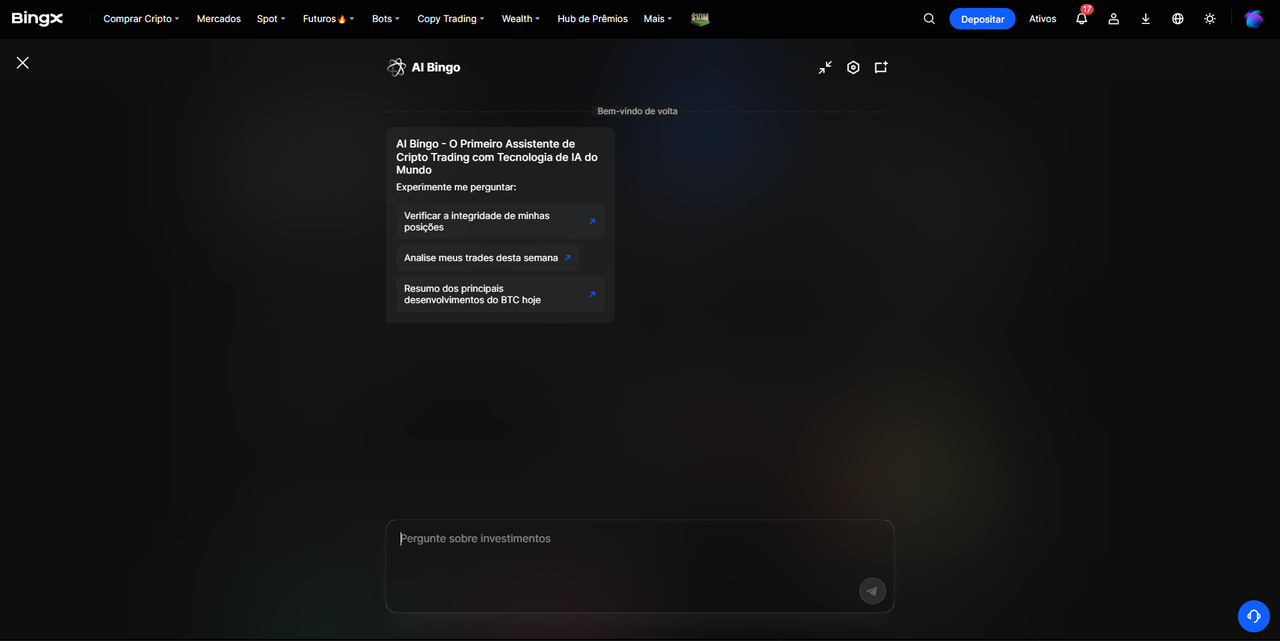
Traders using BingX enjoy native access to AI-driven tools right out of the box, removing the need for complex external environments or the security risks associated with connecting third-party API keys. BingX AI serves as an intelligent trading assistant, analyzing your personal trade history, suggesting tailored risk parameters, and delivering real-time market sentiment feeds. It provides critical utility for Copy Trading, breaking down granular analytics regarding a master trader’s style, maximum drawdown, and win-rate consistency before you decide to mirror their strategy.
For those seeking structured automation, BingX provides institutional-grade Grid Trading Bots (including Futures Grid bots, which have been expanded to support up to 500 grids per strategy) alongside a Recurring Buy feature. This lets users automate Dollar-Cost Averaging (DCA) into core assets like Bitcoin seamlessly, taking emotional bias out of market execution.
The integration between BingX AI and the platform's tokenized TradFi infrastructure is particularly impactful: the AI engine works directly alongside tokenized traditional assets, such as global equities and indices. This ensures crypto traders can tap into automated, AI-driven analytics across both digital assets and legacy financial markets within a single, unified trading environment.
Risks and Core Limitations of Crypto AI
No automation framework completely removes risk from the equation, and this is doubly true when unleashing AI agents into highly volatile crypto primitives. Key points of caution include:
Model Hallucinations: Agents reliant on generative AI or complex LLM layers can occasionally interpret market data incorrectly, resulting in erratic trading decisions based on fabricated correlations.
The "Black-Box" Problem: Deep learning and complex neural network agents often lack transparency. Because their underlying decision-making paths are difficult to audit, diagnosing why an agent executed a specific losing trade during high-volatility events can be challenging.
Smart Contract and Vector Exploits: Since autonomous agents interact directly with DeFi liquidity pools, any underlying security flaw, economic exploit, or oracle vulnerability within the target smart contract puts the agent's managed capital at immediate risk.
Evolving Regulatory Landscapes: The legal frameworks governing autonomous on-chain agents that move financial capital are still nascent globally. Even when using platforms that operate as fully compliant, regulated VASPs (Virtual Asset Service Providers), completely autonomous, machine-led trading operates within a rapidly evolving regulatory gray area.
Over-Reliance and Risk Neglect: Delegating financial survival entirely to a machine learning system without any human oversight is a dangerous pitfall. Industry experts strongly advocate keeping a "human in the loop." Implementing robust risk management parameters—such as setting hard exposure ceilings and manual stop-loss overrides—remains the fundamental responsibility of the trader.
Frequently Asked Questions About Crypto AI Agents
Is a crypto AI agent the same thing as a trading bot?
Not quite. A traditional trading bot operates strictly on fixed, hard-coded rules and cannot learn or adapt over time. Conversely, a crypto AI agent leverages machine learning to dynamically adjust to changing market conditions by processing alternative data streams beyond simple price feeds.
Is it safe to let an AI agent manage my crypto wallet?
It depends on the chosen tier of autonomy and the underlying security framework of the tool. The industry best practice is to start with semi-autonomous agents that require manual authorization for critical executions, while always enforcing hard exposure caps and maximum drawdown limits via Stop-Loss and Take-Profit orders.
Can AI agents accurately predict Bitcoin's price?
No tool can guarantee price predictions in any financial market, and digital assets are no exception. AI agents identify high-probability patterns based on historical and live on-chain datasets, but they do not eliminate the structural market risks or volatility inherent to crypto.
What is the difference between an AI agent and an LLM like ChatGPT?
An LLM is a reactive tool that provides text-based answers when prompted by a human. An AI agent is proactive and goal-oriented; it can independently access web tools, manage native Web3 wallets, and execute transactions on-chain without requiring a new prompt at every step.
Do I need programming skills to use a crypto AI agent?
Not necessarily. Leading exchanges like BingX offer native AI-driven tools directly within their user interface, allowing traders to deploy automated strategies by simply adjusting intuitive parameters without needing any coding knowledge.
Can AI agents launch their own cryptocurrencies?
Yes, autonomous token generation is already happening. For instance, Clanker is a popular autonomous agent operating on the Base network that allows users to deploy new tokens instantly simply by tagging the agent in a social media post, generating millions of dollars in blockchain network fees within weeks of deployment.
How large is the AI agent market right now?
The global AI agent market was valued at $5.1 billion in 2024 and is projected to cross $47 billion by 2030, according to MarketsandMarkets. This explosive growth reflects rapid institutional adoption across multiple verticals, particularly quantitative finance. To stay ahead of this trend, traders closely monitor the sector's liquid ecosystem by tracking top AI crypto tokens.
Key Takeaways
- AI agents are autonomous systems that aggregate data, analyze trends, make decisions, and settle transactions on-chain without requiring constant human intervention.
- Their core competitive advantage over traditional trading bots is their capacity for machine learning and dynamic strategy optimization, rather than relying on rigid rulesets.
- These agents operate via their own digital wallets, allowing them to autonomously manage capital, cover gas fees, and interact across DeFi protocols.
- Current institutional use cases include automated portfolio rebalancing, cross-venue arbitrage, real-time fraud detection, and pre-deployment smart contract auditing.
- BingX streamlines this technology for everyday users through its native suite of intelligent automation features, including BingX AI analytics, Grid Trading, and Recurring Buy options.
- Systemic risks—such as black-box model opacity, underlying smart contract vulnerabilities, and an unformed global regulatory framework—mean strict risk management and human oversight are essential.
Related Articles
- What Are the 10 Best Crypto Trading Bots of 2026?
- Top 10 Crypto AI Projects to Watch in 2026
- What Are the Best AI-Powered Crypto Exchanges for Beginners in 2026?
- Best Artificial Intelligence Cryptocurrencies to Invest in for 2026
- OpenAI Pre-IPO 2026: The Trillion-Dollar Artificial Intelligence Race Enters the Final Stretch
