


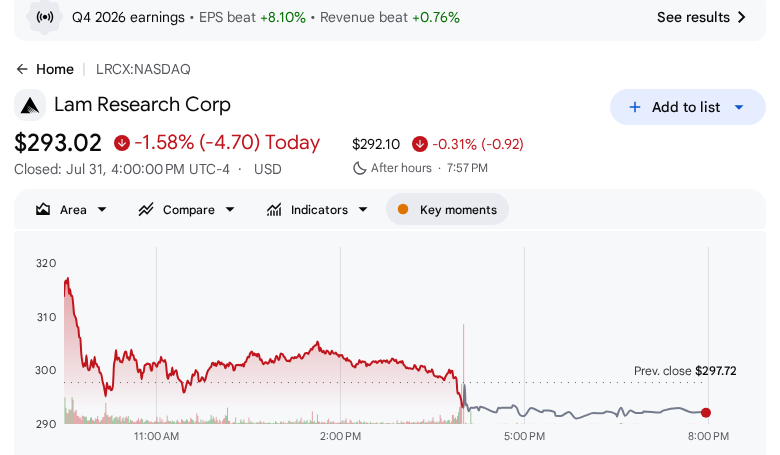
Lam Research (LRCX) reported fiscal 2026 fourth-quarter results on July 29, 2026, with revenue of $6.72 billion and non-GAAP diluted EPS of $1.82. The following session, LRCX closed at $297.72, up 17.98% from its July 29 close of $252.35, before ending July 31 at $293.02. Management also guided September-quarter revenue to $8.10 billion, plus or minus $400 million, with diluted EPS of $2.15, plus or minus $0.15.
The results strengthened the near-term earnings picture, but they do not settle the valuation question. Record revenue, operating margin, and EPS support the case for a stronger semiconductor equipment cycle, while the next test is whether AI infrastructure, advanced memory demand, and customer capex can sustain that momentum. Export controls, customer spending delays, and any margin miss could still limit how much valuation premium the market is willing to rebuild
The LRCX stock forecast for 2026 now centres on two competing views:
- The AI and memory-intensity case: Lam’s July 29 guidance calls for $8.10 billion of September-quarter revenue, plus or minus $400 million, and $2.15 of diluted EPS, plus or minus $0.15. If leading-edge logic, DRAM and NAND process complexity keep lifting deposition and etch intensity, the market can focus on operating leverage rather than a one-quarter beat.
- The multiple-reset case: The stock still has to absorb a changing view of AI capital expenditure, export-control exposure and customer concentration. A sharp guidance miss, a lower margin outcome or a renewed equipment-spending pause would put the multiple, not just earnings estimates, under pressure.
This guide breaks down the LRCX stock forecast, 2026 price scenarios, key risks and dated analyst actions, plus how to trade LRCX stock futures on BingX TradFi with USDT collateral.
Top 5 Things for Lam Research Investors to Know in August 2026
- Q4 revenue of $6.72 billion and non-GAAP EPS of $1.82 both beat consensus: Fiscal Q4 revenue reached $6.72 billion, up 15.1% sequentially and 30.0% year over year. GAAP diluted EPS was $1.81, while non-GAAP diluted EPS was $1.82.
- A 17.98% July 30 rally followed the results release: LRCX closed at $297.72 on July 30 after the release, a 17.98% advance from the prior session. It then closed at $293.02 on July 31, down 1.58% on the day, showing that the market was still repricing the outlook rather than treating the beat as settled.
- September-quarter revenue guidance of $8.10 billion points 21% above Q4: Lam guided September-quarter revenue to $8.10 billion plus or minus $400 million, gross margin to 52.0% plus or minus 1%, operating margin to 39.5% plus or minus 1%, and diluted EPS to $2.15 plus or minus $0.15.
- Systems revenue of $4.25 billion and support revenue of $2.47 billion rose sequentially: Systems revenue was $4.25 billion in Q4, while customer support-related revenue and other revenue was $2.47 billion. That second stream matters because services, spares and upgrades can moderate the cyclicality of new-tool shipments.
- Named targets run from $350 to $390, while the 22-analyst consensus is $344: The market will be watching whether orders, customer acceptances and mix can deliver Lam’s guided revenue and margin range. The next earnings estimate in the data set is October 21, 2026, subject to company confirmation.
What Is Lam Research (LRCX)?
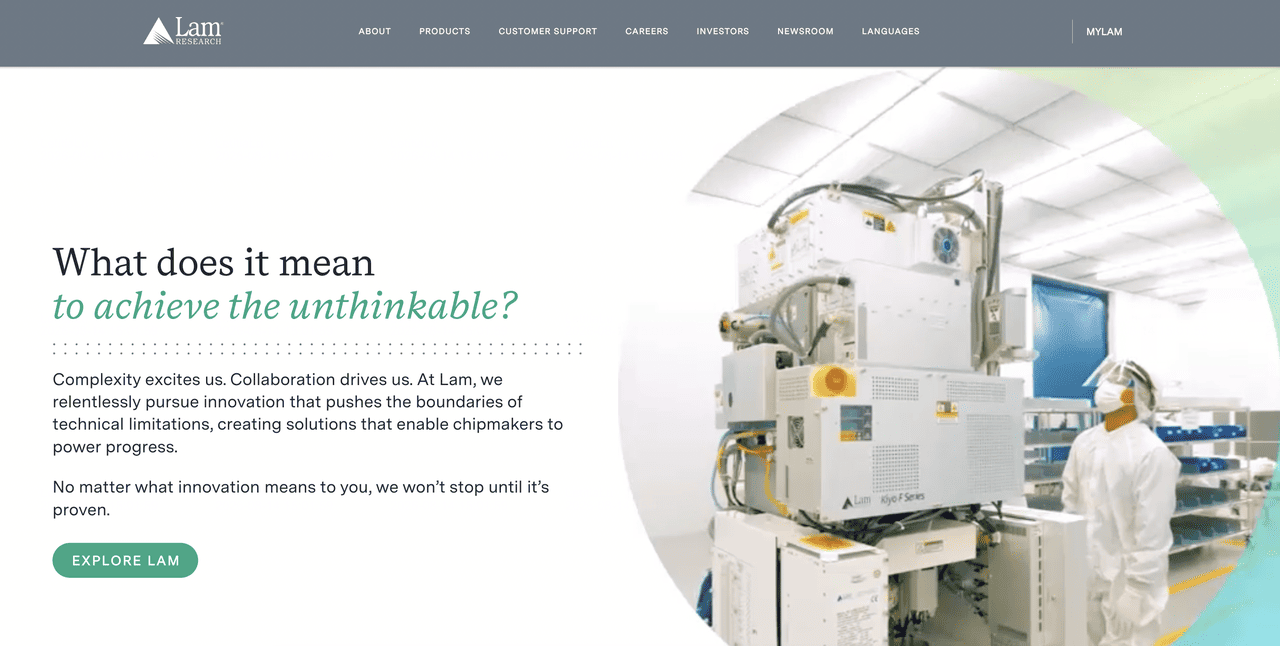
Lam Research supplies wafer-fabrication equipment and related services. Its core exposure is deposition and etch, two process steps that become more valuable as chip structures add layers, shrink features and move toward more complex memory and logic architectures. The company’s customer base includes major global semiconductor manufacturers, making its results sensitive to wafer-fab equipment spending rather than end-device demand alone.
The business mix helps explain why the current cycle is being viewed through an AI lens. Advanced logic and high-bandwidth memory demand can raise the number and complexity of process steps per wafer. But the same concentration makes Lam sensitive to customers’ capital-budget timing, manufacturing ramps and policy constraints in key regions.
Read More: Top High-Bandwidth Memory (HBM) Stocks to Buy in the 2026 Memory Supercycle
Lam Research (LRCX) Fiscal Q4 2026 Earnings: What Drove the Outcome?
- Revenue growth came from a stronger systems run rate. Systems revenue rose to $4.25 billion from $3.73 billion in the March quarter, while total revenue increased by $880.8 million sequentially. That is the most direct evidence that equipment shipments, not only services, powered the Q4 acceleration.
- Customer support added a second engine. Customer support-related revenue and other revenue was $2.47 billion, up from $2.11 billion in the prior quarter. This mix includes services, spares, upgrades and non-leading-edge equipment, which can help preserve revenue quality across different customer spending phases.
- Margins expanded alongside volume. GAAP gross margin improved to 51.7% from 49.8% sequentially, and GAAP operating margin rose to 37.4% from 35.0%. The improvement shows that the quarter was not merely a top-line catch-up.
- Management’s forward model was materially higher. The September-quarter revenue midpoint of $8.10 billion is above Q4’s $6.72 billion. The guide also calls for a 39.5% operating-margin midpoint, which makes margin delivery a central test of the AI-driven demand narrative.
- Deferred revenue and Japan acceptance mechanics require context. Deferred revenue ended Q4 at $2.43 billion, up from $2.22 billion in March. Lam also estimated $490.2 million of future revenue from Japan shipments awaiting customer acceptance, an item investors should track because timing can affect reported revenue.
Read More: Lam Research (LRCX) Q4 2026 Earnings News: $8.10B Revenue Outlook Drives a 17.98% Rally
Lam Research Fiscal Q4 2026 Financial and Consensus Profile: Revenue, EPS and Margins
The June-quarter release was strong on both reported results and forward operating leverage, but the price debate now depends on the next guide being converted into revenue and margin delivery.
|
Financial Metric |
Guidance / Consensus |
Reported / Actual |
Surprise |
|
Revenue |
$6.66 billion consensus |
$6.72 billion |
Beat. About 0.86% above consensus. |
|
Non-GAAP diluted EPS |
$1.69 consensus |
$1.82 |
Beat. About 7.69% above consensus. |
|
GAAP gross margin |
— |
51.7% |
Above prior quarter. Up 190 basis points q/q. |
|
GAAP operating margin |
— |
37.4% |
Above prior quarter. Up 240 basis points q/q. |
|
Systems revenue |
— |
$4.25 billion |
Higher sequentially. Up from $3.73 billion. |
|
Customer support-related revenue and other |
— |
$2.47 billion |
Higher sequentially. Up from $2.11 billion. |
|
September-quarter revenue guidance |
$8.10 billion ± $0.40 billion |
— |
Forward guide. Management’s model. |
|
September-quarter diluted EPS guidance |
$2.15 ± $0.15 |
— |
Forward guide. Management’s model. |
For the quarter ended June 28, 2026, Lam generated $1.46 billion in operating cash flow and ended with $5.60 billion in cash, cash equivalents and restricted cash. Its capital-return actions remained sizeable, including $246.6 million of treasury-stock purchases and $325.3 million of dividends paid during the quarter. Those figures support the balance-sheet discussion, but they do not eliminate the cycle risk embedded in equipment spending.
Lam Research (LRCX) 2026 Investment Outlook: Can September-Quarter Delivery Rebuild the Multiple?
Lam’s outlook for the rest of 2026 depends on one central question: whether strong AI and memory-driven equipment demand can sustain the September-quarter growth outlook, or whether weaker customer spending, export restrictions, and margin pressure slow the momentum.
The Bull Case: AI and Memory Demand Pushes LRCX Toward $390
The bullish case requires Lam to deliver near or above its September-quarter guidance, with revenue around the $8.10 billion midpoint and margins holding close to management’s targets. Continued spending on leading-edge logic, DRAM, NAND and AI infrastructure would strengthen the case that the Q4 acceleration reflects a broader equipment cycle rather than shipment timing.
A move toward the $390 Street high would require investors to see sustained systems growth, resilient support revenue and clean execution on customer acceptance. It would also require AI memory-related process intensity to remain strong enough to support Lam’s current earnings trajectory.
Read More: Top AI Memory Stocks to Buy in 2026: DRAM, HBM, and AI Storage Demand Explained
The Base Case: Strong Guidance but Valuation Discipline Keeps LRCX Between $300 and $340
The base case assumes Lam delivers broadly in line with the September-quarter outlook, but investors remain cautious about restoring a higher valuation multiple after a volatile semiconductor cycle. Revenue and margins would continue to improve, though the market may still wait for another quarter of consistent demand before pricing in a stronger premium.
The $300 to $340 article range is not a Wall Street target. It reflects a scenario in which Lam executes on guidance but still faces uncertainty around customer capex, shipment timing, export restrictions and the durability of AI-driven equipment demand.
The Bear Case: Demand or Margin Pressure Pulls LRCX Toward $250
The bear case does not require Lam’s technology position to weaken. It requires customer spending delays, export-control pressure or softer memory and logic investment to make the September-quarter outlook harder to achieve.
The $250 to $280 article range is a valuation sensitivity, not an analyst forecast. Observable bear-case signals would include a revenue guide cut, margins falling below the guided range, weaker systems demand or customers delaying wafer-fab equipment spending.
LRCX Stock Price Forecasts for 2026 By Wall Street Analysts
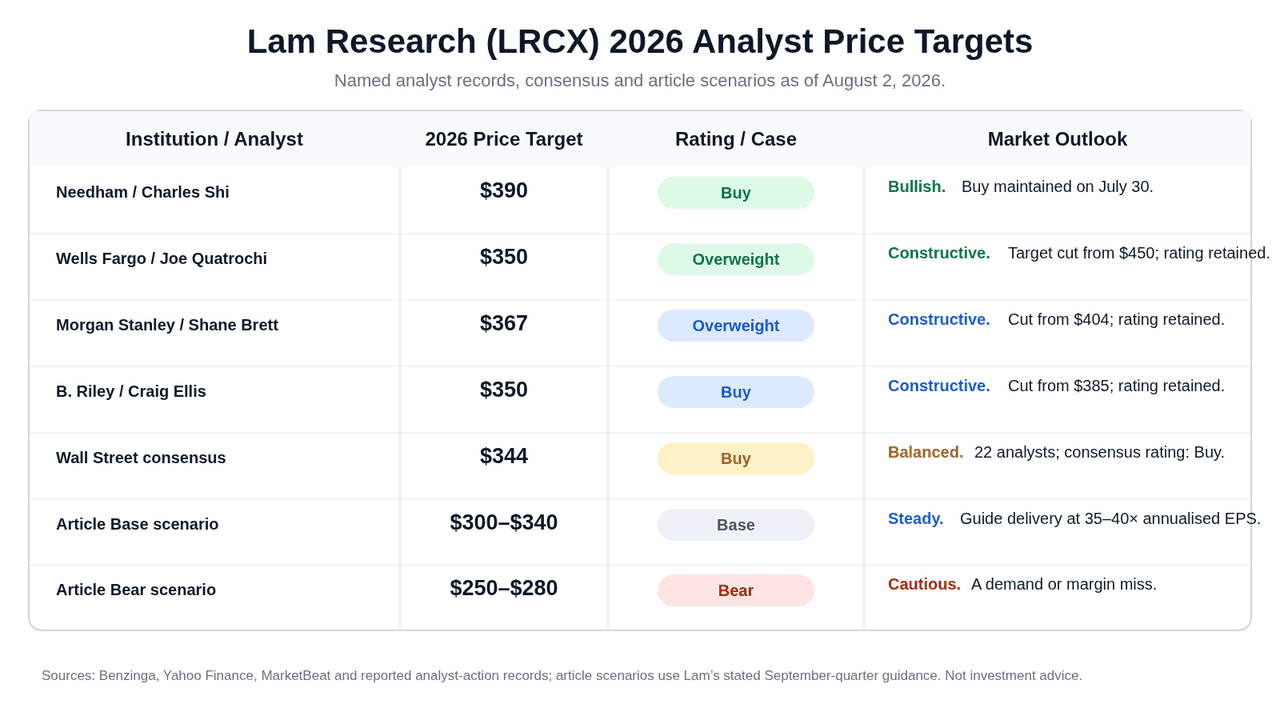
Wall Street coverage remained broadly positive after Lam’s fiscal Q4 results, but several analysts lowered their price targets on July 30. The four named targets now range from $350 to $390, while the broader 22-analyst consensus sits at $344. The revisions suggest analysts still see earnings upside, but with a more cautious valuation framework after the recent semiconductor-sector volatility.
|
Institution / Analyst |
2026 Price Target |
Rating / Case |
Market Outlook |
|
Needham / Charles Shi |
$390 |
Buy |
Bullish. Buy maintained on July 30. |
|
Wells Fargo / Joe Quatrochi |
$350 |
Overweight |
Constructive. Target cut from $450; rating retained. |
|
Morgan Stanley / Shane Brett |
$367 |
Overweight |
Constructive. Target cut from $404; rating retained. |
|
B. Riley / Craig Ellis |
$350 |
Buy |
Constructive. Target cut from $385; rating retained. |
|
Wall Street consensus |
$344 |
Buy |
Balanced. 22 analysts; consensus rating: Buy. |
|
Article Base scenario |
$300–$340 |
Base |
Steady. Guide delivery at 35–40× annualised EPS. |
|
Article Bear scenario |
$250–$280 |
Bear |
Cautious. A demand or margin miss. |
Benzinga listed a Buy consensus from 22 analysts with an average target of $344 as of August 2. These are third-party target statistics, not probabilities. They also differ from the article’s ranges because the article scenarios use a transparent annualised-EPS multiple framework tied to Lam’s own September-quarter guide.
How to Trade Lam Research (LRCX) Stock on BingX
Navigate Lam Research's semiconductor cycle using BingX TradFi and BingX AI tools. AI-driven market analysis can help traders track sentiment and price action around earnings, memory spending, AI infrastructure demand, and semiconductor equipment orders.
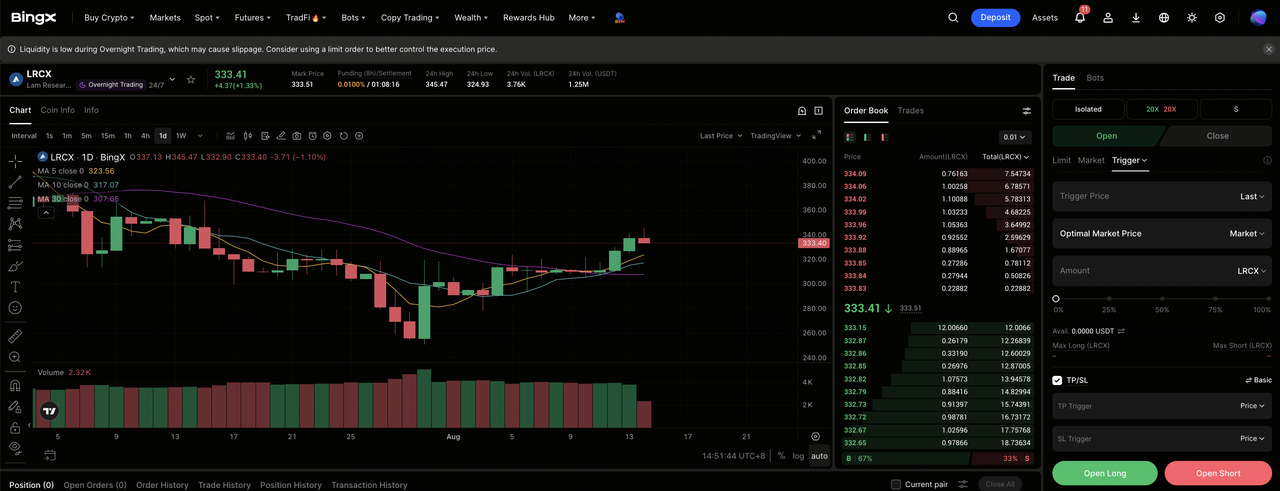
Step 1: Access BingX TradFi. Sign up and navigate to the specialized TradFi section on the main BingX exchange dashboard.
Step 2: Select Lam Research (LRCX). Search for and select the LRCX-USDT perpetual futures contract.
Step 3: Choose your direction. Select Open Long if you expect AI-driven semiconductor investment, advanced memory demand, and stronger wafer fabrication equipment spending to support Lam Research's orders and earnings. Select Open Short if memory spending weakens, semiconductor capital expenditure slows, export restrictions pressure sales, or customer investment plans fall below expectations.
Step 4: Select leverage and margin mode. Choose Isolated or Cross-Margin based on your risk tolerance. LRCX can move sharply around earnings, guidance, semiconductor equipment forecasts, and changes in AI and memory demand, so conservative leverage and clear position sizing are important.
Step 5: Execute strict risk protocols. Set Take-Profit and Stop-Loss (TP/SL) levels before or immediately after entering the trade. LRCX can react quickly to quarterly earnings, customer capex updates, DRAM and NAND spending trends, foundry investment, AI infrastructure demand, and semiconductor export policy changes.
Top 5 Risks to Watch for LRCX Investors in 2026
- AI capex digestion is the sector’s dominant risk: A pause in leading-edge logic or memory investments would reduce tool demand and pressure systems revenue. Watch customer capex plans and Lam’s next revenue guide.
- China and export controls can alter revenue access: China represented 26% of June-quarter revenue. Tighter restrictions or compliance changes could affect sales, product mix and customer purchasing patterns. Watch management’s regional commentary and policy updates.
- Customer acceptance timing can move reported revenue: Lam’s Japan acceptance model left an estimated $490.2 million of future revenue associated with shipments awaiting acceptance. Watch the future-revenue estimate and inventory dynamics.
- Margin performance can reverse the operating-leverage thesis: The September guide assumes 52.0% gross margin and 39.5% operating margin at the midpoint. Watch actual gross margin, operating expense and mix against those benchmarks.
- Valuation remains sensitive after a volatile July: The stock finished July below its 50-day moving average despite remaining above its 200-day average. Watch whether subsequent earnings evidence, rather than a single reaction session, changes the market’s willingness to apply a higher multiple.
Final Thoughts: Should You Invest in Lam Research in 2026?
Lam’s fiscal Q4 2026 report established a stronger operating baseline: record revenue, expanded margins and a September-quarter guide far above the June-quarter revenue level. The positive case is clear if AI-related process complexity, memory investment and margin discipline allow that model to be delivered.
The unresolved issue is valuation durability. The July 30 rally showed the earnings model can change quickly, while the July 31 pullback showed that a beat does not resolve every cycle and policy risk. Investors assessing LRCX should focus on the September-quarter revenue, gross-margin and operating-margin guide, plus acceptance timing and regional demand, rather than treating any analyst target or article scenario as a certainty.
Risk Reminder: Trading and investing in equities such as LRCX involves a high risk of capital loss. Lam Research is exposed to semiconductor-capex cycles, customer concentration, export controls, supply-chain conditions and execution risks. Leveraged and derivative products can amplify losses and may not be suitable for all traders. This article is for informational purposes only and does not constitute financial advice. Conduct independent research and use appropriate risk controls.
Related Reading
- Lam Research (LRCX) Q4 2026 Earnings News: $8.10B Revenue Outlook Drives a 17.98% Rally
- Top High-Bandwidth Memory (HBM) Stocks to Buy in the 2026 Memory Supercycle
- Top AI Memory Stocks to Buy in 2026: DRAM, HBM, and AI Storage Demand Explained
- AMAT Stock Price Prediction 2026: $575 Street-High AI Supercycle or Overvalued Supply Chain Trap?
- ASML (ASML) Price Prediction 2026: Can a Third Guidance Raise Push ASML Past $2,000?
