

Surviving the financial terrain of 2026 requires crypto investors to balance growth seeking with capital preservation. As traditional equity markets wobble under the weight of persistent inflation and localized corrections, the digital asset space has split into two camps: hyper-speculative tokens and tokenized real-world assets (RWAs). For traders looking to navigate this landscape safely, Pax Gold (PAXG) has emerged as an essential sanctuary. By embedding the absolute ownership rights of physical gold into the Ethereum blockchain as a highly liquid ERC-20 token, PAXG provides a transparent, zero-storage-fee gateway to the world's oldest safe-haven asset.
In the 2026 financial markets, tokenized gold is no longer a niche curiosity; it has captured critical institutional market share. In Q1 2026 alone, spot trading volume for tokenized gold products exploded to an unprecedented $90.7 billion, surpassing the $84.6 billion recorded across the entirety of 2025. Backed 1-to-1 by fine troy ounces of London Good Delivery bullion housed in secure LBMA vaults, PAXG allows market participants to lock in hard-asset security while maintaining the 24/7 mobility and settlement speeds native to crypto.
This complete guide explores why Pax Gold (PAXG) is structurally positioned as the best crypto investment for hedging modern portfolio downside, backed by the latest H2 2026 market projections and automated risk management tactics on BingX.
What Is Pax Gold (PAXG) Gold-Backed Stablecoin and How Does It Work?
Pax Gold (PAXG) is an institutional-grade, real-world asset (RWA) token issued by the Paxos Trust Company that enables investors to bypass the high storage fees and illiquidity of traditional precious metal markets. Operating as a fully regulated ERC-20 token on the Ethereum blockchain, each PAXG token represents legal ownership of exactly one fine troy ounce of a 400-ounce London Good Delivery gold bar. The physical gold backing the circulating supply is held in secure, LBMA-accredited vaults in London and is audited monthly by independent third-party accounting firms to ensure a strict 1:1 asset-to-token ratio.
Practically, PAXG converts a centuries-old store of value into a programmable, digital asset that can be split into fractions out to 18 decimal places. This allows retail and institutional market participants to acquire exposure to allocated gold with a minimum purchase amount as low as 0.01 tokens, roughly $45. Because it utilizes blockchain infrastructure, PAXG settles near-instantly, features zero custody or storage fees, and can be integrated into decentralized finance (DeFi) networks as loan collateral. For large-scale holders, the token offers unique utility, as it remains the only digital gold asset that can be directly redeemed through the Paxos platform for physical, accredited gold bullion bars or liquidated for USD at real-time market spot prices.
Pax Gold's Digital Bullion Advantage: Why Is Institutional Money Flowing to PAXG?
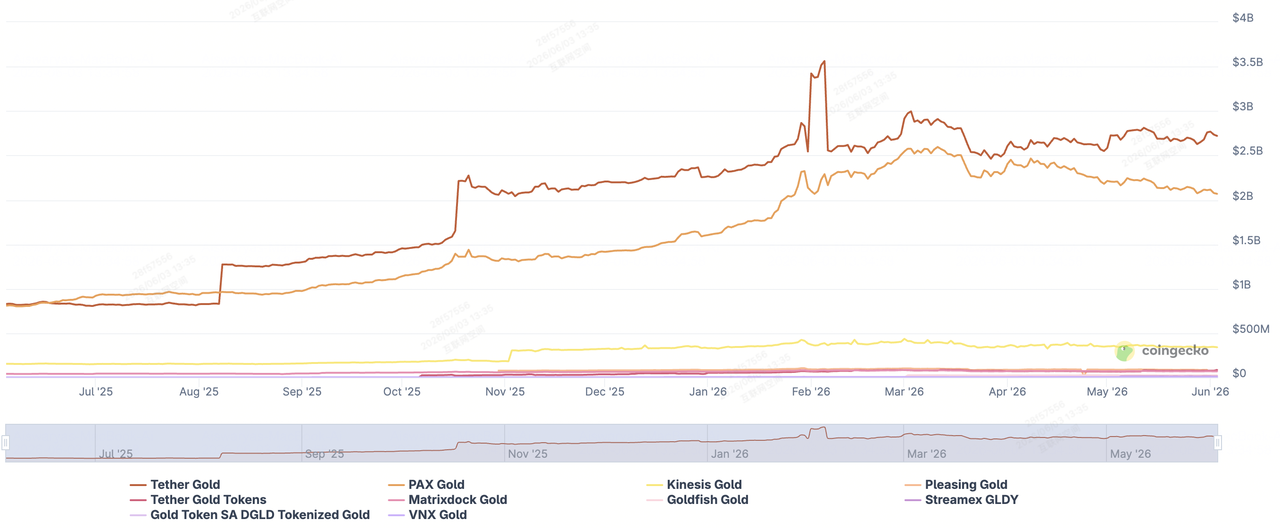
Market cap of tokenized gold products | Source: CoinGecko
The primary catalyst driving capital into PAXG in 2026 is the rapid degradation of traditional unbacked fiat and nominal debt instruments. Historically, institutional players seeking defensive allocations turned to sovereign government bonds. However, with macro indicators revealing structural debasement risks, highlighted by the U.S. national debt ceiling scaling to $41.1 trillion, global portfolio managers are shifting from nominal claims to non-inflationary real assets. This structural reallocation has created a massive tailwind for tokenized precious metals, driving the total tokenized real-world asset RWA market to a staggering $19.32 billion by the end of Q1 2026, according to CoinGecko's 2026 RWA Report.
Traditional gold vehicles like Exchange-Traded Funds (ETFs) carry hidden friction points that do not align with modern, fast-moving corporate treasuries. Gold ETFs only trade during restrictive stock exchange hours, impose recurring management fees ranging from 19 to 40 basis points annually, and explicitly lack a mechanism for fractional retail redemption. Data from the World Gold Council's Q1 2026 Gold Demand Trends report underscores this shift in investor behavior: while total global gold demand value surged 74% year-on-year to a record-breaking $193 billion, physically-backed gold ETFs faced sizeable outflows in Western markets like the U.S., as institutional capital increasingly rotated into more direct, flexible instruments.
PAXG rewrites this equation entirely. It trades continuously across global digital asset order books with zero custody or storage overhead. Furthermore, every single token contains an immutable on-chain tracking mechanism mapped directly to the unique serial number, purity, and exact weighting of an isolated, physical gold bar under the custody of Paxos Trust Company. This clear title of ownership, completely detached from systemic credit or settlement risks, is precisely why institutional allocations to on-chain gold have expanded rapidly. According to CoinGecko, tokenized commodities jumped 289% to a $5.55 billion market capitalization by the close of Q1 2026, with PAXG capturing a massive 41.8% share of this rapidly accelerating market.
Read more: How to Invest in Gold on BingX: A 2026 Beginner’s Guide
Paxos Gold (PAXG) vs. Tether Gold (XAUT): Comparing Liquidity and Transparency
As tokenized commodities claim over 28% of the broader RWA ecosystem, the choice for the optimal secure vehicle narrows down to the two dominant heavyweights that control over 89% of the market capitalization: Pax Gold (PAXG) and Tether Gold (XAUT). While both effectively track the real-time spot price of gold, their underlying regulatory frameworks and auditing architectures present stark contrasts for risk-averse investors.
|
Feature |
Pax Gold (PAXG) |
Tether Gold (XAUT) |
|
Primary Regulatory Body |
New York State NYDFS & Federal OCC |
Regulated in offshore jurisdictions |
|
Audit Verification |
Monthly third-party attestations (KPMG) |
Periodic third-party attestations |
|
On-Chain Transparency |
Address lookup for exact physical bar serials |
Fractional pool verification |
|
Legal Architecture |
Bankruptcy-remote allocated custody |
Pooled asset backing |
|
Transfer Costs |
Zero on-chain transfer fees on select rails |
Standard network gas fees |
The critical differentiator favoring PAXG as a structural safe haven is its status as a federally overseen trust. Paxos operates as a qualified custodian under New York State Banking Law and secured a pivotal clearing agency registration under Section 17A of the Securities Exchange Act. This ensures that even in extreme black-swan events, investor holdings are legally isolated inside a bankruptcy-remote structure.
Conversely, while Tether Gold (XAUT) enjoys massive liquidity, it operates within an offshore regulatory model that structural risk models penalize during periods of systemic financial distress. For investors evaluating the absolute safest digital proxy for physical gold, PAXG's institutional-grade transparency framework sets the industry benchmark.
Read more: Tether Gold (XAUT) vs. Pax Gold (PAXG): Which Tokenized Gold Coin Is Better in 2026?
Pax Gold vs. Bitcoin: Which Is a Better Safe Haven in 2026 Volatile Markets?
Choosing between Bitcoin (BTC) and Pax Gold (PAXG) during periods of high market volatility depends entirely on whether a portfolio requires directional growth optionality or absolute draw-down insulation. In June 2026, as macroeconomic pressures mount and the crypto market experiences sharp corrections, evidenced by the Crypto Fear & Greed Index plunging into Extreme Fear at a reading of 11, capital behaviors have sharply diverged. Bitcoin, trading near $66,593 after a swift 5.78% daily drop, continues to suffer from high beta and structural correlation to tech equity liquidations. BlackRock’s quantitative macro research reveals that while BTC frequently underperforms gold during the first 10 days of a systemic liquidity shock due to forced margin calls, its long-term convexity typically takes over within a 60-day window, capturing massive upside that a pegged commodity cannot match.
For immediate capital preservation, PAXG is practically the superior defensive tool. Trading steadily around $4,475, PAXG acts as a hard financial shock absorber, offering near-zero correlation to digital asset liquidations and carrying a low double-digit annualized volatility profile compared to Bitcoin's 50% to 80% swings. For active traders on BingX, the tactical play is not binary. The most effective strategy involves utilizing PAXG as a dynamic risk-off vehicle: rotating a predetermined 15% to 20% allocation of speculative altcoin or BTC profits into PAXG to lock in wealth during market peaks, then reallocating that stable, hard-backed liquidity back into heavily discounted BTC once extreme volatility cools down.
Read more: Bitcoin vs. Gold: What’s a Better Investment in 2026?
Pax Gold Technical Outlook: Breaking Down PAXG Price Predictions for H2 2026
The macroeconomic background for gold in mid-2026 is exceptionally strong. Driven by aggressive central bank accumulation, which averaged a net 244 tonnes in Q1 alone, and an escalating global debasement trade, the underlying commodity market has established an ironclad floor. Following a healthy 19% technical drawdown from its historic January peak of $5,622 down to the current $4,500 consolidation zone, top-tier banking institutions are forecasting a powerful macro continuation for the remainder of the year.
Our unified PAXG price prediction models for H2 2026 align tightly with revised institutional commodity research. Analysts at J.P. Morgan recently upgraded their long-term thesis, outlining a base case end-2026 target of $6,000 to $6,300 per ounce, citing a sharp acceleration in Western ETF inflows and sustained physical bar demand by high-net-worth market participants. Concurrently, technical models from BMO Capital Markets and Wells Fargo independently project an H2 peak of $6,350 based on current money supply expansion metrics.
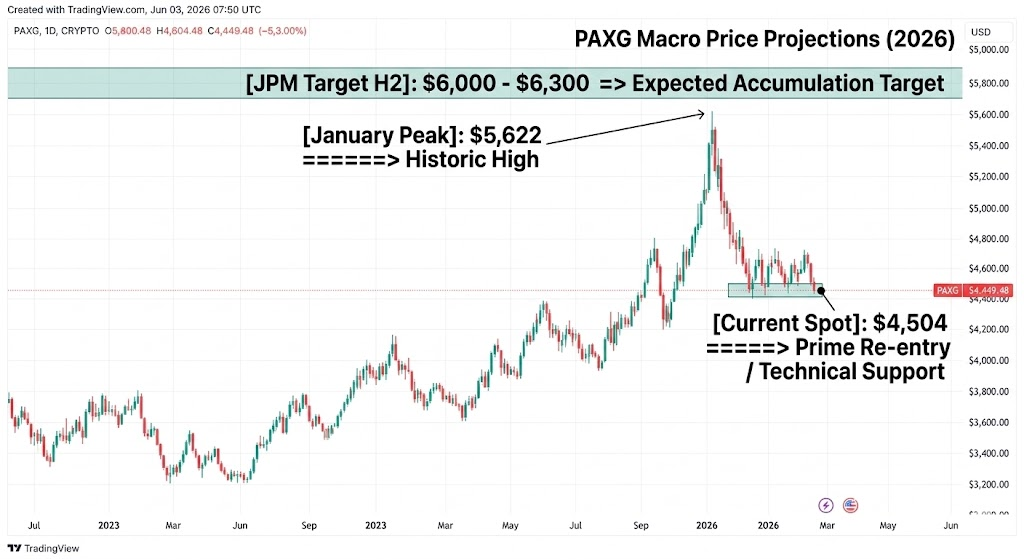
From a purely technical perspective on the daily chart, PAXG is undergoing a classic accumulation phase near the key $4,400–$4,500 support level. This zone represents an incredibly asymmetric entry point for the second half of 2026. While short-term algorithms are executing tactical distribution models within a tight range, a confirmed daily close above the $4,600 resistance line will signal the macro uptrend's re-ignition toward the institutional target cluster of $6,000+.
How to Invest in Gold to Hedge Against Tech Sector and Crypto Volatility
The year 2026 has witnessed unprecedented capital concentration in high-beta mega-cap technology and AI equities. While these sectors have driven sensational nominal returns, extreme overvaluation metrics have introduced systemic vulnerability into traditional 60/40 portfolios. When tech sectors experience sudden liquidity flushes or algorithmic corrections, correlated digital assets like Bitcoin can experience swift, double-digit drawdowns.
Strategic portfolio construction mandates the use of uncorrelated anchors. Historical data compiled by asset managers confirms that while Bitcoin can underperform gold during the initial 10-day window of an acute liquidity crisis due to forced margin liquidations, gold acts as an immediate volatility dampener.
Allocating a 15% to 20% structural slice of your crypto capital into PAXG acts as a financial shock absorber. Because tokenized gold shares zero fundamental vulnerabilities with semiconductor supply chains or tech earnings multiples, it balances out high-beta crypto holdings, preserving your net worth's purchasing power when broader speculative markets face a correction.
Read more: Is Gold a Good Investment in 2026? Risks & Returns Explained
How to Buy Pax Gold: Trading Strategy for Moving Profits into PAXG on BingX
Executing a defensive portfolio transition does not require exiting into traditional, inflating fiat systems. Sophisticated traders utilize a Stable-to-Hard Asset rotation strategy on BingX to lock in speculative gains directly into a yield-bearing or value-preserving commodity proxy.
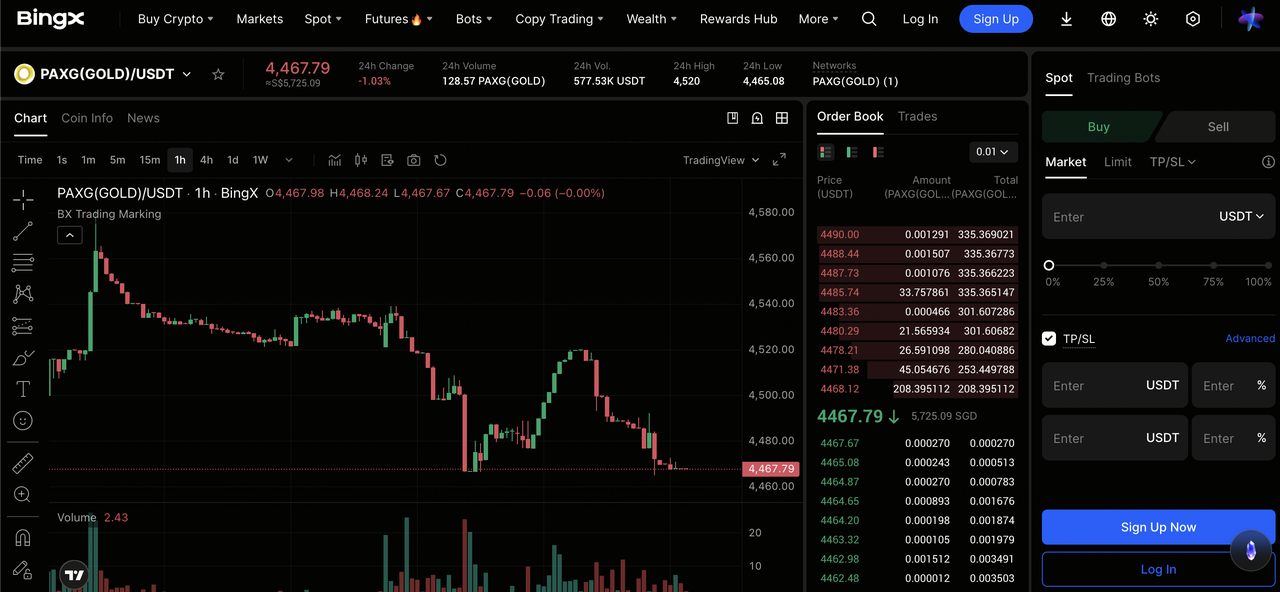
To rotate your digital asset profits into PAXG seamlessly, follow this precise, optimized procedural sequence:
- Consolidate Speculative Profits into USDT: Monitor your high-beta altcoin or BTC positions on the BingX Spot interface. When a target profit zone is hit, execute a Limit Order to convert those positions into USDT or USDC to freeze the volatile fiat value.
- Navigate to the BingX Spot Market: Access the search terminal on the BingX Spot trading dashboard and input the PAXG/USDT pair. BingX maintains highly concentrated liquidity pools for this asset, preventing order-book slippage for large order profiles.
- Execute an Accumulation Limit Order: Avoid executing a raw Market Order during periods of high hourly volatility. Instead, set a Limit Order within the technical support band of $4,450–$4,500 to automatically absorb regional dips while capturing BingX's low maker fee structure.
- Transfer to Fund Account or DeFi: Once filled, move your PAXG tokens from your Trading Account to your secure BingX Fund Account. From here, you can hold to hedge against incoming tech sector volatility, deploy it as institutional collateral, or utilize the BingX Convert Fiat gateway to initiate a physical or cash off-ramp.
By mastering this rotation strategy, you successfully decouple your portfolio's base value from speculative crypto corrections while maintaining instant, 24/7 liquidity back into growth assets the moment market structures turn decisively risk-on.
Volatility Alert: While recent cross-chain security incidents like the Gravity Bridge key compromise emphasize the platform risk of moving assets across experimental DeFi bridges, PAXG's core ERC-20 smart contract on Ethereum remained completely uncompromised. For maximum security, maintain your core hedging positions on Tier-1 trading hubs like BingX that utilize verified corporate custody loops.
Key Considerations Before Investing in Pax Gold
Before allocating capital to tokenized precious metals, investors must evaluate the structural nuances and operational parameters that govern blockchain-based real-world assets.
- Underlying Commodity Exposure: PAXG is a direct proxy for the spot price of physical gold, meaning it does not generate passive yield natively and will inherently underperform high-beta cryptocurrencies during aggressive digital asset bull markets.
- Smart Contract and Platform Vulnerabilities: As an ERC-20 token running on the Ethereum network, PAXG inherits baseline blockchain risks, including potential smart contract exploits, network congestion fees, and the operational custody security of the issuer, Paxos Trust Company.
- Systemic Intermediary and Bridge Risks: While the core token backing remains audited and secure, utilizing PAXG within decentralized finance (DeFi) protocols or moving it across cross-chain infrastructure introduces external smart contract and key-management exposure, as evidenced by third-party bridge exploits.
- Redemption Thresholds and Logistics: Physical redemption for London Good Delivery gold bars is fully supported, but the process enforces strict minimum quantity requirements and associated logistical delivery fees that may be impractical for smaller retail holders.
- Regulatory Compliance Frameworks: PAXG benefits from stringent oversight under the New York State Department of Financial Services (NYDFS) and federal Office of the Comptroller of the Currency (OCC), meaning its long-term utility is closely tied to ongoing regulatory developments in the RWA tokenization space.
Conclusion: Should You Buy and Hold Pax Gold (PAXG) in 2026?
Pax Gold represents a mature convergence of traditional asset preservation and blockchain innovation, offering market participants an efficient method to hold investment-grade gold without legacy constraints. By matching the strict regulatory standards of a federally overseen trust with the 24/7 liquidity of global digital asset exchanges, the token provides a practical mechanism for portfolio diversification. As demonstrated by record-breaking tokenized commodity volumes in early 2026, institutional and retail software wallets alike are increasingly viewing on-chain gold as a necessary counterweight to broader market volatility.
Ultimately, utilizing PAXG within a broader financial framework is an exercise in risk balancing rather than a replacement for high-growth digital assets or direct physical custody. Integrating tokenized gold into active trading setups allows users to hedge against systemic tech sector pullbacks while remaining positioned to capture sudden market pivots. By understanding custody architectures, auditing frequencies, and the logistical realities of real-world asset protocols, investors can successfully utilize PAXG to maintain stability throughout shifting macroeconomic cycles.
Risk Reminder: Digital asset trading involves significant market risk and price volatility. Tokenized real-world assets are subject to tracking errors relative to underlying spot prices, smart contract vulnerabilities, and evolving jurisdictional regulations. Always conduct thorough due diligence and verify your platform's specific operational and custody policies before executing large capital reallocations.
Related Reading
- What Are Gold-Backed Crypto Tokens? $4B Market Surges as Physical Gold Hits Record High
- How to Invest in Gold on BingX: A 2026 Beginner’s Guide
- What Is PAX Gold (PAXG) Gold-Backed Token and How Does It Work?
- Is Gold a Good Investment in 2026? Risks & Returns Explained
- Tether Gold (XAUT) vs. Pax Gold (PAXG): Which Tokenized Gold Coin Is Better in 2026?
