
Buying Tether (USDT) in Brazil in 2026 is easier than it was a few years ago, largely because local payment methods such as Pix have made moving Brazilian reais into crypto much faster. Instead of relying on international transfers or complicated on-ramps, Brazilian users can now choose between direct BRL deposits, card payments, and peer-to-peer transactions depending on how they want to pay and how much control they want over fees and execution.
On BingX, the three main ways to buy USDT are Pix, credit or debit card, and P2P trading. Pix is the most direct route for users starting with BRL, card payments simplify the purchase flow, and P2P gives buyers more flexibility over offers and payment methods. This guide compares all three options and explains how to buy USDT step by step, what verification and fees to expect, and what to consider after the purchase, including storage networks and Brazilian tax reporting.
Reminder: This content is for informational purposes only and does not constitute investment advice. Cryptocurrency involves significant risk, so buyers should assess their financial situation and risk tolerance before investing.
5 Key Takeaways on Buying USDT in Brazil
- Pix is the main BRL buying route: On BingX, users can pay with Pix and receive USDT directly through Quick Buy, or deposit BRL first and buy on the spot market for more price control.
- Card payments are the simplest direct-buy option: Credit or debit cards reduce the number of steps, though payment-provider fees can make them more expensive.
- P2P offers more flexibility: BingX P2P lets buyers compare sellers, prices, limits, and BRL payment methods before placing an order, and USDT is the most widely traded asset on the P2P market.
- The three methods differ mainly in cost and convenience: Pix generally suits users funding with BRL, cards prioritize simplicity, and P2P gives more choice over how the transaction is completed.
- The right network matters for USDT: Tether exists on several blockchains, so buyers who withdraw USDT should confirm the network, such as TRC-20 or ERC-20, before sending.
What Is USDT and How to Use It in Brazil?
Tether (USDT) is a stablecoin designed to maintain a value close to one U.S. dollar. It is widely used to hold dollar-denominated value, transfer funds between wallets and exchanges, and trade cryptocurrencies without converting back to fiat. In Brazil, USDT has become especially relevant: according to Brazil's Federal Revenue Service, stablecoins represented around 80% of declared crypto transaction volume in 2025, with USDT accounting for the vast majority of stablecoin activity.
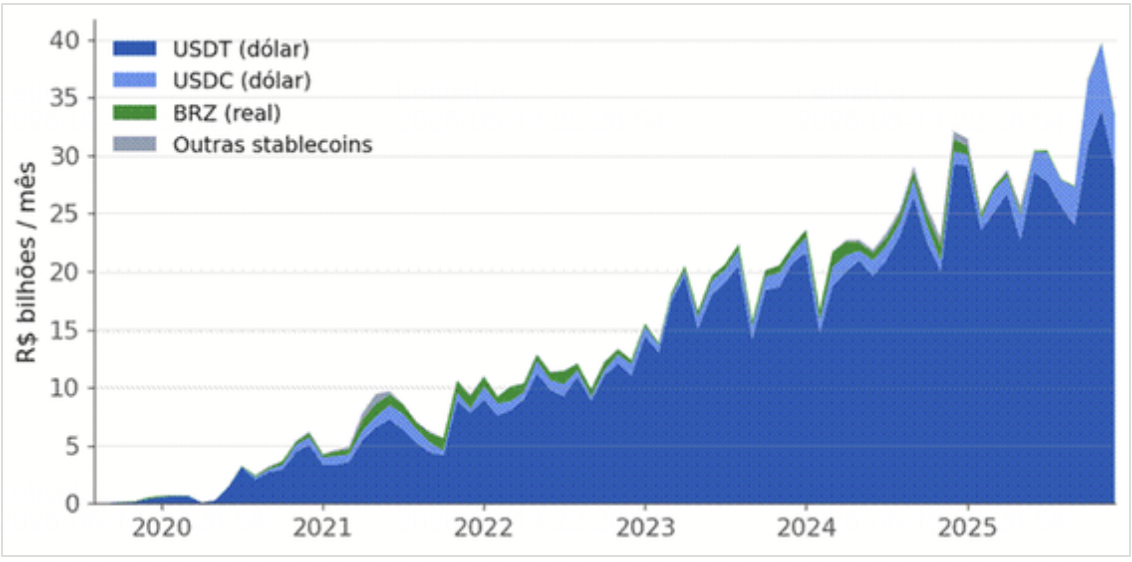
Source: Brazil’s Federal Revenue Service (Receita Federal do Brasil)
Brazilian users can buy USDT with BRL through methods such as Pix, credit or debit cards, and P2P trading, depending on the platform. USDT can then be held, transferred, or used as a trading pair on crypto exchanges. Because USDT is available on multiple blockchain networks, users should always confirm that the sending and receiving networks are compatible before making a transfer.
Read More: What Is USDT in 2026? Complete Beginner's Guide to Tether's Stablecoin
Where to Buy USDT in Brazil in 2026: Best Ways to Buy Tether
USDT can be bought in Brazil through centralized crypto exchanges, P2P marketplaces, crypto ATMs, and payment apps. The best option depends on factors such as fees, BRL payment support, liquidity, convenience, and whether you want to keep USDT on a platform or transfer it to your own wallet.
For most users, a centralized exchange is the most practical starting point because it can combine BRL payment methods, spot trading, liquidity, and account security tools in one place. P2P marketplaces offer more flexibility in payment methods, while crypto ATMs may be convenient but often come with higher fees. Crypto platforms may also require identity verification before users can access certain BRL payment or trading services.
BingX gives Brazilian users access to several of these buying methods in one platform, including BRL deposits through Pix, credit or debit card purchases, and P2P trading. The next section explains how each method works in practice.
|
Method |
Speed |
Typical Cost |
Best For |
|
Centralized exchange |
Minutes |
Generally low |
Buying USDT directly with strong liquidity |
|
P2P marketplace |
Minutes to hours |
Varies by offer |
Flexible BRL payment methods |
|
Crypto ATM |
Minutes |
Generally high |
Buyers prioritizing convenience |
|
Payment app |
Minutes |
Spread and service fees |
Users wanting a simple mobile purchase |
Read More: Choosing Your Path to Crypto: CEX vs. DEX vs. P2P On-Ramps in Brazil (2026 Guide)
How to Buy USDT in Brazil: 3 Ways to Buy Tether on BingX
Brazilian users can buy USDT on BingX in three main ways: Pix, credit or debit card, and P2P trading. Each method offers a different balance of cost, speed, and flexibility. Pix provides a direct route from BRL to USDT, card payments simplify the purchase process, and P2P allows buyers to compare sellers, prices, and local payment options before placing an order.
|
Method |
How It Works |
Cost |
Best Suited For |
|
Pix |
Deposit BRL, then buy USDT |
Generally lower |
Buying USDT with BRL |
|
Credit/Debit Card |
Buy USDT directly with a card |
Generally higher |
Simple, direct purchases |
|
P2P |
Buy from another user |
Varies by offer |
Flexible BRL payments |
1. Buy USDT on BingX with Pix in Brazil
Pix is the most practical route for users who already hold BRL in a Brazilian bank account. The process has two parts: first you deposit BRL into your BingX fiat balance using Pix, then you convert that balance into USDT. Because USDT tracks the US dollar, the conversion is straightforward and the amount you receive follows the live BRL to dollar rate.
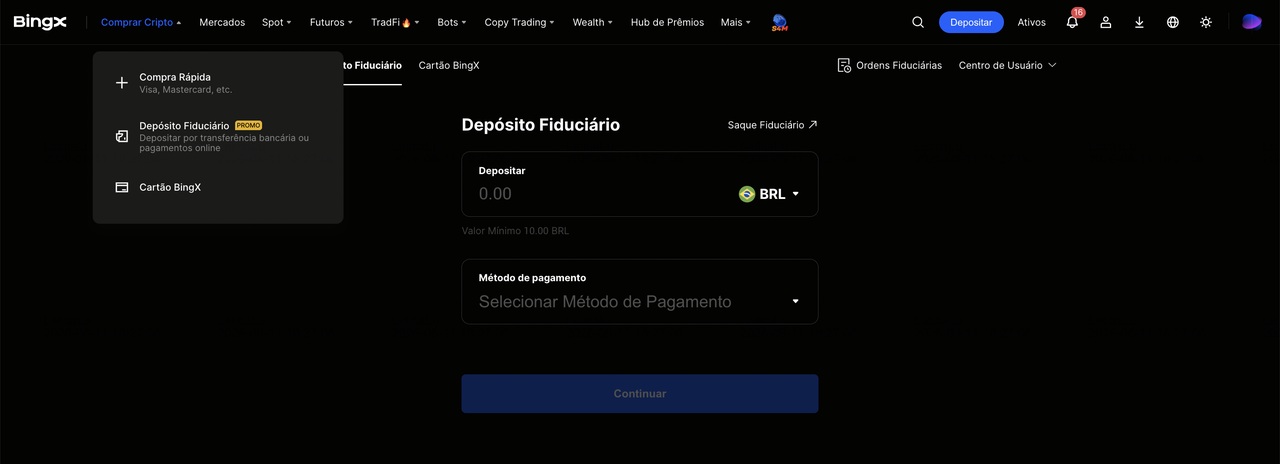
- Create and verify your account: Register on BingX, enable two-factor authentication, and complete the required identity and CPF verification. CPF verification is needed before your first deposit.
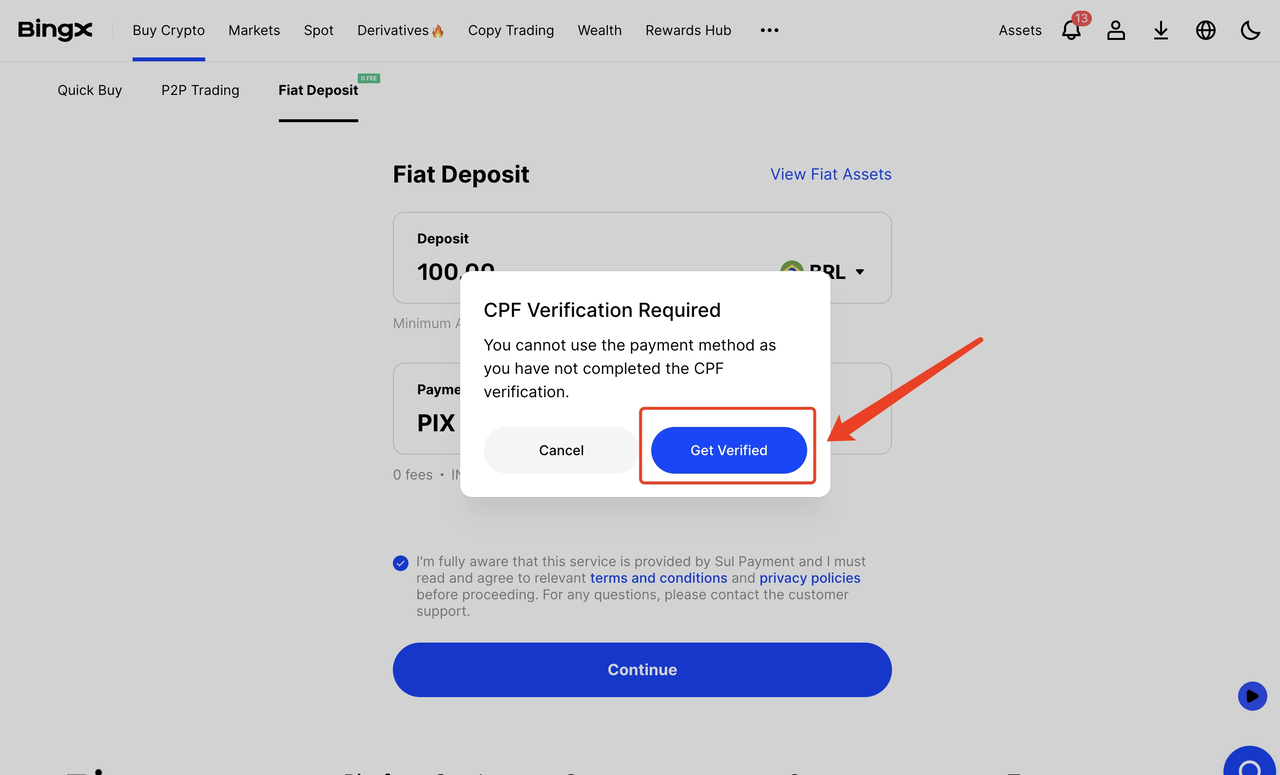
- Deposit BRL with Pix: Go to Buy Crypto > Fiat Deposit, select BRL, enter the amount, and choose Pix as the payment method. Scan the QR code and complete the transfer in your banking app, then tap "Paid." Pix runs 24/7 and deposits are credited in real time. Note that the QR code expires after 30 minutes.
- Convert your BRL to USDT: Once the BRL is credited, go to Assets > Funding Account > Fiat Currency > Convert and use Fiat Conversion to swap BRL into USDT instantly. Alternatively, open the spot market and place an order on a USDT pair if you want more control over the exact price, using a market order to buy instantly or a limit order to set your price.
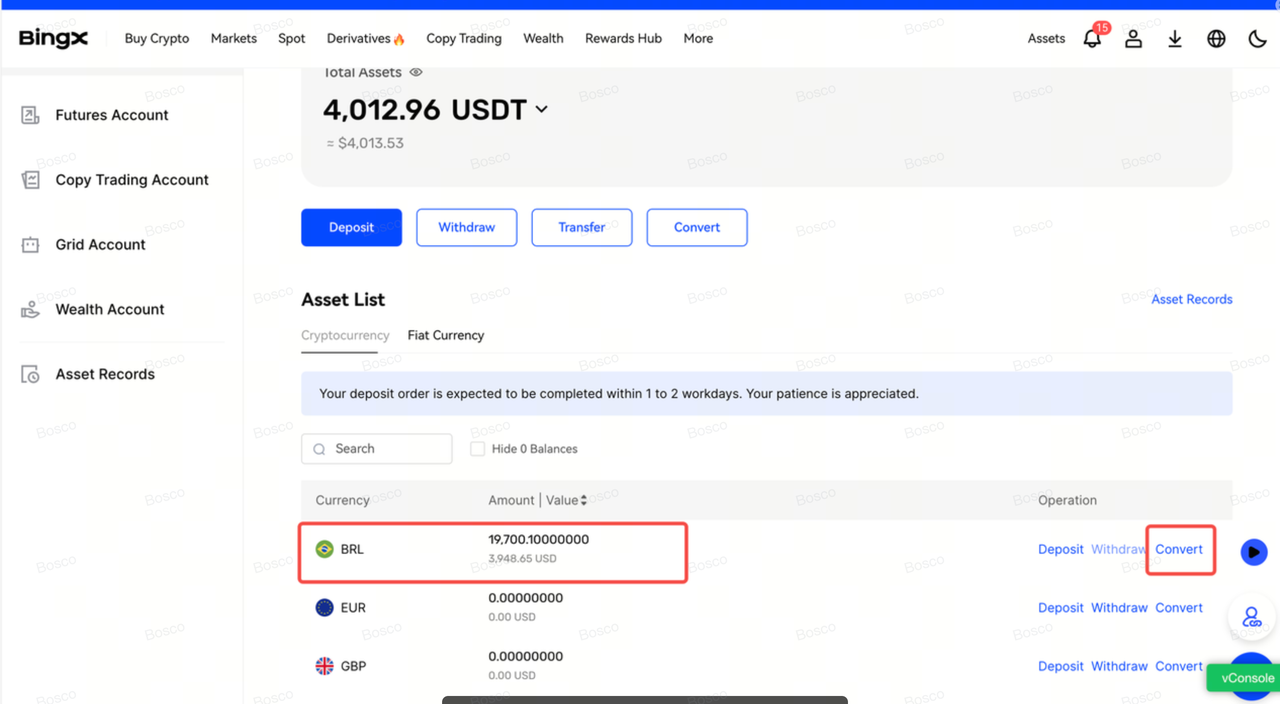
- Confirm the details: Check the amount of USDT you will receive and any fee before confirming. The purchased USDT then appears in your BingX account, where you can hold it, trade it, or withdraw it to a personal wallet.
Read More: How to Buy Your First Crypto in Brazil Using PIX: A Step-by-Step Guide (2026)
2. Buy USDT on BingX with a Credit or Debit Card in Brazil
Card payments are the most direct way to buy USDT, letting you purchase it instantly without first depositing BRL into a fiat balance. On BingX, card purchases are processed through Quick Buy partners MoonPay, Alchemy Pay, and Mercuryo, which support Visa and Mastercard across more than 20 fiat currencies with instant settlement. The trade-off is cost, since these providers may add fees or apply a different exchange rate than the Pix route.
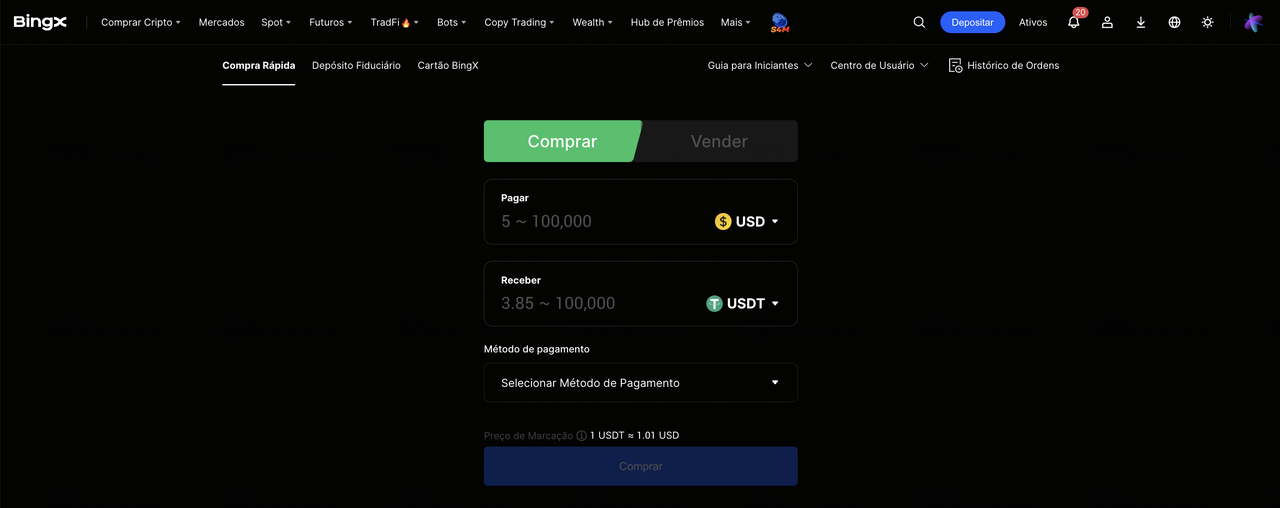
- Open Quick Buy: Go to Buy Crypto > Quick Buy after signing in.
- Select USDT: Choose USDT and enter the amount you want to buy. The minimum purchase is 10 USD equivalent for Tether.
- Choose a payment card: Select a supported Visa or Mastercard, or use Apple Pay or Google Pay. Make sure the card supports 3D Secure and online international transactions.
- Review the quote: Check the USDT amount, exchange rate, and applicable charges.
- Complete the payment: Confirm the purchase and wait for the USDT to be credited to your BingX account.
3. Buy USDT on BingX via P2P in Brazil
BingX P2P lets you buy USDT directly from vetted merchants rather than through a standard exchange order, with zero transaction fees, escrow protection, and multiple local payment options. Buyers can compare individual offers based on price, payment method, limits, and seller history before choosing a trade. USDT is one of the most actively traded assets on the P2P market, so BRL liquidity through Pix is typically deep.
Because you transact with another person, BingX holds the seller's USDT in escrow until you confirm payment, so payments and communication should always stay within the platform.
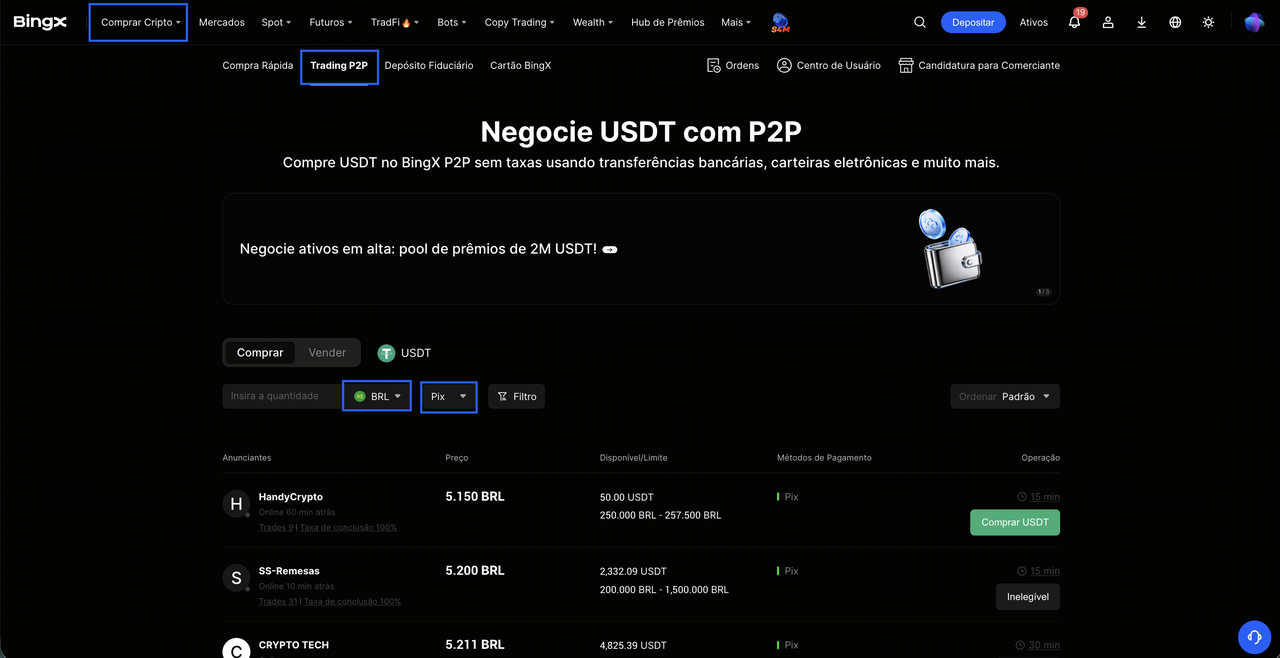
- Open P2P Trading: Go to Buy Crypto > P2P Trading and select Buy.
- Set your filters: Choose BRL, enter the amount, and select a payment method such as Pix.
- Compare offers: Review price, transaction limits, completion rate, and seller terms.
- Send the payment: Pay from an account matching your verified identity and only mark the order as paid after the transfer is complete.
- Receive the crypto: Once the seller confirms payment, the escrowed USDT is released to your BingX account. Use the appeal function if a dispute occurs.
How to Store USDT Safely After Buying
After buying USDT, the main choice is whether to keep it on an exchange or move it to self-custody. Keeping USDT on BingX is convenient for active traders because the funds remain available for trading, conversion, or withdrawal. BingX maintains 100% Proof of Reserves, meaning user assets are fully backed, and also operates a $100+ million Shield Fund designed to provide additional protection against unexpected platform incidents such as security or technical risks.
For users who prefer direct control of their assets, a self-custody software wallet such as MetaMask or Trust Wallet provides access to the private keys, while a hardware wallet like Ledger or Trezor keeps those keys offline and is commonly used for larger or longer-term holdings. Because USDT exists on multiple blockchains, always confirm that your receiving wallet supports the withdrawal network and that the network matches on both sides. Using an incompatible network can result in loss of funds. Recovery phrases and private keys should be stored offline and never saved in screenshots, email, or cloud storage.
Do You Need to Pay Tax or Declare USDT in Brazil?
Buying USDT and realizing a taxable gain are separate events. Although USDT is designed to track the U.S. dollar, gains measured in BRL may still arise because of exchange-rate movements. Tax obligations can become relevant when USDT is sold for BRL, exchanged for another cryptoasset, or otherwise disposed of, depending on the transaction and applicable tax rules. Brazil also has specific reporting requirements for cryptoassets, separate from whether a transaction generates taxable income.
Brazil's crypto reporting rules continue to evolve, with the DeCripto framework applying to transactions from July 2026. Buyers should keep records of purchase dates, BRL values, USDT quantities, fees, transfers, and sale proceeds. Cryptoassets may also need to be reported in the annual income tax return depending on their acquisition value and the taxpayer's circumstances. This section is a general overview and does not constitute tax advice.
Further reading: Crypto Taxes in Brazil: A Guide to Declaring Your On-Ramp and Off-Ramp Transactions
5 Mistakes to Avoid When Buying USDT
Buying USDT is relatively straightforward, but small mistakes around fees, payments, withdrawals, or storage can still make the process more expensive or risky than necessary.
- Ignoring the total purchase cost: The advertised USDT rate is only part of the cost. Compare the final amount of USDT received after trading fees, spreads, and payment charges, especially when choosing between Pix, card, and P2P.
- Choosing the wrong network when withdrawing: USDT exists on multiple blockchains. Sending it on a network your receiving wallet does not support, or pasting the wrong address, can result in permanent loss. Always confirm the network and address before confirming a withdrawal.
- Moving a P2P transaction off-platform: Taking payment or communication outside BingX removes much of the protection provided by escrow and the platform's dispute process. Keep the full transaction inside the P2P marketplace.
- Assuming a stablecoin carries no risk: While USDT aims to hold a steady value, stablecoins depend on their issuer and reserves and are not entirely without risk. Understand what you are holding and why.
- Having no storage plan: Decide in advance whether the USDT is intended for active trading or longer-term holding. Larger balances may warrant self-custody rather than being left on an exchange for frequent trading.
Final Thoughts: What Is the Best Way to Buy USDT in Brazil?
For most Brazilian users, the main decision is no longer whether USDT can be bought with BRL, but which payment route best fits their needs. Pix offers a direct way to fund a BingX account and buy USDT, card payments prioritize convenience, and P2P provides more flexibility when comparing sellers, prices, and payment methods.
The purchase method is only the first part of the process. Buyers should also compare the total USDT received after fees, decide which network to hold or withdraw on, secure their account or wallet properly, and keep complete transaction records for future tax reporting. Choosing the right combination of payment method, custody, and network can make the overall buying experience much more efficient.
Related Reading
- USDT Networks 2026: TRC20 vs ERC20 vs BEP20 vs Solana vs TON - Full Comparison
- Crypto Taxes in Brazil: A Guide to Declaring Your On-Ramp and Off-Ramp Transactions
- How to Buy Your First Crypto in Brazil Using Pix: A Step-by-Step Guide
- Navigating Brazil's Crypto Regulations: KYC, AML, and Compliance (2026 Guide)
- Best Crypto Exchanges for Cryptocurrency Trading in Brazil (Spot and Futures)
- Top 5 PIX-Supported Crypto Exchanges in Brazil (2026 Comparison)
- A Deep Dive into On-Ramp Fees in Brazil: PIX, Boleto, Credit Card, and Bank Transfer (2026 Guide)
FAQs About Buying USDT in Brazil
1. How do I buy USDT with Pix in Brazil?
On BingX, you can buy USDT with Pix by depositing BRL through the Pix-supported fiat deposit flow, then converting BRL to USDT through Convert or the spot market. BingX also supports Pix as a local BRL payment method for Brazilian users.
2. Where can I buy USDT in Brazil?
You can buy USDT in Brazil through centralized exchanges, P2P marketplaces, crypto ATMs, and some payment apps. BingX supports BRL funding, P2P trading, and direct crypto purchase options for Brazilian users.
3. What is the minimum amount to buy USDT on BingX?
The minimum amount to buy USDT on BingX is US$10 through its direct purchase flow, including Quick Buy. For spot trading, minimum order requirements are separate and depend on the trading pair.
4. Is it safe to buy USDT in Brazil?
Yes, you can buy USDT through established crypto platforms in Brazil, but no crypto purchase is risk-free. Using 2FA, completing identity verification, checking payment details, and keeping P2P transactions within escrow can reduce account and transaction risks; USDT itself also carries issuer and reserve risks.
5. Is USDT legal in Brazil?
Yes. Buying, holding, transferring, and selling USDT is permitted in Brazil. Crypto service providers operating under Brazil's regulatory framework are subject to rules established by authorities including the Banco Central do Brasil, as well as applicable AML and reporting requirements.
6. Do I need to pay tax when I buy USDT in Brazil?
No, buying USDT by itself does not create a taxable gain. Tax consequences may arise later when USDT is sold, exchanged, or otherwise disposed of at a gain measured in BRL. Crypto transactions may also have separate reporting requirements under Brazil's DeCripto framework, which applies to transactions from July 2026.
