U.S. stock liquidity changes throughout the trading day as market makers, institutions, and individual traders enter and leave the market. During regular trading hours, higher participation generally supports tighter bid-ask spreads and deeper liquidity. Before the market opens or after it closes, fewer available orders and sudden reactions to news can increase slippage and execution costs, even when trading fees remain unchanged.
BingX provides eligible users with access to 7,000+ U.S. stocks and ETFs through Stocks Trading, alongside USDT-margined stock perpetual futures on TradFi. Supported stocks offer 24/5 trading, while selected stock perpetual contracts support 24/7 access. This guide explores how liquidity changes across trading sessions, compares execution costs, and explains how BingX's deep stock perpetual order books, flexible trading hours, and risk management tools help traders navigate market volatility. Explores practical ways to manage spreads, slippage, and fees across BingX Stocks and TradFi perpetual futures.
Key Takeaways
- Regular market hours offer deeper liquidity: U.S. stocks generally have tighter spreads and more available orders from 9:30 a.m. to 4:00 p.m. Eastern Time, although volatility can increase near the open and close.
- After-hours trading may increase execution costs: Wider spreads and thinner liquidity can lead to higher slippage or partial fills, particularly during earnings announcements and major market events.
- BingX provides flexible stock market access: Eligible users can trade 7,000+ actual U.S. stocks and ETFs 24/5, alongside selected 24/7 stock perpetual futures with long and short exposure.
- BingX offers deep stock perpetual liquidity: Its September 2026 analysis reported 2.2× average order-book depth across selected major U.S. stock perpetuals compared with the second-ranked exchange, although liquidity varies by contract and session.
How Does Liquidity Change During Regular and After-Hours Trading?
U.S. stock liquidity refers to how easily shares can be bought or sold without significantly affecting their price. Regular trading runs from 9:30 a.m. to 4:00 p.m. Eastern Time, when higher institutional and retail participation generally supports tighter bid-ask spreads and deeper liquidity. Extended trading includes pre-market, after-hours, and eligible overnight sessions, although available order sizes and execution conditions vary.
After hours, fewer market makers and institutional participants may lead to wider spreads and lower available liquidity. Earnings announcements and economic events can also trigger sharp price movements when fewer orders are available. Even when trading volume increases, a tight quoted spread does not guarantee sufficient liquidity for larger orders. Traders should compare live bid-ask prices, available order sizes, and session-specific conditions rather than relying on the previous closing price.
|
Trading Session |
U.S. Eastern Time (ET) |
UTC+8 (Standard Time) |
Liquidity Conditions |
What Traders Should Watch |
|
Pre-market |
4:00–9:30 a.m. |
5:00–10:30 p.m. |
Fewer orders, wider spreads |
Earnings, economic releases |
|
Regular hours |
9:30 a.m.–4:00 p.m. |
10:30 p.m.–5:00 a.m. (+1 day) |
Generally deeper liquidity |
Opening and closing volatility |
|
After-hours |
4:00–8:00 p.m. |
5:00–9:00 a.m. (+1 day) |
Thinner liquidity, partial fills |
Earnings, guidance, price swings |
|
Overnight (eligible stocks) |
8:00 p.m.–4:00 a.m. |
9:00 a.m.–5:00 p.m. (+1 day) |
Venue-dependent liquidity |
Available order size, trading restrictions |
During U.S. daylight saving time (EDT), all UTC+8 times shift one hour earlier. Actual sessions depend on the trading venue, security, and holiday schedule.
Read More: What Is Liquidity in TradFi Trading and How Does It Work on BingX?
How Much More Can You Pay When Trading Stocks After Hours?
The bid-ask spread is the difference between the best available buying and selling quotes, while slippage occurs when an order executes at a different price than expected. After-hours trading can involve wider spreads and smaller available orders, increasing execution costs even when commissions remain unchanged. On BingX, traders can use limit orders to set their maximum purchase price and manage execution costs, although orders may fill partially or remain unfilled.
Consider buying 100 shares of a U.S. stock priced near $100. The following hypothetical example illustrates how wider spreads and available order sizes can affect the total purchase cost. A $100.10 buy limit, for instance, would prevent execution above that price rather than accepting a less favorable fill.
|
Illustrative Condition |
Best Bid / Ask |
Sell Orders Available |
Cost to Buy 100 Shares |
|
Regular hours |
$99.99 / $100.01 |
100 shares at $100.01 |
10,001(100.01/share) |
|
After-hours |
$99.90 / $100.10 |
50 shares at $100.10; 50 at $100.20 |
10,015(100.15/share) |
|
Additional purchase cost |
Wider spread |
Smaller size at best ask |
+$14 |
Read More: How Does Liquidity Affect Trading Costs? Trade With Lower Costs on BingX
How Does BingX Help Traders Access U.S. Stocks During and After Market Hours?
BingX combines actual U.S. stock trading with stock perpetual futures, providing flexible market access, deep liquidity across selected contracts, and advanced trading tools. Eligible users can trade beyond regular U.S. market hours while managing execution costs and market exposure through different products.
- 7,000+ U.S. stocks and ETFs: BingX Stocks Trading provides actual securities through Alpaca Securities LLC, with USDT or USDC funding and fractional shares from 5 USDC or 0.0001 shares.
- 24/5 stock trading access: Eligible stocks support extended-hours trading, with limit orders available during supported sessions. Market orders placed outside regular hours may queue until the next session.
- 24/7 stock perpetual futures: Selected stock futures with USDT-margined contracts support long and short positions with leverage, using separate order books from the underlying stocks.
- Deep stock perpetual liquidity: BingX reported 2.2× average order-book depth across selected major U.S. stock perpetuals compared with the second-ranked exchange, although actual liquidity varies by contract and session.
|
Trading Feature |
BingX Stocks Trading |
BingX Stock Perpetual Futures |
|
What you trade |
Actual U.S. stocks and ETFs |
Stock-linked contracts without share ownership |
|
Trading hours |
24/5 for eligible securities |
Selected contracts support 24/7 |
|
Liquidity and execution |
U.S. securities venues through Alpaca; potentially thinner after hours |
Contract-specific order books; depth varies by session |
|
Extended-hours orders |
Eligible limit orders; market orders may queue |
Market and limit orders, subject to contract rules |
|
Position exposure |
Fully paid shares, including fractional stocks |
Long/short positions using USDT margin and leverage |
|
Trading costs |
Spread-based, no separate stock commission |
Trading fees, spreads, and periodic funding |
|
Key risks |
Wider spreads, partial fills, and price gaps |
Slippage, funding costs, and liquidation |
Read More: What Is BingX Stocks Trading? A Beginner's Guide to Trading U.S. Stocks and ETFs With Crypto
How Deep Is BingX Stock Perpetual Futures Liquidity?
According to BingX's September 2026 liquidity report, BingX recorded 2.2 times the average order-book depth of the second-ranked exchange across selected major U.S. stock perpetuals and 1.7 times across AI and semiconductor contracts. The analysis measured depth within 0.1%, 0.5%, and 1% of market prices. These figures represent group averages rather than individual-contract results or separate after-hours measurements.
|
Stock Perpetual Group |
Highlighted Contracts |
Reported Average Depth |
|
Major U.S. stocks |
AAPL, TSLA, SPCX |
2.2× second-ranked exchange |
|
AI and semiconductors |
GOOGL, AVGO, SKHYNIX, INTC |
1.7× second-ranked exchange |
BingX also offers 700+ TradFi perpetual instruments across stocks, indices, forex, and commodities, providing broader market access. While deeper order books can help reduce slippage, actual liquidity varies by contract, trading session, and order size. Traders should review live spreads, available depth, and funding rates, particularly outside regular U.S. stock market hours.
Read More: Best Multi-Asset Platforms for Crypto and U.S. Stock Liquidity in 2026
How to Trade U.S. Stock Perpetual Futures on BingX: 5 Simple Steps
BingX allows eligible users to take long or short positions in stock perpetual futures with USDT margin, including selected contracts available outside regular U.S. hours. Follow these five steps, checking contract-specific trading sessions before submitting an order.
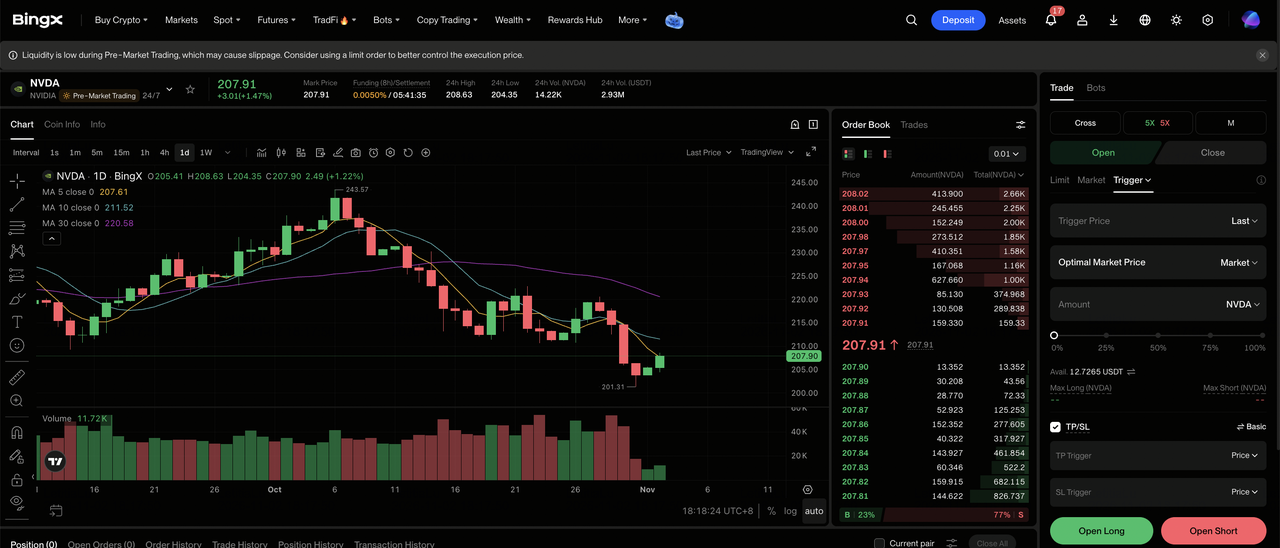
Step 1: Access BingX TradFi. Sign up or log in, complete any required verification, and open BingX TradFi. Confirm that stock perpetual futures are supported in your region.
Step 2: Select a Stock Perpetual Contract. Open a supported contract such as AAPL-USDT or TSLA-USDT. Review bid-ask prices, the opposite side of the order book, live trading hours, funding rate, and contract multiplier before sizing the position.
Step 3: Prepare USDT Margin. Deposit or transfer USDT to your Futures Account. Check available collateral and the required margin for your selected contract and position size.
Step 4: Set Direction, Order Type, and Leverage. Choose Isolated or Cross-Margin, review the estimated liquidation price, and select a supported market or limit order. Use Open Long or Open Short based on your price view. A limit order sets an acceptable execution price but does not guarantee a fill.
Step 5: Manage Your Position and Risk. Set Take-Profit and Stop-Loss (TP/SL) and monitor margin, funding, and market movements. Where supported, BingX Fixed Risk calculates position size using an entry price, stop-loss level, and maximum acceptable loss. It does not guarantee the final loss amount, particularly in fast markets.
5 Ways to Manage Liquidity Risk During and After Market Hours
Liquidity conditions vary across U.S. stock trading sessions, affecting execution prices, slippage, and holding costs. BingX provides flexible order types and risk management tools to help traders manage these differences across Stocks Trading and stock perpetual futures.
- Monitor live spreads and order-book depth: Compare current bid-ask prices and available liquidity before trading, particularly outside regular market hours. For perpetual futures, review depth on the side your order will consume.
- Choose suitable order types: Use limit orders to control execution prices during extended sessions. Stock market orders submitted outside regular hours may be queued until the next session.
- Adjust position sizes to liquidity: Larger orders may execute across multiple price levels, increasing slippage. Smaller orders can help manage immediate price impact, although execution costs still apply.
- Manage leverage and liquidation risks: Review funding rates, margin requirements, and liquidation prices. Use TP/SL or BingX Fixed Risk on supported contracts to manage exposure.
- Prepare for earnings and market closures: Major announcements can trigger rapid price movements outside regular hours. Check trading schedules, holiday closures, and contract availability before placing orders.
Final Thoughts: How BingX Helps Traders Manage After-Hours Liquidity
Regular U.S. trading hours generally offer deeper liquidity and tighter spreads, while after-hours trading provides additional opportunities with potentially higher execution costs. The 100-share example illustrates how thinner liquidity can increase purchase costs by $14, even without a change in the stock's reference price. Comparing live spreads, available order sizes, and trading sessions helps traders manage these differences more effectively.
BingX combines 24/5 access to 7,000+ actual U.S. stocks and ETFs through Alpaca with selected 24/7 stock perpetual futures, providing flexible exposure across market sessions. Its reported 2.2× average order-book depth across selected major stock perpetuals supports its liquidity positioning, while market and limit orders, TP/SL, and Fixed Risk on supported contracts help traders manage execution and leveraged exposure. Actual liquidity and trading conditions depend on the selected product and session.
Risk Reminder: U.S. stocks and stock perpetual futures involve volatility and potential losses. After-hours spreads may widen, orders may remain unfilled, and leveraged positions carry funding and liquidation risks. Stop-loss and Fixed Risk tools do not guarantee a maximum loss. Product availability varies by region, and this article does not constitute investment advice.
Related Reading
- What Is Liquidity in TradFi Trading and How Does It Work on BingX?
- How Does Liquidity Affect Trading Costs? Trade With Lower Costs on BingX
- Trading Volume vs. Liquidity: What Is the Difference?
- What Is BingX Stocks Trading? A Beginner's Guide to Trading U.S. Stocks and ETFs With Crypto
- Best U.S. Stock Perpetual Futures Platforms for High Liquidity in 2026
- Best U.S. Stock Trading Platforms With High Liquidity in 2026: Fees and Features Compared
FAQs About U.S. Stock Trading Liquidity and Market Hours
1. Is U.S. Stock Liquidity Always Lower After Hours?
Not always. After-hours liquidity is generally thinner due to fewer market participants, but earnings announcements and major news can increase trading activity. Wider spreads, slippage, and partial fills may still occur.
2. Can I Trade U.S. Stocks 24/5 on BingX?
Yes. BingX Stocks Trading offers eligible users 24/5 access to 7,000+ U.S. stocks and ETFs through Alpaca Securities LLC. Trading hours and supported order types vary by security and session.
3. Can I Use Market Orders During BingX Stock After-Hours Sessions?
Market orders submitted outside regular U.S. trading hours are generally queued until the next regular session. Eligible users can place limit orders during supported extended-hours sessions, although execution is not guaranteed.
4. Can Stock Perpetual Futures Trade While U.S. Stock Markets Are Closed?
Yes. Selected BingX stock perpetual futures support 24/7 trading, with separate order books from the underlying stocks. Liquidity, spreads, funding rates, and contract availability may change outside regular market hours.
5. How Can I Reduce Slippage When Trading Stocks After Hours?
Compare live bid-ask spreads, review available order sizes, and consider limit orders to control execution prices. Limit orders may fill partially or remain unfilled, particularly during volatile sessions.
