

Corning Incorporated (GLW) is one of the world’s largest optical fiber and connectivity companies, supplying glass, fiber, cabling and optical technologies used across telecom networks, data centers, consumer electronics and other industrial markets. Its Optical Communications business has become increasingly important to the AI infrastructure buildout, with demand rising for fiber and connectivity systems that move data between servers, racks and data centers. This gives Corning direct exposure to AI networking growth, but also leaves the stock sensitive to data-center spending, customer concentration and whether current optical demand can remain elevated.
Its latest quarter showed how quickly that AI exposure is expanding. Second-quarter core sales reached $4.74 billion, up 17% year over year, while core EPS rose 30% to $0.78. Optical Communications sales grew 32% to $2.07 billion, with Enterprise Networks up 65% and segment net income rising 77% to $438 million. The broader investment case now depends on whether AI-driven optical demand, long-term customer agreements and Corning’s Springboard expansion plan can sustain growth as year-over-year comparisons become more difficult.
The GLW stock forecast for 2026 now centers on two competing views:
- The AI connectivity case: Bulls expect the Springboard 20-30-40 plan, multi-billion-dollar customer agreements, a new photonics platform and continued optical growth to sustain a multi-year cycle, with analyst targets averaging near $196.
- The valuation and comparison case: Bears see a stock that has risen sharply, a premium forward multiple near 38 times earnings, and concern that optical growth will slow as easier year-over-year comparisons fade.
This guide breaks down the GLW stock forecast, 2026 price scenarios, key risks, and research from Citi, Mizuho, Truist, Morgan Stanley and the broader Street, drawing on the July 27 earnings release and the Q2 investor call, plus how to trade GLW stock futures on BingX TradFi with USDT collateral.
Top 5 Things for GLW Investors to Know in July 2026
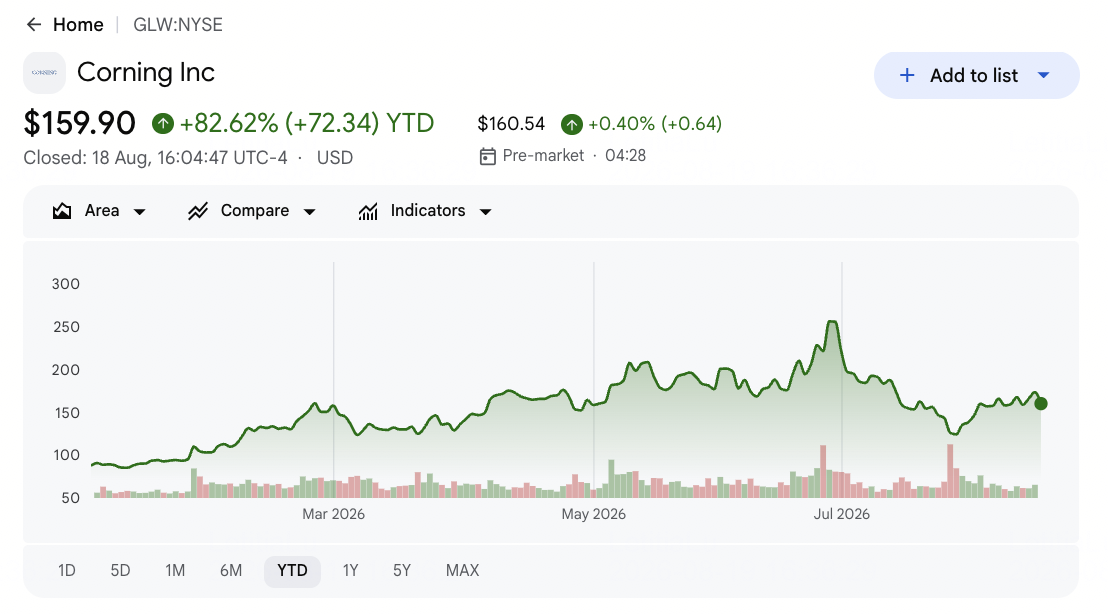
- Q2 core sales reached $4.74 billion: Core sales rose 17% year over year and beat the roughly $4.61 billion consensus, while core EPS increased 30% to $0.78. The key question is whether growth can hold as comparisons become tougher.
- Optical Communications is the main AI growth engine: Sales rose 32% to $2.07 billion, with Enterprise Networks up 65% and segment net income up 77% to $438 million. Continued upside depends on AI and data-center demand staying strong.
- Margins improved alongside growth: Core gross margin expanded 120 basis points to 39.6%, while core operating margin increased 190 basis points to 20.9%. Sustaining those gains will be important as Corning continues investing in capacity.
- Q3 guidance points to continued momentum: Management guided core sales to $4.9 billion to $5.0 billion and core EPS to $0.85 to $0.89. Corning also said its $20 billion annualized sales run-rate target could be reached a quarter early.
- The sell-off showed expectations were already high: GLW fell more than 15% in premarket trading and over 20% at points despite the beat. Future performance now depends on continued optical growth, margin delivery, and progress toward Springboard targets.
What Is Corning Incorporated (GLW)?
Corning Incorporated is a materials science company headquartered in Corning, New York, specializing in glass, ceramics and optical physics. It supplies optical fiber and cable, display glass, specialty glass, environmental technologies and solar materials across communications, consumer electronics, automotive and life sciences markets.
The business has become increasingly tied to AI infrastructure. Optical Communications, its largest segment, provides the fiber, cable and connectivity products that data centers use to link AI accelerators, and grew 32% in the quarter with Enterprise Networks up 65%. Under CEO Wendell Weeks, Corning has outlined its Springboard plan to grow the annualized sales run rate from $20 billion by the end of 2026 to $30 billion by the end of 2028 and $40 billion by the end of 2030, a roughly 19% sales compound annual growth rate. The company has secured multi-billion-dollar long-term agreements with Apple, Meta, NVIDIA and Amazon, including a $6 billion Meta supply deal, and is developing a $10 billion photonics platform by 2030. Its other segments span display, specialty materials, environmental technologies and a growing solar business.
Corning (GLW) Q2 2026 Earnings Overview: Optical Growth Beat Expectations While the Stock Sold Off
- Core sales beat expectations and grew 17% year over year. Corning reported $4.74 billion in Q2 core sales, above the roughly $4.61 billion consensus, while core EPS of $0.78 also topped the $0.76 estimate. The results confirmed solid underlying demand, even as investors focused on whether that growth can continue.
- Optical Communications was the main growth engine. Segment sales rose 32% to $2.07 billion, with Enterprise Networks up 65% and segment net income increasing 77% to $438 million. AI data-center demand remained the clearest driver behind the quarter.
- Margins improved alongside higher volume. Core gross margin expanded 120 basis points to 39.6%, while core operating margin rose 190 basis points to 20.9%. The gains showed stronger operating leverage as revenue scaled.
- Long-term agreements strengthened the growth pipeline. Corning highlighted major agreements with Apple, Meta, NVIDIA, and Amazon, including a $6 billion multiyear deal with Meta. These contracts add visibility to the company’s Springboard growth plan.
- The sell-off reflected concerns about durability. GLW fell sharply despite the earnings beat as investors questioned whether optical growth can remain elevated once easier year-over-year comparisons fade. The next few quarters will show whether AI demand can sustain the current pace.
Read More: Corning (GLW) Q2 2026 Earnings News: $145M GAAP Sales Miss Triggers a 12.10% Selloff
Corning Q2 2026 Financial and Consensus Profile: Revenue, EPS and Margins
Corning's Q2 print showed a company delivering strong AI-driven optical growth and margin expansion while the market focused on durability and valuation. The gap between a beat and a 15%-plus sell-off is the central fact of the quarter.
|
Financial Metric |
Guidance / Consensus |
Reported / Actual |
Surprise |
|
Q2 2026 Core Sales |
~$4.61 billion consensus |
$4.74 billion |
Beat; up 17% year over year |
|
Q2 2026 Core EPS |
~$0.76 consensus |
$0.78 |
Beat; up 30% year over year |
|
Q2 2026 Core Gross Margin |
— |
39.60% |
Up 120 basis points year over year |
|
Q2 2026 Core Operating Margin |
— |
20.90% |
Up 190 basis points year over year |
|
Q2 2026 Optical Communications Sales |
— |
$2.07 billion |
Up 32% year over year |
|
Q2 2026 Enterprise Networks |
— |
Up 65% |
Driven by generative AI demand |
|
Q2 2026 Optical Segment Net Income |
— |
$438 million |
Up 77% year over year |
|
Q2 2026 Solar Sales |
— |
Up 90% |
Completed facility upgrade |
|
Q3 2026 Core Sales Guidance |
— |
$4.9 to $5 billion |
Up about 16% year over year |
|
Q3 2026 Core EPS Guidance |
— |
$0.85 to $0.89 |
Up about 28% year over year |
For context, Corning's Q2 core sales of $4.74 billion exceeded the guided range of prior quarters, and core EPS of $0.78 beat its own $0.73 to $0.77 guide. The Springboard plan targets a 19% sales compound annual growth rate through 2030, and management indicated it may reach the $20 billion annualized run rate in Q3 rather than Q4. GLW shares were up roughly 62% year to date and more than 126% over the prior 52 weeks heading into the report, and the stock traded at a premium forward multiple near 38 times earnings, above the sector median.
Corning (GLW) 2026 Investment Outlook: $196 Bull Case vs. Comparison-Driven Bear Case
Corning's outlook for the rest of 2026 depends on one central question: whether AI-driven optical demand and the Springboard plan represent a durable multi-year cycle, or whether a premium-valued stock faces slowing growth as year-over-year comparisons become harder.
The Bull Case: The Springboard Plan and AI Optical Demand Push GLW Toward $196
The bull case rests on the durability of AI-driven optical demand. Optical Communications grew 32%, Enterprise Networks grew 65%, and generative AI product sales grew significantly faster, while Corning secured multi-billion-dollar agreements with Apple, Meta, NVIDIA and Amazon. That combination supports the Springboard plan to grow the run rate from $20 billion to $40 billion by 2030.
This scenario requires AI data center connectivity demand to sustain the optical growth engine. Corning's $6 billion Meta deal, its new photonics platform, and a 19% sales compound annual growth rate target support the case for a multi-year cycle. The average analyst target near $196 reflects confidence in the plan, and continued optical growth would strengthen the path toward that level from the post-sell-off price.
The Base Case: Corning Consolidates Below the Average Target
In the base case, Corning delivers its guidance while the market digests the sharp sell-off and premium valuation. Q3 core sales land within the $4.9 billion to $5 billion range, the company approaches its $20 billion run rate, and the stock consolidates as investors assess how durable optical growth is against harder comparisons.
The margin expansion and long-term agreements provide support while the valuation stays premium. With a Moderate Buy consensus and multiple customer commitments, steady execution could keep GLW recovering toward its average target as the Springboard plan progresses. The clustered analyst targets define the range.
The Bear Case: Fading Comparisons Pull GLW Lower
The bear case does not require AI demand to collapse. It requires optical growth to slow against harder comparisons at a premium valuation. GLW trades near 38 times forward earnings, well above the sector median, after a large run, leaving room for a pullback.
Slowing optical growth as year-over-year comparisons ease would be the clearest trigger. If the exceptional growth rates in Enterprise Networks and generative AI products moderate, the market could re-rate a premium-valued stock. Uncertainty around the timing and adoption of optical scale-up in AI factories, which management acknowledged, adds to the risk. Several analysts cut targets after the print, with Morgan Stanley lowering to $165 and keeping an Equal Weight rating.
GLW Stock Price Forecasts for 2026 By Wall Street Analysts
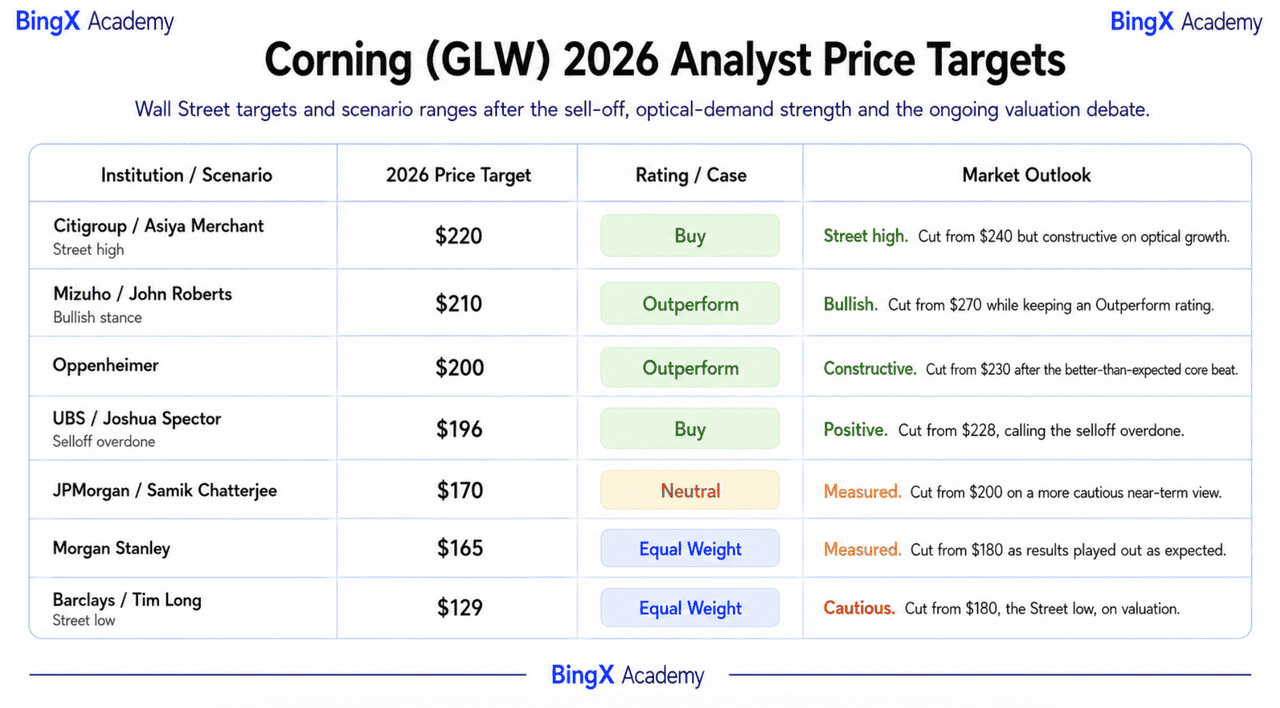
Wall Street stayed largely bullish on Corning while cutting targets across the board after the sell-off, with roughly 11 of 16 analysts rating it Buy. The consensus fell toward $174 to $196, and firms framed the pullback as valuation-driven rather than a change in the AI optical thesis.
|
Institution |
2026 Price Target |
Rating |
Market Outlook |
|
Citigroup / Asiya Merchant |
$220 |
Buy |
Street high. Cut from $240 but constructive on optical growth. |
|
Mizuho / John Roberts |
$210 |
Outperform |
Bullish. Cut from $270 while keeping an Outperform rating. |
|
Oppenheimer |
$200 |
Outperform |
Constructive. Cut from $230 after the better-than-expected core beat. |
|
UBS / Joshua Spector |
$196 |
Buy |
Positive. Cut from $228, calling the selloff overdone. |
|
JPMorgan / Samik Chatterjee |
$170 |
Neutral |
Measured. Cut from $200 on a more cautious near-term view. |
|
Morgan Stanley |
$165 |
Equal Weight |
Measured. Cut from $180 as results played out as expected. |
|
Barclays / Tim Long |
$129 |
Equal Weight |
Cautious. Cut from $180, the Street low, on valuation. |
How to Trade Corning Incorporated (GLW) Stock on BingX
Navigate the volatility of Corning's earnings cycle using BingX TradFi and BingX AI tools. By leveraging AI-driven predictive analytics, you can better anticipate market sentiment shifts and price action around quarterly releases.
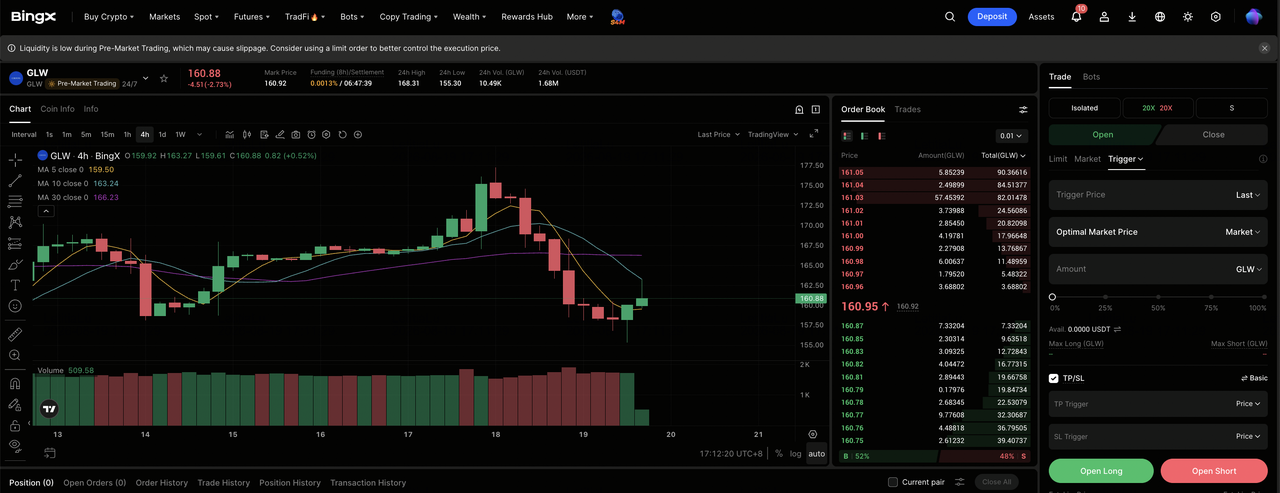
Step 1: Access BingX TradFi. Sign up and navigate to the specialized TradFi section on the main BingX exchange dashboard.
Step 2: Select Corning Incorporated (GLW). Search for and select the GLW-USDT perpetual futures contract.
Step 3: Choose your direction. Select Open Long if you expect AI-driven optical demand to sustain the Springboard plan, customer agreements to deepen, and margins to keep expanding. Select Open Short if you expect optical growth to slow against harder comparisons, or the market to reprice a premium multiple.
Step 4: Select leverage and margin mode. Choose Isolated or Cross-Margin based on your risk tolerance. Because GLW fell more than 15% despite a Q2 beat and can move sharply on optical growth signals, conservative leverage and clear position sizing are important.
Step 5: Execute strict risk protocols. Set Take-Profit and Stop-Loss (TP/SL) levels before or immediately after entering the trade. GLW can react quickly to quarterly earnings and guidance, optical and Enterprise Networks growth trends, hyperscaler and customer agreement news, AI data center capex commentary, and analyst rating changes.
Top 5 Risks to Watch for GLW Investors in 2026
Corning’s AI optical growth and Springboard plan support the upside case, but five risks could determine whether that momentum holds through the rest of 2026.
- Year-over-year comparisons are getting tougher. Optical Communications has posted unusually strong growth, but easier comparisons will fade. The key test is whether AI-driven demand can sustain double-digit growth from a higher base.
- The valuation leaves less room for disappointment. GLW trades at a premium earnings multiple, making the stock more sensitive to slower revenue growth, weaker guidance, or margin pressure.
- Optical scale-up timing remains uncertain. Management has acknowledged uncertainty around when next-generation optical technologies will see broader adoption in AI infrastructure. Delays could push revenue expectations further out.
- AI capex remains an important demand driver. Corning’s optical growth is increasingly tied to hyperscaler data-center investment. Any slowdown in AI infrastructure spending could reduce demand for fiber and connectivity products.
- Large customer agreements increase concentration. Multi-billion-dollar deals with major technology companies improve revenue visibility, but they also increase exposure to a smaller group of customers and their spending plans.
Final Thoughts: Should You Invest in Corning in 2026?
Corning after the July 27 report is a story of strong AI-driven optical growth met with a sharp sell-off. Core sales up 17%, core EPS up 30%, Optical Communications up 32%, and multi-billion-dollar customer agreements are not in dispute. What is in dispute is whether optical growth can sustain as year-over-year comparisons harden and whether a premium-valued stock deserves its multiple.
The bull case is that AI data center connectivity demand, the Springboard 20-30-40 plan, and deep customer commitments support a durable multi-year cycle. The bear case is that growth will slow against harder comparisons at a premium valuation near 38 times earnings. Investors who believe the AI optical cycle is durable may view the sell-off as a buying opportunity, a view several analysts share. More conservative traders might wait for evidence that optical growth sustains beyond the easy comparisons, using the average target near $196 as a reference point.
Risk Reminder: Trading and investing in equities like GLW involves a high risk of capital loss. Corning is exposed to AI data center capital spending, optical demand cycles, customer concentration, and a premium valuation that amplifies any slowdown. Conduct independent research before allocating capital.
Related Reading
- Top AI Optical Stocks to Buy in 2026: Photonics, Optics, Fiber, and Data Center Interconnects
- Top AI Networking Stocks 2026: AI Fabric, Switches, Copper, Fiber, and Optics Connectivity
- Top AI Data Center Stocks to Buy in 2026: Cloud, Servers, and AI Compute Infrastructure
- Nvidia (NVDA) Stock Price Outlook for 2026: Can Blackwell and Vera Rubin Take NVDA Back to $300?
- Amazon (AMZN) Stock Price Prediction 2026: Can AWS AI Re-acceleration Offset a $200B CapEx Gamble?
- Apple (AAPL) Stock Outlook for 2026: MacBook Neo Growth or AI Valuation Trap?
- Meta (META) Stock Price Prediction 2026: Can AI Efficiency and Custom Silicon Drive META to $900?
