


Coinbase Global, Inc. (COIN) is the largest US-listed cryptocurrency exchange, offering spot and derivatives trading, custody, staking, stablecoin services, and a growing range of subscription products. Trading fees remain an important source of revenue, but businesses such as USDC, staking, custody, prediction markets, and Base are becoming more important as Coinbase works to reduce its dependence on volatile crypto trading activity.
The growth story now depends on whether those newer businesses can scale fast enough to support Coinbase through weaker trading cycles. In Q2 2026, revenue fell to $1.2 billion from $1.5 billion a year earlier, while the company reported a net loss of $359 million, or $1.36 per share, as lower crypto prices and trading volumes weighed on results. At the same time, Coinbase reached an all-time high in trading market share, strengthening the case that it can continue gaining users and activity even during a softer market. The key question for investors is whether subscription and services revenue, derivatives, prediction markets, USDC, and Base can grow quickly enough to make revenue more stable across crypto cycles.
The COIN stock forecast for 2026 now centers on two competing views:
- The diversification case: Bulls expect subscription and services revenue, prediction markets, derivatives, USDC balances and continued market-share gains to build a more durable growth base that is less tied to spot trading fees, with analyst targets raised as high as $330.
- The trading-cycle case: Bears see transaction revenue at roughly $599 million a quarter, three consecutive GAAP losses, and a valuation exposed to crypto volatility, with softer volumes and lower prices pressuring near-term earnings.
This guide breaks down the COIN stock forecast, 2026 price scenarios, key risks, and analyst views, drawing on the July 30 earnings release, plus how to trade COIN stock futures on BingX TradFi with USDT collateral.
Top 5 Things for Coinbase Investors to Know in August 2026
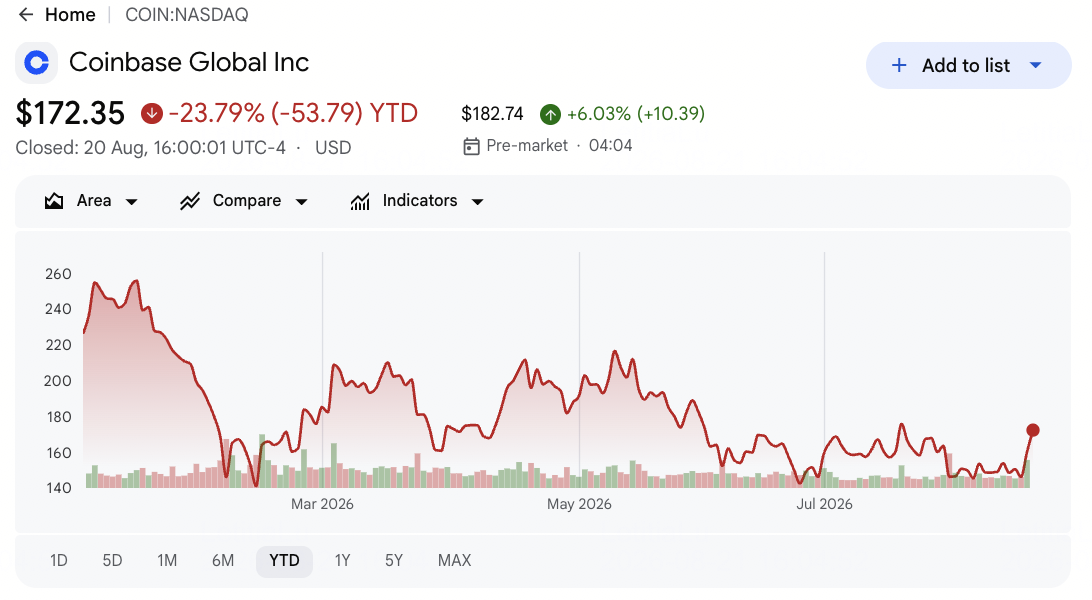
COIN closed around $167 in mid-August 2026, up on the year but well below its highs, with the stock moving sharply around crypto prices, trading volumes and analyst revisions.
- Q2 revenue fell 19% year over year to $1.2 billion. Revenue came below the roughly $1.3 billion consensus as weaker crypto markets reduced trading activity. The miss kept attention on whether recurring revenue can offset softer transaction fees during slower trading periods.
- Crypto trading market share reached a record 10.3%. Coinbase increased its market share from 9.1% in Q1 to 10.3% in Q2 2026, a new all-time high. Gaining share during a weaker market suggests the platform is capturing more trading activity even as overall industry volumes decline.
- Coinbase posted a third consecutive GAAP loss. The company reported a net loss of $359 million, or $1.36 per share, driven largely by losses on crypto assets held for investment. Adjusted EBITDA remained positive at $208 million, marking the 14th consecutive quarter of positive adjusted EBITDA.
- Subscription and services revenue reached about $555 million. The segment accounted for roughly 48% of net revenue, reducing Coinbase's dependence on spot trading fees. Prediction markets also crossed a $100 million annualized revenue run rate after growing more than 100% quarter over quarter.
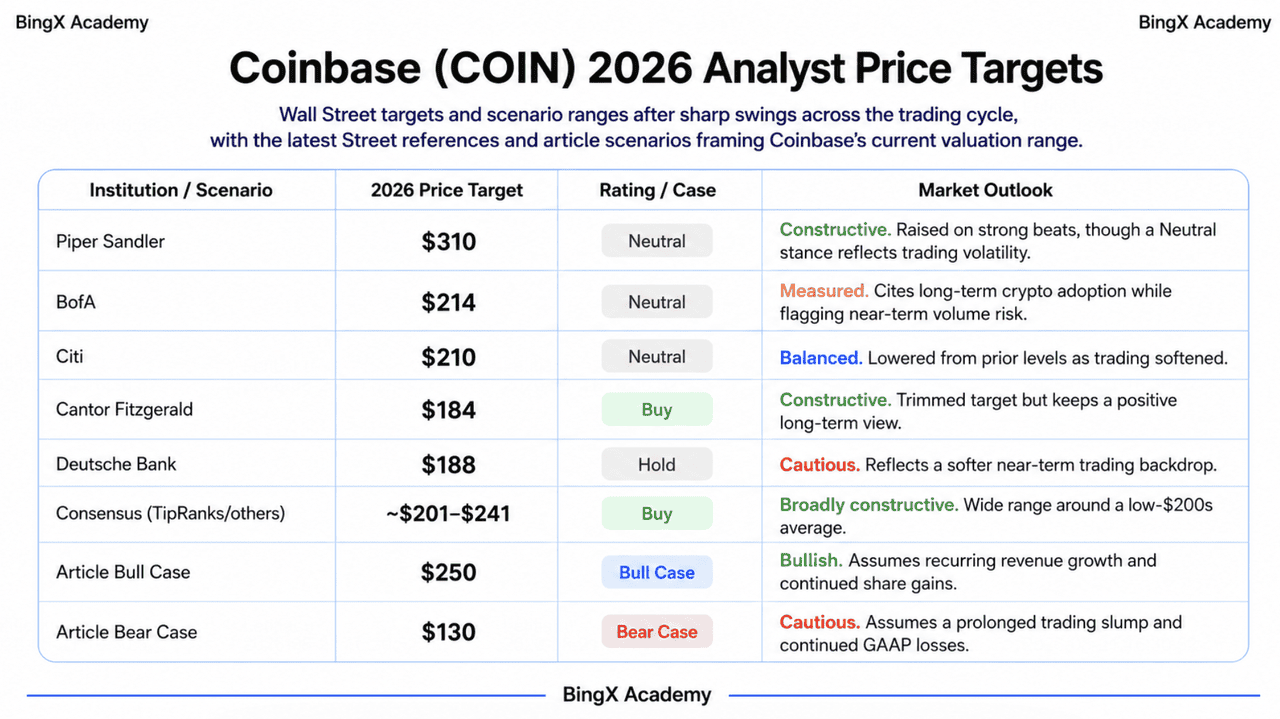
- Analyst price targets remain widely divided. Recent targets have ranged from roughly $95 to $330, with consensus estimates in the low $200s. The wide range reflects stronger market share and product diversification on one side, and weaker trading volumes and earnings volatility on the other.
What Is Coinbase Global, Inc. (COIN)?
Coinbase Global is the largest publicly traded cryptocurrency exchange in the United States, providing trading, custody, staking, payments, and blockchain infrastructure to retail users, institutions, developers, and businesses. Its platform includes spot and derivatives trading, institutional custody, the USDC stablecoin partnership with Circle, the Base layer-2 network, and a growing range of subscription and services products. Trading fees remain the most cyclical part of the business, but Coinbase has been expanding revenue sources that are less dependent on short-term crypto trading activity.
The growth story now depends on whether Coinbase can build a more durable revenue model around that broader ecosystem. The company is expanding derivatives, prediction markets, custody, staking, stablecoin balances, and Base-related activity while continuing to gain trading market share. For investors, the key question is whether these newer and more recurring revenue streams can grow quickly enough to offset weaker transaction activity and make Coinbase less dependent on crypto market cycles.
Coinbase (COIN) Q2 2026 Earnings Overview: What Drove the Revenue Decline and the Reported Loss
- Revenue fell to $1.2 billion as crypto trading cooled. Second-quarter revenue declined 19% year over year and came in below consensus as lower crypto prices and weaker spot trading activity reduced transaction revenue. The result kept Coinbase’s diversification beyond trading at the center of the investment case.
- Trading market share reached a record 10.3%. Coinbase posted its third consecutive quarter of market-share gains even as overall crypto trading activity weakened. The increase suggests the platform is capturing a larger share of industry volume despite a softer market environment.
- Crypto asset losses drove the GAAP loss. Coinbase reported a net loss of $359 million in Q2, largely due to markdowns on crypto assets held for investment and smaller gains from equity investments. These balance-sheet movements added significant volatility to reported earnings despite stronger underlying operating performance.
- Subscription and services revenue remained near $555 million. The segment represented roughly 48% of net revenue, while prediction markets surpassed a $100 million annualized revenue run rate and average USDC balances on Coinbase reached nearly $20 billion. These businesses are becoming increasingly important as Coinbase looks to reduce its dependence on spot trading.
- Adjusted EBITDA stayed positive at $208 million. Coinbase recorded its 14th consecutive quarter of positive adjusted EBITDA as operating expenses remained below management’s guidance midpoint. Continued cost discipline helped support profitability even as weaker trading conditions and crypto asset movements pressured GAAP results.
Coinbase Q2 2026 Financial and Consensus Profile: Revenue, EPS and Segments
Coinbase's Q2 results showed a weaker trading quarter and a GAAP loss alongside record market share and resilient recurring revenue. The table separates underlying operating performance from crypto asset markdowns and highlights the shift toward subscription and services revenue.
|
Financial Metric |
Guidance / Consensus |
Reported / Actual |
Surprise |
|
Q2 2026 Revenue |
~$1.3 billion consensus |
$1.2 billion |
Below Street. Down 19% year over year. |
|
Q2 2026 GAAP EPS |
~$0.15 expected |
$(1.36) |
Below expectations. Crypto asset markdowns drove the loss. |
|
Q2 2026 Transaction Revenue |
- |
$599 million |
Lower. Softer spot trading volumes. |
|
Q2 2026 Subscription & Services |
- |
$555 million |
Resilient. ~48% of net revenue. |
|
Q2 2026 Adjusted EBITDA |
- |
$208 million |
Positive. 14th consecutive positive quarter. |
|
Q2 2026 Trading Market Share |
- |
10.30% |
Record. Third straight quarter of gains. |
|
Average USDC in Products |
- |
~$20 billion |
All-time high. Recurring revenue driver. |
|
Cash and Equivalents |
- |
~$13.1 billion |
Strong. Supports strategy through the cycle. |
For context, Coinbase is using product expansion into derivatives, prediction markets, custody and stablecoins to reduce its dependence on cyclical trading fees. Record market share and resilient subscription revenue support the diversification thesis, while a soft trading quarter and crypto asset markdowns pressured reported results. The key question is whether recurring revenue can scale fast enough to offset trading-cycle swings.
Coinbase (COIN) 2026 Investment Outlook: $250 Bull Case vs. $130 Bear Case
Coinbase's outlook for the rest of 2026 depends on one central question: whether recurring revenue growth and market-share gains can drive another leg higher, or whether a softer crypto trading cycle keeps the stock range-bound around current levels.
The Bull Case: Diversification Momentum Pushes COIN Toward $250
The bullish case begins with the strength of Coinbase's recurring revenue lines. Subscription and services revenue near half of net revenue, record trading market share, prediction markets scaling past $100 million annualized, and USDC balances at all-time highs are broadening the revenue base beyond spot trading fees.
This outcome requires those recurring lines to keep growing while trading volumes stabilize or recover. With COIN trading around $167, further upside depends less on a single volatile trading quarter and more on continued market-share gains, stronger derivatives and prediction markets adoption, and evidence that recurring revenue can carry results through crypto downturns.
The Base Case: Steady Share Gains Keep COIN Between $170 and $220
The base case assumes Coinbase holds its market-share gains and recurring revenue growth while investors wait for a clearer trading recovery. Transaction revenue stays cyclical, subscription and services revenue grows, and the company remains adjusted-EBITDA positive across the cycle.
This scenario would keep COIN near its current range rather than assuming a sharp re-rating. Confirmation would come from continued market-share gains, growth in prediction markets and derivatives, higher USDC balances and evidence that the business is becoming less dependent on spot trading fees.
The Bear Case: Trading Weakness Pulls COIN Toward $130
The bear case does not require the diversification thesis to fail. It requires the crypto trading cycle to stay soft while GAAP losses and crypto asset markdowns weigh on sentiment. Transaction revenue at roughly $599 million a quarter leaves results exposed to lower volumes and prices.
The clearest triggers would be a prolonged decline in crypto prices, weaker trading volumes or slower growth in recurring revenue. If trading activity stays depressed, COIN could retrace toward the $130 area even as the longer-term platform story stays intact.
COIN Stock Price Forecasts for 2026 By Wall Street Analysts
Published analyst targets on Coinbase have moved sharply in both directions around the trading cycle, and now span a wide range. The table shows the latest available Street reference points alongside article scenarios that reflect the stock's current valuation range.
|
Institution / Scenario |
2026 Price Target |
Rating / Case |
Market Outlook |
|
Piper Sandler |
$310 |
Neutral |
Constructive. Raised on strong beats, though a Neutral stance reflects trading volatility. |
|
BofA |
$214 |
Neutral |
Measured. Cites long-term crypto adoption while flagging near-term volume risk. |
|
Citi |
$210 |
Neutral |
Balanced. Lowered from prior levels as trading softened. |
|
Cantor Fitzgerald |
$184 |
Buy |
Constructive. Trimmed target but keeps a positive long-term view. |
|
Deutsche Bank |
$188 |
Hold |
Cautious. Reflects a softer near-term trading backdrop. |
|
Consensus (TipRanks/others) |
~201–241 |
Buy |
Broadly constructive. Wide range around a low-$200s average. |
|
Article Bull Case |
$250 |
Bull Case |
Bullish. Assumes recurring revenue growth and continued share gains. |
|
Article Bear Case |
$130 |
Bear Case |
Cautious. Assumes a prolonged trading slump and continued GAAP losses. |
How to Trade Coinbase (COIN) Stock on BingX
Navigate the volatility of Coinbase's crypto-linked earnings cycle using BingX TradFi and BingX AI tools. By leveraging AI-driven predictive analytics, you can better anticipate market sentiment shifts and price action around crypto prices, trading volumes and analyst revisions.
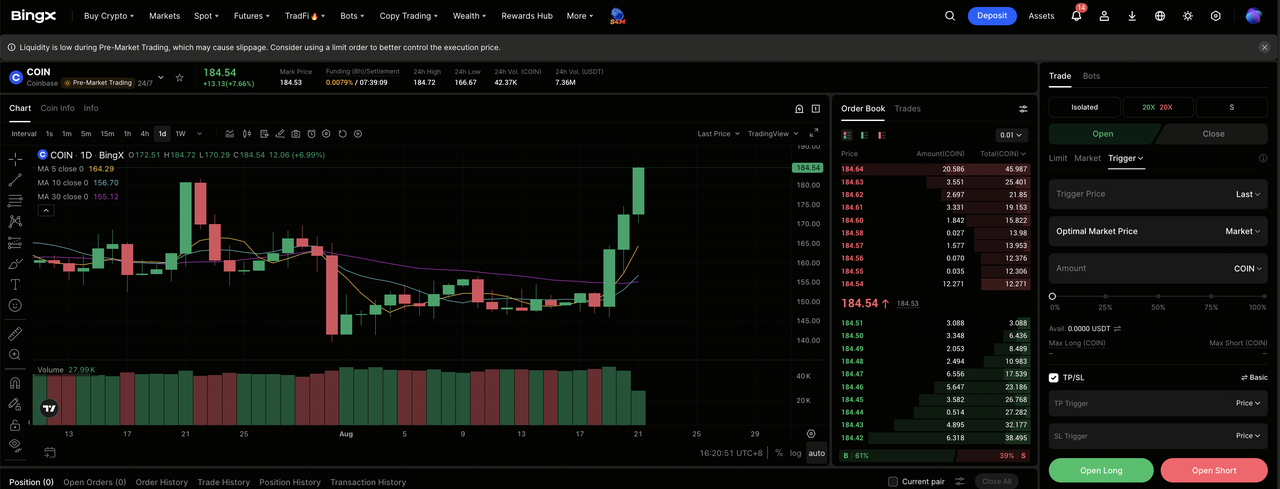
Step 1: Access BingX TradFi. Sign up and navigate to the specialized TradFi section. Complete KYC if required in your region and enable two-factor authentication before funding an account.
Step 2: Select Coinbase Global, Inc. (COIN). Deposit USDT, then search for and select the COIN-USDT perpetual futures contract.
Step 3: Choose your direction. Select Open Long if you expect recurring revenue to keep scaling, market share to keep rising, and a crypto trading recovery. Select Open Short if you expect trading volumes to stay soft, crypto prices to fall, or GAAP losses to weigh on the stock.
Step 4: Select leverage and margin mode. Choose Isolated or Cross-Margin based on your risk tolerance. Because COIN can move sharply with crypto prices and trading volumes, conservative leverage and clear position sizing are important.
Step 5: Execute strict risk protocols. Set Take-Profit and Stop-Loss (TP/SL) levels before or immediately after entering the trade. COIN can react quickly to crypto prices, trading volume trends, quarterly earnings, regulatory news and product launches.
Top 5 Risks to Watch for COIN Investors in 2026
Coinbase’s diversification is improving, but five risks could determine whether newer revenue streams are strong enough to offset a weaker crypto trading cycle.
- Trading revenue is still highly cyclical. Transaction revenue remains closely tied to crypto prices and trading volumes. A prolonged downturn could pressure results even if subscription and services revenue continues to grow.
- Crypto asset markdowns can make GAAP earnings volatile. Losses on crypto assets held for investment contributed to recent reported losses. Further declines in crypto prices could continue to create large swings in net income.
- Competition is increasing across multiple products. Coinbase competes with crypto exchanges, brokerages, stablecoin platforms, and other trading providers. Continued market-share gains in spot, derivatives, and payments are not guaranteed.
- Regulation remains an important swing factor. Changes to rules covering trading, stablecoins, staking, custody, and derivatives could affect product growth, compliance costs, and Coinbase’s ability to expand certain businesses.
- COIN remains sensitive to broader crypto sentiment. Even as the business becomes more diversified, the stock can still move sharply with Bitcoin, crypto trading activity, and broader risk appetite. Weak sentiment could pressure the valuation even when operating trends remain relatively stable.
Final Thoughts: Should You Invest in Coinbase in 2026?
Coinbase enters the rest of 2026 with a stronger market position but a still-cyclical earnings profile. Q2 revenue reached $1.2 billion, trading market share rose to a record 10.3%, subscription and services revenue stayed near $555 million, and adjusted EBITDA remained positive. At the same time, weaker crypto markets contributed to another GAAP loss, showing that trading activity and crypto asset movements still have a major impact on reported results.
The bull case is that subscription revenue, derivatives, prediction markets, stablecoin activity, and continued market-share gains make Coinbase less dependent on spot trading over time. The bear case is that a prolonged weak crypto cycle keeps transaction revenue under pressure and earnings volatile. The main confirmation points to watch are recurring revenue growth, further market-share gains, adoption of newer products, and evidence that Coinbase can deliver more stable results across different crypto market conditions.
Risk Reminder: Investing in COIN carries a high risk of capital loss. Coinbase remains exposed to crypto prices, trading volumes, regulation, competition, and earnings volatility. Investors should conduct independent research and assess their own risk tolerance before trading.
Related Reading
- Best Crypto Stocks to Watch in 2026: Top Picks to Know
- Circle (CRCL) Stock Outlook for 2026: Can USDC Growth and Dominance Drive CRCL Stock to $250+?
- Strategy (MSTR) Stock Outlook 2026: Can MSTR Cross $700 on Bitcoin Treasury Strategy?
- Robinhood (HOOD) Stock Forecast 2026: Can the Super-App Strategy Push HOOD Toward $160?
- IREN Limited (IREN) Stock Outlook 2026: Can Bitcoin Mining and AI Cloud Expansion Drive IREN Higher?
- CleanSpark (CLSK) Price Prediction 2026: $27.00 AI Hyperscaler or 32% Short-Squeezed Mining Trap?
